
Exam AB-731: AI Transformation Leader
The AB-731: AI Transformation Leader certification validates your ability to lead and guide AI-driven transformation within an organization. As a candidate, you are expected to understand how to identify meaningful AI opportunities, select appropriate AI tools and resources, plan and execute AI adoption strategies, optimize business processes, and foster innovation using Microsoft 365 Copilot and Azure AI services.
– Target Audience
This certification is designed for business decision-makers and leaders at all levels who are responsible for driving transformation and innovation across teams or entire organizations. It is ideal for professionals who influence strategic direction and adoption initiatives rather than technical implementation.
– Role Expectations
In this role, you are expected to demonstrate:
- Strong AI fluency and strategic thinking
- The ability to lead and influence AI adoption across multiple teams and business functions
- A clear understanding of how AI supports organizational goals
No programming or coding skills are required for this certification.
– Key Skills and Competencies
As a successful candidate, you should be able to:
- Evaluate and prioritize AI opportunities aligned with business objectives
- Advocate for and implement responsible AI practices
- Align AI investments with organizational strategy and outcomes
- Lead change management and adoption initiatives in a business environment
– Required Knowledge and Experience
Candidates should have:
- Experience leading or supporting AI adoption or digital transformation initiatives
- Familiarity with Microsoft 365 services, including Copilot
- Working knowledge of Azure AI services and general AI capabilities
- A solid understanding of how AI can be applied to improve productivity, decision-making, and innovation across business processes
Exam Details
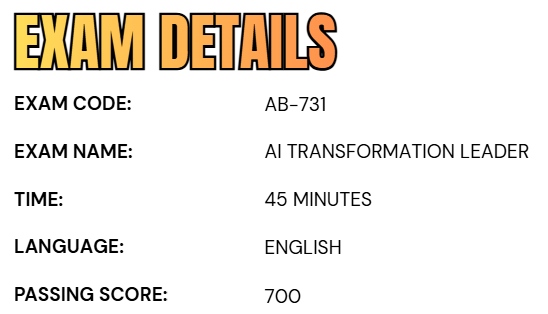
- The AB-731: AI Transformation Leader exam is a beginner-level Microsoft certification designed for professionals in business leadership roles.
- Candidates are given 45 minutes to complete the assessment.
- The exam is proctored and may include interactive components as part of the evaluation process. It is currently offered in English.
- To successfully pass the exam and earn the certification, candidates must achieve a minimum score of 700.
Course Outline
The AB-731: AI Transformation Leader exam covers the following topics:
1. Identifying the business value of generative AI solutions (35–40%)
Identifying the foundational concepts of generative AI
- Describing the differences between generative AI and other types of AI
- Selecting a generative AI solution to meet a business need
- Describing the differences between AI models, including fine-tuned and pretrained models
- Explaining the cost drivers in generative AI usage, including tokens and return-on-investment (ROI) considerations
- Identifying the challenges of using generative AI solutions, including fabrications, reliability, and bias
- Identifying when generative AI solutions can provide business value, including scalability and automation
Identifying the benefits and capabilities of generative AI solutions
- Describing the impact of prompt engineering
- Understanding techniques of prompt engineering
- Identifying business requirements for grounding solutions
- Understanding how retrieval-augmented generation (RAG) is used for AI solutions
- Understanding the impact of data on AI solutions, including data type, data quality, and representative datasets
- Describing the importance of secure AI
- Identifying scenarios when machine learning adds value
- Describing the lifecycle of a machine learning solution
- Identifying security considerations for AI systems, including application security, data security, and authentication requirements
2. Understanding benefits, capabilities, and opportunities for Microsoft’s AI apps and services (35–40%)
Identifying the benefits and capabilities of Microsoft 365 Copilot and Microsoft Copilot
- Mapping business processes and use cases to Copilot
- Understanding differences in capabilities between versions of Copilot
- Understand the capabilities of Microsoft 365 Copilot Chat web and mobile experiences
- Understanding capabilities of the Copilot experience in various Microsoft 365 apps
- Understanding the capabilities of Microsoft Copilot Studio
- Understand capabilities of Microsoft Graph
- Identifying the benefits and capabilities of an integrated Microsoft AI solution, including risk mitigation and safety benefits
- Mapping business processes and use cases to Microsoft’s AI apps and services
- Identifying when to use Researcher or Analyst in Copilot
- Identifying when to build, buy, or extend, including the Microsoft 365 Copilot extensibility framework

Identifying benefits and capabilities of Azure AI services
- Mapping business processes and use cases to Azure AI services
- Identifying capabilities of Azure AI services, including Azure AI Vision, Azure AI Search, and Azure AI Foundry
- Matching an AI model to a business need
- Identifying the benefits of Azure AI services for generative AI, including scalability and security
3. Identifying an implementation and adoption strategy for Microsoft’s AI apps and services (20–25%)
Aligning an AI strategy with Microsoft’s responsible AI policies
- Explaining the importance of responsible AI
- Establishing governance principles for AI use
- Establishing an AI council to guide strategy, oversight, and cross-functional alignment
- Ensuring that AI solutions meet responsible AI standards, including fairness, reliability, safety, privacy, security, inclusiveness, transparency, and accountability
Planning for AI adoption across the organization
- Establishing an adoption team
- Identifying common barriers to adoption
- Establishing an AI champions program
- Understand potential impacts to data, security, privacy, and cost
- Understanding Copilot license types, including pay-as-you go, monthly, and included with Microsoft 365 subscription
- Understanding Azure AI services subscription models, including pay-as-you-go and prepaid
Exam AB-731: AI Transformation Leader FAQs
Microsoft Exam Policies
Microsoft enforces a comprehensive set of exam policies to maintain fairness, consistency, and integrity across all certification programs. Understanding these policies is essential for candidates preparing for Microsoft exams. Two of the most important areas to review are the Retake Policy and the Scoring Methodology.
– Retake Policy
Microsoft’s retake policy applies to role-based, specialty, and fundamentals certifications and is designed to encourage adequate preparation between exam attempts. If a candidate does not pass an exam on the first attempt, a mandatory 24-hour waiting period is required before the exam can be retaken. For all subsequent attempts, a 14-day waiting period must be observed.
Candidates are permitted a maximum of five attempts within a 12-month period, calculated from the date of the initial exam attempt. If all five attempts are used without achieving a passing score, the candidate must wait 12 months from the date of the first attempt before becoming eligible to take the exam again. Once an exam has been successfully passed, it cannot be retaken unless the associated certification has expired. Where applicable, exam fees apply to each retake.
– Scoring Methodology
Microsoft certification exams use a scaled scoring system ranging from 1 to 1,000, with a minimum passing score of 700. Because the scoring is scaled, results do not reflect a fixed percentage of correct answers. Instead, the final score represents the candidate’s overall level of proficiency, factoring in elements such as question difficulty, exam version, and required competency levels.
Microsoft Office certification exams also follow a 1 to 1,000 scoring scale, although the passing score may vary depending on the specific exam. This scaled scoring approach ensures consistent, fair, and accurate assessment of candidate skills across different exam formats and difficulty levels.
Exam AB-731: AI Transformation Leader Study Guide
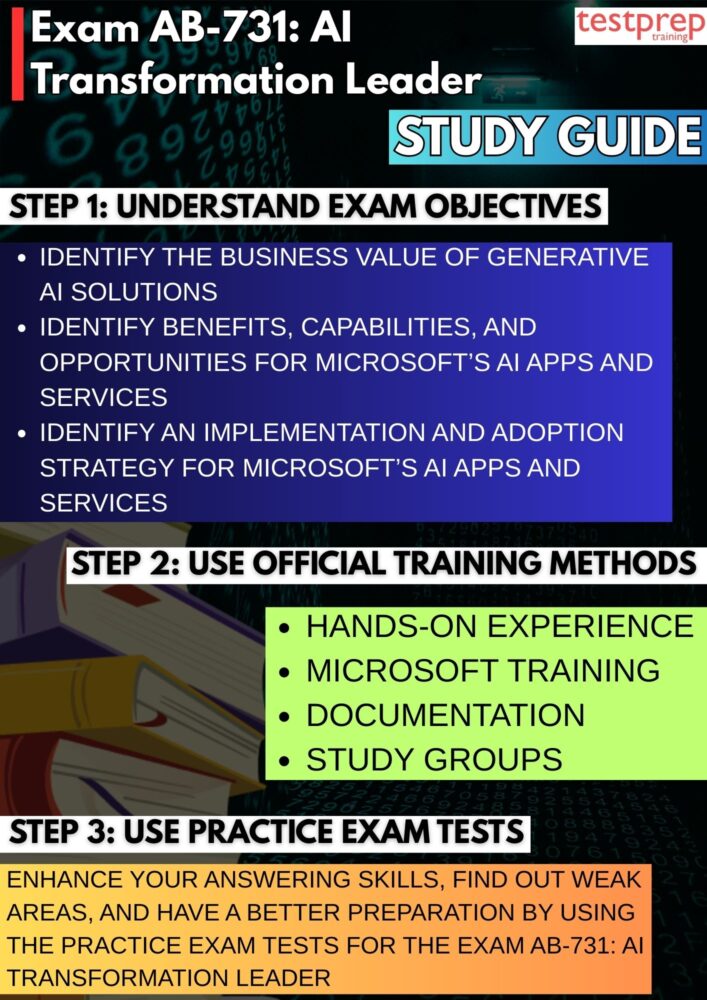
1. Thoroughly Understand the Official Exam Guide
Start by carefully reviewing the official AB-731 exam guide and skills outline published by Microsoft. This document defines the knowledge domains, learning objectives, and assessment focus areas. Pay close attention to how Microsoft frames AI transformation from a business leadership perspective, including strategy, governance, adoption, and value realization. Use the guide to map out a structured study plan, prioritize high-weight domains, and ensure your preparation aligns directly with the exam’s intent.
2. Develop Practical Insight Through Hands-On Business Scenarios
While AB-731 does not require coding, it strongly emphasizes practical decision-making and applied understanding. Gain hands-on exposure by exploring how AI is integrated into everyday business workflows using Microsoft 365 Copilot and Azure AI services. Focus on real-world scenarios such as improving productivity, enhancing customer experiences, optimizing operations, and supporting data-driven decision-making. This practical familiarity enables you to confidently address scenario-based and strategic questions during the exam.
3. Use Microsoft Training to Build Structured Knowledge
Leverage Microsoft Learn training paths and official learning modules designed for AI leadership and transformation roles. These resources provide guided instruction, use-case-driven learning, and self-assessments that reinforce key concepts such as AI adoption frameworks, organizational readiness, and responsible AI principles. Completing these modules helps ensure your knowledge is both comprehensive and aligned with Microsoft’s recommended best practices.
– Course AB-731T00-A: Driving AI Transformation in the Organization
This course equips learners with the knowledge and leadership perspective required to guide AI-driven transformation within an organization successfully. Participants will develop a clear understanding of how to recognize high-value AI use cases, make informed investment decisions, and integrate AI initiatives with broader business objectives. A strong emphasis is placed on responsible AI adoption, organizational readiness, and strategic execution to ensure sustainable and measurable outcomes.
The course focuses on practical, business-oriented decision-making rather than technical implementation, making it accessible to leaders without a technical background. Through real-world scenarios and strategic frameworks, learners gain the confidence to lead AI adoption, foster innovation, and drive operational efficiency using Microsoft’s AI ecosystem.
Designed for business leaders and decision-makers, including directors, vice presidents, and executives across functions such as marketing, sales, operations, human resources, finance, and corporate strategy, this course also benefits emerging leaders seeking to build foundational expertise in AI transformation. Upon completion, learners will be prepared to plan, scale, and govern AI initiatives effectively while aligning technology investments with organizational goals.
4. Study Microsoft Documentation for Depth and Accuracy
Complement your training with a deep review of official Microsoft documentation related to Microsoft 365, Copilot, Azure AI services, and AI governance. Documentation provides authoritative details on capabilities, limitations, security considerations, compliance requirements, and implementation guidance. This level of detail is especially valuable for understanding trade-offs, constraints, and strategic implications—areas frequently tested in leadership-focused exams like AB-731.
5. Engage with Study Groups and Professional Communities
Participating in study groups, discussion forums, and professional communities can significantly enhance your learning experience. Engaging with peers allows you to exchange insights, validate understanding, and gain exposure to diverse perspectives on AI transformation. Community discussions often highlight practical challenges, exam patterns, and real-world examples that help bridge the gap between theory and applied leadership decision-making.
6. Reinforce Learning Through Practice Tests and Self-Assessment
Practice exams play a critical role in evaluating your readiness for the AB-731 exam. Use high-quality practice tests to become familiar with the exam structure, question styles, and time constraints. Analyze your results carefully to identify knowledge gaps and areas requiring further review. Focus not only on correct answers but also on the reasoning behind them, ensuring a deeper understanding of AI strategy, governance, and adoption principles.
Further, in the final stage of preparation, revisit key concepts, frameworks, and decision-making principles related to AI transformation leadership. Review notes, summaries, and flagged topics from earlier practice tests. Strengthen your ability to evaluate scenarios, weigh business outcomes, and select the most appropriate AI-driven solutions. A focused final review ensures clarity, confidence, and readiness on exam day.
