
Salesforce Certified Agentforce Specialist
The Salesforce Certified Agentforce Specialist credential is designed for professionals who manage, configure, and optimize Agentforce within the Salesforce ecosystem. This certification validates a candidate’s ability to design intelligent AI agents while demonstrating a strong command of Salesforce platform configuration and Agentforce capabilities to support real-world business objectives.
The Salesforce Certified Agentforce Specialist exam assesses an individual’s expertise in developing and operationalizing AI agents that deliver meaningful, context-aware interactions. It confirms proficiency in agent design, prompt engineering, data grounding, system integration, and lifecycle management—ensuring that AI agents are reliable, secure, and aligned with organizational goals.
Candidates who earn this certification demonstrate the ability to apply Agentforce strategically to improve workflows, enhance customer and employee experiences, and drive measurable business value.
Intended Audience
This certification is ideal for professionals responsible for implementing and managing AI agents using Agentforce on the Salesforce Platform. Typical candidates include administrators, solution architects, consultants, and technical professionals who work closely with stakeholders to translate business requirements into intelligent agent solutions.
Successful candidates possess a comprehensive understanding of Salesforce configuration, along with the skills needed to deploy AI agents that deliver personalized and contextually relevant outcomes.
Skills and Knowledge Validated
The Salesforce Certified Agentforce Specialist exam evaluates a candidate’s knowledge and practical understanding across the following areas:
- Collaborating with business and technical stakeholders to identify Agentforce-driven opportunities, challenges, and improvement areas
- Designing and configuring AI agents using standard and custom topics, as well as standard and custom agent actions
- Selecting appropriate use cases for Prompt Builder, managing prompt templates, and applying grounding techniques for reliable AI outputs
- Enhancing agent accuracy and personalization through the Agentforce Data Library
- Understanding how Data Cloud retrievers ground agent responses using both structured and unstructured data sources
- Managing the agent deployment lifecycle, including testing in the Agentforce Testing Center and promoting agents from sandbox to production
- Monitoring agent adoption, performance, and enforcing appropriate security controls
- Understanding interoperability concepts, including Model Context Protocol (MCP), agent-to-agent communication, and the use of the Agent API
Value of the Certification
Professionals who successfully pass the Salesforce Certified Agentforce Specialist exam demonstrate the ability to build and manage custom AI agents equipped with prebuilt and tailored capabilities for multiple departments. They can integrate AI agents with existing systems, apply best practices for accuracy and contextual relevance, and ensure agents are deployed securely and effectively.
Exam Details
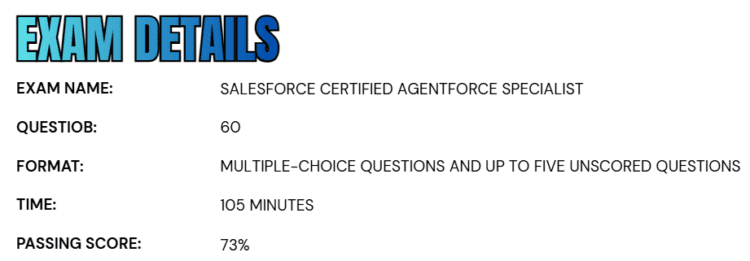
- The Salesforce Certified Agentforce Specialist Exam is a proctored assessment designed to evaluate a candidate’s practical and conceptual understanding of Agentforce within the Salesforce Platform.
- The exam consists of 60 scored multiple-choice questions, along with up to five additional unscored questions that are included for statistical and performance analysis purposes. These unscored questions are randomly distributed throughout the exam and do not affect the final score.
- Candidates are given a total of 105 minutes to complete the exam.
- To successfully pass, a minimum score of 73% is required.
- The exam is available through supervised delivery options, allowing candidates to take it either at an authorized testing center or via an online proctored environment, depending on personal preference and availability.
- During the exam, no reference materials are permitted, including hard-copy documents or online resources. This ensures that the assessment accurately reflects a candidate’s independent knowledge and readiness to apply Agentforce concepts in real-world scenarios.
Course Outline
The Salesforce Certified Agentforce Specialist Exam covers the following topics:
1. Understand AI Agents: 35%
- Given a use case, manage deterministic behavior for the agent using filters and variables.
- Explain how an agent works and how the reasoning engine powers Agentforce.
- Given a scenario, select and configure standard topics, custom topics, standard agent actions, and custom agent actions based on agent types.
- Explain how to manage Agentforce security, including the concept of the Agent User and how it applies to an Employee Agent, Service Agent, or Sales Agent.
- Given a scenario, identify when to use an Employee agent, Service agent, or Sales agent.
- Explain the process for connecting agents to various channels such as digital experience, email, and Slack.
2. Learn about Prompt Engineering: 20%
- Given business requirements, identify when it’s appropriate to use Prompt Builder.
- Identify the right user roles to manage and execute prompt templates.
- Identify the considerations for creating a prompt template using field generation and flex types.
- Given a scenario, identify the appropriate grounding technique.
- Explain the process for creating, activating, and executing prompt templates.
- Explain how to use best practices for writing effective prompts.
3. Understand Data Cloud for Agentforce: 20%
- Explain the considerations of Agentforce Data Library and its types.
- Given a scenario, improve an agent’s response with unstructured data using chunking and indexing.
- Identify the considerations for retrievers in Data Cloud such as individual and ensemble.
- Given a scenario, identify the considerations for search type such as keyword, vector, and hybrid.

4. Learn about Development Lifecycle: 20%
- Given a scenario, test an agent using Agentforce Testing Center.
- Identify the considerations for deploying an agent from sandbox to production.
- Explain the process for managing and monitoring agent adoption.
5. Overview of Multi-Agent Interoperability: 5%
- Explain the purpose of Model Context Protocol (MCP) and its use cases.
- Explain the purpose of agent to agent protocol.
- Given a scenario, identify when it’s appropriate to use Agent API.
Salesforce Certified Agentforce Specialist Exam FAQs
Salesforce Exam Candidate Code of Conduct
At Salesforce, trust is a core value, and safeguarding the integrity of Salesforce certifications is a shared responsibility. By participating in the Salesforce Credentialing and Certification Program, candidates agree to comply with the terms and conditions outlined in the program agreement.
Candidates are expected to prepare using Salesforce-approved learning resources, including official exam guides and training available through Trailhead. Engaging with the Trailblazer Community is also encouraged, as it allows candidates to collaborate with peers, participate in study groups, and benefit from community-led learning and mentorship opportunities.
All candidates must follow the established rules for both online-proctored and in-person exams. Any activity that compromises the security or fairness of the certification process should be reported to the Salesforce certification security team.
Prohibited actions include sharing or requesting exam questions, answers, or Superbadge solutions, seeking or offering assistance during the exam, or engaging in any behavior that violates the Salesforce Credentialing and Certification Program Agreement. Compliance with this code of conduct helps ensure that Salesforce certifications remain credible, fair, and trusted worldwide.
Salesforce Certified Agentforce Specialist Exam Study Guide
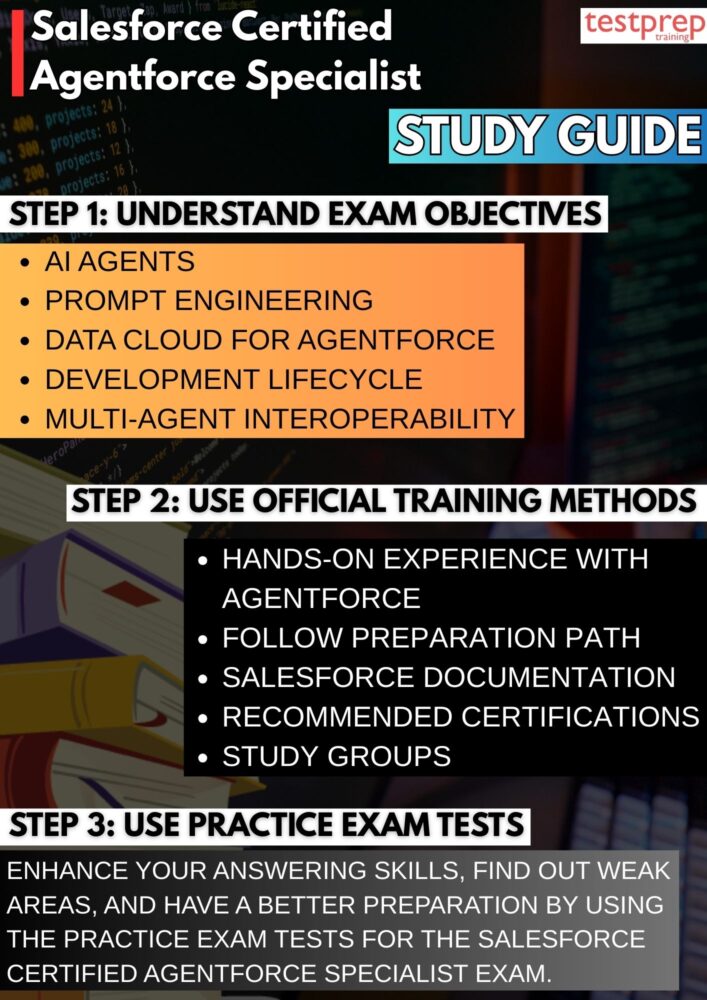
1. Develop a Clear Understanding of Exam Objectives and Expectations
The first step in preparation is gaining a comprehensive understanding of the exam objectives and how each domain contributes to the overall assessment. Candidates should study the official exam outline to understand which Agentforce capabilities are tested and how they align with business use cases. This includes agent design, prompt engineering, data grounding, lifecycle management, security, and monitoring. Understanding the intent behind each objective helps candidates think critically rather than memorizing features, which is essential for scenario-based exam questions.
2. Build Deep Hands-On Experience with Agentforce
Hands-on experience is a core requirement for success in this exam. Candidates should actively work in a sandbox environment on the Salesforce Platform, creating and configuring AI agents for realistic scenarios. This includes defining standard and custom topics, configuring agent actions, and connecting agents to relevant data sources. Experimenting with different prompt designs, grounding strategies, and agent behaviors allows candidates to understand how Agentforce responds to real-world business inputs. Practical experimentation also helps in understanding limitations, performance considerations, and best practices.
3. Follow the Agentforce Specialist Certification Preparation Path
Salesforce provides structured learning resources that are closely aligned with the exam blueprint. Completing the Agentforce Specialist certification preparation materials on Trailhead ensures coverage of all tested topics in a guided and progressive manner. These learning paths reinforce theoretical concepts with hands-on challenges, helping candidates connect knowledge with application. Repeating modules and challenges can further strengthen retention and confidence.
4. Perform an In-Depth Review of Official Salesforce Documentation
Official documentation should be treated as a primary reference rather than supplementary reading. Candidates should thoroughly review documentation related to Agentforce architecture, prompt engineering principles, grounding techniques, Data Cloud integration, deployment workflows, and monitoring tools. Documentation often includes implementation nuances, configuration options, and best practices that are critical for answering advanced or situational exam questions accurately. Regular review also helps reinforce terminology and platform behavior expected in the exam.
5. Strengthen Core Platform Knowledge with Recommended Certifications
Although not mandatory, foundational certifications significantly improve exam readiness. The Salesforce Certified Platform Administrator certification builds essential knowledge around user management, security, automation, and platform configuration, all of which directly impact Agentforce implementations. The Salesforce Certified Platform App Builder certification further strengthens skills in designing and deploying custom solutions using declarative tools. Together, these certifications help candidates understand how Agentforce integrates seamlessly into broader Salesforce solutions rather than operating in isolation.
6. Engage Actively in Study Groups and Salesforce Communities
Learning in isolation can limit perspective, especially for a rapidly evolving area like AI agents. Participating in study groups and engaging with the Trailblazer Community enables candidates to exchange insights, discuss real-world use cases, and learn from others’ implementation experiences. Community discussions often surface practical considerations, common mistakes, and exam-relevant scenarios that may not be emphasized in formal documentation.
7. Focus on Governance, Security, and Responsible AI Practices
A key aspect of the Agentforce Specialist role is ensuring secure and responsible AI usage. Candidates should understand user access controls, data security considerations, and monitoring mechanisms for AI agents. Knowledge of how to manage agent permissions, protect sensitive data, and ensure compliance with organizational policies is critical. The exam may assess how well candidates can balance innovation with governance, making this an important study area.
8. Validate Knowledge Through Practice Tests and Targeted Review
Practice exams play a crucial role in final preparation. They help candidates become familiar with question phrasing, difficulty level, and time constraints. After each practice test, candidates should analyze incorrect answers to identify knowledge gaps and revisit related documentation or hands-on exercises. Repeated testing and focused revision improve accuracy, reinforce learning, and build confidence for exam day.
Beyond technical knowledge, exam success depends on an effective strategy. Candidates should practice managing time across all questions, identifying keywords in scenario-based questions, and eliminating incorrect options logically. Understanding how Salesforce frames business problems in exam questions helps candidates choose the most appropriate solution rather than a technically correct but contextually weaker answer.
