
Certified Tester Advanced Level Test Management (CTAL-TM)
The Certified Tester Advanced Level – Test Management (CTAL-TM) v3.0 certification is a senior-level qualification offered under the ISTQB certification scheme. It is designed for professionals responsible for planning, leading, and controlling software testing activities throughout the software development lifecycle (SDLC).
This certification develops advanced competencies required to manage testing as a structured, value-driven discipline that supports business and project objectives. The primary goal of the CTAL-TM certification is to enable candidates to take full responsibility for test management within software projects and organizations. It focuses on:
- Designing an appropriate test approach based on organizational test policies and project needs
- Establishing and adapting test strategies for different development models
- Building, leading, and developing effective test teams
- Ensuring testing activities are aligned with business risks and quality goals
The certification emphasizes both strategic decision-making and practical execution of test management tasks. This certification is a comprehensive qualification for professionals seeking leadership roles in software testing. It validates the ability to manage testing strategically, align testing with business objectives, lead teams effectively, and continuously improve testing processes—making it a highly respected credential for senior testing and quality management professionals worldwide.
Intended Audience
The CTAL-TM qualification is aimed at professionals who are directly or indirectly involved in managing software testing activities, including:
- Test Managers and Test Leads
- Software Testers and Senior Testers
- Test Consultants
- User Acceptance Testers
- Scrum Masters and Agile Leaders
- Project Managers and Product Owners
It is also well-suited for professionals who require an advanced understanding of software testing to support their roles, such as:
- Quality Managers
- Software Development Managers
- Business Analysts
- IT Directors
- Management Consultants
Prerequisites for CTAL-TM Certification
To be eligible for the CTAL-TM exam, candidates must:
- Hold the Certified Tester Foundation Level (CTFL) v4.0 or any earlier version
- Have sufficient practical experience in software testing
Relationship with Other ISTQB Certifications
The ISTQB certification scheme supports testing professionals at all stages of their careers. Candidates who achieve the CTAL-TM certification may also consider:
Advanced Level Core Certifications:
- Advanced Level Test Analyst
- Advanced Level Technical Test Analyst
Expert Level Certifications:
- Expert Level Test Management
- Expert Level Improving the Test Process
Agile and Specialist Streams:
- Agile Technical Tester
- Agile Test Leadership at Scale
- Specialist certifications such as Test Automation, AI Testing, and Mobile Application Testing
- Domain-specific certifications covering industries such as Automotive and Gaming
Business Outcomes and Learning Objectives
A professional who has achieved the Certified Tester Advanced Level – Test Management certification should be able to demonstrate the following capabilities:
- Test Management Across Projects
- Manage testing activities in various types of software development projects
- Apply defined test management processes within project teams or test organizations
- Stakeholder and Lifecycle Awareness
- Identify relevant test stakeholders in different project contexts
- Recognize and adapt to different software development lifecycle models
- Risk-Based Testing
- Organize and facilitate risk identification and risk assessment sessions
- Use risk analysis results to define test priorities and objectives across any SDLC
- Test Strategy and Planning
- Define a project-level test strategy aligned with the organizational test strategy
- Plan test activities, including required test infrastructure and resources
- Estimate testing effort accurately and realistically
- Monitoring, Control, and Reporting
- Continuously monitor and control testing activities to meet project goals
- Assess test progress using meaningful metrics
- Report testing status clearly and effectively to project stakeholders
- Team Leadership and Skill Development
- Identify skills required for effective testing
- Develop and strengthen testing competencies within the team
- Business Value of Testing
- Prepare and present business cases for testing in different contexts
- Clearly articulate testing costs, risks, and expected benefits
- Test Process Improvement
- Lead test process improvement initiatives at the project or product stream level
- Contribute to organization-wide test process improvement programs
- Defect Management
- Define and implement defect reporting practices
- Establish defect workflows suitable for the selected software development lifecycle
Exam Details
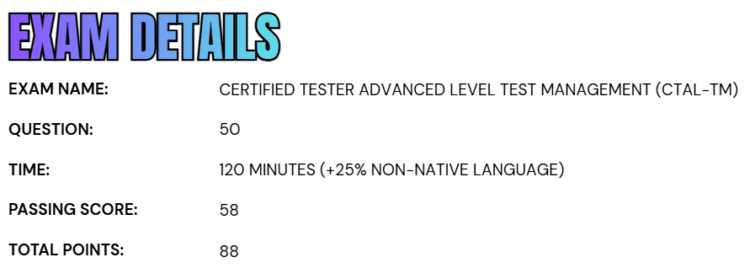
- The Certified Tester Advanced Level – Test Management (CTAL-TM) v3.0 examination, offered under the ISTQB certification scheme, assesses a candidate’s advanced knowledge and practical understanding of test management concepts.
- The exam consists of 50 questions, with a total of 88 available points.
- To successfully pass the examination, candidates must achieve a minimum score of 58 points.
- The standard exam duration is 120 minutes, with an additional 25% extra time granted to candidates taking the exam in a non-native language.
Course Outline
The Certified Tester Advanced Level – Test Management (CTAL-TM) v3.0 Exam covers the following topics:
1. Learn About Managing the Test Activities – 750 minutes
1.1 The Test Process
- (K2) Summarizing test planning
- (K2) Summarize test monitoring and test control
- (K2) Summarizing test completion
1.2 The Context of Testing
- (K2) Comparing why different stakeholders are interested in testing
- (K2) Explaining why stakeholders’ knowledge is important in test management
- (K2) Explaining testing in a hybrid software development model
- (K2) Summarizing test management activities for various software development lifecycles
- (K2) Comparing test management activities at various test levels
- (K2) Comparing test management activities for various test types
- (K4) Analyzing a given project and determine test management activities that emphasize test planning, test monitoring, and test control
1.3 Risk-Based Testing
- (K2) Explaining the various measures that risk-based testing takes in order to respond to risks
- (K2) Giving examples of different techniques a test manager can use for identifying risks related to product quality
- (K2) Summarizing the factors that determine the risk levels related to product quality
- (K4) Selecting appropriate test activities to mitigate risks according to their risk level in a given context
- (K2) Differentiate between heavyweight and lightweight examples of risk-based testing techniques
- (K2) Give examples of success metrics and difficulties associated with risk-based testing
1.4 The Project Test Strategy
- (K2) Explaining typical choices for a test approach
- (K4) Analyzing an organizational test strategy and the project context to select the appropriate test approach
- (K3) Use the S.M.A.R.T. goal methodology to define measurable test objectives and exit criteria
1.5 Improving the Test Process
- (K2) Explaining how to use the IDEAL model for test process improvement on a given project
- (K2) Summarizing the model-based improvement approach to test process improvement and understand how to apply it on a project context
- (K2) Summarizing the analytical-based improvement approach to test process improvement and understand how to apply it on a project context
- (K3) Implementing a project or iteration retrospective to evaluate test processes and discover testing areas to improve
1.6 Test Tools
- (K2) Summarizing the best practices for tool introduction
- (K2) Explaining the impact of different technical and business aspects when deciding on a tool type
- (K4) Analyzing a given situation to create a plan for tool selection, covering risks, costs, and benefits
- (K2) Differentiating among the stages of the tool lifecycle
- (K2) Give examples for metric collection and evaluation by using tools
2. Understand Managing the Product – 390 minutes
2.1 Test Metrics
- (K2) Giving examples of metrics to achieve the test objectives
- (K2) Explaining how to control test progress using test metrics
- (K4) Analyzing test results to create test reports that empower stakeholders to make decisions
2.2 Test Estimation
- (K2) Explaining the factors that need to be considered in test estimation
- (K2) Giving examples of factors that may influence test estimates
- (K4) Selecting an appropriate technique or approach for test estimation for a given context
2.3 Defect Management
- (K3) Implementing a defect management process, including the defect workflow, that can be used to monitor and control defects
- (K2) Explaining the process and participants required for effective defect management
- (K2) Explaining the specifics of defect management in Agile software development
- (K2) Explain the challenges of defect management in hybrid software development
- (K3) Using the data and classification information that should be gathered during defect management
- (K2) Explaining how defect report statistics can be used to devise process improvement

3. Learn about Managing the Team – 225 minutes
3.1 The Test Team
- (K2) Give examples of typical skills needed by test team members within four areas of competence
- (K4) Analyzing a given project context to determine required skills for test team members
- (K2) Explaining typical techniques for skill assessments for test team members
- (K2) Differentiating between the typical approaches for developing skills of test team members
- (K2) Explaining skills required to manage a test team
- (K2) Give examples of motivating and hygiene factors for test team members
3.2 Stakeholder Relationship
- (K2) Giving examples for each of the four categories determining the cost of quality
- (K3) Applying a cost-benefit calculation to estimate the added value of testing for stakeholders
Certified Tester Advanced Level Test Management (CTAL-TM) Exam FAQs
Certified Tester Advanced Level Test Management (CTAL-TM) Exam Study Guide
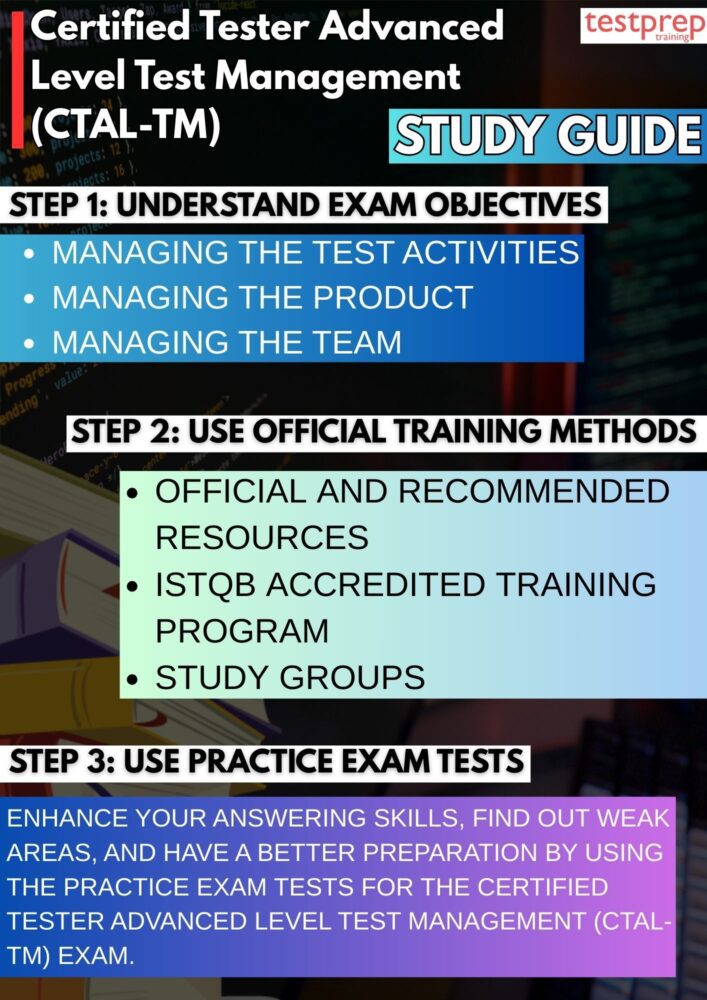
1. Understand the Exam Objectives and Assessment Approach
Begin your preparation by carefully analyzing the exam objectives defined in the official CTAL-TM syllabus. Each objective specifies the depth of knowledge required and the expected cognitive level, such as understanding, applying, or analyzing test management concepts. Familiarity with these objectives helps you focus on high-weight topics and prepares you for scenario-based questions that test decision-making and managerial judgment rather than rote memorization. In addition, review the exam structure, scoring model, and question types to set clear expectations before starting detailed study.
2. Perform an In-Depth Study of the Official CTAL-TM Syllabus
The CTAL-TM syllabus should serve as the central reference throughout your preparation. Study each chapter thoroughly, ensuring clarity on areas such as test strategy development, risk-based testing, test organization, monitoring and control, defect management, and test process improvement. While studying, relate syllabus topics to your own professional experience to strengthen understanding. Creating structured notes, diagrams, and summaries can help reinforce complex concepts and improve long-term retention.
3. Attend Training from ISTQB-Accredited Providers
Enrolling in training delivered by accredited providers can greatly enhance your learning experience. These courses are available in classroom, virtual instructor-led, and self-paced e-learning formats, allowing you to choose a mode that suits your schedule and learning style. Accredited training ensures coverage aligned with the latest syllabus version and often includes practical case studies, interactive discussions, and expert explanations of advanced topics that may be difficult to grasp through self-study alone.
4. Build a Detailed and Realistic Self-Study Plan
Self-study remains a highly effective option when supported by a well-defined study plan. Create a schedule that allocates sufficient time for learning new topics, revising previously covered sections, and practicing exam-style questions. Use the official syllabus, recommended reference materials, and reputable test management literature to deepen your understanding. Revisiting topics at regular intervals and applying concepts to sample scenarios will help solidify your preparation.
5. Engage Actively in Study Groups and Testing Communities
Participating in study groups and professional testing communities can significantly improve comprehension of advanced concepts. Group discussions provide opportunities to clarify doubts, explore different interpretations of syllabus topics, and learn from others’ practical experiences. Online forums, professional networks, and local testing communities often share study tips, exam experiences, and real-world examples that are especially useful for an advanced-level certification like CTAL-TM.
6. Practice Extensively with Sample Questions and Mock Exams
Consistent practice is essential to build confidence and exam readiness. Attempt sample questions and full-length mock exams to familiarize yourself with the exam format, scoring pattern, and time constraints. Practice tests help you develop analytical thinking, improve time management, and recognize common question patterns. Reviewing both correct and incorrect answers is crucial to understanding the reasoning expected in the actual exam.
7. Analyze Performance and Refine Your Exam Strategy
After completing practice exams, carefully analyze your results to identify weak areas and recurring mistakes. Focus on improving your understanding of complex or high-weight topics and refining your approach to scenario-based questions. Develop a clear exam-day strategy that includes efficient time allocation, careful reading of questions, and prioritization of high-value questions. This final refinement phase ensures you enter the exam with confidence and a well-practiced approach.
