
PMI Certified Professional in Managing AI (PMI-CPMAI)
The PMI Certified Professional in Managing AI (PMI-CPMAI)™ certification is designed for professionals who want to lead and manage AI-driven initiatives with confidence. Built on a tool-agnostic and outcome-focused framework, this certification validates your ability to handle complexity, coordinate cross-functional teams, and deliver AI solutions that align with business goals.
Rather than focusing on specific technologies or platforms, PMI-CPMAI emphasizes strategic thinking, structured execution, and measurable impact—ensuring that your AI projects deliver real value in dynamic and evolving environments.
Whether you are already working on AI initiatives or planning to transition into this domain, PMI-CPMAI provides a clear methodology and industry-recognized credibility to turn innovative ideas into scalable, sustainable outcomes.
Key Skills You Will Gain
By pursuing PMI-CPMAI, you will develop the ability to:
- Translate AI concepts into actionable plans
- Convert high-level AI ideas into structured, achievable project roadmaps.
- Adapt to evolving technologies
- Work effectively in rapidly changing environments without relying on specific tools or platforms.
- Collaborate across diverse teams
- Align stakeholders from technical, business, and operational backgrounds under a unified approach.
- Deliver responsible and measurable outcomes
- Ensure AI solutions are ethical, transparent, and capable of withstanding organizational and regulatory scrutiny.
Who Should Consider This Certification?
PMI-CPMAI is suitable for a wide range of professionals, including:
- Project and Program Managers
- Product Managers
- AI and Data Professionals
- IT and Technology Specialists
- Consultants and Business Analysts
Regardless of your background, this certification helps you enhance your expertise and stay competitive in a market that increasingly values AI-driven leadership.
Eligibility Requirements
To earn the PMI-CPMAI certification, candidates must meet the following criteria:
- Minimum Age Requirement
- Applicants must be at least 18 years old.
- Mandatory Training Completion
- Completion of the PMI-CPMAI Exam Prep Course is required. This course introduces the CPMAI (Cognitive Project Management in AI) methodology and prepares candidates for the exam.
- No Prior Experience Required
- There are no mandatory prerequisites in project management, AI, or technical certifications to enroll or take the exam. However, having a basic understanding of project or product management and AI fundamentals can be beneficial.
Exam Details
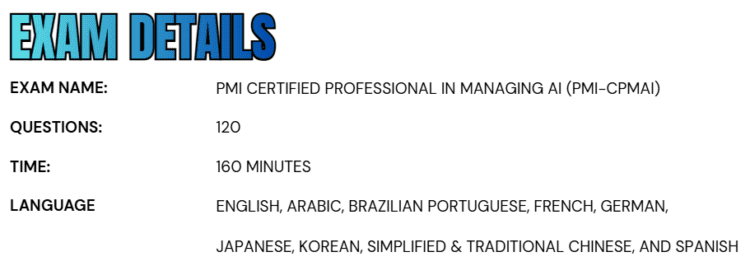
- The PMI Certified Professional in Managing AI (PMI-CPMAI) exam is a comprehensive assessment designed to evaluate a candidate’s ability to manage AI-driven projects effectively.
- The exam consists of 120 questions, out of which 20 are pre-test questions that are included for validation purposes and do not impact the final score. These pre-test items are distributed randomly throughout the exam, ensuring a seamless testing experience.
- Candidates are given a total of 160 minutes (2 hours and 40 minutes) to complete the exam, whether taken in a computer-based test center or through an online proctored format.
- While some candidates may finish earlier, the full duration is provided to ensure adequate time for thoughtful responses. It is important to note that no scheduled breaks are included during the exam session.
- Before the exam begins, candidates are presented with a brief tutorial, and after completion, a survey is provided. Together, these may take up to 15 minutes, but this time is not deducted from the actual exam duration.
- Currently, the exam is available in English and multiple languages—including Arabic, Brazilian Portuguese, French, German, Japanese, Korean, Simplified and Traditional Chinese, and Spanish.
Course Outline
The PMI-CPMAI exam is designed around a structured framework that aligns with the domains, while also integrating practical strategies for effective AI adoption and delivery. A key emphasis is placed on tailoring approaches to maximize the value of the CPMAI methodology, and this principle is consistently embedded across all five domains rather than being confined to a single area. Additionally, the distribution of questions across these domains may differ slightly depending on the specific version of the exam. However, the domain are:
1. Understand about Support Responsible and Trustworthy AI Efforts – 15%
Task 1 Overseeing privacy and security plan:
- Establishing data governance protocols for personally identifiable information (PII)
- Implementing encryption and access controls for AI training data
- Conduct privacy impact assessments for AI model deployment
- Ensure compliance with GDPR, CCPA, and other data protection regulations
- Design secure data handling procedures throughout the AI lifecycle
Task 2 Managing AI/ML transparency (e.g., data selection, algorithm selection):
- Documenting model selection criteria and decision rationale
- Creating transparent reporting on data sources and preprocessing steps
- Establishing explainability requirements for stakeholder communication
- Maintaining audit trails for algorithmic decision-making processes
- Implementing model interpretability tools and techniques
Task 3 Conducting bias checks (e.g., model, data, algorithm):
- Analyzing training data for demographic and representation imbalances
- Performing fairness testing across different population groups
- Implementing bias detection metrics and monitoring systems
- Reviewing model outputs for discriminatory patterns
- Applying bias mitigation techniques during model development
Task 4 Monitoring regulatory and policy compliance:
- Tracking evolving AI regulations and industry standards
- Ensuring adherence to sector-specific compliance requirements
- Coordinating with legal and compliance teams on AI governance
- Implementing compliance monitoring and reporting mechanisms
- Maintaining documentation for regulatory audits and reviews
Task 5 Managing accountability documentation and audit trail:
- Creating comprehensive records of AI model development decisions
- Establishing version control for models, data, and training processes
- Documenting stakeholder approvals and go/no-go decision points
- Maintaining chain of custody records for training and test data
- Preparing accountability reports for executive and regulatory review
2. Learn about Identifying Business Needs and Solutions – 26%
Task 1 Identifying problem to be solved (e.g., needs, persona)
- Conducting stakeholder interviews to understand business pain points
- Analyzing existing processes to identify automation opportunities
- Defining target user personas and use cases for AI solutions
- Mapping business problems to appropriate AI patterns and approaches
- Validating problem statements with subject matter experts
Task 2 Evaluating initial AI feasibility
- Assessing technical viability of proposed AI solutions
- Analyzing data availability and quality for model training
- Evaluating computational resource requirements and constraints
- Reviewing organizational readiness for AI implementation
- Comparing AI approaches against traditional solution alternatives
Task 3 Conducting risk assessment(s) (e.g., security, safety, ethics)
- Identifying potential failure modes and safety implications
- Assessing cybersecurity vulnerabilities in AI systems
- Evaluating ethical implications of AI decision-making
- Analyzing reputational and business continuity risks
- Developing risk mitigation strategies and contingency plans
Task 4 Developing AI project scope statement
- Defining project boundaries and deliverables for AI initiatives
- Establishing success criteria and performance metrics
- Identifying in-scope and out-of-scope functionality
- Documenting assumptions and constraints for AI implementation
- Aligning scope with business objectives and resource availability
Task 5 Determining ROI
- Calculating expected benefits from AI solution implementation
- Estimating total cost of ownership including infrastructure and maintenance
- Developing business case with financial justification
- Establishing metrics for measuring return on investment
- Creating cost-benefit analysis for stakeholder decision-making
Task 6 Managing adoption/integration risks
- Assessing organizational change management requirements
- Identifying potential user resistance and adoption barriers
- Planning integration with existing systems and workflows
- Developing training and communication strategies for end users
- Monitoring adoption metrics and address implementation challenges
Task 7 Drafting AI solution
- Creating high-level architecture for AI system design
- Defining data flow and processing requirements
- Specifying AI model types and algorithmic approaches
- Documenting integration points with existing systems
- Outlining deployment and operational considerations
Task 8 Defining success criteria (e.g., KPIs, metrics)
- Establishing measurable performance indicators for AI models
- Defining business impact metrics and success thresholds
- Creating technical performance benchmarks and targets
- Developing user satisfaction and adoption measurement criteria
- Aligning success metrics with organizational objectives
Task 9 Supporting business case creation
- Gathering financial data and projected benefits for business case
- Collaborating with finance teams on cost estimates and projections
- Developing compelling narratives for executive presentations
- Providing technical expertise for business case validation
- Reviewing and refining business case documentation
Task 10 Identifying project resources (e.g., people, hardware, contractors)
- Assessing skill requirements for AI project team composition
- Evaluating hardware and infrastructure needs for development and deployment
- Identifying gaps requiring external contractors or consultants
- Planning resource allocation and timeline for project phases
- Coordinating with procurement for specialized AI tools and platforms
3. Learn About Identifying Data Needs – 26%
Task 1 Defining required data
- Specifying data types and formats needed for AI model training
- Determining data volume requirements and sampling strategies
- Identifying temporal and granularity requirements for data collection
- Defining data quality standards and acceptance criteria
- Mapping data requirements to business objectives and use cases
Task 2 Identifying data SMEs
- Locating domain experts with knowledge of relevant data sources
- Engaging business users who understand data context and meaning
- Connecting with data stewards and data governance teams
- Identifying technical experts familiar with data systems and structures
- Establishing communication channels with identified subject matter experts
Task 3 Identifying data sources and locations
- Mapping internal databases and data warehouses containing relevant information
- Exploring external data sources and third-party data providers
- Assessing cloud storage and distributed data repositories
- Inventory legacy systems and historical data archives
- Document data ownership and access permissions
Task 4 Coordinating AI workspace and infrastructure
- Provisioning computing resources for data processing and model training
- Establishing secure development environments for AI teams
- Configuring data storage and backup systems for project needs
- Setting up collaboration tools and version control systems
- Ensuring compliance with security and governance requirements
Task 5 Gathering required data
- Executing data extraction from identified sources and systems
- Coordinating data transfers and migrations to AI development environments
- Implementing data collection processes for ongoing data feeds
- Validating data completeness and accuracy during collection
- Establishing data refresh and update procedures

Task 6 Checking data privacy, compliance, and access
- Verifying data usage rights and licensing agreements
- Ensuring compliance with data protection regulations and policies
- Implementing access controls and user permissions for data resources
- Conducting privacy impact assessments for data usage
- Document data lineage and usage for audit purposes
Task 7 Overseeing data evaluation
- Assessing data quality dimensions including accuracy, completeness, and consistency
- Analyzing data distributions and identify potential biases or gaps
- Evaluating data freshness and relevance for AI model training
- Reviewing data schema and structure for modeling compatibility
- Conducting exploratory data analysis to understand data characteristics
Task 8 Determining if data meets solution needs
- Comparing available data against defined requirements and specifications
- Assessing data sufficiency for training robust AI models
- Identifying data gaps and develop strategies for addressing deficiencies
- Validating data representativeness for target use cases
- Make go/no-go decisions based on data readiness assessment
Task 9 Conveying data understanding to leadership
- Preparing executive summaries of data assessment findings
- Creating visualizations and reports to communicate data insights
- Presenting data readiness status and recommendations to stakeholders
- Translating technical data concepts into business-relevant language
- Providing regular updates on data preparation progress and challenges
4. Understand about Managing AI Model Development and Evaluation – 16%
Task 1 Overseeing AI/ML model technique(s) (e.g., algorithm, selection)
- Researching and evaluating appropriate algorithms for specific use cases
- Guiding selection between supervised, unsupervised, and reinforcement learning approaches
- Assessing trade-offs between model complexity, performance, and interpretability
- Coordinating with data scientists on model architecture decisions
- Reviewing algorithm selection criteria and decision documentation
Task 2 Overseeing AI/ML model QA/QC (e.g., configuration management, model performance)
- Establishing model testing protocols and quality assurance procedures
- Implementing configuration management for model versions and parameters
- Monitoring model performance metrics during development and testing
- Coordinating peer reviews and technical validation of model designs
- Ensuring adherence to coding standards and best practices
Task 3 Managing AI/ML model training
- Planning training schedules and resource allocation for model development
- Monitoring training progress and computational resource utilization
- Coordinating hyperparameter tuning and optimization activities
- Overseeing cross-validation and model selection processes
- Managing training data versioning and experiment tracking
Task 4 Managing data transformation to conduct data preparation
- Overseeing data cleaning and preprocessing workflows
- Coordinating feature engineering and selection activities
- Managing data normalization and standardization processes
- Supervising data augmentation and synthetic data generation
- Ensuring data transformation reproducibility and documentation
Task 5 Verifying data quality for go/no-go decision to conduct data preparation
- Conducting final data quality assessments before model training
- Validating data preprocessing and transformation results
- Assessing data representativeness and potential bias issues
- Making decisions on data readiness for model development
- Documenting data quality findings and recommendations
Task 6 Verifying model ready for operationalization go/no-go decision
- Evaluating model performance against established success criteria
- Assessing model robustness and generalization capabilities
- Reviewing deployment readiness including infrastructure requirements
- Validating model documentation and operational procedures
- Making final approval decisions for model deployment
5. Learn About Operationalizing AI Solution – 17%
Task 1 Managing creation of AI solution deployment plan
- Developing comprehensive deployment strategy and timeline
- Planning infrastructure requirements and resource allocation
- Coordinating with IT teams on system integration and deployment
- Establishing rollback procedures and contingency plans
- Creating deployment checklists and validation criteria
Task 2 Managing AI solution deployment
- Coordinating deployment activities across technical teams
- Monitoring deployment progress and resolve implementation issues
- Validating system functionality and performance in production environment
- Managing user access provisioning and security configurations
- Conducting post-deployment verification and testing
Task 3 Overseeing model governance
- Establishing model lifecycle management procedures
- Implementing model versioning and change control processes
- Monitoring model performance and drift detection
- Coordinating model updates and retraining schedules
- Ensuring compliance with governance policies and standards
Task 4 Overseeing AI solution metrics (e.g., KPI, model performance)
- Implementing monitoring dashboards for business and technical metrics
- Tracking key performance indicators and success measures
- Analyzing model performance trends and degradation patterns
- Generating regular performance reports for stakeholders
- Establishing alerting systems for performance threshold breaches
Task 5 Preparing final report/lessons learned
- Documenting project outcomes and achievement of objectives
- Capturing lessons learned and best practices for future projects
- Analyzing what worked well and areas for improvement
- Creating knowledge transfer documentation for operational teams
- Presenting final project results to stakeholders and leadership
Task 6 Managing AI solution transition plan
- Planning transition from project team to operational support
- Coordinating knowledge transfer to production support teams
- Establishing ongoing maintenance and support procedures
- Defining roles and responsibilities for operational phase
- Creating handover documentation and training materials
Task 7 Overseeing AI solution contingency plan
- Developing incident response procedures for AI system failures
- Planning backup and disaster recovery strategies
- Establishing escalation procedures for critical issues
- Creating business continuity plans for AI service disruptions
- Testing and validating contingency procedures regularly
PMI Certified Professional in Managing AI (PMI-CPMAI) Exam FAQs
Maintaining Your PMI-CPMAI Certification
Achieving the PMI-CPMAI certification is an important milestone, and maintaining it ensures that your knowledge and skills remain current in the rapidly evolving AI landscape. Continuous learning is essential for staying relevant and demonstrating ongoing professional growth.
To keep your certification active, you are required to earn 30 Professional Development Units (PDUs) within a three-year cycle. Each PDU represents one hour dedicated to professional development activities, which may include expanding your knowledge, sharing expertise, delivering presentations, engaging in volunteer work, reading industry materials, or creating relevant content. This flexible approach allows you to build and showcase your expertise in ways that align with your career goals.
Retaking the Exam
If you are unable to pass the exam on your first attempt, you are encouraged to continue your preparation by revisiting the PMI-CPMAI study materials and strengthening your understanding of key concepts before trying again. It is generally recommended to allow approximately 30 days of additional preparation before retaking the exam.
Candidates are permitted to attempt the exam up to three times within a one-year (365-day) eligibility period. This policy helps maintain the integrity of the certification process while ensuring fair access for all candidates. During this eligibility period, you may also choose to pursue other PMI certifications if desired. Please note that each retake requires payment of the exam fee before scheduling a new attempt.
PMI Certified Professional in Managing AI (PMI-CPMAI) Exam Study Guide
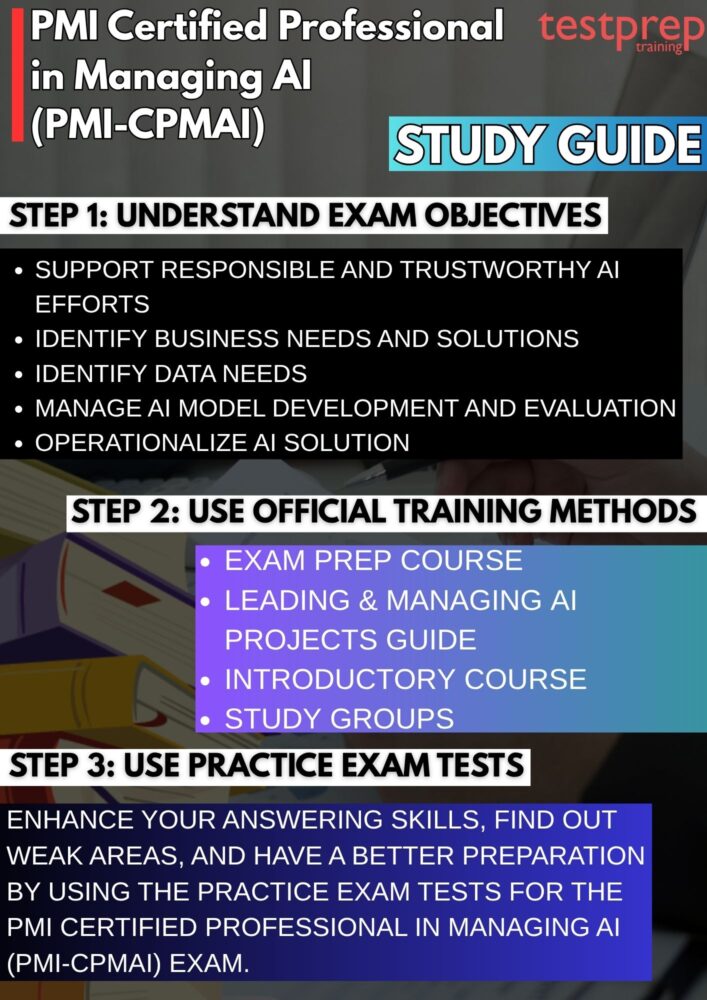
1. Understand the Exam Framework and Objectives
Start by carefully reviewing the official exam blueprint to gain a clear understanding of the domains, knowledge areas, and competencies being tested. The PMI-CPMAI exam is not limited to theoretical AI knowledge—it emphasizes how AI projects are planned, governed, executed, and evaluated. Pay special attention to:
- The CPMAI (Cognitive Project Management in AI) methodology
- Key themes such as ethical AI, governance, risk management, and stakeholder alignment
- The integration of business value with technical execution
This step helps you create a focused study plan and prevents unnecessary effort on topics that are not relevant to the exam.
2. Complete the PMI-CPMAI Exam Prep Course Thoroughly
The official PMI-CPMAI Exam Prep Course is a mandatory requirement and serves as the core foundation of your preparation. It is designed to walk you through the entire lifecycle of AI project management using the CPMAI framework.
The PMI-CPMAI Exam Prep Course (21 hours) is designed to equip you with the essential knowledge and practical skills needed to pass the exam and successfully manage AI projects. Structured around the six phases of the CPMAI methodology, the course combines scenario-based exercises, real-world case studies, and a downloadable workbook to help you apply concepts in a practical context.
Delivered in a self-paced format, it includes multimedia lessons, guided coverage of the Exam Content Outline (ECO), and independent learning activities—allowing you to study flexibly while building a strong foundation. The course begins by explaining the importance of AI project management and why many AI initiatives fail. It then focuses on aligning AI solutions with business goals, defining scope, and evaluating feasibility. You will learn how to identify and manage data requirements, prepare high-quality datasets, and support the full AI lifecycle.
As you progress, the course covers model development and iteration, followed by testing and evaluation to ensure performance, reliability, and transparency. Finally, it addresses the deployment and operationalization of AI systems, including governance, monitoring, and continuous improvement, ensuring long-term success in real-world environments.
3. Build a Strong Foundation with the Free Introductory Course
The Free Introduction to PMI-CPMAI course is an excellent starting point, especially for beginners or professionals transitioning into AI project management. It introduces the core principles of cognitive project management in a simplified and accessible manner. It serves as a preview of the full PMI-CPMAI certification program, helping you understand why many AI projects fail and how a disciplined, data-driven approach can improve outcomes.
The course highlights how CPMAI combines proven project management practices, Agile principles, and data-focused strategies to guide successful AI implementations. Ideal for beginners or professionals exploring the certification, it builds a foundational understanding that can be expanded through the complete exam prep course.
4. Deepen Your Knowledge with the “Leading & Managing AI Projects” Guide
The Leading & Managing AI Projects Digital Guide provides a broader and more strategic perspective on AI implementation. It complements the exam prep course by focusing on real-world applications and leadership considerations. While studying this guide, focus on:
- AI governance frameworks and compliance considerations
- Risk identification and mitigation strategies in AI projects
- Managing cross-functional teams and stakeholder expectations
- Ensuring ethical, transparent, and accountable AI outcomes
This resource is particularly valuable for understanding how theoretical concepts are applied in practical scenarios, which is critical for answering scenario-based exam questions.
5. Engage with Study Groups and Professional Communities
Joining study groups, forums, or professional networks can significantly enhance your learning experience. Interacting with other candidates allows you to exchange knowledge, clarify doubts, and gain diverse perspectives. Benefits include:
- Exposure to real-world experiences and case discussions
- Learning different approaches to solving scenario-based problems
- Staying motivated and consistent in your preparation
You can explore platforms like PMI communities, LinkedIn groups, or online forums dedicated to AI and project management.
6. Practice with Mock Tests and Scenario-Based Questions
Consistent practice is essential to assess your readiness for the exam. The PMI-CPMAI exam often includes application-based and scenario-driven questions, making it important to develop analytical thinking. While practicing:
- Attempt full-length mock exams to simulate real exam conditions
- Analyze each question to understand why an answer is correct or incorrect
- Focus on improving time management and decision-making under pressure
Practice tests also help you identify knowledge gaps and refine your approach before the actual exam.
7. Revise Strategically and Strengthen Weak Areas
As your exam date approaches, shift your focus to targeted revision and reinforcement. Instead of revisiting everything, concentrate on areas where your performance is weaker. Effective revision strategies include:
- Reviewing key frameworks, models, and methodologies
- Revisiting notes from the exam prep course
- Practicing additional questions from weak domains
- Summarizing complex topics into quick revision points
