
Exam AB-410: Intelligent Applications Builder Associate
The Microsoft Certified: Intelligent Applications Builder Associate certification (Exam AB-410) is designed for professionals who develop intelligent business applications using Microsoft Power Platform and AI-powered capabilities. Candidates pursuing this certification are expected to build innovative solutions by leveraging Microsoft Copilot, natural language experiences, low-code development tools, automation workflows, and AI-driven features to enhance business productivity and user experiences.
This certification validates the skills required to create, customize, and deploy intelligent applications that integrate data, automation, AI models, agents, and business processes within the Microsoft ecosystem.
Role of an Intelligent Applications Builder
As an Intelligent Applications Builder, your primary responsibility is to design and develop AI-enhanced business solutions that help organizations streamline operations, improve decision-making, and automate repetitive tasks.
Professionals in this role utilize Microsoft Power Platform technologies to create applications, automate workflows, manage data, and integrate AI capabilities into business solutions. They focus on delivering user-friendly experiences while ensuring scalability, security, and alignment with organizational requirements.
Core Responsibilities
Candidates preparing for the AB-410 exam should be capable of performing a variety of development and solution-building tasks, including:
- Building Dataverse Solutions
- A key responsibility involves designing and managing data structures within Microsoft Dataverse. This includes creating tables, relationships, business rules, and data models that serve as the foundation for intelligent applications.
- Developing Power Apps Applications
- Professionals should be able to build both:
- Model-driven applications for data-centric business processes
- Canvas applications for highly customized user experiences
- Professionals should be able to build both:
- Integrating AI and Copilot Capabilities
- Modern business applications increasingly rely on AI-driven experiences. Candidates should understand how to incorporate:
- Microsoft Copilot features
- AI-powered prompts
- Intelligent agents
- Automated assistance capabilities
- Modern business applications increasingly rely on AI-driven experiences. Candidates should understand how to incorporate:
Into Power Apps, Power Pages, and other Power Platform solutions.
- Creating Automated Business Processes
- Automation is a critical aspect of intelligent applications. Candidates should be able to design and implement:
- Cloud flows
- Automated workflows
- Business process logic
- Event-driven automation solutions
- Automation is a critical aspect of intelligent applications. Candidates should be able to design and implement:
using Microsoft Power Automate.
- Enhancing User Experiences
- Developers should be capable of enriching applications with:
- AI-generated content
- Intelligent recommendations
- Data visualizations
- Agent interactions
- Automated decision-support mechanisms
- Developers should be capable of enriching applications with:
to improve productivity and user engagement.
Collaboration with Other Teams
Building intelligent applications often requires cross-functional collaboration. Professionals in this role regularly work with multiple stakeholders throughout the solution lifecycle.
- Environment and Security Administrators
- Collaboration with administrators is essential for managing:
- Security roles
- Authentication methods
- Identity management
- Compliance requirements
- Environment policies
- Collaboration with administrators is essential for managing:
- Governance and Compliance Teams
- Application builders must align their solutions with organizational governance standards, including:
- Responsible AI practices
- Application Lifecycle Management (ALM)
- Solution deployment strategies
- Monitoring and reporting requirements
- Pipeline management processes
- Application builders must align their solutions with organizational governance standards, including:
- Solution Architects and Development Teams
- Professionals frequently collaborate with:
- Solution architects
- Agent developers
- Power Platform developers
- Business application builders
- Professionals frequently collaborate with:
to design scalable and effective business solutions.
- Business Stakeholders
- Close engagement with business users helps ensure that applications meet organizational needs. Responsibilities often include:
- Gathering requirements
- Conducting solution reviews
- Refining business processes
- Supporting user adoption initiatives
- Incorporating stakeholder feedback
- Close engagement with business users helps ensure that applications meet organizational needs. Responsibilities often include:
Recommended Technical Experience
Before attempting the AB-410 certification exam, candidates should have practical experience with several Microsoft Power Platform technologies and concepts.
- Natural Language Solution Development
- Candidates should be comfortable using natural language prompts and AI-assisted tools to create application components, workflows, and business solutions more efficiently.
- Microsoft Dataverse
- A strong understanding of Dataverse is important, including:
- Table creation
- Relationships
- Data management
- Business rules
- Security concepts
- A strong understanding of Dataverse is important, including:
- Power Automate
- Hands-on experience with cloud flows and workflow automation is highly beneficial. Candidates should understand how to automate business processes across various systems and services.
- Power Apps Development
- Individuals should be familiar with designing, customizing, and maintaining both model-driven and canvas applications within Power Apps.
- AI Features in Power Platform
- Knowledge of built-in AI capabilities and intelligent automation features available across the Power Platform ecosystem is essential.
- Power Pages
- Candidates should understand how to create and manage Power Pages sites that provide secure access to business information and services.
Prerequisite Knowledge Areas
While there are no mandatory certification prerequisites, successful candidates typically possess foundational knowledge in several important areas.
- Copilot Experiences Across Power Platform
- Candidates should be familiar with using:
- Copilot in Power Apps
- Copilot in Power Automate
- Copilot in Power Pages
- Copilot capabilities within Dataverse
- Candidates should be familiar with using:
to accelerate development and enhance productivity.
- Microsoft Copilot Studio Awareness
- Understanding the basics of creating and configuring intelligent agents using Microsoft Copilot Studio can provide valuable context for exam topics.
- AI Models and Prompt Fundamentals
- Candidates should have foundational knowledge of:
- AI models
- Prompt engineering concepts
- AI Hub capabilities
- AI-assisted business solutions
- Candidates should have foundational knowledge of:
within the Microsoft ecosystem.
- Business Process Mapping
- The ability to analyze business requirements and determine whether a solution should be implemented using:
- Automated flows
- AI agents
- Applications
- Integrated platform capabilities
- The ability to analyze business requirements and determine whether a solution should be implemented using:
- Dataverse as a Central Data Platform
- Candidates should understand how Dataverse serves as the primary data platform for storing, managing, and securing business information across Power Platform solutions.
- Low-Code Development Concepts
- Knowledge of low-code development approaches, including familiarity with Power Fx, helps candidates build applications and automation solutions efficiently.
- Governance and Lifecycle Management
- Professionals should be aware of key governance concepts such as:
- Environment management
- Security roles
- Organizational policies
- Solution packaging
- Deployment processes
- Application lifecycle management practices
- Professionals should be aware of key governance concepts such as:
Exam Details
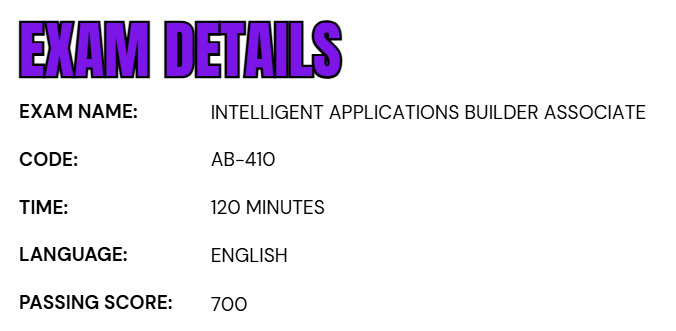
- Exam AB-410: Building Intelligent Applications is the required examination for earning the Microsoft Certified: Intelligent Applications Builder Associate certification.
- The certification is classified at the Intermediate level, making it suitable for individuals who already possess foundational knowledge of Microsoft Power Platform and want to validate their ability to build intelligent, AI-enhanced applications that support business processes and improve productivity.
- From a job-role perspective, this certification is designed primarily for Developers who are responsible for creating applications, automating workflows, integrating AI capabilities, and designing data-driven business solutions.
- The AB-410 exam provides candidates with 120 minutes to complete all required assessment activities.
- During the examination, candidates may encounter a combination of question formats, including traditional assessment questions as well as interactive components that evaluate practical problem-solving and application-building skills in realistic scenarios.
- To maintain exam integrity and ensure a secure testing environment, the examination is proctored, meaning candidates are monitored throughout the testing session according to Microsoft certification policies and procedures.
- Currently, the exam is available in English, allowing candidates worldwide to demonstrate their knowledge and technical competencies in building intelligent applications using Microsoft technologies.
- To successfully earn a passing result, candidates must achieve a minimum score of 700 on Microsoft’s scoring scale. Reaching or exceeding this score demonstrates that the candidate possesses the knowledge and practical skills required to perform effectively as a Microsoft Intelligent Applications Builder Associate.
Course Outline
The Exam AB-410: Building Intelligent Applications covers the following topics:
1. Creating a foundation for intelligent applications (25–30%)
Designing Microsoft Power Platform solutions by using AI-enabled tools
- Analyzing requirements to identify components and options for implementation (Microsoft Documentation: Determine integration requirements)
- Evaluating built-in agents to include in the business solution (Microsoft Documentation: About agent evaluation, Agents built by Microsoft)
- Recommending extensibility options (Microsoft Documentation: Microsoft 365 Copilot extensibility overview, Extensibility requests)
- Recommending environment types (Microsoft Documentation: Power Platform environments overview)
- Applying a Microsoft Power Platform solution and ALM strategy (Microsoft Documentation: Overview of application lifecycle management with Microsoft Power Platform, ALM basics with Microsoft Power Platform)
- Creating and editing tables in the data workspace (Microsoft Documentation: create and modify Dataverse tables by using the Data workspace, Work with existing tables in data workspace)
- Creating and modifying standard tables (Microsoft Documentation: Create and edit tables using Power Apps)
- Configuring table properties (Microsoft Documentation: Set or change table properties)
- Creating and modifying columns (Microsoft Documentation: Create and edit columns in Dataverse using Power Apps)
- Configuring table relationships (Microsoft Documentation: Microsoft Dataverse table relationships)
- Configure prompt columns (Microsoft Documentation: Prompt columns)
- Configuring row summaries (Microsoft Documentation: Configure a row summary for a model-driven app, Use row summaries in model-driven apps)
- Configure public views (Microsoft Documentation: Create and edit public or system views, Manage access to public system views)
- Configuring main forms (Microsoft Documentation: Create, edit, or configure forms using the form designer)
- Configuring security
2. Process of creating intelligent applications (25–30%)
- Creating and configuring forms for model-driven apps (Microsoft Documentation: Create and design model-driven app forms)
- Creating and configuring views for model-driven apps (Microsoft Documentation: Understand model-driven app views)
- Create generative pages by using natural language (Microsoft Documentation: Generate a page using natural language)
- Composing a model-driven app (Microsoft Documentation: Build your first model-driven app, What are model-driven apps in Power Apps?)
- Configuring access to forms and views for model-driven apps (Microsoft Documentation: Manage model-driven app forms settings)
- Configuring access to model-driven apps
- Creating and configuring model-driven app charts and dashboards (Microsoft Documentation: Create and configure model-driven app interactive experience dashboards, Create or edit model-driven app dashboards, Create or edit a model-driven app system chart)
- Creating a canvas app using data (Microsoft Documentation: Create a canvas app with data from a list, Create a canvas app using Microsoft Dataverse)
- Designing apps for accessibility, performance, responsiveness, and usability (Microsoft Documentation: Create accessible canvas apps)
- Automating business processes from canvas apps (Microsoft Documentation: Build an AI agent to automate your business process, Business process flows overview)
- Creating reuseable components, including named formulas, user-defined functions, and component libraries (Microsoft Documentation: Canvas component overview, Component library)
- Managing variables and collections (Microsoft Documentation: Manage variables and the variables pane)
- Implementing error handling
- Testing canvas apps, including using Monitor (Microsoft Documentation: Debugging canvas apps with Live monitor, Debug Canvas apps by using Live monitor and Trace)
- Creating a Copilot Studio agent from a canvas app (Microsoft Documentation: Add a custom Copilot to a canvas app, Add a Copilot control to a canvas app)

3. Building business application logic and automation (40–45%)
- Recommending cloud flow triggers (Microsoft Documentation: Triggers, Work with triggers and actions)
- Evaluating and recommending connectors (Microsoft Documentation: Connector reference overview)
- Managing approvals by using cloud flows (Microsoft Documentation: Create and test an approval workflow with Power Automate, Manage sequential approvals with Power Automate)
- Configuring cloud flow actions (Microsoft Documentation: Create a cloud flow in Power Automate, Actions)
- Implementing flow control with conditions and loops (Microsoft Documentation: Flow control actions)
- Testing and troubleshooting cloud flows (Microsoft Documentation: Troubleshoot a cloud flow, Test cloud flows, cloud flows troubleshoot)
Creating prompts and models in AI Hub
- Building prompts from templates or from blank
- Consuming a prompt in apps (Microsoft Documentation: Use your prompt in Power Apps, Use your prompt actions in Microsoft Copilot Studio)
- Consuming a prompt in cloud flows (Microsoft Documentation: Use your prompt in Power Automate)
- Adding knowledge to a prompt (Microsoft Documentation: Add knowledge to your prompt)
- Customizing prompt settings, including models (Microsoft Documentation: Change the model version and settings)
- Adding inputs to a prompt (Microsoft Documentation: Add inputs to your prompt)
- Consuming an AI model in apps (Microsoft Documentation: Use AI Builder models in Power Apps)
- Consuming an AI model in cloud flows (Microsoft Documentation: AI Builder in Power Automate overview, Use a document processing model in Power Automate)
Implementing business and process logic
- Configuring business rules (Microsoft Documentation: Create a business rule for a table)
- Configure business process flows (Microsoft Documentation: Business process flows overview)
- Configuring calculated, rollup, and formula columns (Microsoft Documentation: Work with formula columns, Specialized columns using code)
- Evaluating use cases for business logic
Microsoft AB-410 Exam FAQs
Microsoft Certification Exam Policies
Microsoft has established a comprehensive set of certification policies and testing standards designed to provide a consistent, secure, and fair examination experience for candidates around the world. Before registering for an exam, candidates are encouraged to review the official certification requirements, testing procedures, identification guidelines, and exam rules. Familiarity with these policies can help avoid scheduling complications, missed appointments, and unnecessary delays in achieving certification goals.
– Exam Retake Policy
Candidates who do not pass the exam on their first attempt are permitted to retake it; however, Microsoft enforces specific waiting periods between attempts. After an unsuccessful first attempt, candidates must wait at least 24 hours before scheduling a second attempt. If additional retakes are required, a 14-day waiting period applies between the third and subsequent attempts.
To preserve the integrity and value of Microsoft certifications, candidates are limited to five attempts for the same exam within a rolling 12-month period, beginning from the date of their first attempt. Once a candidate successfully passes an exam, retaking that same exam is generally not permitted unless Microsoft introduces a mandatory renewal requirement, recertification process, or the certification status has expired.
It is also important to remember that each exam attempt typically requires payment of a separate examination fee unless the candidate has an eligible voucher, discount code, or promotional offer that can be applied.
– Rescheduling and Cancellation Policy
Microsoft allows candidates to modify their exam appointments when necessary, offering flexibility for changing schedules. To avoid penalties, exam appointments should generally be rescheduled or cancelled at least 24 hours before the scheduled testing time.
Candidates who fail to make changes within the permitted timeframe may lose their exam registration benefits, including prepaid exam fees, vouchers, or promotional discounts. Additionally, candidates who do not attend their scheduled exam appointment without prior cancellation may be marked as a no-show. In such cases, the original exam registration is forfeited, and a new exam fee may be required before another appointment can be scheduled.
Microsoft AB-410 Exam Study Guide
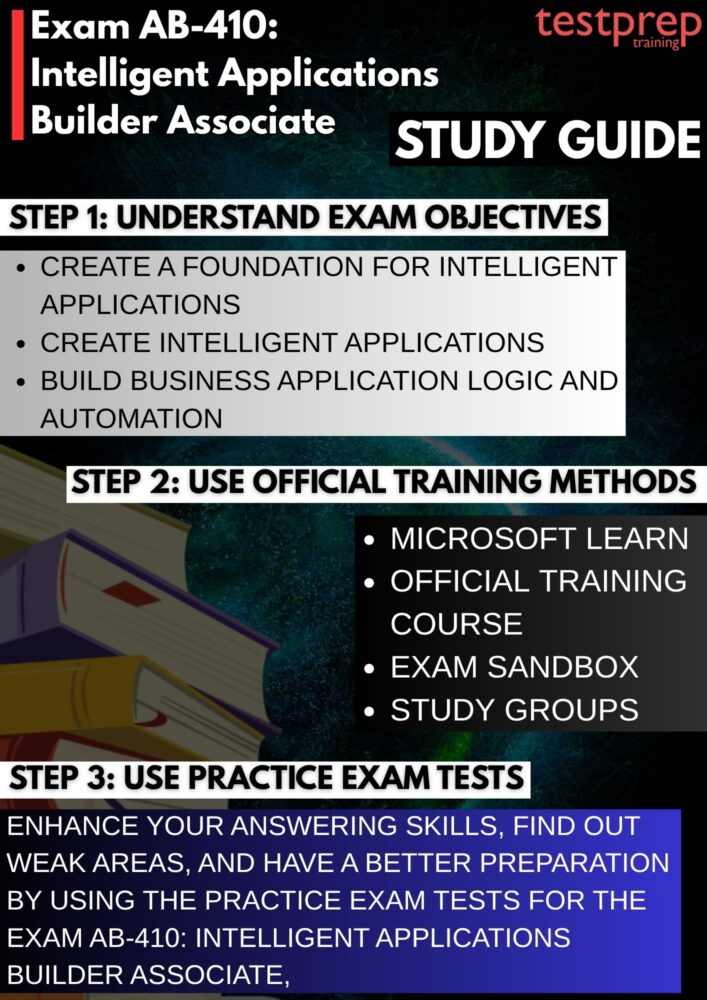
Step 1: Carefully Analyze the Official Exam Skills Outline
The first step in any certification journey should be reviewing the official exam objectives and skills measured document. The exam guide serves as a blueprint for everything that can be assessed during the examination. Candidates should examine each objective area and identify their current strengths and knowledge gaps. Breaking the exam topics into manageable sections allows for a more organized study plan and helps ensure that no important subject area is overlooked. The objective list can also be used as a progress tracker throughout the preparation process.
Step 2: Build Core Knowledge with Microsoft Learn
Once you understand the exam domains, the next step is to work through the relevant learning paths available on Microsoft Learn. These self-paced modules provide official guidance on Power Platform development, Microsoft Copilot capabilities, Dataverse, Power Apps, Power Automate, Power Pages, and AI-powered solution development.
While studying, focus on understanding not only how individual features work but also when and why they should be used in real-world business scenarios. Taking notes, completing module exercises, and revisiting challenging topics can significantly improve retention and comprehension.
Step 3: Complete Microsoft Official Training
Instructor-led or official Microsoft training courses can provide a deeper understanding of exam topics through structured learning experiences. These courses are designed to align closely with certification objectives and often include demonstrations, hands-on exercises, and practical implementation examples.
Official training can be particularly valuable for candidates who prefer guided learning or who are transitioning into intelligent application development from another technical role. The combination of expert instruction and practical labs helps reinforce concepts that may appear in exam scenarios. However, the related course includes:
– AB-410T00-A – Build Intelligent Applications
The AB-410T00-A: Build Intelligent Applications course helps learners understand how to create AI-powered solutions using the Microsoft Power Platform. The training covers the use of Power Apps, Power Automate, Power Pages, Copilot Studio, copilots, agents, and AI capabilities to build intelligent applications that improve business processes, productivity, and user experiences.
This course is ideal for individuals who are new to AI-powered solution development and want to learn how to design, build, and enhance applications using low-code tools. It also introduces key concepts related to intelligent automation, agent-driven experiences, governance, and responsible AI practices, making it valuable preparation for the Microsoft AB-410 certification exam.
Step 4: Gain Hands-On Experience in the Power Platform Environment
Reading documentation alone is rarely enough to master the skills tested in AB-410. Candidates should spend significant time building solutions in a practice environment using Microsoft Power Platform tools. Hands-on activities may include:
- Creating Dataverse tables and relationships
- Developing canvas and model-driven apps
- Building Power Automate cloud flows
- Using Copilot-assisted development features
- Creating AI prompts and integrating AI capabilities
- Exploring Power Pages functionality
- Testing business process automation scenarios
Practical experience helps transform theoretical knowledge into real-world skills and improves the ability to answer scenario-based questions confidently.
Step 5: Explore the Exam Sandbox and Question Experience
Microsoft provides an exam sandbox environment that allows candidates to familiarize themselves with the testing interface before exam day. This practice environment helps reduce anxiety by showing how different question formats, navigation tools, review options, and interactive exam components function. Understanding the exam interface in advance allows candidates to focus their attention on solving questions rather than learning how to use the testing platform during the actual exam.
Step 6: Participate in Study Groups and Professional Communities
Learning alongside other candidates can provide valuable insights and expose you to different perspectives on exam topics. Joining Microsoft certification communities, Power Platform forums, user groups, and professional discussion channels can help reinforce learning and keep motivation high. Community participation offers opportunities to:
- Discuss difficult concepts
- Share study resources
- Learn practical implementation tips
- Review real-world use cases
- Stay informed about certification updates
Engaging with other professionals can often reveal common mistakes and best practices that are not immediately obvious from study materials alone.
Step 7: Validate Your Readiness with Practice Assessments
As the exam date approaches, candidates should evaluate their preparedness through official practice assessments and exam-focused review activities. Practice tests help identify weak areas, measure progress, and improve familiarity with the style and structure of certification questions.
Rather than simply memorizing answers, use practice assessments as a diagnostic tool. Carefully review explanations for both correct and incorrect responses, revisit topics that require improvement, and continue strengthening areas where confidence is low. Repeated assessment and targeted review can significantly improve exam performance and readiness.
