
GitHub Certified: Agentic AI Developer (GH-600)
The GitHub Certified: Agentic AI Developer (GH-600) certification is intended for professionals who possess the skills and practical experience required to operate, integrate, supervise, and govern AI agents within modern software development environments. The certification validates an individual’s ability to work with intelligent coding agents while ensuring development processes remain secure, reliable, and efficient.
Professionals pursuing this certification should understand how AI agents can be incorporated into production-grade Software Development Lifecycle (SDLC) workflows using GitHub as the primary platform for collaboration, governance, and operational control. The role focuses on balancing automation with oversight to ensure that AI-assisted development aligns with organizational standards and business objectives.
Core Responsibilities of an Agentic AI Developer
An Agentic AI Developer is responsible for enabling AI-powered development workflows while maintaining appropriate controls, security measures, and governance practices throughout the software lifecycle.
- Operating Agent Workflows Within the SDLC
- Candidates should understand how AI agents participate in different stages of the software development lifecycle, including planning, coding, testing, deployment, and maintenance. This includes integrating agent-driven workflows into existing development processes and ensuring that automation contributes positively to productivity and software quality.
- Supervising Autonomous Agent Behavior
- As AI agents become capable of performing increasingly complex tasks, effective supervision becomes critical. Developers must understand how to monitor agent activities, establish operational boundaries, review generated outputs, and apply GitHub controls that ensure agents act within approved guidelines and organizational policies.
- Evaluating and Improving Agent Performance
- AI-generated outputs should be continuously assessed for accuracy, quality, security, and compliance. Candidates are expected to know how to evaluate agent performance using available scans, logs, reports, and development artifacts. They should also be able to identify opportunities for optimization and fine-tuning to improve overall effectiveness.
- Configuring Custom Agents
- Organizations often require AI agents that are tailored to specific workflows, coding standards, or business requirements. Professionals should understand how to customize agent behavior through instructions, tools, configurations, and integrations that align with organizational development practices.
- Coordinating Multi-Agent Workflows
- Modern development environments may involve multiple AI agents working together to perform specialized tasks. Candidates should understand how to safely coordinate multi-agent execution, manage communication between agents, prevent conflicts, and ensure that collaborative automation remains secure and predictable.
Collaboration Across Development Teams
Agentic AI Developers work closely with a wide range of stakeholders throughout the software development process. These may include software architects, platform engineers, DevOps engineers, application developers, product managers, security teams, and operational staff.
Through collaboration, they help design, deploy, manage, and optimize AI-powered development solutions that improve efficiency while maintaining governance, security, and quality standards.
Recommended Knowledge and Experience
Candidates preparing for the GH-600: Developing in Agentic AI Systems exam should have practical experience with software development workflows and modern DevOps practices. A strong understanding of GitHub features and development operations is highly beneficial. Recommended areas of experience include:
- Software Development Lifecycle (SDLC) concepts and practices
- GitHub workflows and repository management
- Code review and collaboration processes
- Secure software development practices
- Code quality and compliance controls
- Continuous Integration and Continuous Deployment (CI/CD)
- AI-assisted software development workflows
- Governance and oversight of autonomous systems
GitHub Copilot and Agentic AI Expertise
A significant portion of the certification focuses on working with coding agents and AI-assisted development tools. Candidates should be comfortable using GitHub Copilot and understanding how agentic AI capabilities can enhance developer productivity. Key areas of knowledge include:
- GitHub Copilot capabilities and configuration
- Agent-based coding workflows
- MCP (Model Context Protocol) servers
- Custom instructions for AI agents
- Custom agent creation and configuration
- Tool integration and extensibility
- Agent setup and operational management
- Safe deployment of AI-powered development assistants
Exam Details
- The GitHub Certified: Agentic AI Developer (GH-600) certification is an intermediate-level credential designed for professionals who develop, deploy, manage, and govern AI-powered agents within modern software development environments.
- This certification is particularly relevant for professionals working in roles such as AI Engineer, Developer, DevOps Engineer, Solution Architect, Data Engineer, and App Maker. It focuses on the practical application of AI agents throughout the software development lifecycle, emphasizing responsible deployment, operational oversight, customization, and governance.
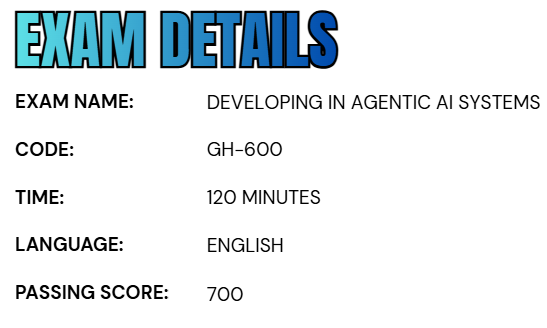
- Candidates are allotted 120 minutes to complete the GH-600 examination. The assessment is designed to evaluate both conceptual understanding and practical knowledge of agentic AI development within GitHub-centric environments.
- The exam is proctored, meaning candidates are monitored throughout the testing session to help maintain exam integrity and certification standards. Depending on the exam version, candidates may also encounter interactive assessment components that require hands-on problem-solving and practical decision-making rather than relying solely on traditional multiple-choice questions.
- Currently, the GH-600 certification exam is available in English, allowing candidates to demonstrate their skills using a globally recognized language for software development and technical collaboration.
- To successfully earn the certification, candidates must achieve a minimum score of 700. The final score is based on overall performance across the exam objectives and reflects a candidate’s readiness to work with agentic AI systems in real-world development scenarios.
- GitHub and its certification providers support accessibility and inclusive testing practices. Candidates who use assistive technologies, require additional testing time, or need modifications to the standard exam experience can request accommodations before their scheduled exam date. These accommodations are intended to provide a fair testing environment while ensuring that all candidates can demonstrate their knowledge and skills effectively.
Course Outline
The GH-600: Developing in Agentic AI Systems exam covers the following topics:
1. Concept of preparing agent architecture and SDLC processes (15–20%)
Integrating agents into the software development lifecycle (SDLC)
- Identifying steps for agents to perform
- Identifying and mitigating common anti-patterns in agents
- Defining inputs, outputs, and success criteria for agents
Defining boundaries between planning, reasoning, and action
- Configuring agent planning to be distinct from agent execution
- Configuring an agent to output a structured plan
- Validating agent plans
- Preventing agent action until the agent checked and approved
Configuring observability and control for autonomous agents
- Planning and implementing the degree of agent autonomy, including guardrails
- Configuring agent to produce inspectable artifacts within standard development tooling
- Configuring human intervention for autonomous agents without slowing delivery
2. Implementing tool use and environment interaction (20–25%)
Selecting and configuring agent tools
- Identifying required tools
- Configuring agent tools
- Configuring agent tool permissions
- Adding an MCP server as a tool to an agent
- Configuring a GitHub remote MCP server
- Configuring the MCP registries
- Configuring MCP allow lists
Integrating agents within development environments
- Evaluating the execution context for an agent
- Configuring an agent’s scope to a specific repository
- Configuring an agent to be invoked in a CI workflow
- Configuring an agent to use branch-based scope
- Enabling an agent to perform autonomous actions, including creating branches and pull requests
- Configuring an agent to handle environment-specific constraints
Operating agents with safe execution paths and robust error handling
- Implementing error handling
- Implement retries
- Implementing rollbacks
- Implementing escalation paths
- Implement traceability and accountability for agent actions
3. Understand about managing memory, state, and execution (10–15%)
Implementing agent memory strategies
- Choosing between short-term, long-term, and external memory
- Scope agent memory to task-relevant information
- Defining memory expiration, pruning, and reset rules
Persisting agent state and manage context drift
- Capturing task progress and decisions as durable artifacts
- Resuming agent work without repeating steps or diverging from prior decisions
- Detecting and correcting drift during extended agent execution
Ensuring continuity of agent memory and state across tools and environments

4. Performing evaluation, error analysis, and tuning (15–20%)
Defining success criteria and evaluation signals for agent tasks
- Specifying expected outcomes and operational constraints for agent tasks
- Identifying qualitative and quantitative evaluation signals to evaluate agents
- Aligning evaluation criteria with development intent
- Generating evaluation signals by using automated scanning tools
Analyzing agent failures and identify root causes
- Identifying failures by using logs, plans, traces, outputs, and workflow artifacts
- Classifying root causes, including reasoning errors, tool misuse, and context or environment issues
Tuning agent behavior based on evaluation results
- Revising instructions, workflows, or constraints
- Refining memory usage
- Refining tool usage and tool access
5. Orchestrating multi-agent coordination (15–20%)
Operating and managing multi-agent workflows
- Applying an orchestration pattern to coordinate multiple agents
- Configuring agent isolation for parallel execution
- Detecting and resolving agent conflicts, including overlapping code changes, duplicated effort, and contradictory outputs
Configuring observability for multi-agent behavior by using logs, artifacts, and operational signals
- Configuring multi-agent workflows to produce artifacts suitable for review and audit
- Documenting key decisions, handoffs, and outcomes across agents
- Performing post-hoc analysis of multi-agent behavior
Detecting and responding to multi-agent failures and degraded behavior
- Identifying failed, partial, or stalled agent executions
- Responding to degraded behavior or coordination across agents
- Implementing multi-agent recovery patterns, including rollback and human-in-the-loop
Managing the lifecycle of agents within multi-agent workflows
- Adding agents to existing multi-agent workflows
- Updating, reconfiguring, or replacing agents without disrupting active workflows
- Retiring agents while preserving auditability and workflow continuity
6. Implementing guardrails and accountability (10–15%)
- Classifying agent actions by operational, security, and compliance risk to right-size human interventions
- Assigning autonomy levels to maximize delivery speed while remaining compliant with organizational security and Responsible AI standards
Implementing guardrails and human-in-the-loop workflows
- Identifying the subset of actions that require human judgment
- Block actions that violate defined security, compliance, or Responsible AI policies
- Scope permissions and execution contexts to enforce least-privilege access
- Requiring explicit authorization or controlled paths for irreversible or compliance-sensitive changes
- Preserving execution velocity by minimizing approvals that do not materially reduce risk
GitHub Certified: Agentic AI Developer (GH-600) Exam FAQs
Certification Exam Policies
Microsoft maintains certification policies and testing standards to provide a secure, fair, and consistent exam experience for candidates worldwide. Before scheduling an exam, candidates should review the official requirements, identification rules, testing procedures, and exam regulations. Understanding these guidelines can help prevent appointment issues, testing disruptions, or delays in achieving certification.
– Exam Retake Policy
Candidates who do not pass an exam on their first attempt may retake it. A 24-hour waiting period is generally required before scheduling a second attempt. Beginning with the third attempt, candidates must typically wait 14 days between exam registrations.
Microsoft also limits candidates to a maximum of five attempts for the same exam within a 12-month period. Once an exam has been successfully passed, it usually cannot be retaken unless a renewal or recertification requirement is introduced. Additionally, each exam attempt normally requires a separate registration fee unless a valid voucher, discount, or promotional offer is available.
GH-600: Developing in Agentic AI Systems Exam Study Guide
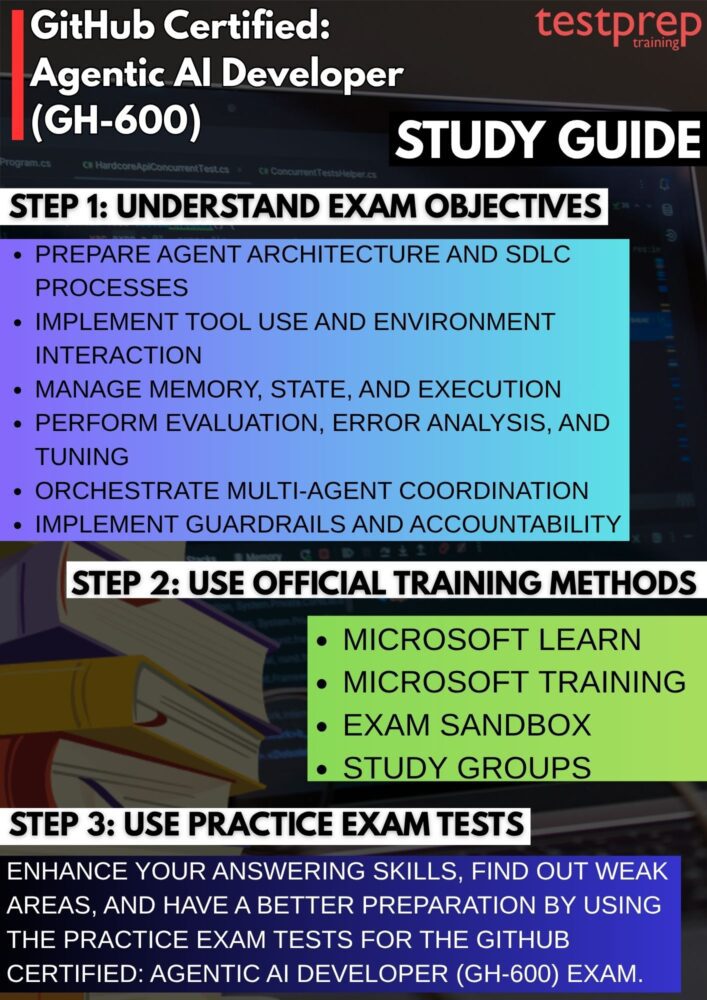
1. Thoroughly Review the Official Exam Objectives
A successful preparation strategy begins with understanding exactly what the exam measures. The official GH-600 skills outline serves as the blueprint for the certification and identifies the domains, tasks, and competencies that candidates are expected to demonstrate. Reviewing the exam objectives allows you to prioritize your study efforts and allocate time based on the weight and complexity of each topic.
As you review the objectives, create a checklist of skills you already possess and areas that require additional study. This approach helps establish a focused learning path and prevents spending excessive time on topics that are less relevant to the exam. Regularly revisiting the skills outline throughout your preparation can also help ensure that no exam domain is overlooked.
2. Complete the Official Microsoft Learn Learning Paths
Microsoft Learn is one of the most valuable resources available for GH-600 candidates because it provides official, up-to-date training aligned with the certification objectives. The learning modules are designed to introduce concepts progressively, helping candidates understand both foundational and advanced aspects of agentic AI development.
While working through Microsoft Learn content, focus on understanding how AI agents interact with software development workflows, how GitHub Copilot supports developer productivity, and how governance and security controls are applied to AI-assisted development. Take notes on important concepts, architecture patterns, and best practices, as these can serve as useful revision materials closer to exam day.
3. Develop Practical Experience with Agentic AI Systems
The GH-600 exam is designed for professionals who can apply their knowledge in real-world environments. Therefore, hands-on experience is just as important as theoretical study. Candidates should spend time working directly with GitHub Copilot, AI-assisted development workflows, custom instructions, and agent configurations.
Practice creating development workflows that incorporate AI agents, explore how agents can automate repetitive development tasks, and learn how to supervise and validate AI-generated outputs. Understanding how to configure tools, customize agent behavior, and integrate external capabilities can significantly improve your readiness for scenario-based questions.
Hands-on experimentation also helps you become familiar with common challenges such as managing agent permissions, validating code quality, handling security concerns, and ensuring reliable AI-generated outcomes.
4. Use the Exam Sandbox to Familiarize Yourself with the Testing Environment
Many candidates focus exclusively on technical preparation while overlooking the exam experience itself. The Exam Sandbox allows you to explore the interface used during the actual certification exam and interact with various question formats before test day. By using the sandbox, you can become comfortable with navigation controls, review features, question layouts, and interactive components that may appear during the assessment.
This familiarity helps reduce exam-day anxiety and minimizes the amount of time spent learning the interface during the actual test. Understanding how to move efficiently between questions, flag items for review, and manage your time within the testing environment can contribute to a smoother exam experience.
5. Participate in Study Groups and Professional Communities
Learning alongside other candidates can provide valuable perspectives that are difficult to gain through self-study alone. Certification communities, discussion forums, and study groups often contain individuals who are preparing for the same exam or have already earned the certification. These communities can help you clarify complex topics, discover additional learning resources, and stay informed about updates related to the certification.
Discussions often include practical implementation scenarios, troubleshooting experiences, and real-world use cases involving agentic AI systems and GitHub workflows. Engaging with peers can also increase motivation and accountability, helping you maintain a consistent study schedule throughout your preparation journey.
6. Evaluate Your Knowledge with Practice Tests
Practice tests are an essential component of any certification preparation plan. They provide an opportunity to measure your understanding of exam topics while simulating the pace and structure of the actual assessment. When taking practice exams, focus not only on your overall score but also on the reasoning behind each answer. Carefully review incorrect responses to identify knowledge gaps and revisit the corresponding topics. This process helps transform mistakes into learning opportunities and strengthens your understanding of key concepts.
Practice assessments also improve time management skills by helping you become accustomed to answering questions within a limited timeframe. Regular testing can build confidence and provide a more accurate picture of your exam readiness.
7. Create a Structured Revision and Exam Readiness Plan
During the final stages of preparation, shift your focus from learning new material to reinforcing existing knowledge. Organize your notes, review key concepts from each exam domain, and revisit areas where practice tests indicate weaknesses. A structured revision plan should include scheduled review sessions, hands-on practice, and periodic self-assessments. Focus on critical topics such as agent workflows, GitHub controls, governance mechanisms, custom agent configuration, MCP server concepts, multi-agent coordination, and AI-assisted software development practices.
In the days leading up to the exam, concentrate on consolidating your understanding rather than attempting to learn entirely new topics. A balanced combination of official learning resources, practical experience, community engagement, and practice testing can significantly improve your chances of achieving a passing score and earning the GH-600 certification.
