
Certified Tester Advanced Level Agile Technical Tester (CTAL-ATT)
The Certified Tester Advanced Level Agile Technical Tester (CTAL-ATT) certification is an advanced ISTQB® credential designed for testing professionals who want to strengthen their technical testing capabilities within Agile software development environments. It focuses on equipping testers with the knowledge and practical techniques required to support modern Agile teams through effective testing, automation, and continuous delivery practices.
As organizations increasingly adopt Agile methodologies, technical testers play a vital role in maintaining software quality while enabling rapid and reliable software releases. The CTAL-ATT certification helps professionals develop the advanced skills needed to meet these evolving testing demands.
What You Will Learn
The CTAL-ATT syllabus emphasizes the technical competencies required to perform testing efficiently throughout the Agile software development lifecycle. Key learning areas include:
- Applying Agile testing principles and technical testing techniques.
- Designing and executing effective test automation strategies.
- Supporting Continuous Integration (CI), Continuous Delivery (CD), and Continuous Deployment (CD).
- Using modern testing approaches that align with Agile development practices.
- Understanding service virtualization and its role in testing complex systems.
- Collaborating effectively with cross-functional Agile teams through clear communication and shared responsibilities.
Certification Prerequisites
To be eligible for the CTAL-ATT certification, candidates must meet one of the following requirements:
- Hold a valid Certified Tester Foundation Level (CTFL 4.0) certification, or
- Hold a valid Foundation Level certification issued before CTFL 4.0 along with a valid Certified Tester Foundation Level Agile Tester (CTFL-AT) certification.
In addition, candidates are expected to possess relevant practical testing experience. Specific experience requirements may vary depending on the authorized exam provider or national ISTQB® Member Board.
Business Outcomes
After earning the CTAL-ATT certification, professionals will be able to:
- Apply Agile testing techniques to achieve effective and comprehensive test coverage.
- Define clear, testable requirements that support Agile development practices.
- Design and implement appropriate Agile testing approaches using suitable testing techniques.
- Contribute to the planning, development, and maintenance of test automation solutions.
- Support Continuous Integration processes to enable faster and more reliable software delivery.
- Assist Agile teams in implementing Continuous Delivery and Continuous Deployment practices.
- Understand the concepts and practical applications of service virtualization for testing complex environments.
- Collaborate effectively with developers, testers, product owners, and other stakeholders using efficient communication methods to improve overall team performance.
Who Should Take This Certification?
The CTAL-ATT certification is ideal for experienced testing professionals, Agile testers, automation engineers, technical test analysts, quality assurance specialists, and software engineers who want to enhance their technical testing expertise and contribute more effectively to Agile software development projects. It is particularly valuable for professionals involved in automation, DevOps, and continuous software delivery initiatives.
Exam Details
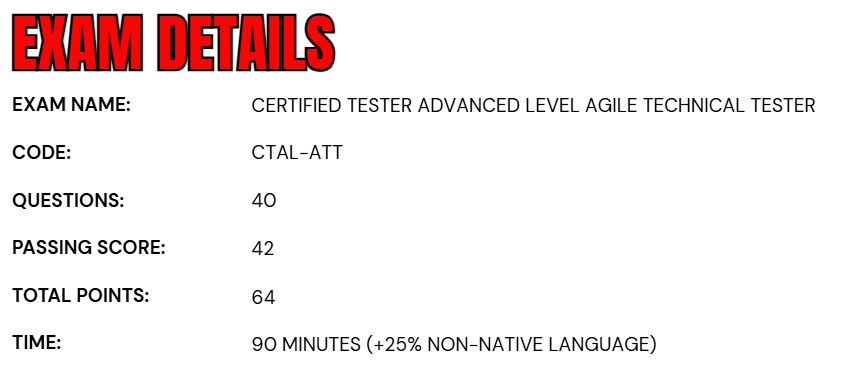
- The Certified Tester Advanced Level Agile Technical Tester (CTAL-ATT) certification exam is designed to evaluate a candidate’s advanced knowledge of technical testing practices within Agile software development environments. The exam assesses the ability to apply Agile testing techniques, automation strategies, continuous integration and delivery concepts, service virtualization, and effective collaboration within Agile teams.
- The examination consists of 40 multiple-choice questions with a maximum score of 64 points.
- To successfully earn the certification, candidates must achieve a minimum passing score of 42 points.
- The standard exam duration is 90 minutes.
- Candidates taking the exam in a language that is not their native language are typically granted an additional 25% time, allowing sufficient time to read, interpret, and answer the questions accurately.
Course Outline
The Certified Tester Advanced Level Agile Technical Tester (CTAL-ATT) certification exam covers the following topics:
1. Understand Requirements Engineering 180 minutes
1.1 Requirements Engineering Techniques
- Analyzing user stories and epics using requirements engineering techniques
- Describing the requirements engineering techniques and how they can help testers
- Creating and evaluating testable acceptance criteria for a given user story using requirements engineering and test techniques
- Describing the elicitation techniques
2. Learn Testing in Agile 540 minutes
2.1 Agile development and test techniques
- Applying test-driven development (TDD) in the context of a given example in an Agile project
- Understanding the characteristics of a Unit test
- Understanding the meaning of the mnemonic word FIRST
- Applying behavior-driven development (BDD) in the context of a given user story in an Agile project
- Understanding how to manage guidelines for a formulation of a scenario
- Analyzing a product backlog in an Agile project to determine a way to introduce acceptance test-driven development (ATDD)
2.2 Experience-based testing in Agile
- Analyzing the creation of a test approach using test automation, experience-based tests and back-box tests, created using other approaches (including risk-based testing) for a given scenario in an Agile project
- Explaining differences between Mission critical and non-critical
- Analyzing user stories and epics to create test charters
- Understanding the use Experienced-based techniques
2.3 Aspects of code quality
- Understanding the importance of refactoring test cases in Agile projects
- Understanding practical task-list for Refactoring Test cases
- Analyzing code as part of a code review to identify defects and technical debt
- Understanding Static code Analysis
3. Understand Test Automation 135 minutes
3.1 Test Automation Techniques
- Applying data-driven and keyword-driven test techniques to develop automated test scripts
- Understanding how to apply test automation to a given test approach in an Agile environment
- Understanding the test automation
- Understanding differences between various test approaches
3.2 Level of Automation
- Understanding the factors to consider when determining the level of test automation needed to keep up with the speed of deployment
- Understanding the challenges of test automation in agile settings

4. Concept of Deployment and Delivery 105 minutes
4.1 Continuous Integration, continuous testing, and continuous delivery
- Applying continuous integration (CI) and summarize its impact on testing activities
- Understanding the role of continuous testing in continuous delivery and continuous deployment (CD)
4.2 Virtualization
- Understanding the concept of service virtualization and its role in Agile projects
- Understanding the benefits of service virtualization
Certified Tester Advanced Level Agile Technical Tester (CTAL-ATT) Exam FAQs
Certified Tester Advanced Level Agile Technical Tester (CTAL-ATT) Exam Study Guide
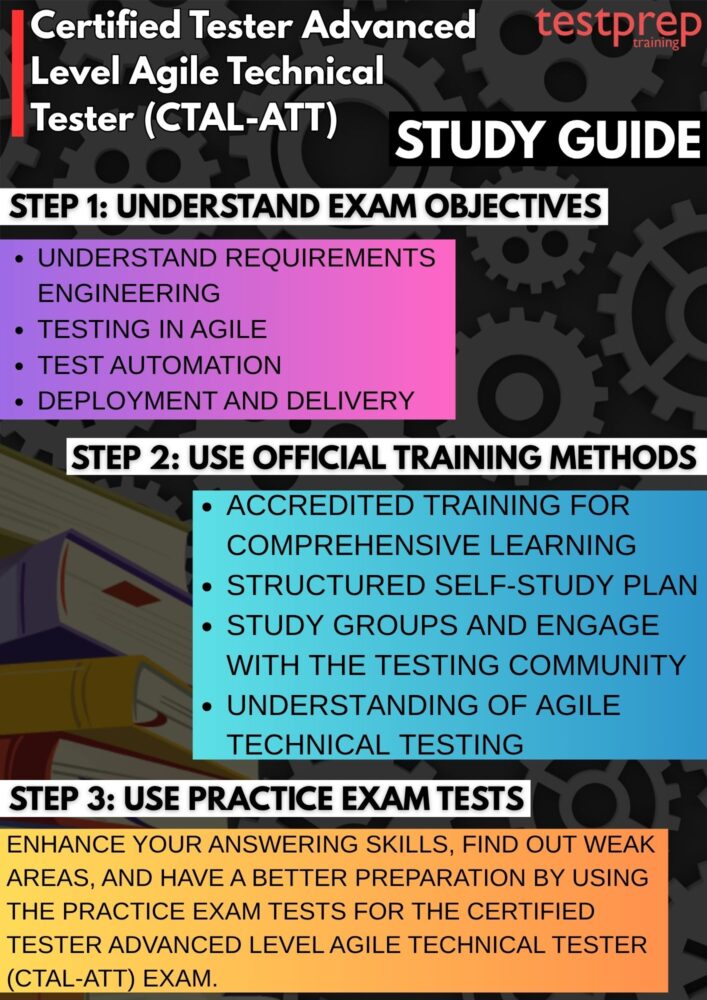
1. Understand the Official Exam Syllabus and Learning Objectives
The first step in your preparation should be a detailed review of the official CTAL-ATT syllabus and examination objectives. The syllabus outlines every topic that may be assessed in the exam, including the expected learning outcomes and cognitive levels for each section. Carefully understanding these objectives enables you to identify the knowledge areas that require greater attention and ensures your study plan remains aligned with the official certification requirements.
As you progress through the syllabus, create concise notes, highlight key terminology, and map relationships between Agile technical testing concepts such as test automation, continuous integration, service virtualization, and Agile collaboration. A thorough understanding of the syllabus serves as the foundation for all subsequent preparation activities.
2. Attend Accredited Training for Comprehensive Learning
One of the most effective ways to prepare for the CTAL-ATT certification is by enrolling in an ISTQB Accredited Training Provider (ATP) course. Accredited training is available in multiple formats, including instructor-led classroom sessions, virtual live training, and self-paced e-learning, allowing candidates to choose the option that best suits their learning preferences.
These training programs are reviewed and approved by an ISTQB® Member Board to ensure the content is accurate, up to date, and fully aligned with the official syllabus. In addition to structured learning, accredited courses often include practical examples, instructor guidance, hands-on exercises, revision materials, and exam-oriented discussions that help candidates better understand complex Agile technical testing concepts and apply them effectively in real-world scenarios.
3. Develop a Structured Self-Study Plan
Candidates who prefer independent learning should establish a disciplined self-study schedule that covers every section of the syllabus in a logical sequence. Use the official syllabus together with recommended reference materials to gain a deeper understanding of each topic rather than relying solely on summary notes. Divide the syllabus into manageable study sessions, set realistic weekly goals, and regularly review previously completed topics to reinforce retention.
Supplement your learning by exploring practical examples, Agile testing case studies, and technical testing scenarios that demonstrate how theoretical concepts are implemented in modern software development environments. Maintaining a consistent study routine significantly improves knowledge retention and reduces last-minute preparation pressure.
4. Join Study Groups and Engage with the Testing Community
Learning alongside other certification candidates and experienced testing professionals can greatly enhance your preparation. Participate in online discussion forums, certification study groups, professional testing communities, and Agile-focused networking platforms where members regularly exchange study materials, discuss challenging concepts, and share practical experiences.
Collaborative learning exposes you to different problem-solving approaches and real-world Agile testing practices that may not be fully covered in textbooks. Discussing difficult topics with peers also helps reinforce your understanding, clarify misconceptions, and increase confidence before the examination.
5. Practice with Mock Exams and Analyze Your Performance
Consistent practice is essential for measuring your readiness and improving your exam performance. Attempt full-length mock examinations and topic-specific practice questions under timed conditions to become familiar with the structure, difficulty level, and question patterns used in the CTAL-ATT exam. Rather than focusing only on your score, carefully analyze every incorrect answer to understand why it was wrong and revisit the corresponding syllabus section.
Tracking your performance across multiple practice tests helps identify weak areas, monitor your progress, and improve both accuracy and time management. Regular assessment also builds confidence by simulating the actual exam experience.
6. Strengthen Your Practical Understanding of Agile Technical Testing
The CTAL-ATT certification evaluates your ability to apply technical testing knowledge within Agile software development environments rather than simply recalling theoretical definitions. Focus on understanding how Agile technical testing practices support software quality throughout the development lifecycle. Study the practical implementation of automated testing, test design techniques, continuous integration, continuous delivery, continuous deployment, service virtualization, and technical collaboration within cross-functional Agile teams. Reviewing real-world examples and project scenarios will help you understand how these concepts interact in practice, enabling you to confidently answer application-based and scenario-oriented exam questions.
7. Perform a Comprehensive Final Revision
As the examination date approaches, shift your focus from learning new topics to reinforcing your existing knowledge. Conduct a comprehensive review of your study notes, important Agile testing concepts, technical testing techniques, and frequently tested syllabus areas. Revisit topics that were challenging during your preparation, complete a few final mock exams, and verify that you are comfortable with the exam format and timing. Organizing a structured revision plan during the final days helps strengthen long-term retention, reduces exam anxiety, and ensures you enter the examination with greater confidence and a clear understanding of the certification objectives.
