
AWS Certified CloudOps Engineer – Associate

The AWS Certified CloudOps Engineer – Associate certification, previously known as AWS Certified SysOps Administrator – Associate, validates technical expertise in operating, monitoring, and maintaining workloads on the AWS Cloud. The certification emphasizes operational responsibility across availability, security, performance, cost optimization, and incident management. This credential focuses on hands-on operational capabilities required to support production AWS environments in accordance with AWS best practices and the AWS Well-Architected Framework.
Exam Purpose and Scope
The SOA-C03 exam evaluates a candidate’s ability to deploy, manage, and operate AWS workloads. It measures operational decision-making skills rather than architectural design, with a strong emphasis on maintaining system reliability, security, and efficiency.
The exam is intended for professionals who perform day-to-day cloud operations and are responsible for maintaining AWS-based systems. Furthermore, this certification is designed for CloudOps Engineers and operations-focused roles responsible for managing AWS environments, responding to incidents, implementing operational controls, and supporting business continuity requirements.
Exam Capabilities and Skills Validated
Workload Operations and Maintenance
- Support and maintain AWS workloads in alignment with the AWS Well-Architected Framework
- Apply operational best practices to ensure system stability and reliability
- Perform operational tasks across multiple AWS services and environments
AWS Interfaces and Tooling
- Perform administrative operations using the AWS Management Console
- Execute operational and troubleshooting tasks using the AWS Command Line Interface (CLI)
- Work with repeatable and automated operational workflows
Security Controls and Compliance
- Implement AWS security controls to meet organizational and regulatory requirements
- Manage identity, access, and encryption mechanisms
- Apply security best practices in operational environments
Monitoring, Logging, and Troubleshooting
- Monitor system health, availability, and performance
- Analyze logs and metrics to identify and resolve operational issues
- Perform root cause analysis and corrective actions
Networking Concepts and Operations
- Apply foundational networking concepts such as DNS, TCP/IP, routing, and firewall rules
- Operate and troubleshoot VPC-based network architectures
- Understand traffic flow and security boundaries
Architectural and Performance Requirements
- Support architectures designed for high availability and fault tolerance
- Manage performance, scaling, and capacity requirements
- Assist with optimization activities based on workload demand
Business Continuity and Disaster Recovery
- Execute backup, restore, and recovery procedures
- Support disaster recovery operations and continuity planning
- Maintain recovery objectives and operational readiness
Incident Identification and Remediation
- Detect, classify, and respond to operational incidents
- Implement remediation steps to restore services
- Support post-incident review processes
Target Audience
The target candidate typically has approximately one year of hands-on experience deploying, managing, and troubleshooting AWS workloads. In addition, the candidate usually has at least one year of experience in an operations-focused role such as system administrator, cloud support engineer, or operations engineer.
Recommended General IT Knowledge and Experience
Candidates are expected to possess working knowledge of:
- Monitoring, logging, and troubleshooting methodologies
- Core networking concepts including DNS, TCP/IP, and firewall configurations
- Architectural operational requirements such as availability, performance, and capacity
- Basic scripting skills for automation and operational tasks
- Experience with at least one major operating system
- Foundational cloud computing concepts
- Containerization and orchestration fundamentals
- CI/CD concepts and version control systems such as Git
Recommended AWS Knowledge and Experience
Candidates should have familiarity with the following AWS concepts and services:
- AWS Frameworks and Core Concepts
- The AWS Well-Architected Framework
- AWS storage solutions and container services
- AWS monitoring and observability tools
- Management, Automation, and Infrastructure
- AWS Management Console and AWS CLI
- Infrastructure as Code (IaC) practices and AWS CloudFormation
- Networking, Security, and Compliance
- AWS networking services and VPC design
- AWS security services and identity management
- Implementation of AWS security controls and compliance requirements
- Financial and Operational Management
- Cloud financial management and cost optimization principles
- Operations within hybrid and multi-VPC AWS environments
- AWS Services
- Database services: Amazon RDS, Amazon DynamoDB, Amazon ElastiCache
- Compute services: Amazon EC2, AWS Lambda, Amazon ECS
Exam Details
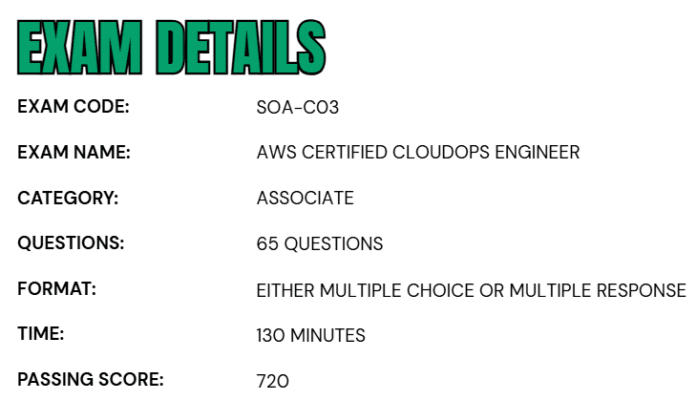
- The AWS Certified CloudOps Engineer – Associate (SOA-C03) is an Associate-level certification exam designed to assess operational expertise in managing and supporting AWS environments.
- The exam is delivered in a proctored format and has a total duration of 130 minutes, during which candidates must demonstrate both conceptual understanding and practical operational judgment.
- The exam consists of 65 questions presented in either multiple-choice or multiple-response formats.
- Multiple-choice questions require the selection of a single correct answer from four options, while multiple-response questions require candidates to identify two or more correct answers from a larger set of options. These question types are structured to evaluate how well candidates can apply AWS operational knowledge in realistic scenarios.
- In both formats, incorrect options—referred to as distractors—are intentionally designed to appear plausible. These distractors typically reflect common misunderstandings or partial knowledge, ensuring that only candidates with a solid grasp of the subject matter consistently select the correct responses. Some questions may require selecting one or more answers that best complete a statement or directly address a problem scenario.
- Unanswered questions are automatically marked as incorrect; however, there is no negative marking for incorrect answers, meaning candidates are not penalized for guessing. Of the 65 total questions, 50 questions are scored and directly contribute to the final result. Each scored question, whether multiple-choice or multiple-response, carries equal weight as a single scoring opportunity.
- The remaining 15 questions are unscored and do not impact the final exam result. These questions are included for statistical and evaluation purposes, allowing AWS to assess their effectiveness for potential inclusion in future exam versions. Candidates are not informed which questions are unscored during the exam.
- The SOA-C03 exam follows a pass or fail evaluation model. Exam performance is measured against a predefined minimum competency standard established by AWS certification experts in accordance with recognized certification industry practices. Results are reported as a scaled score ranging from 100 to 1,000, with a minimum passing score of 720.
Course Outline
The AWS Certified CloudOps Engineer – Associate (SOA-C03) exam covers the following topics:
Domain 1: Understand Monitoring, Logging, Analysis, Remediation, and Performance Optimization 22%
Task 1.1: Implementing metrics, alarms, and filters by using AWS monitoring and logging services
- Skill 1.1.1: Configuring AWS monitoring and logging by using AWS services (for example, Amazon CloudWatch, AWS CloudTrail, Amazon Managed Service for Prometheus) (AWS Documentation: Logging and monitoring, Monitor Amazon Managed Service, Logging Amazon Managed Service for Prometheus API calls)
- Skill 1.1.2: Configuring and managing the CloudWatch agent to collect metrics and logs from Amazon EC2 instances, Amazon Elastic Container Service (Amazon ECS) clusters, or Amazon Elastic Kubernetes Service (Amazon EKS) clusters (AWS Documentation: Setting up the CloudWatch agent to collect cluster metrics, Collect metrics, logs, and traces, Deploying the CloudWatch agent)
- Skill 1.1.3: Configuring, identifying, and troubleshooting CloudWatch alarms that can invoke AWS services directly or through Amazon EventBridge (for example, by creating composite alarms and identifying their invokable actions) (AWS Documentation: Using Amazon CloudWatch alarms, Alarm events and EventBridge)
- Skill 1.1.4: Creating, implementing, and managing customizable and shareable CloudWatch dashboards that display metrics and alarms for AWS resources across multiple accounts and AWS Regions (AWS Documentation: Using Amazon CloudWatch dashboards, Creating a customized CloudWatch dashboard, Creating a CloudWatch cross-account cross-Region dashboard, Sharing CloudWatch dashboards)
- Skill 1.1.5: Configuring AWS services to send notifications to Amazon Simple Notification Service (Amazon SNS) and to invoke alarms that send notifications to Amazon SNS (AWS Documentation: What is Amazon SNS?, Configure Amazon SNS to send messages for alerts to other destinations)
Task 1.2: Identifying and remediating issues by using monitoring and availability metrics
- Skill 1.2.1: Analyzing performance metrics and automating remediation strategies by using AWS services and functionality (for example, CloudWatch, AWS User Notifications, AWS Lambda, AWS Systems Manager, CloudTrail, auto scaling) (AWS Documentation: Using CloudWatch metrics with Lambda, Monitoring Run Command metrics using Amazon CloudWatch)
- Skill 1.2.2: Using EventBridge to route, enrich, and deliver events, and troubleshoot any issues with event bus rules (AWS Documentation: Event buses in Amazon EventBridge, Troubleshooting Amazon EventBridge)
- Skill 1.2.3: Creating or running custom and predefined Systems Manager Automation runbooks (for example, by using AWS SDKs or custom scripts) to automate tasks and streamline processes on AWS (AWS Documentation: Creating your own runbooks)
Task 1.3: Implementing performance optimization strategies for compute, storage, and database resources
- Skill 1.3.1: Optimizing compute resources and remediate performance problems by using performance metrics, resource tags, and AWS tools (AWS Documentation: Tools for managing and optimizing AWS compute infrastructure and applications, Overview of AWS Compute Optimizer, Metrics analyzed)
- Skill 1.3.2: Analyzing Amazon Elastic Block Store (Amazon EBS) performance metrics, troubleshoot issues, and optimize volume types to improve performance and reduce cost (AWS Documentation: Amazon EBS volume performance, What is Amazon Elastic Block Store?)
- Skill 1.3.3: Implementing and optimizing Amazon S3 performance strategies (for example, AWS DataSync, S3 Transfer Acceleration, multipart uploads, S3 Lifecycle policies) to enhance data transfer, storage efficiency, and access patterns (AWS Documentation: Best practices design patterns)
- Skill 1.3.4: Evaluating and selecting shared storage solutions (for example, Amazon Elastic File System [Amazon EFS], Amazon FSx), and optimize the solutions (for example, EFS lifecycle policies) for specific use cases and requirements (AWS Documentation: What is Amazon Elastic File System?)
- Skill 1.3.5: Monitoring Amazon RDS metrics (for example, Amazon RDS Performance Insights, CloudWatch alarms), and modify configurations to increase performance efficiency (for example, Performance Insights proactive recommendations, RDS Proxy) (AWS Documentation: Monitoring Amazon RDS metrics with Amazon CloudWatch, Monitoring RDS Proxy metrics with Amazon CloudWatch, Amazon CloudWatch metrics for Amazon RDS Performance Insights)
- Skill 1.3.6: Implement, monitor, and optimize EC2 instances and their associated storage and networking capabilities (for example, EC2 placement groups) (AWS Documentation: Placement groups for your Amazon EC2 instances, Placement strategies for your placement groups)

Domain 2: Learn about Reliability and Business Continuity 22%
Task 2.1: Implementing scalability and elasticity
- Skill 2.1.1: Configuring and managing scaling mechanisms in compute environments (AWS Documentation: What is Amazon EC2 Auto Scaling?)
- Skill 2.1.2: Implementing caching by using AWS services to enhance dynamic scalability (for example, Amazon CloudFront, Amazon ElastiCache)
- Skill 2.1.3: Configuring and managing scaling in AWS managed databases (for example, Amazon RDS, Amazon DynamoDB) (AWS Documentation: Scaling and high availability in Amazon RDS, Managing an Amazon RDS DB instance)
Task 2.2: Implementing highly available and resilient environments
- Skill 2.2.1: Configuring and troubleshooting Elastic Load Balancing (ELB) and Amazon Route 53 health checks (AWS Documentation: Creating Amazon Route 53 health checks, Troubleshoot your Application Load Balancers)
- Skill 2.2.2: Configuring fault-tolerant systems (for example, Multi-AZ deployments) (AWS Documentation: Fault tolerance, Configuring and managing a Multi-AZ deployment for Amazon RDS)
Task 2.3: Implementing backup and restore strategies
- Skill 2.3.1: Automating snapshots and backups for AWS resources (for example, Amazon EC2 instances, RDS DB instances, Amazon Elastic Block Store [Amazon EBS] volumes, Amazon S3 buckets, DynamoDB tables) by using AWS services (for example, AWS Backup)
- Skill 2.3.2: Using various methods to restore databases (for example, point-in-time restore) to meet recovery time objective (RTO), recovery point objective (RPO), and cost requirements
- Skill 2.3.3: Implementing versioning for storage services (for example, Amazon S3, Amazon FSx) (AWS Documentation: How S3 Versioning works, Retaining multiple versions of objects with S3 Versioning)
- Skill 2.3.4: Following disaster recovery procedures (AWS Documentation: Disaster recovery with AWS, Plan for Disaster Recovery (DR))
Domain 3: Understand Deployment, Provisioning, and Automation 22%
Task 3.1: Provisioning and maintaining cloud resources
- Skill 3.1.1: Creating and managing AMIs and container images (for example, Amazon EC2 Image Builder) (AWS Documentation: Create custom images with Image Builder)
- Skill 3.1.2: Creating and managing stacks of resources by using AWS CloudFormation and the AWS Cloud Development Kit (AWS CDK) (AWS Documentation: Managing AWS resources as a single unit with CloudFormation stacks, What is the AWS CDK?, Introduction to AWS CDK stacks)
- Skill 3.1.3: Identifying and remediating deployment issues (for example, subnet sizing issues, CloudFormation errors, permissions issues) (AWS Documentation: Troubleshooting CloudFormation)
- Skill 3.1.4: Provisioning and sharing resources across multiple AWS Regions and accounts (for example, AWS Resource Access Manager [AWS RAM], CloudFormation StackSets) (AWS Documentation: Shareable AWS resources)
- Skill 3.1.5: Implementing deployment strategies and services (AWS Documentation: Deployment strategies)
- Skill 3.1.6: Using and managing third-party tools to automate resource deployment (for example, Terraform, Git) (AWS Documentation: Deploy and manage AWS Control Tower controls by using Terraform)
Task 3.2: Automating the management of existing resources
- Skill 3.2.1: Using AWS services to automate operational processes (for example, AWS Systems Manager) (AWS Documentation: AWS Systems Manager Automation)
- Skill 3.2.2: Implementing event-driven automation by using AWS services and features (for example, AWS Lambda, Amazon S3 Event Notifications) (AWS Documentation: Process Amazon S3 event notifications with Lambda, Creating event-driven architectures with Lambda, Amazon S3 Event Notifications)
Domain 4: Explore Security and Compliance 16%
Task 4.1: Implementing and managing security and compliance tools and policies
- Skill 4.1.1: Implementing AWS Identity and Access Management (IAM) features (for example, password policies, multi-factor authentication [MFA], roles, federated identity, resource policies, policy conditions) (AWS Documentation: AWS Multi-factor authentication in IAM, Policies and permissions in AWS Identity and Access Management)
- Skill 4.1.2: Troubleshooting and auditing access issues by using AWS tools (for example, AWS CloudTrail, IAM Access Analyzer, IAM policy simulator) (AWS Documentation: IAM policy testing with the IAM policy simulator, Using AWS Identity and Access Management Access Analyzer)
- Skill 4.1.3: Implementing multi-account strategies securely (AWS Documentation: Organizing Your AWS Environment Using Multiple Accounts)
- Skill 4.1.4: Implementing remediation based on the results of AWS Trusted Advisor security checks (AWS Documentation: Configure Trusted Advisor check remediation in Trusted Remediator, Trusted Remediator in AMS)
- Skill 4.1.5: Enforcing compliance requirements (for example, AWS Region and service selections)
Task 4.2: Implementing strategies to protect data and infrastructure
- Skill 4.2.1: Implementing and enforcing a data classification scheme (AWS Documentation: Data classification models and schemes)
- Skill 4.2.2: Implementing, configuring, and troubleshooting encryption at rest (for example, AWS Key Management Service [AWS KMS]) (AWS Documentation: Encryption at rest with AWS Key Management Service, AWS Key Management Service)
- Skill 4.2.3: Implementing, configuring, and troubleshooting encryption in transit (for example, AWS Certificate Manager [ACM]) (AWS Documentation: Encrypting Data-at-Rest and Data-in-Transit, Encryption in transit)
- Skill 4.2.4: Securely store secrets by using AWS services (AWS Documentation: What is AWS Secrets Manager?)
- Skill 4.2.5: Configuring reports and remediate findings from AWS services (for example, AWS Security Hub, Amazon GuardDuty, AWS Config, Amazon Inspector) (AWS Documentation: Integrating with AWS Security Hub CSPM, Amazon Inspector integration with AWS Security Hub CSPM)
Domain 5: Understand Networking and Content Delivery 18%
Task 5.1: Implementing and optimizing networking features and connectivity
- Skill 5.1.1: Configuring a VPC (for example, subnets, route tables, network ACLs, security groups, NAT gateways, internet gateway, egress-only internet gateway) (AWS Documentation: Enable internet access for a VPC using an internet gateway)
- Skill 5.1.2: Configuring private networking connectivity (AWS Documentation: Establishing private network connectivity to AWS in AMS, Configure VPC endpoint service connectivity)
- Skill 5.1.3: Auditing AWS network protection services (for example, Amazon Route 53 Resolver DNS Firewall, AWS WAF, AWS Shield, AWS Network Firewall) in a single account (AWS Documentation: AWS WAF, AWS Shield Advanced, AWS Shield network security director and AWS Firewall Manager)
- Skill 5.1.4: Optimizing the cost of network architectures (AWS Documentation: Cost optimization)
Task 5.2: Configuring domains, DNS services, and content delivery
- Skill 5.2.1: Configuring DNS (for example, Route 53 Resolver) (AWS Documentation: Configuring Amazon Route 53 as your DNS service, What is Route 53 VPC Resolver?)
- Skill 5.2.2: Implementing Route 53 routing policies, configurations, and query logging (AWS Documentation: Managing Resolver query logging configurations, Logging and monitoring in Amazon Route 53)
- Skill 5.2.3: Configuring content and service distribution (for example, Amazon CloudFront, AWS Global Accelerator) (AWS Documentation: Configure distributions, What is Amazon CloudFront?)
Task 5.3: Troubleshooting network connectivity issues
- Skill 5.3.1: Troubleshooting VPC configurations (for example, subnets, route tables, network ACLs, security groups, transit gateways, NAT gateways) (AWS Documentation: NAT gateways, Troubleshoot NAT gateways)
- Skill 5.3.2: Collecting and interpreting networking logs to troubleshoot issues (for example, VPC flow logs, Elastic Load Balancing [ELB] access logs, AWS WAF web ACL logs, CloudFront logs, container logs)
- Skill 5.3.3: Identifying and remediating CloudFront caching issues (AWS Documentation: Caching and availability)
- Skill 5.3.4: Identifying and troubleshooting hybrid connectivity issues and private connectivity issues (AWS Documentation: Hybrid Connectivity)
- Skill 5.3.5: Configuring and analyzing Amazon CloudWatch network monitoring services (AWS Documentation: Network Monitoring, What is Amazon CloudWatch?)
AWS Certified CloudOps Engineer Associate Exam FAQs
AWS Exam Policy
Amazon Web Services (AWS) defines formal policies and operational guidelines to ensure fairness, consistency, and reliability across its certification program. These policies outline how exams are attempted, how results are evaluated, and how certifications are maintained over time. Familiarity with these rules helps candidates plan their certification journey more effectively.
Retake and Eligibility Policy
Candidates who do not pass an AWS certification exam are required to wait 14 calendar days before attempting the same exam again. AWS does not impose a limit on the number of retake attempts; however, the full exam registration fee applies to each attempt. After successfully passing an exam, candidates are restricted from retaking that same exam for a period of two years. If AWS releases a revised version of the exam with an updated exam guide and a new exam series code, candidates may register for and take the updated exam.
Certification Validity and Recertification
The AWS Certified CloudOps Engineer – Associate certification remains valid for three years from the date it is earned. Prior to expiration, candidates can renew their certification by passing the latest version of the CloudOps Engineer – Associate exam or by achieving the AWS Certified DevOps Engineer – Professional certification, which automatically renews this Associate-level credential.
Exam Results and Scoring
The AWS Certified CloudOps Engineer – Associate (SOA-C03) exam is evaluated on a pass-or-fail basis. Candidate performance is measured against a minimum competency standard defined by AWS subject matter experts and aligned with established certification industry best practices. Exam results are provided as a scaled score ranging from 100 to 1,000, with a minimum passing score of 720. The scaled scoring approach ensures fairness across multiple exam forms that may differ slightly in difficulty and reflects overall exam performance rather than raw scores.
Section-Level Performance Feedback
Score reports may include section-level performance classifications, offering a high-level view of how candidates performed across different exam domains. The exam follows a compensatory scoring model, meaning candidates are not required to pass each individual section; only the overall exam score determines the final result.
Each exam domain carries a defined weighting, which influences the number of questions drawn from that section. As a result, certain domains contribute more significantly to the final score than others. Section-level feedback should be interpreted carefully, as it is intended to highlight general strengths and improvement areas rather than provide detailed scoring breakdowns.
AWS Certified CloudOps Engineer Associate Exam Study Guide
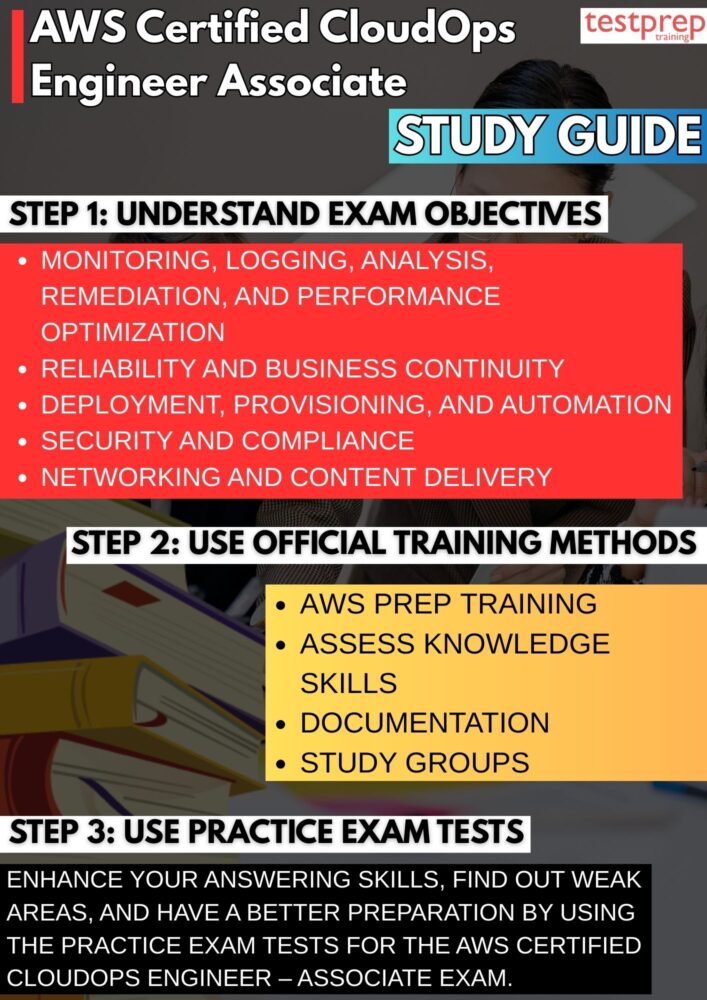
1. Perform a Detailed Examination of the Official Exam Guide
Start your preparation by thoroughly analyzing the official AWS Certified CloudOps Engineer – Associate exam guide. Carefully review each exam domain, its assigned weighting, and the specific operational capabilities being assessed. Break down domain objectives into individual skills such as monitoring, incident response, security enforcement, networking operations, and cost optimization. Align each objective with relevant AWS services and operational scenarios to create a precise and exam-focused study blueprint. This approach ensures that your preparation remains tightly aligned with AWS’s expectations rather than generalized cloud knowledge.
2. Design a Structured and Time-Bound AWS Exam Preparation Plan
Develop a comprehensive study plan based on AWS-recommended training courses, labs, and learning paths. Organize your schedule to progress logically from core operational concepts to more advanced CloudOps responsibilities such as performance tuning, fault isolation, and disaster recovery execution. Incorporate dedicated revision periods and checkpoints to reassess progress. A disciplined, time-bound preparation plan helps maintain consistency, prevents topic overlap, and ensures balanced coverage across all exam domains. However, the related preparation method includes:
– Exam Prep Plan Overview
The Exam Prep Plan Overview course introduces candidates to a structured and methodical approach for preparing for an AWS certification exam. It explains the complete four-step preparation framework, detailing the purpose of each stage and how it contributes to overall exam readiness. The overview also provides practical guidance on recommended time investment for each step, enabling candidates to plan their studies effectively and maintain steady progress throughout the preparation journey.
– Exam Prep Plan 1: From Start to Certified
This exam prep plan is a comprehensive, end-to-end preparation pathway designed to help candidates progress confidently from initial study to exam day. This plan follows a clearly defined four-step structure that supports gradual skill development and continuous assessment. It includes practice assessments featuring more than 135 exam-style questions, allowing candidates to evaluate their understanding and become familiar with the exam format.
In addition to assessments, the plan provides access to AWS SimuLearn scenarios for hands-on, interactive learning, as well as digital training courses that systematically review each exam domain and its associated tasks. Supporting resources such as flashcards reinforce key concepts and terminology, helping candidates retain critical information. Together, these components create a balanced preparation experience that combines conceptual learning, practical application, and ongoing performance evaluation.
3. Build Advanced Hands-On Operational Experience on AWS
Hands-on experience is a critical component of CloudOps exam readiness. Actively work with AWS services by configuring monitoring dashboards, creating alarms, analyzing logs, managing IAM policies, and performing backup and restore operations. Simulate operational incidents such as service outages, scaling failures, and security misconfigurations to understand system behavior under stress. Focus on operational troubleshooting workflows, root cause analysis, and corrective actions, as these are frequently tested through scenario-based exam questions.
4. Strengthen Conceptual Understanding Through AWS Documentation and Best Practices
Augment practical experience with in-depth study of AWS service documentation, architecture guides, and operational best practice references. Pay particular attention to content related to the AWS Well-Architected Framework, including operational excellence, reliability, security, performance efficiency, and cost optimization principles. Understanding the rationale behind AWS-recommended approaches enables you to evaluate multiple solution options and select the most operationally sound response in exam scenarios.
5. Actively Participate in AWS Study Groups and Professional Communities
Engage with structured study groups, certification-focused forums, and AWS professional communities to expand your perspective. These platforms provide exposure to real-world operational challenges, diverse troubleshooting approaches, and exam preparation strategies shared by other candidates and experienced professionals. Participation in technical discussions also helps reinforce learning, clarify complex topics, and stay updated on common exam pitfalls and evolving AWS practices.
6. Use Practice Tests as a Continuous Assessment and Learning Mechanism
Incorporate practice exams throughout your preparation cycle to measure progress and identify weaknesses. Analyze practice test results in detail, paying close attention to incorrect responses and the reasoning behind correct answers. Focus on understanding why certain options are preferred over others in operational contexts. Track performance trends across exam domains to prioritize targeted revisions and reinforce weaker areas systematically.
7. Conduct a Comprehensive Final Exam Readiness Evaluation
As the exam date approaches, perform full-length practice exams under realistic conditions, including strict time limits and minimal distractions. Evaluate your ability to interpret complex, multi-layered scenarios, manage time effectively, and confidently eliminate distractors. Use these final assessments to fine-tune your revision strategy, reinforce critical topics, and confirm consistent scoring performance. A thorough readiness evaluation ensures both technical confidence and mental preparedness on exam day.
