
Certified Pharmaceutical GMP Professional (CGMP)
The Certified Pharmaceutical GMP Professional (CGMP) credential validates a professional’s in-depth understanding of Good Manufacturing Practices (GMP) as applied within the pharmaceutical industry. This certification reflects competence in interpreting and applying GMP requirements established by national and international regulatory authorities. The CGMP scope spans the complete pharmaceutical lifecycle, including:
- Finished human and veterinary drug products
- Biologics, ectoparasiticides, and regulated dietary supplements (nutraceuticals)
- Raw materials, such as Active Pharmaceutical Ingredients (APIs) and excipients
- Packaging and labeling operations that directly impact product quality, safety, and compliance
This certification is ideal for experienced pharmaceutical professionals seeking formal recognition of their GMP expertise and their ability to apply regulatory expectations in real-world manufacturing and quality environments. Professionals holding this certification are expected to ensure GMP adherence across manufacturing, quality systems, and regulatory compliance activities.
To be eligible for the CGMP exam, candidates must meet the following experience criteria:
- Minimum 5 years of full-time, paid professional experience in one or more areas defined within the Certified Pharmaceutical GMP Body of Knowledge
- At least 3 years of this experience must be in a decision-making role
- A decision-making position involves the authority to define, execute, or control processes or projects, along with accountability for outcomes. This role may exist with or without formal managerial or supervisory responsibility.
Employment Criteria
- Experience must be gained in a full-time, paid position
- Part-time, internship, or unpaid roles do not qualify for the eligibility requirements
Exam Details
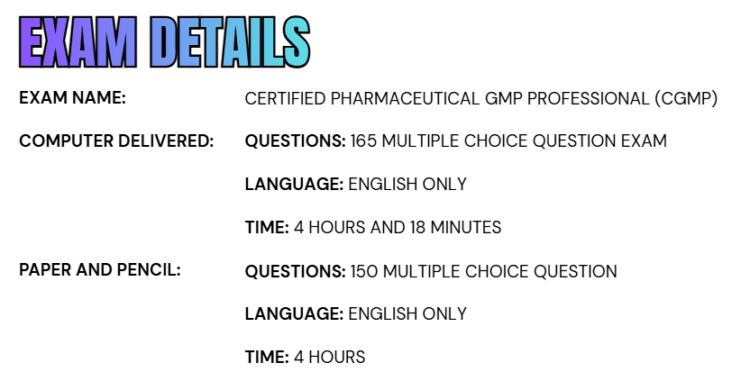
- The Certified Pharmaceutical GMP Professional (CGMP) exam is designed to evaluate a candidate’s ability to understand and apply the Certified Pharmaceutical GMP Body of Knowledge through a comprehensive multiple-choice assessment.
- The examination measures practical comprehension of GMP principles, regulatory expectations, and quality system concepts relevant to the pharmaceutical industry.
- The exam is available in both computer-based and paper-based formats and is offered exclusively in English.
- The computer-delivered exam is a single-part assessment consisting of 165 multiple-choice questions, of which 150 are scored and 15 are unscored for evaluation purposes.
- Candidates are given a total appointment time of four and a half hours, with four hours and eighteen minutes allocated specifically for completing the exam.
- The paper-and-pencil version is also a single-part examination and includes 150 multiple-choice questions to be completed within a four-hour time limit.
- All versions of the CGMP exam follow an open-book format. Candidates are responsible for bringing their own reference materials, as no study resources or reference documents are provided at the examination location.
- This approach reflects real-world GMP practice, where professionals are expected to interpret and apply regulatory guidance using appropriate reference standards.
Course Outline
The Certified Pharmaceutical GMP Professional (CGMP) exam covers the following topics:
1. Understand Regulatory Agency Governance (17 Questions)
A. Global regulatory framework
- Identifying the acts, statutes, and directives that apply to pharmaceuticals. (Understand)
B. Regulations and guidances
- Interpreting frequently used regulations and guidelines/guidances/drafts including those published or administered by the Pharmaceutical Inspection Convention and Pharmaceutical Inspection Cooperation Scheme (PIC/S), the International Conference on Harmonization (ICH), the World Health Organization (WHO), the European Medicines Agency (EMA), the Food & Drug Administration (FDA), Health Canada, USDA 9CFR, and other national regulatory agencies and international standards (e.g. ISOs). (Understand)
C. Mutual recognition agreements
- Interpreting requirements that govern product registration, import or export of raw material or finished product, and the sharing of inspection findings. (Understand)
D. Regulatory inspections
- Defining and describing various types of inspections including pre-approval, system-based, for-cause, and license renewal, and describe the frequency for each. Describe how to prepare for and host in-person and remote evaluations and how to accommodate record requests and digital reporting. (Understand)
E. Enforcement actions
- Defining and describing various global enforcement actions and consequences (e.g., warning letters, consent decree, license withdrawals, product seizure, and import alerts). (Understand)
F. Regulatory agency reporting
- Post-marketing changes
- Describe how post-marketing changes to specifications, processes, and methods are assessed for
impact to determine the appropriate reporting method [e.g., scale up and post-approval changes
(SUPAC)]. (Understand)
- Describe how post-marketing changes to specifications, processes, and methods are assessed for
- Regulatory reporting requirements
- Describe global reporting requirements including supplements, field alerts, biological product deviation reports, adverse events, product recalls, annual reports, and variations to dossiers and applications. (Understand)
- Product Surveillance
- Describe monitoring requirements for risk evaluation and mitigation strategy (REMS) and pharmacovigilance. (Understand)
G. Site Master File (SMF), Validation Master Plan (VMP), Drug Master File (DMF), and Site Reference File (SRF)
- Describe the purpose and content of Site Master Files (SMFs), Validation Master Plans (VMPs), Drug Master Files (DMFs), and Site Reference Files (SRFs). (Understand)
2. Learn about Quality Systems (26 Questions)
A. Quality management system (QMS)
- Describe key elements of the structure of a Quality Management System (QMS). Outline the requirements for the development, operation, and management review for suitability and effectiveness as defined in ICH Q7, ICH Q10, EU GMP, and other guidances. (Evaluate)
B. Quality unit (site) management
- Describe quality management elements for individual sites or units including responsibilities for the quality unit management such as Qualified Person, Management Representative, batch release (disposition) requirements for investigational and commercial products, and the need for quality units to be independent from operations. (Understand)
C. Risk management and assessment
- Risk management
- Use various methods to apply risk management principles as described in ICH Q9, ICH Q12, and other guidance and regulatory documents. (Apply)
- Risk assessment
- Use the Quality Management Maturity (QMM) assessment program to assess the effectiveness of the Quality Management System to ensure process and product quality. (Apply)
D. Training and personnel qualification
- Needs analysis
- Identify the requirements for determining the type of training, qualification, and experience needed by quality staff members, operations personnel, and related functions. (Apply)
- Staff development requirements
- Determine proof of proficiency based on regulations, guidances, and directives including documented evidence and periodic reassessment. (Apply)
- Training effectiveness and role of supervisor
- Apply various methods for testing and evaluating training effectiveness. Identify the role and responsibilities of supervisors including ensuring staff are adequately trained to perform their assigned functions. (Apply)
E. Change control and management
- Pre-change analysis
- Assess the impact that proposed changes will have on products, processes, facilities, utilities, and systems to minimize risk and ensure regulatory compliance. (Analyze)
- Change implementation
- Implement and document the change following a change implementation plan. (Create)
- Post-change analysis
- Analyze data and other inputs to determine the results of a change and evaluate any new risk factors created by the change. (Analyze)
F. Investigations and corrective and preventive action (CAPA)
- Trigger events
- Identify events that require investigation, root cause analysis, and impact assessment both directly and indirectly related to the event. (Evaluate)
- Response actions
- Define immediate action, corrective action, preventive action, management responsibility, and methods of implementing them. (Evaluate)
- CAPA feedback and trending
- Describe how CAPA trending is used to modify appropriate quality system elements. (Create)
G. Audits and self-inspections
- Audits processes and results
- Develop audit schedules, differentiate between various audit types (systems, product, and process) conducted either remotely or on-site, document evidence of audit completion, and analyze audit results to assess conformance to requirements. (Evaluate)
- Audit follow-up
- Use various methods to evaluate and verify the effectiveness of corrective actions taken. (Evaluate)
H. Documents and records management
- GMP document system
- Describe the GMP document system to determine compliance to regulatory requirements including corporate standards, master plans, procedures, manufacturing, and test instructions. (Analyze)
- Records
- Review various records (e.g., logbooks, tags, and training evidence) to confirm compliance to requirements such as Attributable, Legible, Contemporaneous, Original, Accurate (ALCOA) and PIC/S guidelines for data integrity. (Analyze)
- Record retention
- Identify regulatory requirements for record retention. (Understand)
I. Product complaints and adverse event reports
- Product complaints
- Describe and distinguish between product complaints and adverse events. Evaluate complainthandling processes. (Evaluate)
- Adverse events
- Describe regulatory requirements for the reporting of adverse events (e.g. counterfeit product , fraud). (Analyze)
- Event response
- Evaluate the level of action that needs to be taken in response to adverse events such as corrections, and product removal. (Evaluate)
J. Product trend requirements
- Describe and distinguish between components of periodic product assessment, such as the U.S. annual product review (APR) and the European product quality review (PQR), with regard to data trends and other required elements. (Understand)
K. Supplier and contractor quality management
- Supplier quality systems
- Identify and interpret standards and regulations related to monitoring supplier, vendor, and contractor quality management systems. (Understand)
- Supplier controls
- Assess the adequacy of controls over supplier, vendor, and contractor selection and procurement and receipt of raw materials, components, and contract services. Determine the need for formal contracts/quality agreements. (Evaluate)
- Supplier evaluation
- Assess the quality systems of suppliers, vendors, and contractors using various methodologies including supplier qualification, certification, evaluation, audit, and supplied product or service performance trending. (Evaluate)
- Quality agreements
- Explain the purpose and describe the main elements of a quality agreement. (Understand)
- Outsource processes
- Use various methods for the management of contract manufacturing, drug development, testing laboratories, and other outsourcing activities including defining the roles and responsibilities of each party. (Apply)
3. Learn about Laboratory Systems (20 Questions)
A. Compendia (United States, Europe, and Japan)
- Required vs. informational compendia
- Describe and distinguish between required and informational (“general”) compendial chapters. (Apply)
- Marketing requirements vs. compendia
- Distinguish among the U.S. Pharmacopoeia (USP), European Pharmacopoeia (PhEur or EP), and Japanese Pharmacopoeia (JP) in terms of requirements for marketing authorization. (Understand)
- Compendial methods review
- Review compendial methods to ensure they are verified as suitable for use in the testing lab. (Analyze)
- Compendial or non-compendial requirements review
- Review test methods, qualifications, validation, and verification against required compendial chapters (general and informational, as needed). (Analyze)
- Biological, microbiological, chemical, and physical test methods
- Identify and interpret results from compendia identification tests, quantitative analysis, qualitative analysis, and other tests or studies for biological, microbiological, chemical, and physical tests. (Apply)
B. Laboratory investigations of atypical results
- Test data
- Describe and develop procedures for investigating each type of test data including biological, microbiological, chemical test, and unknowns. (Analyze)
- Atypical results
- Identify, analyze, and interpret data on processes or products that are out-of-specification or out-oftrend. Determine the outcome of the laboratory portion of the investigation and the criteria for further investigation. (Evaluate)
C. Instrument management
- Instrument controls
- Apply operating procedures for instrument identification, classification, qualification, calibration, and preventive maintenance. (Apply)
- Instrument calibration
- Determine that instruments are calibrated within the specified range of operation and that they are accurate and precise. (Apply)
D. Specifications
- Types of specifications
- Determine whether approved specifications exist for raw materials, intermediates, packaging components, labels, and finished products. (Analyze)
- Test data and specifications
- Compare test data with specifications to determine whether raw materials, intermediates, packaging, labels, and finished products meet requirements. (Analyze)
- Specifications revision
- Review and update specifications when methods are revised, or compendia are changed. (Evaluate)
E. Laboratory record-keeping and data requirements
- Record-keeping requirements
- Identify and review record-keeping requirements for data acquisition systems to ensure data integrity. (Apply)
- Record review
- Ensure data integrity and prevent loss of data by reviewing laboratory records including audit trails of electronic data to detect errors, falsification, and fraud . (Evaluate)
- Certificates of analysis (COAs)
- Review Certificates of Analysis (COAs) to ensure they are complete, internally reviewed, and appropriately retained. (Apply)
F. Laboratory handling controls
- Sample handling
- Determine whether samples are identified and handled in accordance with requirements including name, sample identification, and chain of custody. (Apply)
- Reagents, solutions, and standards identification
- Determine whether reagents, solutions, and standards are identified and labeled, and quantities are traceable in accordance with requirements including opened-on, expiry, (validated) use-by, or recertify-by dates. (Apply)
- Storage requirements
- Describe and use procedures to store samples, reagents, solutions, solvents, and standards in appropriate environmental conditions (e.g., temperature, humidity, light exposure, and absence of oxygen) to maintain the material’s characteristics for testing. (Apply)
G. Stability programs
- Release tests vs. stability-indicating tests
- Define and distinguish between release and stability-indicating tests. (Analyze)
- Stability test data
- Review stability data against specifications and identify trends that can establish, support, or challenge an expiry date. (Evaluate)
- Stability-point failure
- Identify the stability-point failure of a product or material and evaluate the implications for regulatory compliance. (Evaluate)
H. Reserve samples and retains
- Describe the various regulatory requirements for retains and reserve samples. (Apply)

4. Understand Infrastructure: Facilities, Utilities, and Equipment (17 Questions)
A. Facilities
- Buildings
- Determine and document the requirements for appropriate size and construction of buildings and areas, and the location of control systems. Ensure that construction and location facilitate proper operation and minimize the risk of error and cross contamination including meeting requirements that specify separation of antibiotics, hormones, and toxins). (Apply)
- Manufacture and storage environment
- Identify requirements for appropriate lighting, ventilation, and drainage to avoid adversely affecting product (either directly or indirectly) during manufacturing and storage. (Apply)
- Facilities change control
- Use various methods to verify that change control practices are in use to maintain the qualified state of the facilities. (Apply)
B. Utilities
- Water supply systems
- Identify and interpret regulatory requirements for the design of water supply systems including various unit operations (e.g., dechlorination, reverse osmosis, deionization, and distillation), delivery lines, back-flow or back-siphonage prevention, and drainage systems as appropriate for the type of water (potable, purified, and water for injection) needed in various processing steps. (Apply)
- Compressed air and gas systems
- Identify and apply regulatory requirements related to compressed air and gas systems including storage, flow regulation, filtration, venting, and purging. (Apply)
- Utility design for production
- Identify and select utility designs related to production steps (e.g., washing, sterilizing, and depyrogenation) for use with specific materials and processes. (Apply)
- Utilities design specifications
- Review operations of utilities to ensure they meet design specifications. (Apply)
- Utilities change control
- Verify that change control practices are used to maintain the qualified state of affected utilities. (Apply)
C. Equipment
- Equipment planning
- Review equipment location, design, construction, installation, and maintenance based on the operations to be conducted. (Apply)
- Equipment layout
- Determine the layout of equipment to minimize the risk of errors, to facilitate effective cleaning and maintenance, and to avoid contamination or any other undesired effect on product quality. (Apply)
- Equipment cleaning and maintenance
- Review procedures and schedules for equipment cleaning, maintenance, and sanitization (where necessary) to ensure that they meet requirements. (Apply)
- Equipment cleaning validation or verification
- Evaluate the need and methodology for product-contact cleaning validation and verification. Evaluate the difference between single-use, multi-use, and dedicated equipment. (Evaluate)
- Equipment change control
- Verify that change control has maintained the qualified state of equipment. (Apply)
D. Qualification and validation
- Verify that the qualifications and validations of facilities, equipment, and utilities are conducted in accordance with various requirements including factory and site acceptance testing (FAT/SAT), design, installation, operational, and performance qualification (DQ/IQ/OQ/PQ) prior to process validation. (Analyze)
E. Maintenance and metrology systems
- Maintenance procedures
- Verify that procedures are used for routine and non-routine maintenance of heating, ventilation, air conditioning (HVAC) systems, air and water filters, and other equipment and utilities. (Analyze)
- Metrology change control
- Verify that appropriate calibration and engineering/equipment change control procedures are used and that a metrology program exists for the calibration of instruments that control manufacturing facilities, utilities, and equipment. (Analyze)
F. General cleaning, sanitization, and sterilization systems
- Cleaning procedures
- Review cleaning procedures in accordance with cleaning validation whenever validation is required and performed. (Apply)
- Sanitization procedures
- Review sanitization procedures for facilities and equipment and ensure all are in accordance with any required validation studies including details on cleaning schedules, methods, equipment, materials, sanitizers, disinfectants, sporicides, and sterilants. (Apply)
- Pest control
- Review and verify that a pest control program is established and that it uses authorized rodenticides, insecticides, fungicides, fumigating agents, and appropriate traps for pest elimination. (Apply)
- Sterilization processes
- Verify that appropriate sterilization processes are established and validated. (Apply)
G. Automated or computerized systems
- Validation procedures
- Review procedures for implementation and validation of automated or computerized systems. Verify that critical parameters for their operation and maintenance are controlled and monitored. (Evaluate)
- Open and closed computerized systems
- Distinguish between open and closed computerized systems. (Apply)
- Configuration control
- Verify that version control and configuration are maintained and monitored. (Evaluate)
- Security requirements
- Evaluate on-site, multi-site, and cloud-based computerized systems to ensure they meet regulatory and guidance requirements for key elements such as access control, data protection, electronic signature, change control, data archiving, maintenance, transcription, audit trail, and periodic system monitoring. (Evaluate)
H. Business continuity and disaster recovery planning
- Supply chain impact
- Review plans and verify procedures for disaster recovery, record recovery, and business continuity that will guard operations from interruption to the supply chain and ensure data integrity. (Evaluate)
- Contingency plan
- Verify the testing and effectiveness of contingency plans as required or proceduralized. (Apply)
5. Understand Materials and Supply Chain Management (17 Questions)
A. Receipt of materials
- Incoming materials
- Describe and use processes to receive, label, and store incoming materials (raw materials, bulk chemicals, components, and product labeling) and take appropriate action on deviations (damaged materials, materials from unapproved suppliers, and missing documentation). (Apply)
- Inventory controls
- Describe and use procedures for documenting inventory transactions, updating changes in material status, allocation, and “stop shipments” for quality holds. (Apply)
B. Sampling processes
- Sampling plans
- Review sampling plans for representative sampling, appropriate sample size, and test or inspection criteria. (Apply)
- Sampling environment
- Differentiate and apply the requirements for sampling environment and utensils to the type of the material being sampled. (Apply)
- Cleaning
- Ensure the sampling environment is appropriately cleaned and monitored and that sampling utensils are appropriately cleaned or are single-use. (Apply)
C. Material storage, identification, and rotation
- Storage suitability
- Ensure the storage environment is suitable, controlled, and monitored as required for the type of materials. (Apply)
- Labelling of stored materials
- Confirm that the identification label for stored materials contains the required information. (Apply)
- Stock rotation
- Define and use stock rotation requirements such as first-in/first-out (FIFO) and first-expired/first out (FEFO). (Apply)
- Retest dates vs. expiration dates
- Describe the difference between retest dates and expiration dates. (Understand)
- Mix-up risk
- Identify potential sources of mix-up and identify methods to minimize their risk (material segregation, labeling, special storage for rejects, control of material returns, lot-control methods, and special processes for materials with similar names). (Analyze)
D. Shipping and distribution
- Temperature-sensitive requirements
- Identify special requirements for temperature-sensitive products including tertiary packaging, design, and monitoring devices. (Analyze)
- Special requirements
- Determine specific product requirements and apply them to routine shipping processes. (Apply)
- Report requirements
- Analyze shipping reports and transportation requirements in accordance with good distribution practices. (Analyze)
- Supply chain security
- Identify and apply the various means to secure the supply chain including tamper-evident seals, shipping manifests, verification of documentation, barcoding, radio frequency identification (RFID), and serialization. (Apply)
E. Traceability and sourcing
- Traceability requirements
- Define and differentiate the requirements for traceability of incoming materials, intermediates, and finished drugs. (Apply)
- Biological agent requirements
- Identify and apply the requirements related to biological agents such as bovine spongiform encephalopathy (BSE) and transmissible spongiform encephalopathy (TSE). (Apply)
- Pedigree and sourcing requirements
- Identify and apply requirements for maintaining pedigree and sourcing details for active pharmaceutical ingredients (APIs), biological starting materials, excipients, intermediates, and finished products. Document the supply chain from raw materials through wholesale or retail to end user. (Apply)
F. Salvaged/returned goods and destruction
- Disposition
- Review salvaged and returned goods and evaluate them for disposition. (Evaluate)
- Destruction facilities and processes.
- Determine the destruction requirements for materials including suitable facilities and processes. (Apply)
6. Learn about Sterile and Nonsterile Manufacturing Systems (22 Questions)
A. Master batch and completed batch records
- Required elements
- Review batch records for required elements including proper issuance, sections on yields, critical manufacturing step verification, processing instructions, and hold times. (Apply)
- Record processing requirements
- Confirm that batch records meet requirements for execution, review, and disposition decisions. (Apply)
B. Production operations
- Application factors
- Describe and differentiate the requirements for manufacturing processes according to their application: human drugs, veterinary drugs, or biologics. (Apply)
- Process operations
- Understand and differentiate between continuous and batch manufacturing. (Apply)
- Utility requirements
- Identify the facility and utility requirements that are appropriate for different production environments and product types including sterile vs. nonsterile manufacturing, solid and semisolid dosage forms, liquids, creams, ointments, and combination products. (Analyze)
- Sanitization and protection
- Identify various production operations that require gowning, sanitization, hygiene, and other product-protective steps. (Apply)
C. In-process controls
- In-process testing
- Identify appropriate tests for each step in the manufacturing process and review results. (Analyze)
- Critical process parameters (CPPs)
- Monitor critical process parameters (CPPs). (Analyze)
- Process capability
- Understand the importance of conducting process capability studies, calculate Cp and Cpk, and monitor process capability. (Apply)
- Specification limits
- Assess specification limits in relation to registration or compendial requirements. (Evaluate)
D. Dispensing and weighing controls
- Staging areas
- Review product dispensing and after-dispensing staging areas to determine if they meet requirements. (Apply)
- Dispensing materials
- Identify the requirements for using weighing equipment and handling utensils for dispensing raw materials or intermediates including proper cleaning, labeling, and environmental controls, based on the type of material and manufacturing process being used. (Analyze)
E. Requirements for critical unit processes
- Process parameters
- Use required critical process parameters (CCPs) for unit processes such as sterilization or sterilizing filtration, aseptic filling, depyrogenation, lyophilization, other drying processes, tablet granulation and compression, terminal sterilization, and cream or ointment emulsification. (Apply)
- Validation studies
- Explain and evaluate validation studies, specifically the methodologies and acceptance criteria required before implementing critical unit processes. Explain and evaluate validation studies such as requirements for aseptic processes including process simulations (“media fills”) and temperature controls. (Evaluate)
- Unit operations
- Assess unit processes and their validations for deviations requiring investigation. (Analyze)
- Operating procedures
- Review qualification and validation results and confirm that validated and qualified parameters are reflected in operating procedures or batch records. (Analyze)
- Re-evaluation and revalidation
- Determine appropriate criteria and frequency for re-evaluation and revalidation of unit processes. (Evaluate)
- Environmental monitoring requirements
- Differentiate between environmental monitoring requirements for different manufacturing area classifications. (Apply)
- Environmental monitoring tools
- Describe and use various monitoring tools to measure viable and nonviable particulates, pressure differentials, temperature, and humidity. (Apply)
F. Contamination and cross-contamination
- Sources
- Identify potential sources for, and implement controls to minimize, contamination and crosscontamination. (Analyze)
- Risk mitigation
- Describe and apply various techniques for mitigating the risk of contamination and crosscontamination including cleaning; facility, utility, and equipment design; material and personnel flow; qualified disinfectants; operator training; validation; and monitoring. (Apply)
G. Reprocessed and reworked materials
- Disposition process
- Distinguish reprocessing from reworking and apply appropriate documentation, approval, and disposition methods for these materials. (Apply)
- Storage
- Describe and apply requirements for segregation and secure storage of these materials. (Apply)
7. Process of Filling, Packaging, and Labeling (18 Questions)
A. Filling operations and controls
- Materials control
- Develop and review procedures to ensure the identity, strength, and purity of specified materials (e.g., liquids, powders, ointments, tablets, capsules, and suspensions) and to prevent them from being altered. (Evaluate)
- Filling equipment control
- Analyze the controls needed for various types of production equipment and processes and ensure that the appropriate controls are established to verify filling criteria. (Analyze)
- Contamination controls
- Identify controls to prevent microbial and other contamination at all stages of filling. (Apply)
- Staged materials
- Review staged materials and confirm that they are approved for use. (Apply)
- Status labeling
- Identify and apply proper status labeling throughout the process. (Apply)
B. Environmental monitoring
- Use various monitoring techniques (e.g., active air sampling, settling plates, swab sampling, nonviable particle counting, and contact plates for surfaces and people) to determine that appropriate environmental conditions are maintained during production operations. (Analyze)
C. In-process and finished goods inspections
- Inspections
- Develop criteria for in-process and finished goods inspections of filled and packaged materials including seal tests, torque testing, and bottle rejection systems. (Create)
- Vision and detection systems
- Ensure that vision and detection systems are qualified, calibrated, and challenged as required for the system. (Apply)
- Defect characterizations
- Ensure that defect characterizations are identified for each product and can be detected by inspection or test. (Analyze)
- Equipment failure detection
- Confirm by inspection or test that equipment failures can be detected. (Apply)
D. Product inspection
- Staff evaluation
- Ensure that staff who perform manual and semi-automatic inspections are properly trained and that their inspections meet reproducibility requirements. (Analyze)
- Inspector requirements
- Establish requirements for inspectors to have periodic eye examinations. Confirm and document that they take frequent breaks from inspection. (Apply)
- Automated inspection processes
- Ensure that automated inspection processes are validated. (Apply)
E. Packaging operations and controls
- Content protection
- Develop and apply procedures to prevent the environment or events from altering the identity, strength, purity, and quality of the package content. (Create)
- Qualification and maintenance of equipment
- Ensure that equipment used in packaging operations is qualified and maintained. (Apply)
- Line clearance operations
- Determine that line clearance is performed and documented. (Analyze)
- Quality check criteria
- Identify and apply specified criteria when quality checks are performed. (Analyze)
- Cut-label procedures
- Apply appropriate procedures for cut labels and splices. (Apply)
- Hand-applied label procedures
- Ensure that hand-applied labels are 100% inspected. (Apply)
- Packaging controls
- Distinguish between controls needed for different types of packaging processes. (Apply)
- Contamination controls
- Identify controls to prevent microbial and other contamination at all stages of packaging. (Analyze)
- Tamper-evident packaging
- Ensure that tamper-evident and child-proof packaging requirements are established for required products. (Apply)
F. Labeling operations and controls
- Label printing in packaging
- Confirm and document that any printing done separately or during packaging is performed correctly. (Analyze)
- Quality of print used
- Ensure that any type of print information (engraved and embossed) on packaging materials is clear and resistant to fading, smudging, or erasure. (Apply)
- Label changes
- Determine whether regulatory notification and approval is required for proposed label changes. (Evaluate)
- Label reconciliation
- Confirm that label reconciliation is performed and documented, and discrepancies are investigated. (Analyze)
- Unused labels
- Confirm that procedures are established and used for controlled, unused batch-coded labels and labeling materials. (Analyze)
- Label production
- Define terms related to offline printing, roll label splicing, gang printing, secure storage, and destruction. (Understand)
- Access control
- Ensure that controls are established for the creation, storage, and issuance of labeling such as product labels, package inserts, and printed cartons. (Analyze)
G. Filling and packaging records
- Terms
- Define terms related to these records including evidence of line clearance, printed material reconciliation, and yields. (Understand)
- Setup instructions
- Ensure that packaging line setup instructions are appropriate for all components. (Apply)
8. Understand Product Development and Technology Transfer (13 Questions)
A. Quality by design concepts
- Critical quality attributes (CQAs) and critical process parameters (CPPs)
- Identify critical quality attributes (CQAs) for products and critical process parameters (CPPs) for processes. (Evaluate)
- Design space
- Define the concept of design space as it is used throughout the product lifecycle. (Understand)
- Process analytical technology (PAT) tools
- Identify process analytical technology(PAT) tools including multivariate data analysis, process analyzers, and process and endpoint controls. Describe their use in supporting the manufacture of quality products. (Understand)
B. Phase-appropriate Good Manufacturing Practices (GMP) requirements
- Product life cycle development
- Apply phase appropriate Good Manufacturing Practices (GMPs) throughout the product life cycle. (Apply)
- Development phases
- Identify recommendations and requirements in relation to phases of development including method qualification/validation, comparability protocols, and adoption of critical process parameters and specifications. (Understand)
- Combination products
- Identify Good Manufacturing Practices (GMP) requirements and various studies required for combination drug-device or drug-delivery products. (Understand)
- Clinical trials material
- Describe and apply requirements for production and packaging of clinical trials material and investigational medicinal products (IMPs). (Apply)
C. Raw materials, packaging, and infrastructure for product development
- Select appropriate development studies for raw material selection and evaluate the results to determine their critical quality attributes. (Analyze)
D. New product development studies and reports
- Analyze studies and reports including stability reports, material compatibility, method development, and development reports to support product development and submissions. (Evaluate)
E. Scale-up and transfer activities
- Development and validation principles
- Identify and distinguish between development and validation studies. (Understand)
- Technology transfer types
- Define different types of technology transfer including manufacturing site change and analytical laboratory site change. Analyze inter-site comparison of results. (Analyze)
- Successful technology transfer
- Define various studies including ranging, capability, in-process control, hold times, and shipping to ensure successful transfer between development and commercial processes. (Evaluate)
Certified Pharmaceutical GMP Professional (CGMP) Exam FAQs
Exam Policies and Procedures
Candidates must comply with all exam-day and administrative policies to maintain the integrity of the certification process. On the day of the exam, you are required to present one valid, government-issued photo identification that includes your signature, such as a passport or driver’s license. The name on your ID must exactly match the name used during your exam application. For security reasons, all personal belongings must be stored in a temporary locker provided at the test center, while you are allowed to keep your ID and locker key with you throughout the exam.
If you need to change your exam appointment, reschedule or cancel your booking at least five days before the scheduled exam date. This can be done through the Prometric website or its automated phone system. A rescheduling or cancellation fee applies, and failure to appear for the exam without proper notice will result in forfeiture of all paid application fees.
Test Results and Score Reporting
After completing an ASQ certification exam, results are delivered based on the exam format, with every effort made to ensure timely and secure communication by American Society for Quality. For computer-based exams conducted at Prometric test centers, candidates will see their preliminary pass or fail status immediately on the screen. Official results are typically emailed within seven days, except for Master Black Belt and pilot exams with revised Bodies of Knowledge, which may take up to four weeks.
Paper-based exam results are processed manually once exam materials are returned for evaluation. Official score notifications are usually emailed within two weeks, although certain advanced or pilot exams may require up to four weeks for final processing.
Pass or Fail Outcomes
Candidates who pass a computer-based exam receive immediate confirmation at the test center, followed by an official email within three to five business days. A separate notification is also sent with instructions for claiming the digital certificate and badge through the Accredible platform. For exams based on newly updated or pilot Bodies of Knowledge, official communication may take up to five weeks.
Candidates who do not pass will receive a detailed performance summary by email within three to five business days. For up to two years following the initial attempt, eligible candidates may retake the exam at a significantly reduced retake fee, allowing focused improvement without repeating the full application cost.
Certified Pharmaceutical GMP Professional (CGMP) Exam Study Guide
Step 1: Understand the Exam Objectives and Scope in Detail
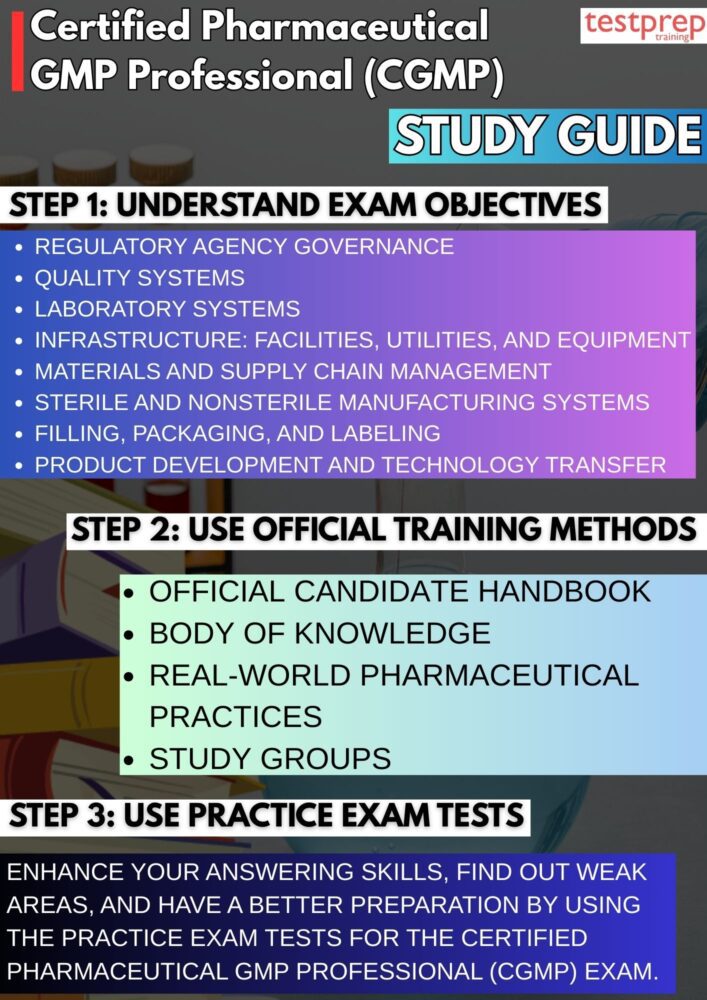
Begin your preparation by clearly understanding what the CGMP exam is designed to measure. Review the exam objectives to identify the GMP areas that carry the most weight and the level of practical understanding expected. The exam focuses not only on regulatory knowledge but also on how GMP principles are interpreted and applied in real pharmaceutical environments. Knowing the scope early helps you prioritize critical topics, avoid irrelevant material, and align your preparation with the competencies expected from a certified GMP professional.
Step 2: Use the Official CGMP Candidate Handbook as a Planning Tool
The official CGMP Candidate Handbook published by American Society for Quality should be treated as a preparation guide rather than just an administrative document. It explains exam eligibility, format, scoring logic, exam-day rules, and result timelines in detail. Reviewing this handbook early allows you to plan your study schedule realistically, understand how questions are structured, and prepare mentally for the exam environment. It also helps you avoid procedural mistakes that could impact your exam experience.
Step 3: Study the Certified Pharmaceutical GMP Body of Knowledge Systematically
The Certified Pharmaceutical GMP Body of Knowledge (BoK) defines the complete and official syllabus for the CGMP exam. Each domain listed in the BoK should be studied thoroughly and in sequence, ensuring that no topic is overlooked. Instead of studying randomly, use the BoK as a checklist to track your progress across areas such as GMP regulations, quality management systems, materials control, manufacturing operations, validation, documentation practices, and regulatory inspections. Revisiting the BoK regularly helps reinforce structure and keeps your preparation exam-focused.
Step 4: Connect GMP Theory with Real-World Pharmaceutical Practices
To perform well in the CGMP exam, it is essential to go beyond memorization and understand how GMP principles function in real pharmaceutical settings. Relate regulatory requirements to everyday activities such as deviation management, change control, batch record review, supplier qualification, complaint handling, and audit readiness. This practical understanding improves your ability to answer judgment-based and scenario-driven questions that assess decision-making, compliance responsibility, and quality risk awareness.
Step 5: Join Study Groups and Professional GMP Communities
Participating in study groups or GMP-focused professional communities can significantly enhance your learning experience. Interacting with peers allows you to discuss complex GMP topics, share practical examples, and gain different perspectives on regulatory interpretation. Group discussions often highlight areas you may have overlooked and help reinforce learning through explanation and debate. In addition, being part of a study community provides motivation, accountability, and consistency throughout the preparation process.
Step 6: Practice with Mock Exams and Perform Focused Review
Practice tests play a critical role in CGMP exam preparation. Attempting mock exams helps you become familiar with the multiple-choice format, improve time management, and understand how GMP concepts are tested. After each practice session, carefully analyze incorrect answers to identify knowledge gaps or weak areas. Use these insights to revisit the relevant sections of the Body of Knowledge and your reference materials. Consistent practice combined with focused review builds confidence and improves accuracy before the actual exam.
