
Exam AB-100: Agentic AI Business Solutions Architect
The Agentic AI Business Solutions Architect is a senior-level professional responsible for designing and delivering intelligent, AI-powered business solutions that drive measurable organizational impact. Candidates for the AB-100 certification are expected to possess deep architectural expertise, combining artificial intelligence capabilities with Microsoft’s business applications ecosystem to modernize workflows, automate decision-making, and enable innovation at scale.
This role goes beyond traditional solution architecture by emphasizing agentic-first design, where autonomous and semi-autonomous AI agents collaborate across systems to execute business processes securely, responsibly, and efficiently.
– Core Architectural Competencies
- AI-Centric Solution Architecture
- Professionals in this role demonstrate advanced capability in architecting solutions that incorporate generative AI, intelligent agents, and Microsoft Foundry Tools. These solutions are aligned with business outcomes and are designed to operate across enterprise environments while maintaining performance, security, and governance standards.
- Agentic-First Design Approach
- A key competency of the AB-100 architect is the ability to design solutions where AI agents are first-class architectural components. This includes defining agent responsibilities, decision boundaries, autonomy levels, and interaction patterns that support complex business workflows.
- Multi-Agent Orchestration
- Candidates are expected to design and manage multi-agent systems where multiple AI agents collaborate, coordinate tasks, and exchange context. This includes agent orchestration patterns, handoff logic, and monitoring strategies to ensure reliable execution across distributed environments.
– Platform and Technology Expertise
- Microsoft Business Applications Ecosystem
- AB-100 architects possess in-depth knowledge of:
- Dynamics 365 core applications
- Microsoft Power Platform
- Microsoft Copilot Studio
- Microsoft Foundry Tools and Foundry Models
- AB-100 architects possess in-depth knowledge of:
This expertise allows architects to seamlessly embed AI-driven intelligence into business applications and workflows.
- Intelligent Agent Development and Prompt Engineering
- Architects are proficient in building and managing agents using Copilot Studio, AI prompts, and Microsoft Foundry. They also understand how to select and apply multiple language models based on use case requirements, performance needs, and cost considerations.
– Enterprise Architecture and Framework Alignment
- Architecture Patterns and Outcome-Driven Delivery
- Successful candidates apply established enterprise architecture patterns and AI adoption frameworks to deliver solutions that produce quantifiable business value. This includes aligning technical design with organizational KPIs, governance models, and long-term digital transformation goals.
- Open Standards and Protocol Integration
- AB-100 architects are skilled in working with open interoperability standards, including:
- Agent2Agent (A2A) communication
- Model Context Protocol (MCP)
- AB-100 architects are skilled in working with open interoperability standards, including:
These standards enable secure, scalable, and vendor-agnostic agent collaboration across platforms.
– Security, Governance, and Responsible AI
- Responsible AI Implementation
- A core responsibility of the role is ensuring AI systems adhere to Microsoft Responsible AI principles. Architects guide organizations in building compliant, transparent, and ethical AI solutions that minimize risk and promote trust.
- AI Security and Data Protection
- Candidates demonstrate advanced skills in securing AI systems, including:
- Protecting model training and tuning processes
- Enforcing data residency and access control policies
- Detecting vulnerabilities and prompt injection risks
- Maintaining audit trails and change tracking
- Safeguarding AI workflows against misuse and manipulation
- Candidates demonstrate advanced skills in securing AI systems, including:
– Monitoring, Optimization, and Continuous Improvement
- Agent Performance and Telemetry Analysis
- AB-100 professionals monitor agent behavior using telemetry and performance metrics to ensure reliability and accuracy. This data-driven approach supports continuous optimization, error reduction, and improved agent decision-making over time.
- ROI and Business Impact Assessment
- Architects are capable of conducting return-on-investment (ROI) evaluations for AI-powered solutions, ensuring that technical implementations translate into tangible business benefits and operational efficiency.
– Key Responsibilities of an Agentic AI Architect
- Strategic Architecture Leadership
- Define enterprise AI architecture strategies that integrate intelligent agents into business solutions
- Establish a roadmap for transitioning to agentic-first business processes
- Solution Design and Implementation
- Translate business and technical requirements into end-to-end AI architectures
- Design, prototype, and validate AI components that demonstrate transformational value
- Lead implementation efforts while ensuring scalability, security, and governance alignment
- Organizational Enablement and Adoption
- Champion AI adoption across development teams and business units
- Guide organizations in evolving into AI-forward enterprises
- Promote best practices for AI integration throughout the application lifecycle
- Lifecycle and Environment Strategy
- Define a cohesive application lifecycle management (ALM) strategy for agentic solutions
- Design environment strategies that support AI workloads, including third-party AI integrations
– Role Impact and Professional Value
As an AI-first solution architect, you play a critical role in reshaping enterprise operations through intelligent automation and AI-driven insights. By leveraging Microsoft’s comprehensive AI and business application portfolio, you enable organizations to unlock innovation, improve decision-making, and achieve sustainable growth through advanced agentic architectures.
– Certification Prerequisites
To earn the Microsoft Certified: Agentic AI Business Solutions Architect credential, candidates must first hold at least one of the following associate-level certifications:
- Dynamics 365 Business Central Developer Associate
- Dynamics 365 Business Central Functional Consultant Associate
- Dynamics 365 Customer Experience Analyst Associate
- Dynamics 365 Customer Service Functional Consultant Associate
- Dynamics 365 Field Service Functional Consultant Associate
- Dynamics 365 Finance Functional Consultant Associate
- Dynamics 365 Supply Chain Management Functional Consultant Associate
- Dynamics 365 Finance and Operations Apps Developer Associate
- Power Platform Functional Consultant Associate
- Power Platform Developer Associate
- Power Automate RPA Developer Associate
- Azure AI Engineer Associate
Exam Details
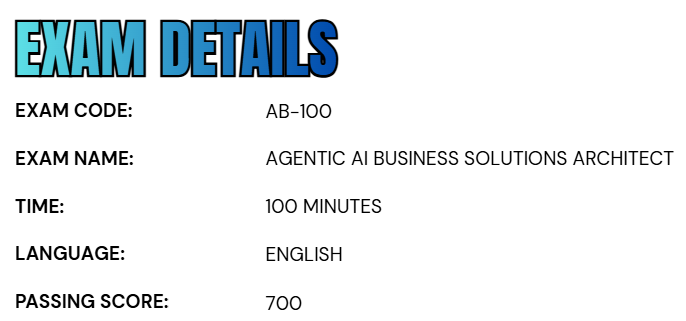
- Exam AB-100: Agentic AI Business Solutions Architect is a professionally supervised certification assessment designed to evaluate advanced architectural and strategic competencies in agentic AI solutions.
- Candidates are allocated 100 minutes to complete the examination, during which they may encounter interactive or scenario-driven components that assess real-world decision-making and solution design capabilities.
- The exam is proctored to maintain integrity and fairness and is currently available in English.
- To achieve a passing result, candidates must obtain a minimum score of 700, reflecting a strong command of the required knowledge and applied skills.
- Microsoft also ensures an inclusive testing experience. Candidates who use assistive technologies, require additional time, or need specific exam modifications due to accessibility needs may formally request testing accommodations in advance to ensure equal opportunity and a fair assessment environment.
Course Outline
The AB-100: Agentic AI Business Solutions Architect Exam covers the following topics:
1. Learn about Planning AI-powered business solutions (25–30%)
Analyzing requirements for AI-powered business solutions
- Assessing the use of agents in task automation, data analytics, and decision-making
- Reviewing data for grounding, including accuracy, relevance, timeliness, cleanliness, and availability
- Organizing business solution data to be available for other AI systems
Designing an overall AI strategy for business solutions
- Implementing the AI adoption process from the Cloud Adoption Framework for Azure
- Designing the strategy for building AI and agents in business solutions
- Designing a multi-agent solution by using platforms such as Microsoft 365 Copilot, Copilot Studio, and Microsoft Foundry
- Developing the use cases for prebuilt agents in the solution
- Defining the solution rules and constraints when building AI components with Copilot Studio, Microsoft Foundry and Foundry Tools
- Determining the use of generative AI and knowledge sources in agents built with Copilot Studio
- Determining when to build custom agents or extend Microsoft 365 Copilot
- Determining when custom AI models should be created
- Providing guidelines for creating a prompt library
- Developing the use cases for customized small language models for the solution
- Providing prompt engineering guidelines and techniques for AI-powered business solutions
- Including the elements of the Microsoft AI Center of Excellence
- Designing AI solutions that use multiple Dynamics 365 apps
Evaluating the costs and benefits of an AI-powered business solution
- Selecting ROI criteria for AI-powered business solutions, including the total cost of ownership
- Creating an ROI analysis for the proposed AI solution for a business process
- Analyzing whether to build, buy, or extend AI components for business solutions
- Implementing a model router to intelligently route requests to the most suitable model
2. Understand how to design AI-powered business solutions (25–30%)
Designing AI and agents for business solutions
- Designing business terms for Copilot in Dynamics 365 apps for customer experience and service
- Designing customizations of Copilot in Dynamics 365 apps for customer experience and service
- Designing connectors for Copilot in Dynamics 365 Sales
- Designing agents for integration with Dynamics 365 Contact Center channels
- Designing task agents
- Designing autonomous agents
- Designing prompt and response agents
- Proposing Foundry Tools for a given requirement
- Proposing code-first generative pages and the use of an agent feed for apps
- Designing topics for Copilot Studio, including fallback
- Designing data processing for AI models and grounding
- Designing a business process to include AI components in a Power Apps canvas app
- Applying the Microsoft Power Platform Well-Architected Framework to intelligent application workloads
- Determining when to use standard natural language processing, Azure conversational language understanding, or generative AI orchestration in Copilot Studio
- Designing agents and agent flows with Copilot Studio
- Designing prompt actions in Copilot Studio

Designing extensibility of AI solutions
- Designing AI solutions by using custom models in Microsoft Foundry
- Designing agents in Microsoft 365 Copilot
- Designing agent extensibility in Copilot Studio
- Designing agent extensibility with Model Context Protocol in Copilot Studio
- Design agents to automate tasks in apps and websites by using Computer Use in Copilot Studio
- Design agent behaviors in Copilot Studio, including reasoning and voice mode
- Optimizing solution design by using agents in Microsoft 365, including Teams and SharePoint
Orchestrating configuration for prebuilt agents and apps
- Orchestrating AI features in Dynamics 365 apps for finance and supply chain
- Orchestrate AI features in Dynamics 365 apps for customer experience and service
- Proposing Microsoft 365 agents for business scenarios
- Orchestrating the configuration of Microsoft 365 Copilot for Sales and Microsoft 365 Copilot for Service
- Propose Microsoft Power Platform AI features, including AI hub
- Designing interoperability of the finance and operations agent chats to use additional knowledge sources
- Recommending the process of adding knowledge sources to in-app help and guidance for Dynamics 365 Finance or Dynamics 365 Supply Chain Management apps
3. Learn about Deploying AI-powered business solutions (40–45%)
Analyzing, monitoring, and tuning AI-powered business solutions
- Recommending the process and tools required for monitoring agents
- Analyzing backlog and user feedback of AI and agent usage
- Applying AI-based tools to analyze and identify issues and perform tuning
- Monitoring agent performance and metrics
- Interpreting telemetry data for performance and model tuning
Managing the testing of AI-powered business solutions
- Recommending the process and metrics to test agents
- Creating validation criteria of custom AI models
- Validating effective Copilot prompt best practices
- Designing end-to-end test scenarios of AI solutions that use multiple Dynamics 365 apps
- Building the strategy for creating test cases by using Copilot
Designing the ALM process for AI-powered business solutions
- Designing the ALM process for data used in AI models and agents
- Design the ALM process for Copilot Studio agents, connectors, and actions
- Designing the ALM process for Microsoft Foundry agents
- Designing the ALM process for custom AI models
- Design the ALM process for AI in Dynamics 365 apps for finance and supply chain
- Designing the ALM process for AI in Dynamics 365 apps for customer experience and service
Designing responsible AI, security, governance, risk management, and compliance
- Design security for agents
- Designing governance for agents
- Design model security
- Analyzing solution and AI vulnerabilities and mitigations, including prompt manipulation
- Reviewing solution for adherence to responsible AI principles
- Validating data residency and movement compliance
- Designing access controls on grounding data and model tuning
- Designing audit trails for changes to models and data
Exam AB-100: Agentic AI Business Solutions Architect FAQs
Microsoft Exam Policies
Microsoft offers a range of policies and guidelines related to its exams and certifications. Key policy areas include the following:
– Retake Policy
Microsoft’s certification retake policy applies to role-based, specialty, and fundamentals exams and is designed to encourage adequate preparation between attempts. If a candidate does not pass an exam on the first attempt, a mandatory 24-hour waiting period must be observed before retaking the exam. For all subsequent attempts, a 14-day waiting period is enforced.
Candidates are permitted a maximum of five attempts within a 12-month period, calculated from the date of the first exam attempt. If all five attempts are used without achieving a passing score, the candidate must wait 12 months from the initial attempt date before becoming eligible to test again. Once an exam has been successfully passed, it cannot be retaken unless the corresponding certification has expired. Where applicable, exam fees may apply to each retake.
– Scoring Methodology
Microsoft technical certification exams use a scaled scoring system ranging from 1 to 1,000, with a minimum passing score of 700. Because the scoring is scaled, the final score does not directly correspond to a fixed percentage of correct answers. Instead, it reflects the candidate’s demonstrated proficiency based on question complexity, exam form, and required competency levels.
Microsoft Office certification exams also follow a 1 to 1,000 scoring scale, although the passing score may differ depending on the specific exam. This approach ensures consistency, fairness, and accurate measurement of skills across different exam versions and difficulty levels.
Microsoft AB-100 Exam Study Guide
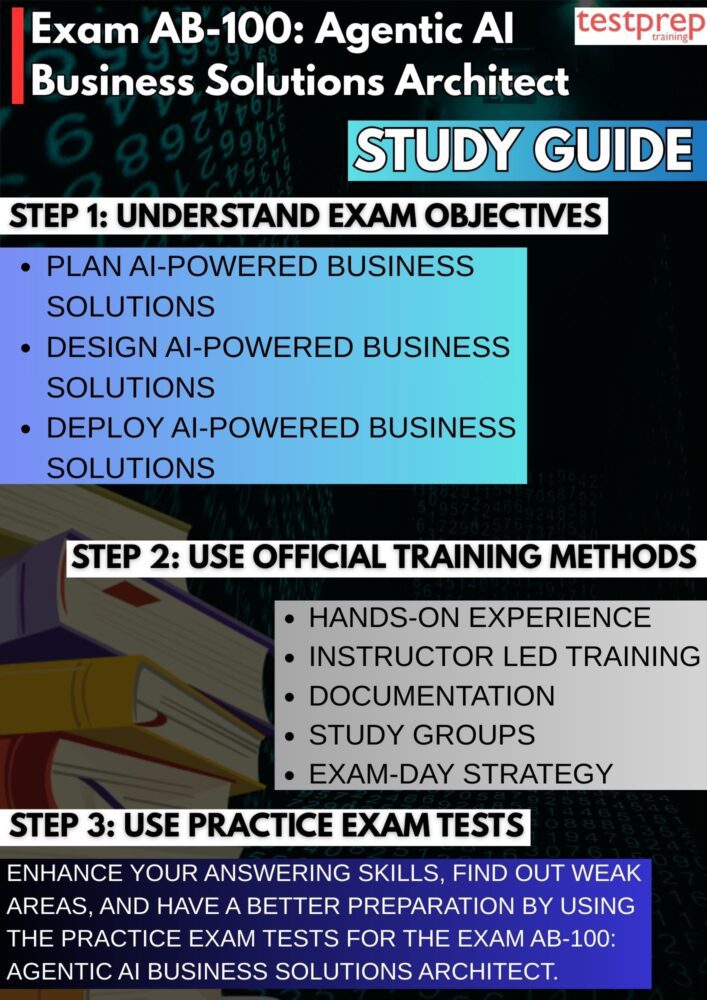
Step 1: Perform a Comprehensive Breakdown of the Official Exam Guide
Begin your preparation by treating the AB-100 exam guide as a formal architecture specification. Carefully analyze each skill area and decompose it into underlying knowledge domains, architectural decisions, and expected outcomes. Identify how Microsoft evaluates agentic-first architectures, AI orchestration strategies, governance models, and business alignment. Map every objective to practical use cases such as intelligent automation, cross-system orchestration, and AI-driven decision support. This step ensures your preparation remains aligned with exam intent rather than surface-level feature knowledge.
Step 2: Build Advanced Hands-On Expertise Through Realistic AI Implementations
The AB-100 exam assumes hands-on architectural experience. Go beyond simple labs by designing end-to-end agentic solutions that simulate enterprise environments. This includes configuring agents in Copilot Studio, integrating them with Dynamics 365, Power Platform, and external services, and orchestrating multiple agents to collaborate on complex business processes. Practice implementing telemetry, error handling, fallback logic, and security boundaries. Hands-on experimentation develops the decision-making skills needed to evaluate trade-offs under exam conditions.
Step 3: Integrate Practical Learning with Instructor-Led and Guided Training
Instructor-led training provides structured exposure to advanced architectural concepts that are often tested indirectly in AB-100. These sessions emphasize design rationale, architectural justification, and Microsoft-recommended patterns rather than tool-specific instructions. Use this training to refine your understanding of agent lifecycle management, enterprise governance, multi-agent coordination, and open protocol integration. Instructor guidance also helps bridge the gap between documentation and real-world application.
Step 4: Deep-Dive into Microsoft Documentation and Architecture References
Microsoft documentation is essential for mastering AB-100 content, but it must be studied strategically. Focus on architecture guides, reference implementations, security models, and governance frameworks rather than isolated service descriptions. Pay special attention to how Microsoft positions responsible AI, compliance, data residency, identity integration, and AI security controls within enterprise solutions. Review architectural diagrams and decision frameworks to understand not just how services work, but why certain approaches are recommended.
Step 5: Actively Participate in Study Groups and Technical Communities
Study groups and professional communities add practical context to your preparation. Engage in discussions around agentic design challenges, orchestration patterns, scalability considerations, and real-world AI adoption barriers. Sharing and reviewing architectural approaches with peers helps reinforce conceptual understanding and exposes you to alternative solution strategies. Community interaction also keeps you informed about platform updates, evolving best practices, and common exam pitfalls.
Step 6: Use Practice Tests to Strengthen Architectural Reasoning and Time Management
Practice exams should be used as diagnostic and refinement tools, not just knowledge checks. Focus on understanding how questions evaluate architectural judgment, business alignment, security implications, and long-term scalability. Review incorrect answers in detail to identify gaps in reasoning rather than memorization. Practice managing time effectively across complex scenarios, ensuring you can analyze requirements, compare options, and select the most enterprise-appropriate solution under exam constraints.
Step 7: Develop Strong Business Alignment and ROI-Focused Thinking
AB-100 places significant emphasis on business value and outcomes. Strengthen your ability to assess AI solutions from a return-on-investment perspective by evaluating cost, complexity, risk, and expected benefits. Practice articulating how agentic AI architectures improve efficiency, reduce manual effort, enhance decision-making, and support organizational goals. This business-focused mindset is critical for answering questions that assess strategic impact rather than technical execution alone.
Step 8: Refine Enterprise Architecture and Governance Decision-Making
As an Agentic AI Business Solutions Architect, you are expected to design solutions that are secure, compliant, and governable at scale. Review governance strategies covering model management, prompt control, data access policies, auditability, and change management. Understand how to balance innovation with risk mitigation and regulatory compliance. These considerations frequently appear in exam scenarios involving sensitive data, cross-region deployments, and regulated industries.
Step 9: Prepare for Exam-Day Strategy and Professional Judgment
In the final phase, focus on exam execution readiness. Practice reading scenario-based questions carefully to identify implicit requirements such as compliance constraints, scalability expectations, or organizational maturity. Apply a structured decision-making approach that prioritizes security, responsible AI, maintainability, and business alignment. The exam rewards thoughtful, enterprise-ready solutions rather than quick or overly technical fixes.
