
Google Cloud Generative AI Leader
The Google Cloud Certified Generative AI Leader credential is designed for forward-thinking professionals who want to guide organizations through the evolving landscape of generative artificial intelligence. This certification validates a candidate’s ability to understand how generative AI can reshape business models, optimize operations, and unlock new opportunities for innovation using Google Cloud technologies.
Rather than focusing on deep technical implementation, this certification emphasizes strategic vision, business alignment, and leadership influence in AI-driven transformation initiatives.
Who Is a Generative AI Leader?
A Generative AI Leader is a strategic decision-maker who understands the business impact of generative AI and how to responsibly integrate it into enterprise environments. These professionals possess a strong conceptual understanding of generative AI technologies while maintaining a business-oriented perspective. They can:
- Recognize high-impact use cases for generative AI across departments and industries
- Align AI initiatives with organizational goals and digital transformation strategies
- Promote responsible and ethical AI adoption
- Facilitate collaboration between technical teams and business stakeholders
- Leverage Google Cloud’s AI-first ecosystem to accelerate innovation
Their expertise lies in strategy, leadership, and influence, not hands-on coding or model development. However, they maintain enough foundational knowledge of generative AI concepts to confidently participate in cross-functional discussions.
Who Should Pursue This Certification?
This certification is suitable for professionals across all job roles, including:
- Business leaders and executives
- Product managers
- Strategy and innovation professionals
- Digital transformation leaders
- Consultants and advisors
- Non-technical professionals seeking AI fluency
Technical experience is not mandatory. The certification is structured to ensure accessibility for individuals who want to understand generative AI from a business leadership perspective.
Core Competencies Validated by the Exam
The Generative AI Leader exam evaluates knowledge across four primary domains.
- Candidates are assessed on their understanding of generative AI principles, including core concepts, model capabilities, limitations, risks, and ethical considerations. This includes awareness of how generative models function and where they deliver business value.
- The exam measures familiarity with Google Cloud’s generative AI ecosystem, including enterprise-ready tools, platforms, and AI services. Candidates should understand how these offerings support scalability, security, compliance, and responsible AI deployment.
- Professionals are expected to understand high-level techniques that improve model performance and output quality, such as prompt refinement, context management, evaluation approaches, and responsible usage frameworks.
- This domain focuses on aligning AI initiatives with measurable business outcomes. Candidates must demonstrate the ability to identify viable use cases, assess return on investment, manage risk, and guide successful implementation strategies within an organization.
Strategic Value of the Certification
Earning the Google Cloud Certified Generative AI Leader credential demonstrates the ability to:
- Lead AI-driven transformation initiatives
- Translate emerging AI capabilities into business value
- Support responsible and ethical AI adoption
- Influence stakeholders across technical and non-technical domains
- Drive innovation using Google Cloud’s enterprise-grade AI solutions
Exam Details
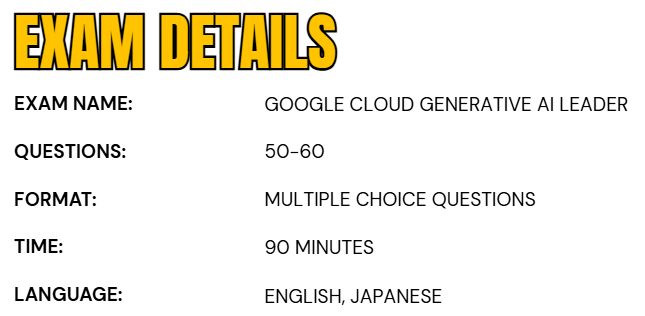
- The Google Cloud Certified Generative AI Leader exam is designed to assess a candidate’s strategic understanding of generative AI within a structured timeframe of 90 minutes.
- The examination is available in English and Japanese, making it accessible to a global audience.
- Candidates can expect approximately 50 to 60 multiple-choice questions, focused on evaluating business-level knowledge, conceptual understanding, and strategic decision-making related to generative AI and Google Cloud offerings.
- The exam can be taken either through an online-proctored format or at an on-site testing center, providing flexibility based on candidate preference.
- Once earned, the certification remains valid for a period of three years, after which recertification is required to maintain active credential status.
Course Outline
The Google Cloud Generative AI Leader exam covers the following topics:
Section 1: Understand the fundamentals of gen AI (30%)
1.1 Describe core generative AI (gen AI) concepts and use cases. Considerations include:
- Defining core gen AI concepts (e.g., artificial intelligence, natural language processing, machine learning, generative AI, foundation models, multimodal foundation models, diffusion models, prompt tuning, prompt engineering, large language models).
- Describing the machine learning approaches (e.g., supervised, unsupervised, reinforcement).
- Identifying the stages of the machine learning lifecycle; data ingestion, data preparation, model training, model deployment, and model management; and the Google Cloud tools for each stage.
- Identifying how to choose the appropriate foundation model for a business use case (e.g., modality, context window, security, availability and reliability, cost, performance, fine-tuning, and customization).
- Identifying business use cases where gen AI can create, summarize, discover, and automate (e.g., text generation, image generation, code generation, video generation, data analysis, and personalized user experience).
- Describing how various data types are used in gen AI and the business implications.
- Explaining the characteristics and importance of data quality and data accessibility in AI (e.g., completeness, consistency, relevance, availability, cost, format).
- Identifying the differences between structured and unstructured data, and identifying real-world examples of each type.
- Identifying the differences between labeled and unlabeled data.
1.2 Describe how various data types are used in gen AI and the business implications. Considerations include:
- Explaining the characteristics and importance of data quality and data accessibility in AI (e.g., completeness, consistency, relevance, availability, cost, format).
- Identifying the differences between structured and unstructured data, and identifying real-world examples of each type.
- Identifying the differences between labeled and unlabeled data.
1.3 Identify the core layers of the gen AI landscape and the business implications. Considerations include:
- Infrastructure
- Models
- Platforms
- Agents
- Applications
1.4 Identify the use cases and strengths of Google’s foundation models. Considerations include:
- Gemini
- Gemma
- Imagen
- Veo
Section 2: Learn Google Cloud’s gen AI offerings (35%)
2.1 Describe Google Cloud’s strengths in the field of gen AI. Considerations include:
- Describing how Google’s AI-first approach and commitment to future innovation translate into cutting-edge gen AI solutions.
- Describing how Google Cloud has an enterprise-ready AI platform (e.g., responsible, secure, private, reliable, scalable).
- Recognizing the advantages of Google’s comprehensive AI ecosystem (e.g., integration of gen AI across Google products and services).
- Describing the benefits of Google Cloud’s open approach.
- Identifying the essential components of Google Cloud’s AI-optimized infrastructure and its benefits (e.g., hypercomputer, Google’s custom-designed TPUs, GPUs, data centers, cloud computing).
- Explaining how Google Cloud’s AI platform provides users with control over their data (e.g., security, privacy, governance, open and leading first party models, pre-built and customizable solutions, agents).
- Describing how Google Cloud’s AI platform democratizes AI development (e.g., low-code and no-code tools, pre-trained models, APIs).
2.2 Describe how Google Cloud’s prebuilt gen AI offerings enable AI powered work. Considerations include:
- Recognizing the functionality, use cases, and business value of the Gemini app and Gemini Advanced (e.g., Gems).
- Recognizing the functionality, use cases, and business value of Gemini Enterprise (e.g., Cloud NotebookLM API, multimodal search, and custom agent capabilities).
- Recognizing the functionality, use cases, and business value of Gemini for Google Workspace.
2.3 Describe how Google Cloud’s gen AI offerings improve the customer experience. Considerations include:
- Recognizing the functionality, use cases, and business benefits of Google Cloud’s external search offerings (e.g., Vertex AI Search, Google Search).
- Recognizing the functionality, use cases, and business value of Google’s Customer Engagement Suite (e.g., Conversational Agents, Agent Assist, Conversational Insights, Google Cloud Contact Center as a Service).
2.4 Describe how Google Cloud empowers developers to build with AI. Considerations include:
- Recognizing the functionality, use cases, and business value of Vertex AI Platform (e.g., Model Garden, Vertex AI Search, AutoML).
- Recognizing the functionality, use cases, and business value of Google Cloud’s RAG offerings (e.g., prebuilt RAG with Vertex AI Search, RAG APIs).
- Recognizing the functionality, use cases, and business value of using Vertex AI Agent Builder to build custom agents.
2.5 Define the purpose and types of tooling for gen AI agents. Considerations include:
- Identifying how agents use tools to interact with the external environment and achieve tasks (e.g., extensions, functions, data stores, and plugins).
- Identifying relevant Google Cloud services and pre-built AI APIs for agent tooling (e.g.,
- Cloud Storage, databases, Cloud Functions, Cloud Run, Vertex AI, Speech-to-Text API, Text-to-Speech API, Translation API, Document Translation API, Document AI API, Cloud Vision API, Cloud Video Intelligence API, Natural Language API, Google Cloud API Library).
- Determining when to use Vertex AI Studio and Google AI Studio

Section 3: Understand the techniques to improve gen AI model output (20%)
3.1 Describe how to proactively overcome foundation model limitations. Considerations include:
- Identifying common limitations of foundation models (e.g., data dependency, the knowledge cutoff, bias, fairness, hallucinations, edge cases).
- Describing the Google Cloud-recommended practices to address limitations (e.g., grounding, retrieval-augmented generation [RAG], prompt engineering, fine-tuning, human in the loop [HITL]).
- Recognizing Google-recommended practices for continuous monitoring and evaluation of gen AI models (e.g., automatic model upgrades, key performance indicators, security patches and updates, versioning, performance tracking, drift monitoring, Vertex AI Feature Store).
3.2 Describe prompt engineering techniques and how they drive better results. Considerations include:
- Defining prompt engineering and describing its significance in interacting with large language models (LLMs).
- Identifying prompting techniques and use cases (e.g., zero-shot, one-shot, few-shot, role prompting, prompt chaining).
- Identifying advanced prompting techniques and when to use them (e.g., chain-of-thought prompting, ReAct prompting).
3.3 Identify grounding techniques and their use cases. Considerations include:
- Describing the concept of grounding in LLMs and differentiating between grounding with first-party enterprise data, third-party data, and world data.
- Describing how retrieval-augmented generation (RAG) can affect the generated output from your gen AI models.
- Google Cloud grounding offerings:
- Pre-built RAG with Vertex AI Search
- RAG APIs
- Grounding with Google Search
- Identifying how sampling parameters and settings are used to control the behavior of gen AI models (e.g., token count, temperature, top-p [nucleus sampling], safety settings, and output length).
Section 4: Learn about the business strategies for a successful gen AI solution (15%)
4.1 Describe the Google Cloud-recommended steps to successfully implement a transformational gen AI solution. Considerations include:
- Recognizing the different types of gen AI solutions (e.g., text generation, image generation, code generation, personalized user needs).
- Identifying the key factors that influence gen AI needs (e.g., business requirements, technical constraints).
- Describing how to choose the right gen AI solution for a specific business need.
- Identifying the steps to integrate gen AI into an organization.
- Identifying techniques to measure the impact of gen AI initiatives.
4.2 Define secure AI and its importance in protecting AI systems from malicious attacks and misuse. Considerations include:
- Explaining security throughout the ML lifecycle.
- Identifying the purpose and benefits of Google’s Secure AI Framework (SAIF).
- Recognizing Google Cloud security tools and their purpose (e.g., secure-by-designinfrastructure, Identity and Access Management (IAM), Security Command Center, and workload monitoring tools).
4.3 Describe the importance of responsible AI in business. Considerations include:
- Explaining the importance of responsible AI and transparency.
- Describing privacy considerations (e.g., privacy risks, data anonymization and pseudonymization).
- Describing the implications of data quality, bias, and fairness.
- Describing the importance of accountability and explainability in AI systems.
Google Cloud Generative AI Leader Exam FAQs
Exam Policies
Before scheduling or renewing a Google Cloud certification exam, it is important to understand the official certification policies. These guidelines define the procedures for appointment changes, cancellations, and renewal requirements, helping candidates avoid penalties and maintain their certification status without disruption.
Rescheduling or Canceling an Exam
If you need to change your exam appointment, you must log in to your certification account through CM Connect and access Webassessor. Within the My Assessments section, you can select your existing booking and choose to reschedule or cancel the exam.
Timing is critical when making modifications. For exams scheduled at a physical testing center, a late fee applies if changes are made less than 72 hours before the scheduled exam time. For online-proctored exams, the policy is stricter—fees apply if changes are made within 24 hours of the appointment. To avoid additional charges, candidates are strongly advised to plan ahead and make any necessary adjustments well in advance of the deadline.
Certification Renewal
Google Cloud certifications remain valid for a defined period to ensure certified professionals stay aligned with the latest advancements in cloud technology. To maintain an active certification status and retain your original credential identification (Series ID), you must complete the recertification process within the approved renewal window.
The renewal eligibility timeline varies by certification level:
- Foundational and Associate certifications: Renewal may begin up to 180 days prior to the expiration date.
- Professional certifications: Renewal may begin up to 60 days prior to the expiration date.
Attempting to renew outside the official eligibility window may result in the attempt being declined, and exam fees may not be reimbursed. Standard exam pricing and retake policies apply to all recertification attempts.
Google Cloud Generative AI Leader Exam Study Guide
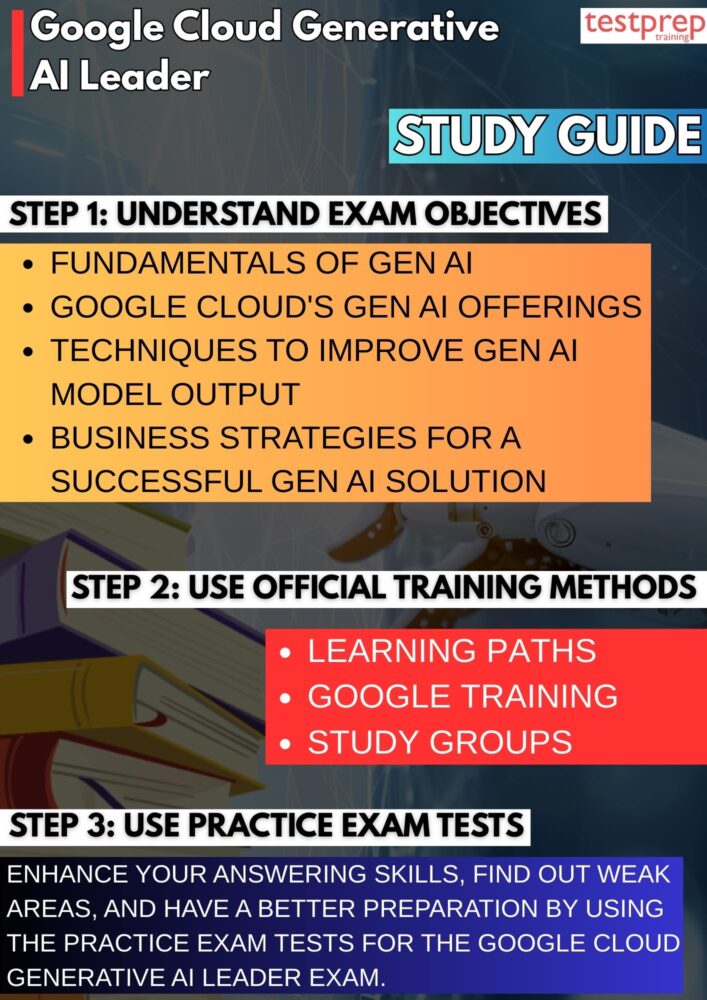
Step 1: Review the Official Exam Objectives Thoroughly
Start by carefully examining the official exam guide to understand the scope, structure, and domain weightings. Identify the four major knowledge areas and break them down into subtopics. Pay attention to the skills being assessed—particularly strategic thinking, business alignment, and responsible AI adoption. Create a study plan that allocates time based on your strengths and weaknesses. Reviewing the objectives early helps prevent studying irrelevant material and ensures alignment with exam expectations.
Additionally, note that this certification emphasizes leadership and influence rather than implementation. Frame your preparation around decision-making, governance, and business impact rather than technical configuration details.
Step 2: Strengthen Your Understanding of Generative AI Fundamentals
Develop a strong conceptual grasp of generative AI technologies. Understand how generative models differ from predictive or analytical AI systems. Study key concepts such as large language models (LLMs), multimodal models, training data considerations, model limitations, bias, hallucinations, and ethical risks.
Go beyond definitions—understand real-world implications. For example, consider how generative AI can impact customer service, marketing automation, software development, and knowledge management. Be prepared to evaluate when generative AI is appropriate and when traditional solutions may be more effective. A leadership-level understanding means you should be able to explain generative AI clearly to non-technical stakeholders while recognizing its risks and governance requirements.
Step 3: Develop Business-Level Knowledge of Google Cloud’s Generative AI Offerings
Gain familiarity with Google Cloud’s AI-first ecosystem and enterprise-ready AI solutions. Focus on understanding how Google Cloud supports scalability, compliance, data security, and responsible AI development within enterprise environments. Rather than memorizing technical specifications, concentrate on:
- How different services support various business use cases
- When to recommend a particular solution
- How Google Cloud ensures data privacy and governance
- How enterprise AI deployments align with organizational standards
Step 4: Complete Official Google Cloud Training and Learning Paths
Follow structured Google Cloud training resources designed for the Generative AI Leader certification. These learning paths provide curated content aligned with exam domains and often include scenario-based explanations. Take notes during training modules and summarize key takeaways in your own words. Reinforce learning by connecting each concept to a practical business scenario. For example, after learning about prompt design, consider how prompt engineering can improve internal productivity tools or customer-facing AI assistants. However, the related training includes:
Generative AI Leader Learning Path:
This training program is designed as a structured learning journey. It begins with foundational concepts of generative AI and gradually progresses toward applying these capabilities within real business environments using Google Cloud. The learning experience includes on-demand modules, engaging video lessons, and interactive activities that help reinforce key concepts.
Participants gain practical exposure through guided exercises using tools such as Gemini Advanced, NotebookLM, and Google AI Studio. These hands-on activities help learners understand how generative AI solutions can support productivity, innovation, and enterprise transformation.
Step 5: Participate in Study Groups and Professional Communities
Joining certification-focused communities can significantly enhance your preparation. Engaging in discussions allows you to see how other professionals interpret AI leadership scenarios and business challenges. You may encounter:
- Real-world implementation stories
- Industry-specific AI use cases
- Clarifications on confusing concepts
- Insights into exam-style questions
Collaborative learning strengthens retention and helps you articulate concepts more clearly—an important skill for leadership-focused certifications. Active participation also exposes you to diverse perspectives on responsible AI governance and enterprise adoption strategies.
Step 6: Practice with Mock Exams and Scenario-Based Questions
Practice tests are critical for identifying knowledge gaps and improving exam readiness. Since this certification emphasizes strategic thinking, expect scenario-driven questions that require evaluating business needs, risk factors, and solution alignment. When reviewing practice questions:
- Analyze why the correct answer is the most strategic choice
- Understand why alternative options are less suitable
- Focus on business impact, compliance, and scalability
Avoid memorization. Instead, train yourself to approach questions from the perspective of a Generative AI Leader responsible for enterprise-wide decision-making.
Step 7: Refine Your Leadership and Strategic Decision-Making Mindset
As your exam date approaches, shift your focus from learning new material to refining your strategic judgment. Revisit core themes such as:
- Responsible AI adoption
- Risk mitigation and governance
- ROI and measurable outcomes
- Change management and stakeholder communication
- Cross-functional collaboration
Remember that this exam evaluates your ability to guide AI initiatives at a strategic level. In every scenario, ask yourself:
- Does this solution align with business objectives?
- Is it responsible and compliant?
- Does it provide measurable value?
- Is it scalable and sustainable?
