
ASQ Certified Calibration Technician (CCT)
The ASQ Certified Calibration Technician (CCT) credential is designed for professionals who ensure the accuracy and reliability of measurement instruments. A certified technician is responsible for testing, calibrating, maintaining, and repairing a wide range of equipment—including electrical, mechanical, electromechanical, analytical, and electronic instruments—to ensure compliance with established standards.
Who Should Pursue the CCT Certification?
This certification is well-suited for individuals involved in the calibration, testing, and maintenance of measurement systems and equipment. It is particularly valuable for:
- Calibration and instrumentation technicians
- Quality control and assurance professionals
- Metrology specialists
- Maintenance and engineering personnel
Typically, candidates are expected to have at least five years of full-time, paid work experience in areas covered by the CCT Body of Knowledge. However, individuals with relevant academic qualifications may qualify for partial experience waivers, making this certification accessible to both experienced professionals and technically educated candidates.
Eligibility Requirements
To apply for the CCT certification, candidates must meet the following criteria:
- A minimum of five years of full-time, paid work experience in one or more domains outlined in the CCT Body of Knowledge
- Experience must be hands-on and directly related to calibration or measurement systems
Educational Waivers
Candidates with formal education in technical or scientific fields may receive a reduction in the required work experience. Only one waiver can be applied, as outlined below:
- Diploma from a technical, military, or trade school — 2 years waived
- Associate degree — 2 years waived
- Bachelor’s degree — 2 years waived
- Master’s or Doctorate degree — 2 years waived
Skills and Knowledge You Will Gain
Earning the CCT certification equips professionals with a comprehensive understanding of calibration principles and practices. Key areas of development include:
- Metrology Fundamentals
- Gain a strong foundation in measurement science, including SI units (base and derived), measurement standards, common measurement techniques, and fundamental constants.
- Measurement Techniques and Practices
- Develop practical skills in executing measurement processes such as Unit Under Test (UUT) evaluation and gage repeatability and reproducibility (Gage R&R) studies.
- Calibration Systems and Procedures
- Learn to apply calibration procedures effectively, including instrument adjustment methods, workflow management for inspection, measuring, and test equipment (IM&TE), as well as validation and reporting practices.
- Applied Mathematics for Measurement
- Understand how to perform advanced calculations related to measurement accuracy, including the evaluation of uncertainty components.
- Quality Systems and Standards
- Explore quality management principles, including auditing techniques, corrective and preventive actions (CAPA), occupational safety considerations, and adherence to recognized quality standards and guidelines.
- Role-Based Competency in Metrology
- Gain insight into the responsibilities and functions across different levels within a metrology department—from entry-level technicians to laboratory managers.
Exam Details
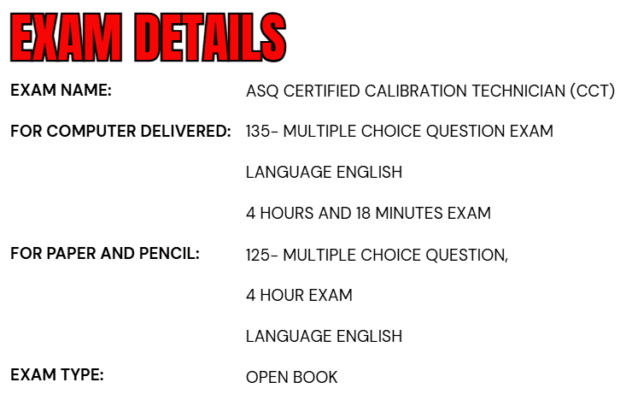
- To achieve the ASQ Certified Calibration Technician (CCT) credential, candidates are required to pass a comprehensive examination. This exam is designed to assess a candidate’s understanding of the CCT Body of Knowledge through a series of multiple-choice questions that evaluate both conceptual clarity and practical application.
- The examination is available in two formats: computer-based and paper-based. In the computer-delivered format, the test consists of 135 multiple-choice questions, of which 125 are scored and 10 are included for evaluation purposes only.
- Candidates are given a total appointment time of four and a half hours, with 4 hours and 18 minutes allocated specifically for completing the exam. This format is conducted exclusively in English.
- Alternatively, candidates may opt for the paper-and-pencil version of the exam. This format includes 125 multiple-choice questions and must be completed within a total duration of four hours. Similar to the computer-based test, the paper-based exam is also offered only in English.
- An important feature of the CCT examination is that it follows an open-book format. Candidates are allowed to bring and refer to their own study materials during the exam. However, it is the candidate’s responsibility to ensure they have all necessary reference resources with them, as no materials are provided at the examination center.
- Overall, the structure of the CCT exam emphasizes not only knowledge retention but also the ability to effectively use reference materials and apply technical concepts in practical scenarios.
Course Outline
The ASQ Certified Calibration Technician (CCT) exam covers the following topics:
1. Concept of General Metrology (30 questions)
A. Base SI units
- Describing and defining the seven base units: 1) meter, 2) kilogram, 3) second, 4) ampere, 5) kelvin, 6) candela, and 7) mole. (Understand)
NOTE: The application of these units is covered in I.B., I.C., I.D, and I.E.
B. Derived SI units
– Defining, calculating, and converting various derived units, such as 1) degree, 2) ohm, 3) pascal, 4) newton, 5) joule, 6) coulomb, 7) hertz, and 8) watt. (Apply)
C. SI multipliers and conversions
- Defining various multipliers, such as 1) kilo, 2) deci, 3) centi, and 4) milli. Calculate converted values, such as mega to kilo and micro to milli. (Apply)
D. Fundamental constants
- Identifying the fundamental constants of 1) velocity or speed of light in a vacuum (c), 2) gravitational constant (g), 3) Planck’s constant (h), 4) Avogadro constant (NA), 5) Boltzmann (kB), and 6) elementary charge (e), and their standard symbols and common applications. (Understand)
NOTE: The values of these constants and the formulas for calculating them will not be tested.
E. Common measurements
- Describing and applying IM&TE in measuring 1) temperature, 2) humidity, 3) pressure, 4) torque, 5) force, 6) mass, 7) voltage / current / resistance, 8) time / frequency, 9) linear displacement, 10) power, 11) dimensional, 12) viscosity, 13) volume, 14) luminosity, 15) flow, 16) energy, and 17) density. (Apply)
F. Traceability standards and hierarchy
- Identifying various aspects of traceability, such as traceability through commercial laboratories, national laboratories, international metrology organizations, and SI units. Understanding the realization and dissemination of SI units. (Apply)
G. Measurement standards
- Defining and distinguishing between various types of standards, such as 1) primary, 2) secondary, 3) reference, 4) working, 5) intrinsic, 6) derived, 7) consensus, and 8) transfering, and identifying when to use them in various situations. (Analyze)
H. Substitution of standards
- Assessing when and how calibration standards can be substituted based on 1) measurement requirements, 2) equipment availability, 3) equipment specifications, etc. (Evaluate)
2. Understand Measurement Systems (26 questions)
A. Measurement methods
- Describing and employing various measurement methods, such as 1) direct (e.g., absolute and fundamental), 2) indirect, 3) ratio, 4) transfer (e.g., comparison), 5) differential, and 6) substitution by unit under test (UUT). (Evaluate)
B. Measurement characteristics
- Definingand distinguishing various characteristics used for basic measurements, such as 1) variability, 2) sensitivity, 3) repeatability, 4) reproducibility, 5) bias, 6) linearity, 7) stability, and 8) measurand. (Apply)
NOTE: The use of these characteristics in uncertainty measurements is covered in IV.
C. Measurement data considerations
- Identifying and analyzing various aspects of measurement data, such as 1) format, 2) readability, 3) resolution, 4) suitability for use, and 5) confidentiality. (Analyze)
D. IM&TE specification terms and characteristics
- Demonstrating knowledge of common specification descriptions, such as 1) percent of full scale, 2) percent of range, 3) percent of reading, and 4) number of counts.
- Describing and distinguishing between characteristics of specifications, such as 5) tolerance and specifications, 6) baseline modifiers and qualifiers, 7) output, 8) scale, and 9) floor terms. (Analyze)
E. Error sources
- Identifying, mitigating, and correcting error sources that can affect measurement results, such as 1) drift, 2) bias, 3) operator error, 4) measurement process, and 5) environment. (Evaluate)
F. Measurement assurance program (MAP)
- Explaining basic MAP concepts, such as 1) interlaboratory comparisons and testing schemes, 2) proficiency tests, 3) gage R&R studies, and 4) statistical process control (SPC). (Understand)
3. Learn about Calibration Systems (28 questions)
A. Calibration procedures
- Identifying and applying common elements of calibration procedures, such as 1) required equipment, 2) equipment listing, 3) environmental considerations and restraints, and 4) common procedures. (Analyze)
B. Standardization and adjustment methods
- Utilizing methods, such as 1) spanning, 2) nulling, 3) zeroing, and 4) linearization, to adjust and standardize IM&TE and analyze the outcomes. (Analyze)
C. Industry practices and regulations
- Industry practices
- Identifying various sources of industry-accepted metrology and calibration practices, such as published resources, national standards, and international standards. (Understand)
- Regulations, mandates, and guidance
- Defining and distinguishing between government regulations, traceability, and other legally mandated metrology requirements, such as national or international guidance. Identify which rules or conventions take precedence in various situations. (Apply)
D. Environmental control
- Recognizing various environmental parameters for 1) humidity, 2) dust levels, 3) electrostatic discharge (ESD), 4) temperature, 5) vibration, 6) pressure, etc., and explain their influence on calibration activities. (Apply)

E. Calibration processes for IM&TE
- Process flow
- Describing the basic flow of IM&TE through the calibration process. (Understand)
- Logistical information
- Explaining IM&TE logistical information, such as 1) equipment identification, 2) ownership, 3) service history, and 4) process tracking systems. (Understand)
- Roles and responsibilities
- Identifying roles and responsibilities of calibration staff members, such as 1) laboratory manager, 2) technical manager, 3) scheduler, 4) quality manager, and 5) technician. (Understand)
- Scheduling
- Determining IM&TE scheduling considerations, such as 1) planned calibration intervals, 2) material or equipment requests, 3) steps in the notification process, 4) overdue lists, and 5) staff workloads, and analyzing their impact. (Analyze)
F. Validation processes
- Determining issues related to validating manual and automated calibration systems and identifying unique validation considerations for software or firmware that is part of IM&TE or calibration processes.
- Applying verification of standard methods and validation of self-developed processes. (Apply)
G. Records management
– Defining and describing document control in terms of maintaining the integrity and confidentiality of various calibration records, such as 1) audit results, 2) staff training, 3) uncertainty budgets, 4) customer data, 5) technical records, 6) documented processes, 7) requests, 8) contracts, and 9) tenders. (Apply)
H. Official reports
- Describing and distinguishing various types of formal results reporting, such as 1) calibration certificates, 2) calibration labels, 3) nonconformance calibration reports, and 4) test reports. (Apply)
4. Understand Measurement Uncertainty and Applied Math (25 questions)
A. Uncertainty terminology
– Defining and explaining basic terms, such as 1) guard-banding, 2) probability for false rejection (PFR, also known as Type I error), 3) probability for false acceptance (PFA, also known as Type II error), 4) test uncertainty ratio (TUR), 5) test accuracy ratio (TAR), 6) bias, 7) percent of tolerance, and 8) gage R&R. (Apply)
B. Uncertainty budget components
– Defining and identifying various type A and type B uncertainty components, such as 1) environment, 2) methods, 3) unit under test, 4) materials, 5) resolution, and 6) the key elements and steps of developing an uncertainty budget. (Apply)
C. Uncertainty determination and reporting
- Defining various methods to determine and report measurement uncertainty, such as 1) combined and expanded uncertainty, 2) coverage factors, 3) confidence levels, 4) effective degrees of freedom, 5) distribution factors, 6) uncertainty calculation elements (e.g., mean, standard deviation, root sum square (RSS), and variance), and 7) statement of conformity/decision rule (e.g., simple acceptance). (Apply)
D. Technical and applied mathematics
- Scientific and engineering notation
- Expressing a floating-point number in scientific and engineering notation. (Apply)
- English / Metric conversions
- Converting various units of measurement between English / U.S. Customary Units and metric units, such as 1) length, 2) area, 3) volume, 4) capacity, and 5) mass. (Apply)
- Ratios
- Expressing various terms, such as 1) percentage, 2) parts per million (ppm), and 3) decibels (dB). (Apply)
- Tables, graphs, and plots
- Interpreting tables and graphs to determine intermediate and extrapolated values. Illustrating the aspects of slope, intercept, and linearity of data sets in relation to graphs and plots. (Analyze)
- Rounding, truncation, and significant figures
- Determining the resolution of calculations (e.g., number of digits and least significant digit). Round and truncate to a specified number of digits. (Apply)
- Order of mathematical operations
- Identifying the correct order for performing mathematical operations and solve equations that contain multiple operations. (Apply)
- Algebraic equations
- Using basic algebra to solve for the unknown. (Apply)
- Angular conversions
- Converting various angular units, such as degrees, minutes, seconds, grads, and radians. (Apply)
5. Understand Quality Systems and Standards (16 questions)
A. Quality management systems
- System components
- Defining and distinguishing between various components of a quality system, such as 1) management and customer focus, 2) employee training and development, and 3) continuous process improvement. (Apply)
- Strategic and tactical processes
- Identifying various methods used to develop, improve, and review quality systems, such as 1) mission and goals, 2) planning and deployment, and 3) cross-functional teams. (Understand)
B. Quality control tools
- Understanding the seven basic quality tools: 1) flowcharts / process maps, 2) check sheets, 3) Pareto chart, 4) cause and effect diagrams, 5) scatter diagrams, 6) control charts, and 7) histograms. (Understand)
C. Quality audits
- Defining and describing the following elements of quality audits. (Understand)
- Types of audits, such as internal, external, product, and process.
- Audit components, such as audit plan, audit purpose, and audit standard.
D. Corrective action for nonconformances
- Nonconformance identification
- Determining conformance status and compare methods with the standards. Apply various methods of identifying and segregating nonconforming IM&TE. (Evaluate)
- Impact assessment
- Applying various tools for evidence (e.g., reverse traceability, customer notification, product recall, calibration standard evaluation, and root-cause analysis) in response to out-oftolerance conditions for IM&TE and nonconforming work. (Apply)
E. Professional conduct and ethics
- Demonstrating appropriate behaviors that are aligned with the ASQ Code of Ethics for various situations. (Apply)
F. Occupational safety requirements
- Hazards and safety equipment
- Assessing potential hazards in the work environment, such as 1) improper ventilation, 2) soldering fumes, and 3) suboptimal workplace lighting. Identify appropriate personal protective equipment (PPE) for various situations. (Apply)
- Occupational health and safety
- Understanding when and how to use various elements of occupational health and safety, such as 1) safety data sheet terms, 2) material labeling requirements, and 3) workplace safety. (Apply)
- Housekeeping
- Applying housekeeping methods in the calibration environment, such as 1) maintenance, 2) 6S, 3) IM&TE, and 4) cleaning. (Apply)
- Pre and post calibration condition
- Describing proper set-up prior to calibration and how to return IM&TE to safe, operational setup upon completion. (Apply)
G. Quality standards and guides
- Explaining the benefits and importance of the following documents and organizations in relation to calibration. (Understand)
- Quality standards and guides, including ISO 9001-2015, ISO / IEC 17025-2017, ISO 10012, GUM (JCGM 100:2008), and VIM (JCGM 200:2012).
- Accreditation bodies such as those recognized by IAF (International Accreditation Forum) and ILAC (International Laboratory Accreditation Cooperation).
ASQ Certified Calibration Technician (CCT) Exam FAQs
Exam Results and Certification Status
After completing the ASQ Certified Calibration Technician (CCT) exam, candidates receive their results based on the testing format selected. For computer-based testing (CBT), the outcome is displayed immediately upon submission of the exam. This instant feedback is followed by an official confirmation email within three to five business days. Successful candidates will also receive a separate communication from ASQ with instructions on how to access and claim their digital certificate and badge through the Accredible platform. In cases where the exam is part of a newly introduced or revised Body of Knowledge (pilot exam), results may take up to five weeks to be finalized and communicated.
If You Do Not Pass
Candidates who do not achieve a passing score in the CBT format will receive a detailed performance summary via email within three to five business days. This report highlights strengths and areas for improvement, helping candidates prepare more effectively for a future attempt. Additionally, candidates are eligible to retake the exam within a two-year period at a reduced fee, making it easier to plan a second attempt.
Testing Options and Scheduling
Candidates can choose between computer-based and paper-based testing formats, each with its own scheduling process. For CBT, once the application is approved, candidates typically receive an eligibility email within one to two business days. This email includes instructions for scheduling the exam through ASQ’s testing partner, Prometric.
For paper-based testing (PBT) or translated exams, candidates do not receive an eligibility email. Instead, a seating letter is issued approximately two weeks before the exam date. This letter provides all necessary details, including the exam schedule and location.
Rescheduling, Cancellations, and Absences
If a candidate needs to change their exam date or time, the request must be made at least five days before the scheduled appointment. This can be done through Prometric’s website using the reschedule/cancel option or via their automated phone system. A fee of $130 is charged for making such changes.
Failure to attend a scheduled exam without prior notice will result in the forfeiture of all application fees. Therefore, it is important for candidates to manage their appointments carefully and make any necessary adjustments within the allowed timeframe.
ASQ Certified Calibration Technician (CCT) Exam Study Guide
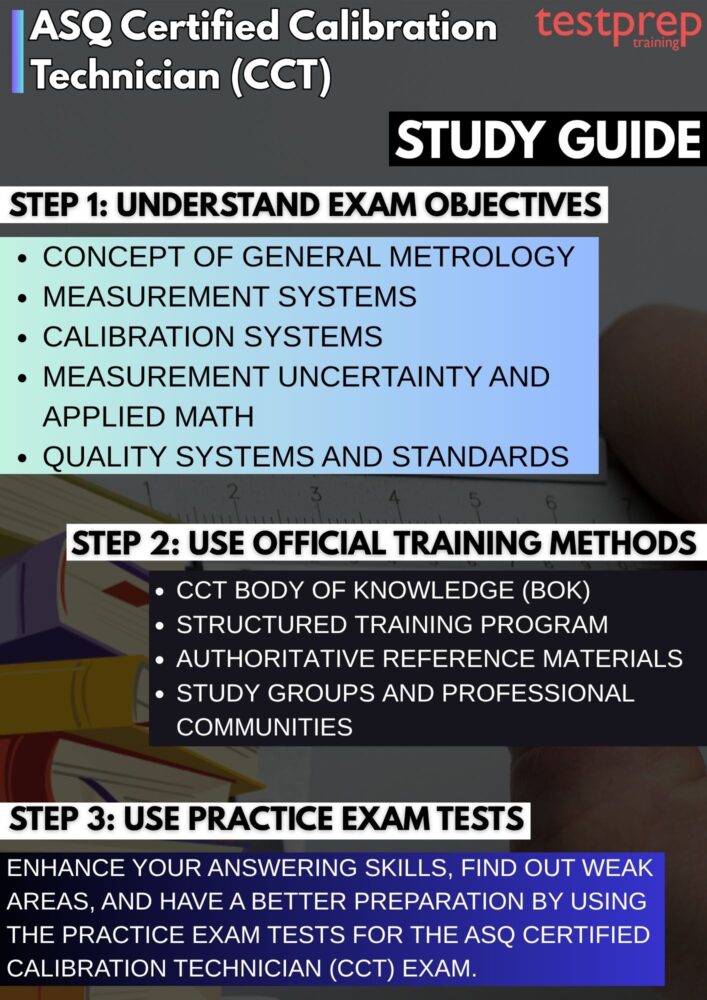
1. Review the Exam Structure and Objectives in Detail
Start by developing a thorough understanding of the exam framework. Go beyond just knowing the number of questions—analyze how the exam is structured, the distribution of topics, and the level of difficulty you can expect. Pay attention to how questions are framed, especially scenario-based or application-oriented questions that test practical knowledge.
It is also important to understand the open-book nature of the exam. This means the focus is not on memorization alone, but on how efficiently you can locate and apply information. Spend time reviewing the official exam objectives and create a checklist of topics. This will help you track your progress and ensure that no critical area is overlooked during preparation.
2. Master the CCT Body of Knowledge (BoK)
The Body of Knowledge (BoK) is the backbone of your preparation and should guide your entire study plan. Each section of the BoK represents a critical competency area, such as measurement systems, calibration methods, uncertainty analysis, and quality practices. Instead of passively reading, break the BoK into smaller sections and assign timelines to each.
Focus on understanding concepts like SI units, traceability, calibration intervals, and measurement errors in depth. Where possible, connect these topics to real-world applications in your work environment. This practical linkage will make it easier to recall and apply concepts during the exam. Additionally, identify high-weightage topics and allocate more time to them. Revisit complex areas multiple times to strengthen retention and clarity.
3. Enroll in a Structured Training Program
A well-designed training course can provide direction and significantly reduce preparation time. Structured programs, such as the ASQ CCT preparation course, are aligned with the exam content and are often taught by experienced instructors who understand the nuances of the certification. These courses typically include interactive sessions, real-life examples, and guided problem-solving exercises.
They also help you stay accountable to a schedule, which is especially useful if you are balancing preparation with work commitments. Another advantage is access to curated study materials and practice questions that reflect the actual exam pattern. If a live course is not feasible, consider self-paced training modules or recorded sessions that allow flexibility while still providing structured guidance.
4. Use Authoritative Reference Materials Effectively
High-quality reference materials play a crucial role in building a strong conceptual foundation. The ASQ Metrology Handbook is widely regarded as a key resource, offering detailed explanations of calibration techniques, measurement systems, and best practices. While studying, avoid simply reading through the material. Instead, create concise notes, highlight important sections, and bookmark key topics for quick reference during the exam.
Since the exam is open-book, organizing your materials efficiently is just as important as understanding them. You should also complement the handbook with other resources such as calibration procedures, industry standards, and internal documentation from your workplace. This multi-source approach will give you a broader perspective and improve your ability to handle application-based questions.
5. Engage with Study Groups and Professional Communities
Learning in isolation can sometimes limit your understanding, especially for complex topics. Joining study groups or professional communities allows you to benefit from shared knowledge and diverse perspectives. In these groups, you can discuss challenging concepts, exchange study materials, and clarify doubts more effectively. Experienced professionals may also share practical insights and exam strategies that are not easily found in textbooks. Active participation is key—ask questions, contribute to discussions, and explain concepts to others. Teaching or discussing a topic often reinforces your own understanding and highlights areas that need improvement.
6. Practice with Mock Exams and Realistic Questions
Consistent practice is one of the most important elements of exam preparation. Practice tests help you become familiar with the exam format and improve your ability to interpret questions accurately. Take full-length mock exams under timed conditions to simulate the actual test environment. This will help you develop time management skills and reduce exam-day anxiety.
After each test, conduct a detailed review of your performance. Identify patterns in your mistakes—whether they are due to lack of knowledge, misinterpretation, or time pressure—and address them systematically. Additionally, focus on understanding why an answer is correct rather than just memorizing it. This approach will improve your ability to handle variations of similar questions in the actual exam.
7. Focus on Revision, Strategy, and Exam Readiness
As the exam date approaches, shift your focus from learning new topics to revising and consolidating what you have already studied. Review key formulas, calibration methods, uncertainty calculations, and quality concepts regularly. Organize your reference materials in a way that allows quick access during the exam. Use tabs, highlights, or indexes to locate important information efficiently.
Since time is limited, knowing where to find answers quickly can make a significant difference. Develop a clear exam strategy—decide how you will approach the questions, how much time to allocate per section, and when to skip and return to difficult questions. Ensure you are well-rested before the exam and mentally prepared to stay focused throughout the duration.
