
Azure AI Cloud Developer Associate (AI-200)
The Microsoft Azure AI Cloud Developer Associate (AI-200) certification is designed for professionals who develop, deploy, and maintain artificial intelligence solutions on the Microsoft Azure platform. This certification validates the skills required to build modern AI-powered applications by integrating Azure AI services, managing data workflows, securing solutions, and monitoring application performance throughout the development lifecycle.
As an Azure AI Cloud Developer, you play a critical role in transforming business requirements into scalable and reliable AI solutions. Your responsibilities extend beyond coding and include participating in solution planning, architecture design, deployment, optimization, security implementation, and operational monitoring.
Role and Responsibilities of an Azure AI Cloud Developer
Professionals pursuing the AI-200 certification are expected to contribute to every stage of the AI solution development process. This includes:
- Requirements Analysis and Solution Planning
- Collaborating with stakeholders to understand business objectives and technical requirements.
- Identifying suitable Azure AI services and cloud components for specific use cases.
- Designing solution architectures that align with scalability, security, and performance requirements.
- Application Development
- Building AI-enabled applications using Azure services and development frameworks.
- Integrating machine learning models, generative AI capabilities, and intelligent APIs into applications.
- Developing backend services that support AI workloads and data processing operations.
- Deployment and Operations
- Deploying AI solutions using cloud-native and containerized approaches.
- Configuring environments for production readiness.
- Managing updates, version control, and application lifecycle processes.
- Security and Compliance
- Implementing authentication, authorization, and data protection mechanisms.
- Securing AI resources and application components according to Azure best practices.
- Ensuring compliance with organizational and regulatory requirements.
- Monitoring and Optimization
- Tracking application performance and resource utilization.
- Troubleshooting issues across AI services and supporting infrastructure.
- Optimizing workloads for reliability, cost efficiency, and scalability.
Core Skills Measured in the AI-200 Exam
To successfully earn the Azure AI Cloud Developer Associate certification, candidates should possess practical experience and technical knowledge in the following areas.
1. Azure SDKs and Third-Party SDK Integration
Candidates should understand how to develop applications using Azure Software Development Kits (SDKs) and integrate external libraries when necessary. This includes:
- Authenticating and connecting applications to Azure services.
- Consuming Azure AI APIs and cloud resources programmatically.
- Managing SDK configurations and dependencies.
- Integrating third-party frameworks and development tools within Azure-based solutions.
2. Azure Data Management Services
AI applications rely heavily on data. Candidates should be familiar with Azure data storage and management services, including:
- Storing structured and unstructured data.
- Managing data access and security.
- Working with cloud databases and storage accounts.
- Supporting AI workloads through efficient data organization and retrieval strategies.
A strong understanding of data management helps ensure that AI systems have access to reliable and high-quality information.
3. Azure Monitoring and Troubleshooting
Maintaining application health is a critical responsibility for Azure AI developers. Candidates should be able to:
- Monitor application performance and availability.
- Analyze logs and diagnostic information.
- Detect and resolve operational issues.
- Configure alerts and automated responses.
- Identify bottlenecks affecting AI service performance.
4. Azure Messaging and Event-Driven Architectures
Modern cloud applications frequently use messaging and event-based communication patterns. Candidates should understand:
- Event-driven application design principles.
- Asynchronous communication between services.
- Message processing workflows.
- Integration of distributed application components.
Knowledge of Azure messaging services enables developers to build scalable and loosely coupled AI solutions.
5. Vector Databases and AI Search Technologies
As generative AI and retrieval-augmented generation (RAG) solutions become increasingly common, developers must understand vector-based data storage and retrieval. Key areas include:
- Vector embeddings and similarity search.
- Storage and management of vectorized data.
- Semantic search implementation.
- Retrieval techniques used in AI-powered applications.
- Integration of vector databases with large language model solutions.
6. Python Programming
Python remains one of the most widely used programming languages for artificial intelligence and cloud development. Candidates should be comfortable with:
- Writing clean and maintainable Python code.
- Working with APIs and SDKs.
- Data manipulation and processing.
- Error handling and debugging.
- Developing backend components for AI applications.
Containerized Application Development on Azure
Containerization has become a standard approach for deploying scalable cloud applications. AI-200 candidates should understand:
- Building and packaging containerized applications.
- Deploying containers within Azure environments.
- Managing container lifecycles and updates.
- Scaling applications to meet workload demands.
- Integrating AI services into container-based architectures.
Who Should Take the AI-200 Exam?
The AI-200 certification is ideal for:
- Azure developers building AI-powered cloud applications.
- Software engineers working with Azure AI services.
- Cloud developers implementing generative AI solutions.
- Backend developers responsible for AI service integration.
- Professionals transitioning into Azure-based AI development roles.
Candidates with hands-on experience in Azure development, Python programming, cloud-native architectures, and AI service integration will be well-positioned to succeed on the exam.
Exam Details
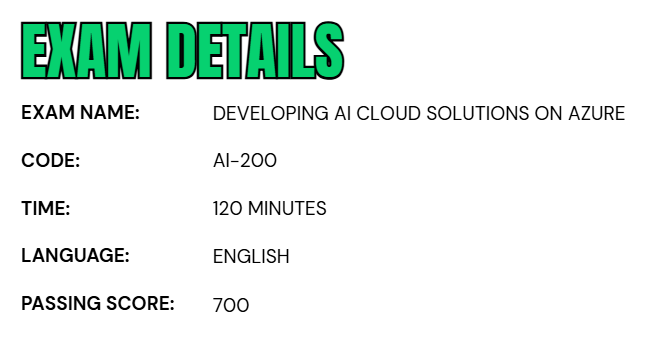
- The Microsoft Certified: Azure AI Cloud Developer Associate certification validates the skills and knowledge required to develop, deploy, and manage AI-powered cloud solutions on Microsoft Azure.
- The AI-200 certification exam, Developing AI Cloud Solutions on Azure, is designed to assess a candidate’s practical understanding of Azure AI development concepts and real-world implementation scenarios.
- To successfully pass the exam, candidates must achieve a minimum score of 700.
- The assessment is allocated 120 minutes, providing sufficient time to complete the various question types and tasks included in the exam.
- The AI-200 exam is a proctored examination, ensuring the integrity and credibility of the certification process. Depending on the exam version, candidates may encounter interactive components and hands-on tasks that evaluate their ability to apply technical knowledge in realistic development and deployment situations rather than relying solely on theoretical understanding.
- Currently, the exam is available in English, allowing candidates worldwide to demonstrate their Azure AI development expertise through a standardized assessment experience.
- Microsoft is committed to providing an inclusive testing environment. Candidates who use assistive technologies, require additional testing time, or need modifications to any aspect of the exam experience can request exam accommodations before scheduling their test. These accommodations are designed to ensure fair access while maintaining the exam’s assessment standards.
- The majority of exam questions focus on Azure features and services that are in General Availability (GA) status. However, candidates should be aware that the exam may also include questions related to Preview features when those features are widely adopted, commonly used by customers, or considered important for real-world Azure AI solution development.
Course Outline
The AI-200: Developing AI Cloud Solutions on Azure exam covers the following topics:
1. Developing containerized solutions on Azure (20–25%)
Implementing container application hosting
- Building, storing, versioning, and managing container images by using Azure Container Registry (Microsoft Documentation: Container image storage in Azure Container Registry, Introduction to Azure Container Registry)
- Building and running images by using Azure Container Registry Tasks (Microsoft Documentation: Build and run a container image, Build and deploy container images, Automate container image builds and maintenance)
- Deploying containers to Azure App Service, including configuring App Service to supply environment variables and secrets (Microsoft Documentation: Deploy containers to Azure App Service, Configure an App Service app, Configure a custom container for Azure App Service)
Implementing container-orchestrated solutions
- Deploying applications to Azure Container Apps, including environment configuration and revision management (Microsoft Documentation: Deploy your first container app with containerapp up, Azure Container Apps overview, Update and deploy changes in Azure Container Apps)
- Implementing event-driven scaling by using Kubernetes Event‑driven Autoscaling (KEDA) in Container Apps (Microsoft Documentation: Simplified application autoscaling with Kubernetes Event-driven Autoscaling (KEDA) add-on)
- Deploying and managing applications to Azure Kubernetes Service (AKS) by using manifest files (Microsoft Documentation: Deploy an application to Azure Kubernetes Service (AKS))
- Monitoring and troubleshooting solutions on AKS and Container Apps by inspecting logs, events, and end-to-end connectivity (Microsoft Documentation: Monitor Azure Kubernetes Service (AKS), Diagnose and resolve AKS network issues, Troubleshoot a container app)
2. Developing AI solutions by using Azure data management services (25–30%)
Developing AI solutions by using Azure Cosmos DB for NoSQL
- Connecting to Azure Cosmos DB for NoSQL by using the SDK and run queries (Microsoft Documentation: Use Azure Cosmos DB for NoSQL with the Azure SDK for .NET)
- Optimizing query performance and Request Units (RUs) consumption by using indexing policies and consistency levels (Microsoft Documentation: Understand request units consumption in Azure Cosmos DB, Indexing policies in Azure Cosmos DB, Optimize request cost in Azure Cosmos DB, Consistency levels in Azure Cosmos DB)
- Storing and retrieving embeddings and execute vector similarity search for semantic retrieval (Microsoft Documentation: Vector Embeddings and Vector Search in Azure Cache for Redis, Vector search in Azure AI Search, Vector search and vector indexes in the SQL Database Engine)
- Implementing a change feed processor to detect and handle new or updated items (Microsoft Documentation: Change feed processor in Azure Cosmos DB, Change feed in Azure Cosmos DB)
Developing AI solutions by using Azure Database for PostgreSQL
- Connecting and querying Azure Database for PostgreSQL by using SDKs (Microsoft Documentation: Connect and query overview for Azure Database for PostgreSQL)
- Modeling schemas and implementing indexing strategies, including designing tables and choosing appropriate data types (Microsoft Documentation: Index architecture and design guide, Search indexes in Azure AI Search)
- Implementing indexing strategies, including optimizing query latency and reducing pgvector compute overhead (Microsoft Documentation: Optimize performance when using pgvector on Azure Cosmos DB for PostgreSQL)
- Configuring compute, memory, and storage resources to support vector workloads (Microsoft Documentation: Compute and storage configurations for Azure DocumentDB, Choose an approach for optimizing vector storage and processing, Choose an Azure service for vector search)
- Running vector similarity search, including storing embeddings, semantic retrieval, and implementing retrieval-augmented generation (RAG) patterns by using metadata filter (Microsoft Documentation: Retrieval-augmented generation (RAG) in Azure AI Search, Retrieval augmented generation (RAG) and indexes, Integrated vector store in Azure DocumentDB)
- Implementing connection optimization to improve throughput and minimize latency (Microsoft Documentation: Optimize network throughput for Azure virtual machines, Mitigate latency and improve performance)
Integrating Azure Managed Redis in AI solutions
- Implementing Azure Managed Redis data operations, including caching, expiration, and invalidation (Microsoft Documentation: Implement data operations in Azure Managed Redis, What is Azure Managed Redis?)
- Implementing vector indexing to enable similarity search (Microsoft Documentation: Vector indexes in Azure AI Search, Create a vector index in Azure AI Search)

3. Understand Connect to and consume Azure services (20–25%)
Developing event- and message-based AI solutions
- Queuing and processing back-end operations by using Azure Service Bus, including dead-letter queue handling, messages, topics, and subscriptions (Microsoft Documentation: Overview of Service Bus dead-letter queues, What is Azure Service Bus?, Service Bus queues, topics, and subscriptions)
- Implementing event-driven workflows by using Azure Event Grid, including filters, custom events, and retries (Microsoft Documentation: Develop event-driven AI workflows with Azure Event Grid, What is Azure Event Grid?)
Developing and implementing Azure Functions
- Building serverless APIs, including implementing triggers and bindings (Microsoft Documentation: Create serverless APIs in Visual Studio, Azure Functions triggers and bindings)
- Configuring and deploying function apps (Microsoft Documentation: Create a function app in the Azure portal, Deployment technologies in Azure Functions)
4. Process of securing, monitoring, and troubleshooting Azure solutions (20–25%)
Implement secure Azure solutions
- Securing secrets by using Azure Key Vault, including rotation and retrieval (Microsoft Documentation: Secure your Azure Key Vault, Secure your Azure Key Vault secrets, Azure Key Vault basic concepts)
- Storing and retrieving app configuration information by using Azure App Configuration (Microsoft Documentation: What is Azure App Configuration?, Create an Azure App Configuration store, Overview of Azure App Configuration)
Monitoring and troubleshooting Azure solutions
- Tracing distributed systems by using OpenTelemetry SDKs (Microsoft Documentation: Enable OpenTelemetry distributed tracing with Durable Task Scheduler, Collect a distributed trace)
- Writing KQL queries to analyze logs and metrics (Microsoft Documentation: Get started with log queries in Azure Monitor Logs, Kusto Query Language overview)
Azure AI Cloud Developer Associate (AI-200) Exam FAQs
Certification Exam Policies
Microsoft follows strict certification policies to ensure a secure and standardized testing experience for all candidates. Before booking an exam, it is important to review the official exam requirements, identification guidelines, testing rules, and candidate responsibilities. Familiarity with these policies can help avoid scheduling problems, exam interruptions, or unnecessary delays.
– Exam Retake Policy
Candidates who do not achieve a passing score may retake the exam. In most cases, a 24-hour waiting period applies before a second attempt can be scheduled. For the third and subsequent attempts, a 14-day waiting period is generally required between exam registrations.
Microsoft also limits candidates to five attempts for the same exam within a one-year period. After successfully passing an exam, retaking it is typically not permitted unless Microsoft introduces a renewal or recertification requirement. Each exam attempt requires a new registration and exam fee unless covered by an eligible voucher or discount program.
Microsoft AI-200: Developing AI Cloud Solutions on Azure Exam Study Guide
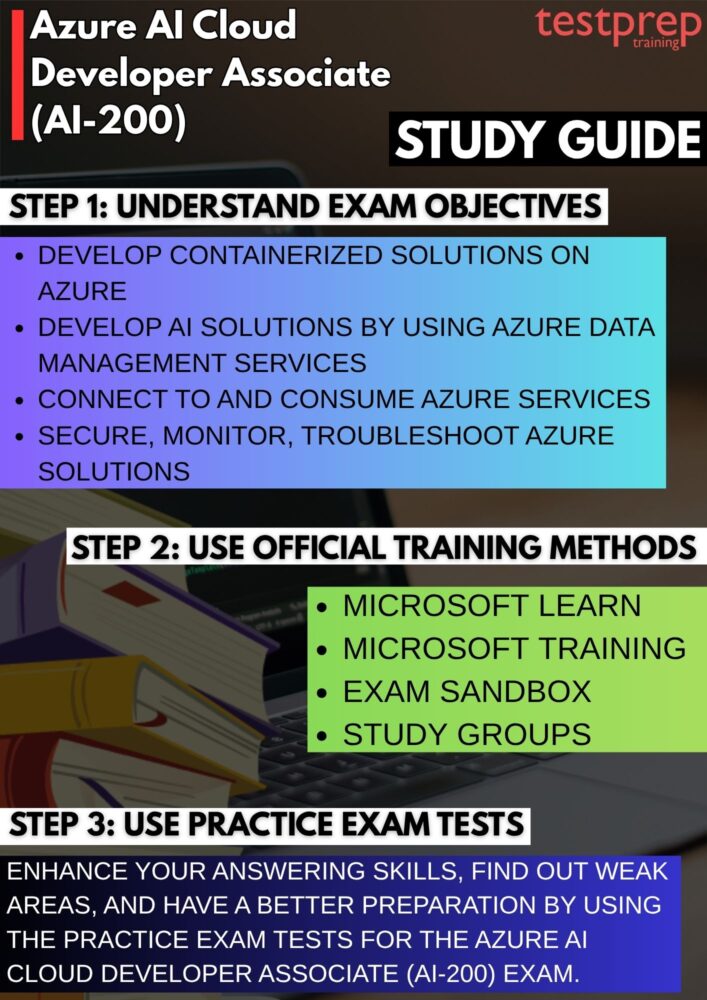
Step 1: Thoroughly Review the Official Exam Skills Outline
Your preparation should begin with a detailed review of the official AI-200 exam skills measured document. This blueprint identifies the knowledge areas Microsoft expects candidates to master and serves as the foundation for your entire study plan. Carefully examine each objective and understand how the various topics relate to real-world AI cloud development on Azure.
Pay special attention to areas such as Azure AI services, application development, data management, monitoring, security, messaging solutions, vector databases, and containerized deployments. Categorize topics based on your current level of expertise and prioritize sections where you have limited practical experience. Using the exam guide as a roadmap helps ensure that your preparation remains focused on exam-relevant content rather than unrelated Azure technologies.
Step 2: Create a Structured and Realistic Study Plan
After reviewing the exam objectives, develop a study schedule that breaks the syllabus into manageable learning milestones. Rather than attempting to study everything at once, divide the content into weekly or daily goals and assign dedicated time to each exam domain.
A well-structured plan should include learning, hands-on practice, revision, and assessment phases. For example, you may dedicate the first few weeks to understanding Azure AI services and SDKs, followed by practical exercises involving deployment, monitoring, and troubleshooting. Scheduling regular review sessions helps reinforce previously learned concepts and prevents knowledge gaps from developing as you progress through the syllabus.
Step 3: Complete the Official Microsoft Learn Training Paths
Microsoft Learn should be one of your primary preparation resources because its content is designed and maintained by Microsoft subject matter experts. The learning paths provide structured lessons that align closely with the skills measured in the AI-200 exam. As you work through the modules, focus on understanding not only how Azure services function individually but also how they integrate within complete AI solutions.
Complete all available exercises, knowledge checks, and hands-on activities. Take notes on important concepts, architectural patterns, deployment methods, security considerations, and best practices discussed throughout the training. However, the related training course includes:
– Course: Develop AI Cloud Solutions on Azure
The Develop AI Cloud Solutions on Azure (AI-200T00-A) course helps developers learn how to build, deploy, monitor, and troubleshoot AI-powered applications on Azure. It covers key topics such as Azure compute services, containerized applications, serverless development with Azure Functions, messaging and event-driven architectures, and AI-focused data solutions.
The course also introduces modern Azure data services, vector search capabilities, application security, and monitoring practices. By completing this training, candidates gain practical skills for creating secure, scalable, and cloud-native AI solutions that align closely with the objectives of the AI-200 certification exam.
Step 4: Gain Hands-On Experience with Azure AI Services
Practical experience is one of the most important factors in passing the AI-200 exam. Since the certification focuses on implementing AI cloud solutions, candidates should spend significant time working directly with Azure services in a live environment.
Create test projects that allow you to explore Azure AI capabilities, SDK integration, application deployment, monitoring, and data management workflows. Practice deploying applications, configuring resources, managing authentication, troubleshooting common issues, and monitoring application performance.
Additionally, experiment with AI-related technologies such as vector search, embeddings, retrieval-augmented generation (RAG) architectures, and containerized deployments. Hands-on practice helps transform theoretical knowledge into practical skills that are easier to recall during exam scenarios.
Step 5: Familiarize Yourself with the Exam Sandbox Experience
Many candidates underestimate the value of understanding the exam interface before test day. Microsoft’s Exam Sandbox provides an opportunity to experience the look and feel of the actual certification exam environment without any pressure. The sandbox allows you to interact with the same user interface used during the real exam and explore different question formats that may appear during the assessment.
This includes navigation controls, case-study layouts, drag-and-drop interactions, multiple-choice questions, and other interactive components. By becoming comfortable with the exam interface in advance, you can reduce distractions during the actual assessment and focus entirely on answering questions accurately and efficiently.
Step 6: Join Azure Communities and Study Groups
Learning alongside other professionals can significantly improve your preparation experience. Azure-focused study groups, technical forums, developer communities, and professional networking platforms provide opportunities to discuss complex concepts and learn from others preparing for the same certification. Community participation allows you to exchange study strategies, discover additional learning resources, clarify difficult topics, and stay informed about updates to Azure services.
Discussions often provide practical insights and implementation tips that extend beyond official documentation. Engaging with experienced Azure developers and certified professionals can also help you better understand how exam concepts are applied in real-world cloud environments.
Step 7: Validate Your Knowledge with Practice Tests and Mock Exams
As your exam date approaches, practice assessments should become a key part of your preparation strategy. High-quality practice tests help measure your understanding of the exam objectives and identify topics that require additional review. Attempt practice exams under timed conditions to simulate the actual testing experience. This helps improve time management skills while building confidence in answering scenario-based and technical questions.
After completing each assessment, thoroughly review both correct and incorrect answers to understand the reasoning behind them. Focus particularly on areas where you consistently score lower and revisit the relevant Microsoft Learn modules or documentation. Repeated practice combined with targeted revision can significantly improve overall exam readiness and increase the likelihood of achieving a passing score on the AI-200 certification exam.
