
Certified Tester Agile Test Leadership at Scale (CT-ATLaS)

The Certified Tester Agile Test Leadership at Scale (CT-ATLaS) certification is an advanced ISTQB qualification designed for professionals responsible for leading quality and testing initiatives across large-scale Agile organizations. Rather than concentrating on individual projects or teams, this certification emphasizes establishing effective quality practices throughout the entire organization to support business agility.
The program teaches professionals how to develop a strategic approach to testing, enabling organizations to deliver high-quality products while continuously adapting to changing business requirements.
What You Will Learn
The CT-ATLaS certification focuses on organizational-level quality leadership and covers essential topics, including:
- Building a culture that promotes quality across multiple Agile teams.
- Developing and implementing an enterprise-wide testing strategy aligned with business objectives.
- Scaling quality assurance practices in Agile environments.
- Transitioning from traditional test management to a collaborative quality assistance approach.
- Applying Lean and Agile principles to improve testing effectiveness.
- Using proven Agile techniques to identify, analyze, and resolve quality-related challenges.
- Driving continuous improvement in testing processes across the organization.
These concepts help organizations strengthen collaboration, improve product quality, and support sustainable Agile transformation.
How CT-ATLaS Differs from Other ISTQB Certifications
The Agile Test Leadership at Scale certification complements several other advanced ISTQB certifications by focusing specifically on organizational quality leadership. Unlike the Advanced Level Agile Technical Tester (CTAL-ATT) certification, which concentrates on technical testing practices, CT-ATLaS addresses organizational strategy, leadership, and quality culture.
It also differs from the Advanced Level Test Management (CTAL-TM) certification. While Test Management primarily focuses on managing testing activities within projects using traditional or hybrid development approaches, CT-ATLaS is dedicated exclusively to Agile environments and improving testing practices across an entire organization.
Who Should Take the CT-ATLaS Exam?
This certification is intended for experienced professionals working in organizations that are adopting Agile at scale or pursuing broader business agility initiatives. It is particularly valuable for professionals in roles such as:
- Test Manager
- Head of Testing
- Test Analyst
- Quality Engineer
- Quality Assurance Professional
- Quality Coach
- Agile Team Member
- Leader of Multiple Agile Teams
- Project Manager
- Release Train Engineer (RTE)
- Scrum Master
Candidates should already have a solid understanding of Agile principles and Agile testing practices before pursuing this certification.
Eligibility Requirements
To qualify for the CT-ATLaS certification exam, candidates must meet the required ISTQB prerequisites. Applicants must possess either:
- A valid Certified Tester Foundation Level (CTFL) 4.0 certification, or
- A Foundation Level certification earned before CTFL 4.0 together with a valid Certified Tester Foundation Level Agile Tester (CTFL-AT) certification.
In addition, candidates are expected to have relevant practical experience in software testing. Specific experience requirements may vary depending on the accredited Exam Board administering the certification.
Business Outcomes
Professionals who successfully earn the Certified Tester Agile Test Leadership at Scale (CT-ATLaS) certification will be able to:
- Promote and sustain a value-driven quality culture throughout the organization.
- Design and implement an organizational testing strategy that strengthens quality engineering capabilities.
- Lead continuous improvement initiatives for testing processes in Agile at scale environments.
- Align quality practices with business objectives to support faster and more reliable product delivery.
- Enhance collaboration between Agile teams while maintaining consistent quality standards.
- Enable organizations to achieve greater business agility through effective quality leadership.
Exam Details
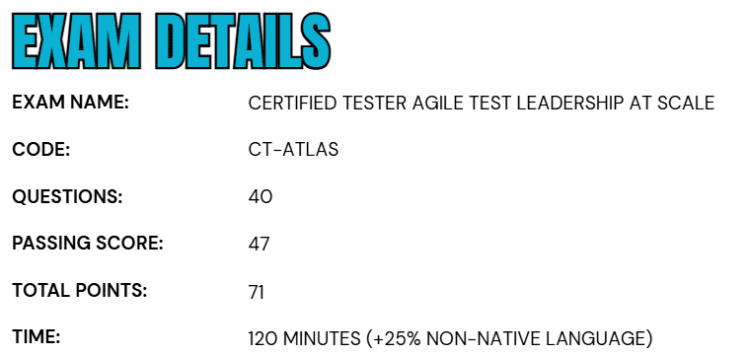
- The Certified Tester Agile Test Leadership at Scale (CT-ATLaS) exam is designed to evaluate a candidate’s ability to apply Agile quality leadership concepts at an organizational level.
- The examination consists of 40 multiple-choice questions with a maximum score of 71 points.
- To successfully earn the certification, candidates must achieve a minimum of 47 points, demonstrating a solid understanding of the exam objectives and the ability to apply Agile testing leadership principles in real-world organizational environments.
- The standard exam duration is 120 minutes. Candidates taking the exam in a language that is not their native language are typically granted an additional 25% time allowance, providing extra time to carefully read and answer the questions. This extended time helps ensure that language differences do not negatively impact a candidate’s performance.
Course Outline
The Certified Tester Agile Test Leadership at Scale (CT-ATLaS) exam covers the following topics:
1. Understand Quality Assistance – 60 minutes
1.1 What Is Quality Assistance
- Explaining quality assistance as an approach to quality and test management
1.2 Skills for Quality Assistance
- Give examples of the change leadership, quality coaching, facilitation, and training skills required for quality assistance
- Given a quality-related problem, provide quality assistance using one or more of the four important skills (change leadership, quality coaching, facilitation, and training)
2. Improving Quality and Flow in a Value-Driven Organization – 120 minutes
2.1 Facilitating Value Stream Mapping
- Explaining value stream as a concept
- Applying value stream mapping as an agile test leader to understand and visualize work flows
2.2 Analyzing a Value Stream from a Quality and Testing Perspective
- Analyzing a value stream to identify waste and other quality and testing issues using basic metrics
3. Learn Continuous Improvement of Quality and Testing – 150 minutes
3.1 Structured Problem-Solving Approach for Quality and Testing Activities
- Applying a Plan-Do-Check-Act cycle to address a quality problem
- Explaining how to embed Plan-Do-Check-Act in the organization
3.2 Systems Thinking and Analysis of Root Causes
- Explaining how systems thinking and root cause analysis support a quality assistance approach
- Applying causal loop diagram to identify root causes
4. Understand Organizational Test Strategy in a Value-Driven Organization – 165 minutes (K4)
4.1 Establishing an Organizational Test Strategy
- Explaining practices supporting DevOps and why to include them in the organizational test strategy
- Exemplifying how an organizational test strategy is created and implemented in a value-driven organization
- Implementing assessment techniques to validate that testing aligns with business and technical needs
4.2 Fit Agile Test Leadership into a Value-Driven Organization
- Analyzing how agile test leadership fits in an organization using an agile scaling framework

5. Understand Test Processes in a Value-Driven Organization – 195 minutes (K4)
5.1 Test Processes
- Exemplifying challenges specific to testing in the context of agile at scale product development
- Exemplifying agile at scale practices that help coordinate test efforts across agile and non-agile teams
- Defining a set of test and flow related metrics to establish transparency for stakeholders
- Structuring challenging test activities and test processes to fit business agility using a quality assistance approach
- Analyzing which test activities should be performed by stream-aligned teams and which should be performed by specialized service teams
Certified Tester Agile Test Leadership at Scale (CT-ATLaS) Exam FAQs
Certified Tester Agile Test Leadership at Scale (CT-ATLaS) Exam Study Guide
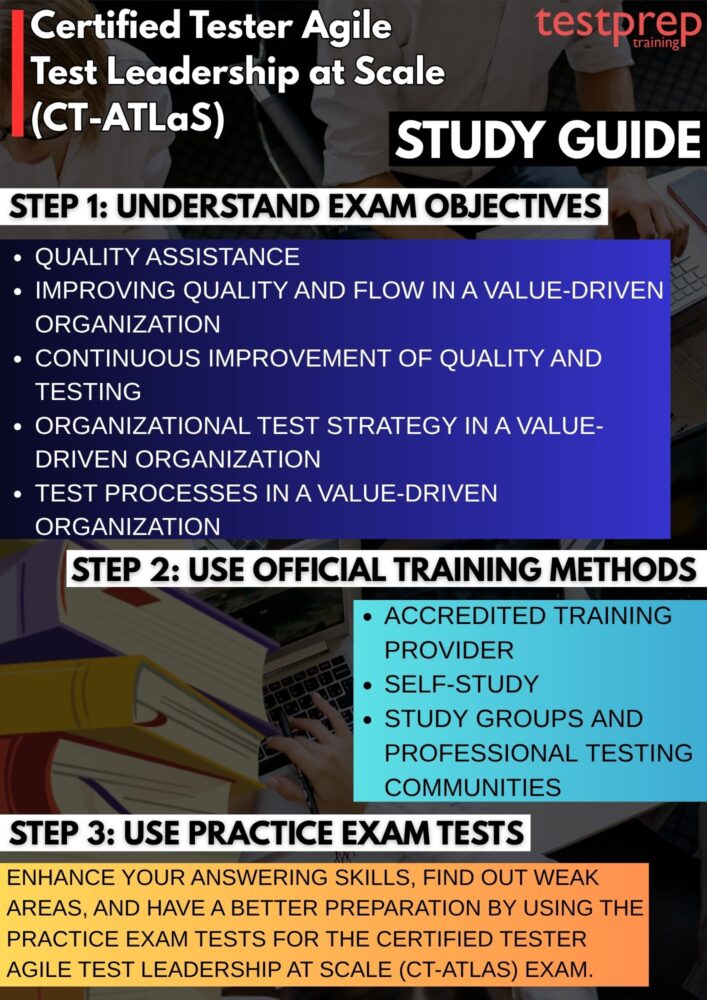
1. Study the Official Exam Syllabus and Learning Objectives Thoroughly
The first step in your preparation should be a detailed review of the official CT-ATLaS syllabus and its learning objectives. The syllabus defines every topic covered in the examination, the expected knowledge level for each objective, and the concepts candidates are expected to understand and apply. Carefully reviewing these objectives helps you identify the areas that require more attention while ensuring your study efforts remain aligned with the actual exam content. Creating a checklist based on the syllabus can also help you track your progress throughout your preparation.
2. Consider Training Through an Accredited Training Provider
Although not mandatory, enrolling in an ISTQB-accredited training course can provide a structured learning experience that closely follows the official certification syllabus. Accredited providers offer classroom training, instructor-led virtual sessions, and flexible e-learning programs to suit different learning preferences. These courses often include practical case studies, interactive discussions, real-world Agile scenarios, and expert guidance that help candidates understand how organizational quality leadership is applied in modern Agile environments. Professional training can also simplify complex topics and improve overall exam confidence.
3. Strengthen Your Knowledge Through Independent Self-Study
Self-study remains one of the most effective preparation methods, especially for professionals with prior Agile testing experience. Use the official syllabus as your primary study guide while supplementing it with the recommended reading materials and other reputable Agile testing resources. Focus on understanding key concepts such as Agile quality culture, Lean thinking, organizational test strategy, continuous improvement, and quality assistance rather than memorizing definitions. Taking organized notes, creating concept summaries, and reviewing practical examples can greatly improve knowledge retention.
4. Participate in Study Groups and Professional Testing Communities
Learning alongside other professionals can provide valuable insights that may not be available through individual study alone. Joining study groups, online forums, or software testing communities allows you to discuss challenging topics, exchange preparation techniques, ask questions, and learn from candidates who have already completed the certification. Engaging in professional discussions also exposes you to different perspectives on Agile quality leadership and organizational testing practices, helping reinforce your understanding of the subject matter.
5. Practice with Mock Exams and Sample Questions
Regular practice is essential for evaluating your readiness before taking the actual examination. Attempting mock exams and sample questions helps you become familiar with the question format, improve time management, and identify knowledge gaps that require additional study. After completing each practice test, carefully analyze both correct and incorrect responses to understand the reasoning behind each answer. This approach strengthens conceptual understanding and reduces the likelihood of making similar mistakes during the certification exam.
6. Revise Key Concepts and Develop an Effective Exam Strategy
As your exam date approaches, shift your focus from learning new topics to reinforcing your existing knowledge. Review your study notes, revisit important syllabus sections, and concentrate on areas where you performed less confidently during practice tests. Ensure you understand the relationships between Agile principles, organizational quality strategies, Lean practices, and continuous improvement techniques. Before exam day, familiarize yourself with the exam format, scoring method, and time allocation so you can approach each question with confidence and manage your time effectively throughout the examination.
