
ISTQB Certified Tester Acceptance Testing (CT-AcT)
The ISTQB® Certified Tester Acceptance Testing (CT-AcT) certification is designed to build strong expertise in acceptance testing by emphasizing collaboration between business and technical stakeholders. It focuses on aligning software delivery with real business needs through structured validation practices.
This certification covers key areas such as User Acceptance Testing (UAT), contractual and regulatory acceptance testing, and practical approaches like alpha and beta testing. The goal is to ensure that the final product meets stakeholder expectations and is ready for real-world use.
Who Should Take This Certification?
The CT-AcT certification is ideal for professionals who are directly or indirectly involved in acceptance testing activities. It is particularly valuable for:
- Product Owners
- Business Analysts
- Testers and Test Analysts
- Test Engineers and Test Consultants
- Test Managers
- User Acceptance Testers
- Software Developers
Eligibility Criteria
To enroll in the CT-AcT certification, candidates must first hold the ISTQB® Certified Tester Foundation Level (CTFL) certification. This ensures a solid understanding of fundamental testing principles before advancing into acceptance testing practices.
Key Learning Focus
This certification emphasizes:
- Effective collaboration between business stakeholders and testing teams
- Understanding and defining acceptance criteria
- Validating business requirements through structured testing
- Ensuring product readiness through real-world testing scenarios
Business Outcomes and Practical Benefits
Professionals who successfully complete the CT-AcT certification gain the ability to contribute meaningfully to acceptance testing processes across different roles.
– For Business Analysts and Product Owners
- Actively participate in designing acceptance tests that reflect real business needs
- Ensure alignment between delivered software and business requirements
- Support validation and verification of deliverables to maintain quality standards
- Improve the overall effectiveness of acceptance testing processes
– For Testers and QA Professionals
- Contribute to defining clear and testable acceptance criteria during requirement discussions
- Collaborate effectively with business stakeholders throughout the testing lifecycle
- Understand business goals and ensure testing aligns with those objectives
- Facilitate better communication between technical teams and business units
Exam Details
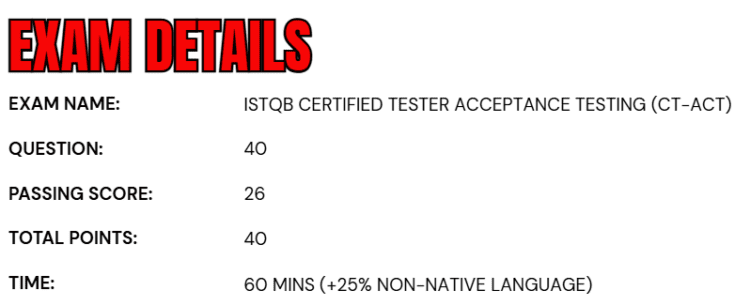
- The ISTQB Certified Tester Acceptance Testing (CT-AcT) exam is structured to evaluate a candidate’s understanding of acceptance testing concepts and their practical application in real-world scenarios.
- The exam consists of 40 multiple-choice questions, with each question carrying one point, making a total of 40 points.
- To successfully pass the certification, candidates must achieve a minimum score of 26 points, demonstrating a solid grasp of the subject.
- The standard duration of the exam is 60 minutes, while candidates who are taking the test in a non-native language are granted an additional 25% extra time to ensure fairness and comprehension.
Course Outline
The ISTQB Certified Tester Acceptance Testing (CT-AcT) exam covers the following topics:
1. Overview and Foundations – 80 mins.
1.1 Fundamental Relationships
- (K1) Recall the relationship between business goals, business needs and requirements
- (K2) Explain the relationship between requirements / user stories, acceptance criteria and acceptance tests
- (K2) Explain how the quality of requirements / user stories and acceptance criteria affects acceptance testing
1.2 Business Analysis and Acceptance Testing
- (K2) Summarize the relationship between acceptance testing activities and business analysis activities
- (K2) Explain how testers and business analysts collaborate in acceptance testing activities
- (K2) Describe Acceptance Test-Driven Development (ATDD) and BehaviorDriven Development (BDD)
2. Learn About Acceptance Criteria, Acceptance Tests and Experience-Based Practices – 165 mins.
2.1 Writing Acceptance Criteria
- (K3) For a given requirement or user story, develop a set of acceptance criteria that meet good practices
2.2 Designing Acceptance Tests
- (K2) Explain test approaches and test techniques for acceptance testing
- (K3) Apply the Gherkin language for designing acceptance tests for a given user story
2.3 Experience-based Approaches for Acceptance Testing
- (K2) Summarize how exploratory testing can be used for acceptance testing
- (K2) Summarize the relationship between beta testing and acceptance testing
3. Overview of Business Process and Business Rules Modeling – 150 mins.
3.1 Modeling Business Processes and Rules
- (K3) Construct a simple business process/rule model* using BPMN and/or DMN notations
3.2 Deriving Acceptance Tests from Business Process/Rule Models
- (K3) Derive a set of acceptance tests covering a given coverage criterion from a given, simple business process/rule model* (in BPMN or DMN)
3.3 Business Process Modeling for Acceptance Testing
- (K2) Summarize the good practices of business process and business rule modeling for acceptance testing
- (K2) Explain how business process and business rule modeling can be used for ATDD
4. Understand Acceptance Testing for Non-Functional Requirements – 95 mins.
4.1 Non-functional Characteristics and Quality in Use
- (K2) Give examples of ISO 25010 non-functional sub-characteristics that should be considered in acceptance tests
- (K1) Recall quality in use characteristics according to the ISO 25010 standard
4.2 Usability and User Experience
- (K2) Relate different types of usage scenarios to the four pillars of UX requirements analysis
- (K2) Summarize different methods for testing usability within the respective domains of application

4.3 Performance Efficiency
- (K2) Explain high-level performance tests according to given efficiency requirements
- (K2) Recognize the impact of different perspectives on performance acceptance criteria
4.4 Security
- (K2) Explain why security acceptance criteria and related high-level security tests are required for a project in accordance with a given security requirement
5. Learn Collaborative Acceptance Testing – 110 mins.
5.1 Collaboration
- (K3) For a given situation, apply social and communication skills relevant for collaborative acceptance testing activities
5.2 Activities
- (K2) Explain how to analyze discrepancies between actual and expected outcomes at the business level in a given context
- (K2) Summarize reporting activities for acceptance testing for stakeholders
- (K2) Explain different QA techniques for acceptance testing activities
5.3 Tool Support
- (K1) Recall scope and objectives of tool support for acceptance testing activities
ISTQB Certified Tester Acceptance Testing (CT-AcT) Exam FAQs
ISTQB Certified Tester Acceptance Testing (CT-AcT) Exam Study Guide
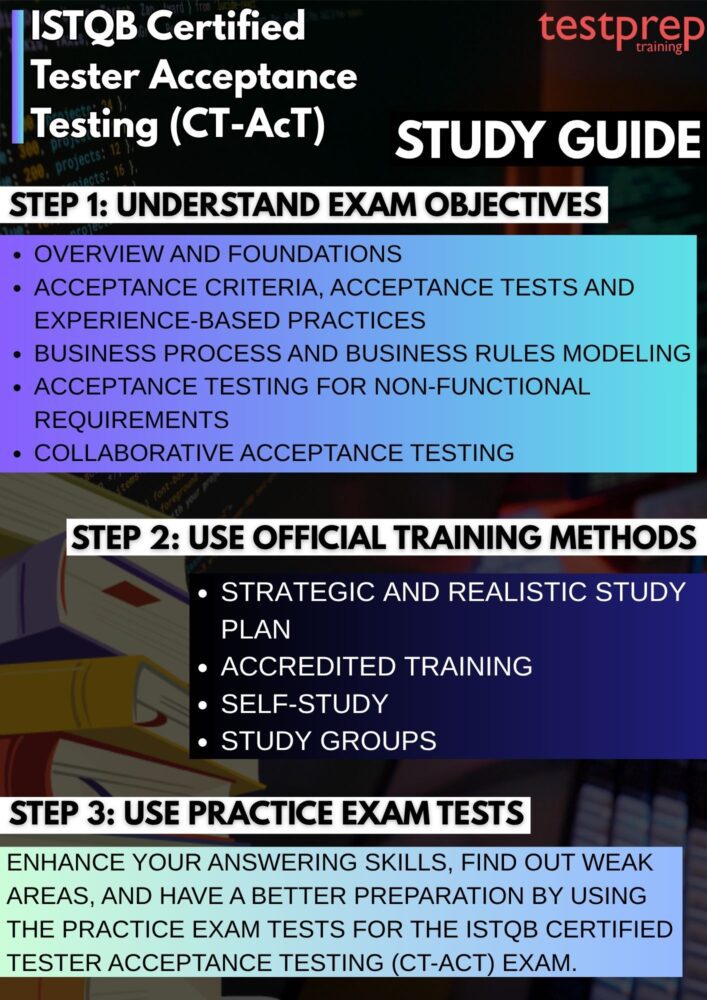
1. Master the Syllabus and Exam Objectives
Start by deeply analyzing the official CT-AcT syllabus rather than just skimming it. Understand the learning objectives (K-levels) associated with each topic, as they define whether you need basic recall, understanding, or application-level knowledge. Focus on high-weightage areas such as acceptance criteria definition, stakeholder collaboration, and different acceptance testing types (UAT, contractual, regulatory, alpha, beta). Pay attention to terminology, as ISTQB exams often test precise definitions and conceptual clarity. Mapping topics to real-world scenarios will make retention easier and improve your ability to handle situational questions.
2. Build a Strategic and Realistic Study Plan
A well-structured study plan is critical for consistent progress. Divide the syllabus into smaller sections and assign timelines based on complexity and your familiarity with each topic. Include dedicated slots for revision, practice tests, and weak-area improvement. If you are a working professional, aim for short but focused daily sessions rather than irregular long study hours. Use techniques like spaced repetition and active recall to improve memory retention. Tracking your progress weekly helps ensure you stay aligned with your preparation goals.
3. Leverage Accredited Training for Structured Learning
Enrolling in an ISTQB® accredited training program can significantly accelerate your preparation. These programs are designed and validated by ISTQB® Member Boards, ensuring alignment with the official syllabus and exam expectations. Training sessions often include real-world examples, case studies, and instructor insights that simplify complex concepts. Additionally, you gain access to curated study materials, exam-oriented tips, and sometimes mock tests. Whether you choose classroom, virtual, or self-paced e-learning, structured guidance can reduce confusion and improve efficiency.
4. Strengthen Concepts Through Self-Study
Self-study is essential to reinforce and deepen your understanding beyond training sessions. Use the official syllabus as your primary reference and complement it with recommended books or trusted resources. Focus on understanding why and how acceptance testing is performed, not just what it is. For example, explore how acceptance criteria are derived from business requirements or how stakeholder collaboration impacts test outcomes. Creating your own notes, diagrams, or summaries can help consolidate knowledge and make revision faster.
5. Engage in Study Groups and Professional Communities
Joining study groups or online communities can provide a collaborative learning advantage. Engaging with peers allows you to discuss challenging topics, clarify doubts, and gain different perspectives on the same concept. You may also discover practical insights, real exam experiences, and useful preparation strategies shared by others. Teaching or explaining concepts within a group is especially powerful, as it reinforces your own understanding and highlights any knowledge gaps.
6. Practice with Mock Exams and Scenario-Based Questions
Consistent practice is key to exam success. Attempt multiple mock tests and sample questions to become familiar with the exam pattern and question style. Focus especially on scenario-based questions, which are common in CT-AcT, and test your ability to apply concepts in real situations. Analyze your performance after each test—identify weak areas, understand why certain answers were incorrect, and revisit those topics. Over time, this will improve both accuracy and speed, which are crucial for completing the exam within the time limit.
7. Perform Targeted Revision and Exam Readiness
In the final phase, shift your focus to targeted revision rather than learning new topics. Review key concepts such as acceptance criteria, stakeholder roles, testing types, and core principles. Go through your notes, highlight important definitions, and revisit previously incorrect questions. Practice time management by attempting full-length mock exams under exam conditions. Ensure you are comfortable with the terminology and confident in interpreting questions correctly. A calm and well-prepared mindset will significantly improve your performance on exam day.
