
ISTQB Certified Tester AI Testing (CT-AI)

The ISTQB® Certified Tester AI Testing (CT-AI) v2.0 certification is a specialized program designed to equip professionals with the skills required to test modern AI-driven systems. This includes not only traditional machine learning models but also advanced generative AI systems such as large language models.
Unlike conventional software testing, AI systems introduce unique challenges such as probabilistic outputs, non-deterministic behavior, and heavy dependency on training data. This certification focuses on addressing these complexities by providing structured knowledge on how to effectively design, execute, and manage tests tailored for AI-based applications.
Lifecycle-Based Learning Approach
The CT-AI v2.0 syllabus follows a comprehensive lifecycle-based testing approach, ensuring that learners understand AI testing from end to end. Key areas covered include:
- Input Data Testing: Validating the quality, integrity, and relevance of data used for training and testing AI models
- Model Testing: Evaluating model behavior, accuracy, robustness, and fairness
- Machine Learning Development Testing: Ensuring quality throughout the ML pipeline, from training to deployment
Additionally, the certification introduces modern testing strategies aligned with the evolving landscape of AI technologies.
Target Audience
This certification is ideal for professionals directly or indirectly involved in AI system development and testing.
– Primary Audience:
- Testers, Test Analysts, and Test Engineers
- Test Managers and Test Consultants
- Data Analysts and Data Scientists
- Software Developers working on AI-based systems
- User Acceptance Testers
– Secondary Audience:
It is also beneficial for individuals seeking a broader understanding of AI testing, including:
- Project Managers
- Quality Managers
- Software Development Managers
- Business Analysts
- IT Directors and Management Consultants
Prerequisite
To enroll in the CT-AI v2.0 certification, candidates must first hold the ISTQB Certified Tester Foundation Level (CTFL) certification. This ensures a strong foundation in software testing principles before advancing into AI-specific concepts.
Key Business Outcomes
Professionals who achieve the CT-AI certification are expected to deliver tangible value within their organizations. Upon completion, candidates will be able to:
- Develop a solid understanding of the current AI landscape, including generative AI technologies
- Gain practical exposure to implementing and testing machine learning models
- Understand the fundamentals of neural networks and their testing considerations
- Apply AI-specific quality characteristics based on recognized standards such as ISO/IEC 25059
- Calculate and interpret key machine learning performance metrics
- Identify and apply AI-specific testing levels within ML systems
- Contribute to building effective and scalable test strategies for AI-based solutions
- Design and execute comprehensive test cases tailored for machine learning systems
Why Choose CT-AI v2.0?
As AI adoption continues to accelerate across industries, the demand for skilled professionals who can ensure the reliability, fairness, and performance of AI systems is growing rapidly. The CT-AI certification positions you at the forefront of this transformation by combining foundational testing knowledge with cutting-edge AI testing practices.
Exam Details
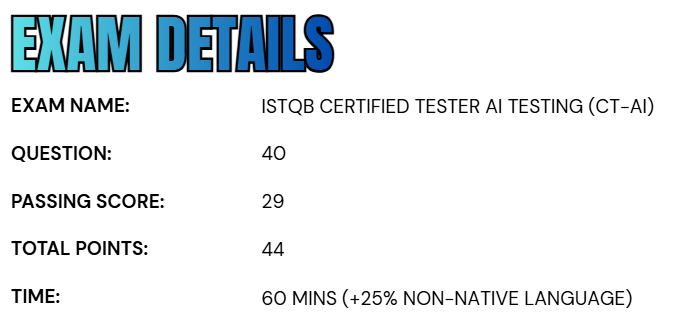
- The ISTQB® Certified Tester AI Testing (CT-AI) v2.0 certification exam is designed to evaluate a candidate’s understanding of AI testing concepts and practices through a structured assessment format.
- The exam consists of 40 questions, carrying a total of 44 points, and candidates are required to achieve a minimum score of 29 points to pass.
- The standard duration of the exam is 60 minutes, with an additional 25% time extension granted to non-native English speakers to ensure a fair testing experience.
Course Outline
The ISTQB Certified Tester AI Testing (CT-AI) certification exam covers the following topics:
1. Overview of Artificial Intelligence – 120 minutes
1.1 Introduction to AI
- (K2) Differentiate between AI-based systems and conventional systems
- (K2) Distinguish between narrow AI, general AI, and super AI
- (K2) Explain the different types of AI technologies
- (K2) Explain generative AI
- (K2) Compare the choices available for hardware to implement machine learning systems
- (K2) Compare the options for the development and hosting of AI models
- (K2) Summarize the functionality provided by ML development frameworks
- (K2) Explain how regulations and standards affect the development and testing of AI-based systems
2. Learn about Quality Characteristics for AI-Based Systems – 45 minutes
2.1 Quality Characteristics for AI-Based Systems
- (K2) Classify behaviors of AI-based systems according to the quality characteristics defined in ISO/IEC 25059
- (K2) Explain the special considerations that arise when AI is used in safety-related systems
2.2 Acceptance Criteria for AI-Based Systems
- (K2) Give examples of acceptance criteria for AI-based systems
3. Understand Machine Learning – 375 minutes
3.1 Introduction to Machine Learning
- (K2) Distinguish between the different forms of ML
- (K2) Summarize the workflow used to create an ML system
- (H2) Create an ML model
- (K2) Summarize the use of pretrained models, fine-tuning, and retrieval-augmented generation
3.2 Data for Machine Learning
- (K2) Explain the activities related to data preparation
- (H2) Perform data preparation to support the creation of an ML model
- (K2) Contrast the use of training, validation, and test datasets in the development of an ML model
3.3 ML Functional Performance Metrics for Classification
- (K3) Calculate common ML functional performance metrics from a given set of confusion matrix data
- (H2) Evaluate an ML model using selected ML functional performance metrics
- (H2) Show the impact of different ML models and dataset combinations on the training and behavior of the models
3.4 Neural Networks
- (K2) Explain the structure and working of a deep neural network
- (H1) Experience the implementation of a perceptron
- (K2) Describe the different coverage measures for neural networks
4. Learn about Testing AI-Based Systems – 195 minutes
4.1 Introduction to Testing AI-Based Systems
- (K2) Compare the testability of locked and adaptive AI-based systems
- (K2) Explain why a statistical approach is often needed when testing AI-based systems
- (K2) Explain the challenges and solutions relating to test oracles for AI-based systems

4.2 Testing Generative AI and LLM
- (K2) Explain how generative AI can be tested
- (K3) Implement red teaming for GenAI systems
- (H2) Apply exploratory testing to an LLM performing boundary value analysis
4.3 Test Levels and Machine Learning Systems
- (K2) Summarize the test levels used to develop machine learning systems
- (K2) Explain how risk-based testing is applied to machine learning systems
5. Understand Input Data Testing for Machine Learning Systems – 180 minutes
5.1 Input Data Testing for Machine Learning Systems
- (K2) Give examples of test approaches used for the risk mitigation of input data for a machine learning system
- (K2) Explain how to test for bias
- (K2) Summarize the various forms of data pipeline testing
- (K2) Explain how to test for data representativeness
- (K3) Apply dataset constraint testing
- (K2) Explain label correctness testing
- (H2) Perform input data testing for ML datasets
6. Learn about Model Testing for Machine Learning Systems – 225 minutes
6.1 Model Testing for Machine Learning Systems
- (K2) Give examples of test approaches used for risk mitigation of ML models
- (K2) Explain the purpose and focus of reviewing ML model documentation
- (K2) Explain how ML functional performance testing is carried out for probabilistic machine learning systems
- (K2) Summarize adversarial testing of machine learning systems
- (K3) Use metamorphic testing to derive test cases for a given scenario
- (H2) Apply metamorphic testing
- (K2) Explain how drift testing is used on operational machine learning systems
- (K2) Explain how overfitting and underfitting are detected by testing
- (K2) Explain how A/B testing is used in the context of machine learning systems
- (K2) Explain how back-to-back testing is used in the context of machine learning systems
7. Overview of Machine Learning Development Testing – 30 minutes
7.1 Machine Learning Development Testing
- (K2) Give examples of test approaches used for risk mitigation of ML development
- (K2) Explain the various forms of ML system deployment testing
ISTQB Certified Tester AI Testing (CT-AI) Exam FAQs

ISTQB Certified Tester AI Testing (CT-AI) Exam Study Guide
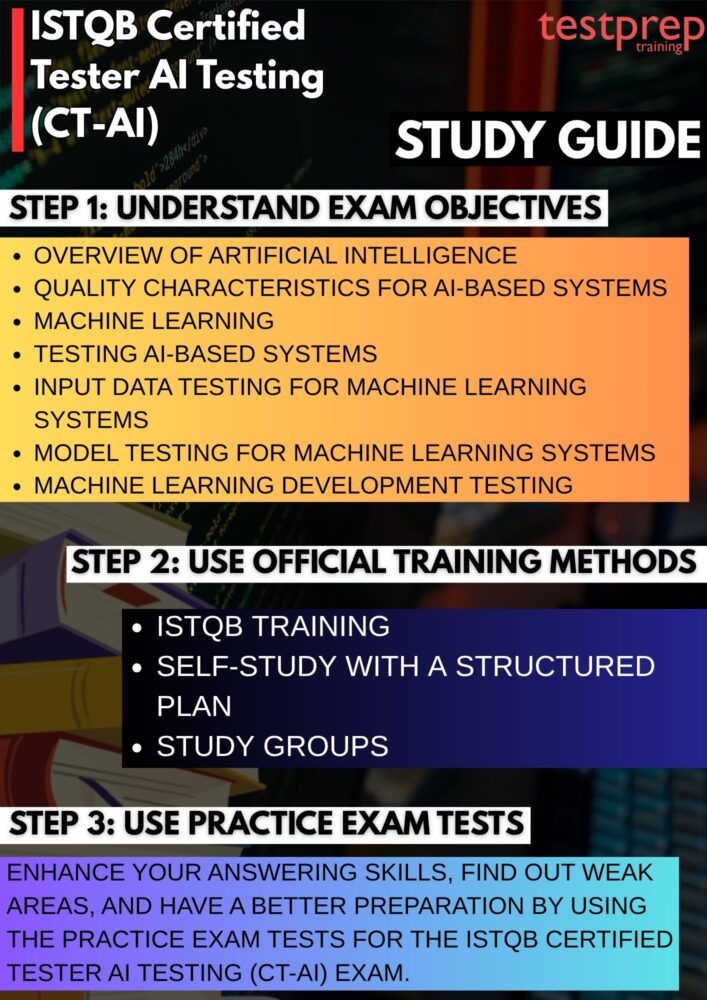
1. Perform a Deep Analysis of the Syllabus and Learning Objectives
Start by going beyond a surface-level reading of the syllabus. Break down each learning objective into measurable outcomes and map them to expected question types. Pay close attention to cognitive levels (e.g., recall, understand, apply), as ISTQB exams often test not just knowledge but your ability to apply concepts in practical scenarios. Identify high-weight topics such as AI-specific quality characteristics, data testing, model validation, and ML lifecycle testing. Creating a topic-wise preparation tracker can help ensure complete syllabus coverage without gaps.
2. Invest in Accredited Training for Structured and Validated Learning
Enrolling in an accredited training course is highly beneficial, as the content is officially reviewed by an ISTQB® Member Board for accuracy and alignment with the syllabus. These programs typically offer structured modules, real-world case studies, and instructor-led explanations of complex topics like non-deterministic behavior and bias in AI systems. More importantly, accredited training helps bridge the gap between theoretical knowledge and practical implementation, which is critical for this certification.
3. Build a Strategic Self-Study Plan Aligned with the ML Lifecycle
Self-study should not be random—it should follow a structured approach aligned with the AI/ML lifecycle. Allocate dedicated time to key areas such as data preparation and validation, model training and evaluation, and deployment testing. Use the syllabus as your backbone and create a weekly study plan with clear milestones. Incorporate active learning techniques such as summarization, mind mapping, and scenario-based thinking to reinforce understanding rather than passive reading.
4. Expand Knowledge with High-Quality Reference Materials
Relying solely on the syllabus is not enough for mastering AI testing concepts. Use recommended reading materials to gain deeper insights into topics like machine learning algorithms, neural networks, performance metrics, and ethical AI considerations. Understanding real-world challenges—such as data drift, overfitting, and model explainability—will give you an edge, especially for application-based questions in the exam.
5. Engage in Collaborative Learning Through Communities and Peer Groups
Joining study groups, forums, or professional communities can significantly accelerate your preparation. Interaction with peers allows you to discuss complex topics, clarify doubts, and learn alternative problem-solving approaches. Participating in discussions around real-world AI testing challenges can also help you connect theoretical concepts with practical use cases, making your preparation more robust and exam-focused.
6. Practice Extensively with Scenario-Based Mock Tests
Practice tests should be treated as a core component of your preparation strategy, not just a final step. Focus on high-quality, scenario-based questions that reflect the real exam pattern. After each test, perform a detailed analysis of your performance—identify incorrect answers, understand the reasoning behind correct ones, and revisit weak areas. This iterative feedback loop will significantly improve both accuracy and confidence.
7. Conduct Focused Revision and Optimize Exam Readiness
In the final phase, shift your focus to consolidation and refinement. Create concise revision notes for critical topics such as AI quality attributes, testing techniques, and ML performance metrics. Revisit challenging concepts multiple times and ensure clarity on commonly confused areas. Additionally, practice time management by simulating real exam conditions to ensure you can complete all questions within the allocated time. A well-planned revision strategy will help you enter the exam with confidence and clarity.
