
ISTQB Certified Tester Gambling Industry Tester (CT-GT)

The ISTQB Certified Tester Gambling Industry Tester (CT-GT) certification is designed to provide a comprehensive understanding of software testing within the gambling domain. It focuses on industry-specific concepts, the overall gambling ecosystem, and the specialized testing approaches required for casino, lottery, and betting systems.
This certification emphasizes critical testing areas such as compliance with regulatory standards, player experience validation (often referred to as “fun factor” testing), mathematical accuracy, audio and visual elements, multiplayer functionality, and system interoperability. By covering these aspects, CT-GT ensures that professionals are equipped to handle the unique challenges of testing gambling software.
Target Audience
The CT-GT certification is suitable for a wide range of professionals involved in software testing and development within the gambling industry. It is particularly beneficial for:
- Software testers, test analysts, and test engineers
- Test consultants and test managers
- User acceptance testers and QA professionals
- Software developers working on gambling platforms
In addition, this certification is valuable for professionals in related roles who want to strengthen their understanding of gambling software testing, such as:
- Project managers and product managers
- Quality assurance managers
- Software development managers
- Business or system analysts
- IT managers and consultants
Who Should Consider This Certification?
The Foundation Level CT-GT certification is ideal for:
- Professionals seeking to expand their knowledge of the gambling industry
- Individuals aiming to build a specialized career in casino, betting, or lottery software testing
- Anyone involved in testing gambling-related applications who wants to gain structured, domain-specific expertise
It is also suitable for stakeholders who require a foundational understanding of testing in this sector, including leadership and strategic roles within gaming organizations.
Prerequisite
To be eligible for the CT-GT certification, candidates must first obtain the ISTQB Certified Tester Foundation Level (CTFL) certification. This ensures that all candidates have a solid grounding in general software testing principles before advancing into this specialized domain.
Key Business Outcomes
Professionals who successfully achieve the CT-GT certification are expected to demonstrate the following capabilities:
- Improved Communication
- Develop a shared vocabulary and understanding across teams, enabling clearer and more effective communication within gambling projects.
- Domain-Specific Quality Awareness
- Recognize and evaluate the unique quality attributes that are critical in gambling systems, such as fairness, reliability, and user engagement.
- Understanding of Industry Practices
- Gain insight into common development and testing methodologies used specifically in the gambling sector.
- Knowledge of Certification and Compliance
- Understand the importance of hardware and software certification processes, which distinguish the gambling industry from many other domains due to strict regulatory requirements.
- Application of Specialized Testing Techniques
- Utilize proven test design techniques tailored to gambling applications, ensuring accurate validation of features like game logic and payouts.
- Awareness of Regulatory Environments
- Appreciate the role of jurisdictions and regulatory authorities, and how compliance impacts software design, testing, and deployment.
Exam Details
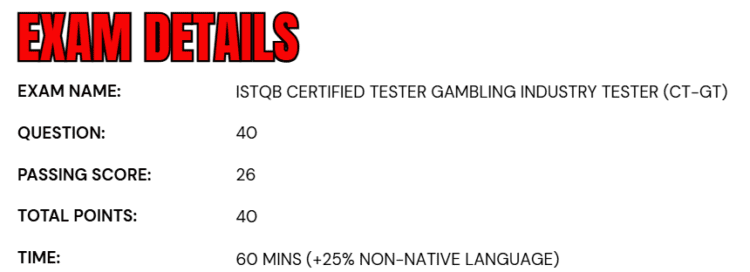
- The ISTQB Certified Tester Gambling Industry Tester (CT-GT) examination is structured to assess a candidate’s understanding of gambling domain-specific testing concepts in a clear and time-bound manner.
- The exam consists of 40 multiple-choice questions, with each question carrying one mark, making a total of 40 points.
- To successfully pass the examination, candidates are required to achieve a minimum score of 26 points.
- The standard exam duration is 60 minutes, with an additional 25% extra time granted to candidates taking the exam in a non-native language, ensuring fairness and accessibility for a global audience.
Course Outline
The ISTQB Certified Tester Gambling Industry Tester (CT-GT) exam covers the following topics:
1. Overview of Gambling Industry – 215 mins.
1.1 Objectives and Overview
- (K1) Recognize the objectives of the gambling syllabus (5 mins)
- (K2) Summarize the specific skills for gambling industry testing, not present in other testing areas (15 mins)
1.2 Gambling Activities and Artefacts
- (K1) Recognize the objectives of gambling (5 mins)
1.3 Types of Gambling
- (K2) Explain casino games (15 mins)
- (K2) Explain lottery systems (15 mins)
- (K2) Explain race and sports wagering (15 mins)
- (K2) Explain online and mobile gambling (15 mins)
1.4 Key Concepts in the Gambling Industry
- (K2) Explain progressive jackpots (15 mins)
- (K2) Explain random number generators (15 mins)
- (K2) Explain the win selection process (15 mins)
- (K2) Explain player privacy and geolocation (15 mins)
- (K2) Explain regulatory commissions, jurisdictions and associations (15 mins)
1.5 Gambling Industry Metrics
- (K2) Explain first pass percentage (15 mins)
- (K2) Explain escape compliance defects (15 mins)
1.6 Gambling Software Development Lifecycle
- (K2) Summarize the gambling software development lifecycle (15 mins)
- (K1) Recognize the role of the independent test lab (ITL) (5 mins)
- (K1) Recognize the role of regulatory commissions (5 mins)
2. Understand The Gambling Industry Ecosystems – 90 mins.
2.1 Testing Phases within the Gambling Software Development Lifecycle
- (K2) Classify different test types for the gambling quality assurance testing phase (15 mins)
- (K2) Explain compliance testing (15 mins)
2.2 The Gambling Ecosystems
- (K2) Explain the gambling industry ecosystem (15 mins)
- (K2) Explain video lottery terminals and their ecosystem (15 mins)
- (K2) Explain slot machines and their ecosystem (15 mins)
- (K2) Explain lottery and its ecosystem (15 mins)
3. Learn about Testing in the Gambling Industry – 435 mins.
3.1 Gambling and Wagering Testing
- (K2) Summarize the concepts of functional testing within the gambling industry (15 mins)
- (K2) Identify common areas where gambling and wagering defects are found (15 mins)
- (K2) Summarize the concepts of casino game compliance testing (15 mins)
3.2 Math Testing
- (K2) Explain math testing (15 mins)

3.3 Platform Testing
- (K2) Summarize the concepts of platform functional testing (15 mins)
- (K2) Identify what areas are covered by platform functional testing (15 mins)
- (K2) Summarize the concepts of platform compliance testing (15 mins)
- (K2) Identify what areas are covered by platform compliance testing (15 mins)
3.4 Casino System Testing
- (K2) Summarize the concepts of casino system functional testing (15 mins)
- (K2) Summarize the concepts of casino system compliance testing (15 mins)
- (K2) Identify what areas are covered by casino system compliance testing (15 mins)
3.5 Protocol Testing
- (K2) Summarize the concepts of protocol functional testing (15 mins)
- (K2) Identify what areas are covered by protocol functional testing (15 mins)
- (K2) Summarize the concepts of protocol compliance testing (15 mins)
- (K2) Identify what areas are covered by protocol compliance testing (15 mins)
3.6 Hardware Testing
- (K2) Summarize the concepts of hardware functional testing (15 mins)
- (K2) Identify what areas are covered by hardware functional testing (15 mins)
- (K2) Summarize the concepts of hardware compliance testing (15 mins)
- (K2) Identify what areas are covered by hardware compliance testing (15 mins)
- (K2) Summarize the concepts of hardware integration testing (15 mins)
- (K2) Identify common areas where hardware integration defects are found (15 mins)
- (K2) Identify what test types are done for hardware integration testing (15 mins)
3.7 Remote Gambling Testing
- (K2) Explain remote gambling testing (15 mins)
3.8 System and Network Security Testing
- (K2) Explain system and network security testing in the gambling industry (15 mins)
3.9 Jackpot Controller Testing
- (K2) Summarize the concepts of jackpot controller testing (15 mins)
- (K2) Identify what areas are covered by jackpot controller testing (15 mins)
3.10 Online Gambling Testing
- (K2) Summarize the concepts of online gambling testing (15 mins)
- (K2) Identify what areas are covered by online gambling testing (15 mins)
- (K2) Identify what test types are done for online gambling testing (15 mins)
ISTQB Certified Tester Gambling Industry Tester (CT-GT) Exam FAQs

ISTQB Certified Tester Gambling Industry Tester (CT-GT) Exam Study Guide
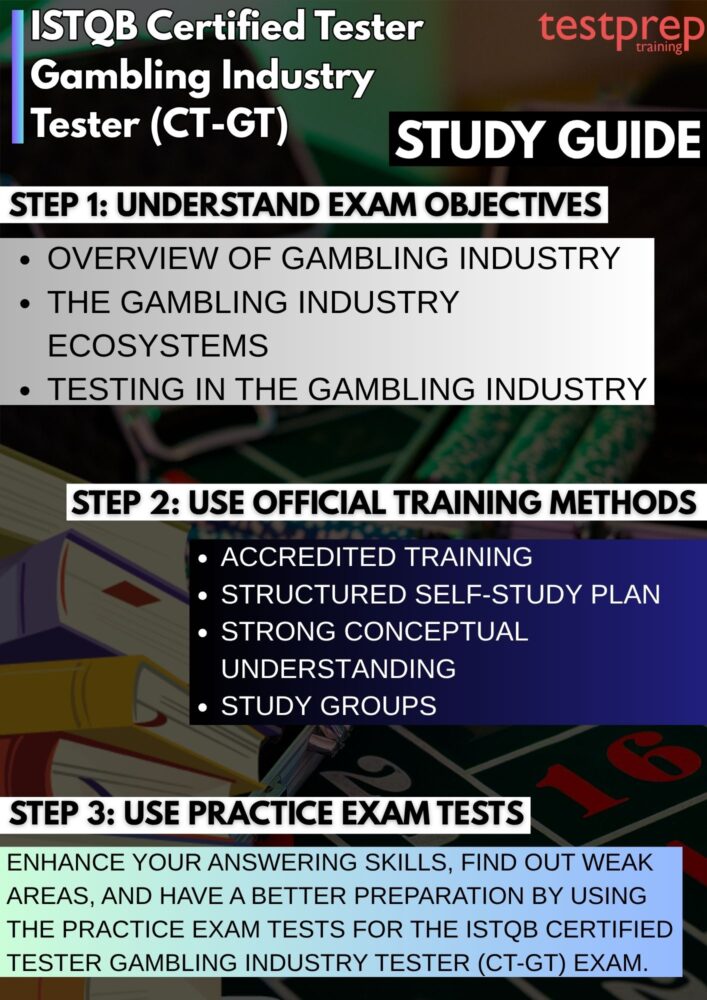
1. Understand the Exam Structure and Syllabus Focus
Begin your preparation by carefully analyzing the official CT-GT syllabus and exam objectives. This acts as the foundation of your study plan, outlining all topics, learning outcomes, and cognitive levels expected in the exam. Break down the syllabus into manageable sections and identify high-weightage areas such as compliance testing, gambling system architecture, and specialized testing techniques. It is also beneficial to map each topic with real-world scenarios to better understand how theoretical concepts are applied in the gambling industry. Creating short notes or mind maps at this stage can significantly improve retention and revision efficiency.
2. Enroll in Accredited Training Programs
Participating in accredited training programs can provide a structured and guided learning experience. These programs are designed in alignment with ISTQB® standards and are reviewed by recognized member boards to ensure accuracy and consistency with the syllabus. Training can be attended in multiple formats, including instructor-led classroom sessions, live virtual classes, or self-paced e-learning modules. In addition to theoretical knowledge, these programs often include practical examples, case studies, and exam-focused tips that help bridge the gap between concepts and real exam scenarios. Access to certified trainers also allows you to clarify doubts instantly and gain deeper insights into complex topics.
3. Follow a Structured Self-Study Plan
Self-study plays a critical role in reinforcing what you learn during training. Develop a well-organized study schedule that allocates sufficient time to each topic based on its complexity and importance. Use the official syllabus as a checklist to track your progress and ensure complete coverage. Supplement your preparation with recommended reading materials, industry articles, and documentation related to gambling systems and testing practices. Incorporating active learning techniques—such as summarizing topics in your own words, creating flashcards, or teaching concepts to others—can enhance understanding and long-term memory.
4. Build Strong Conceptual Understanding
Rather than relying on rote memorization, focus on developing a deep understanding of core concepts. The CT-GT exam often tests your ability to apply knowledge in practical situations, especially in areas like regulatory compliance, fairness validation, and risk-based testing. Try to relate each concept to real-world gambling applications, such as online casinos, sports betting platforms, or lottery systems. Understanding how different components interact within the gambling ecosystem will help you answer scenario-based questions more accurately and confidently.
5. Join Study Groups and Professional Communities
Collaborating with others can significantly enrich your preparation journey. Join online forums, social media groups, or professional communities dedicated to ISTQB certifications. These platforms allow you to discuss challenging topics, exchange study resources, and gain different perspectives on the same concept. Engaging in discussions also exposes you to practical experiences shared by industry professionals, which can deepen your understanding of real-world testing challenges. Additionally, group study sessions can help maintain motivation and accountability throughout your preparation.
6. Practice with Mock Tests and Sample Questions
Consistent practice is essential to achieving success in the CT-GT exam. Attempt a variety of mock tests and sample questions to familiarize yourself with the exam pattern, question styles, and difficulty level. Practice tests help improve your time management skills and train you to think critically under exam conditions. After each test, thoroughly review your answers—especially the incorrect ones—to identify knowledge gaps and areas that require further revision. Keeping track of your performance over time can also help you measure progress and build confidence.
7. Revise Strategically and Track Your Progress
As you approach the exam date, shift your focus toward systematic revision and performance evaluation. Consolidate your notes, highlight key concepts, and revisit topics that you find challenging. Use quick revision techniques such as summary sheets, diagrams, and checklists to reinforce important information. Regularly monitor your mock test scores and analyze trends to ensure continuous improvement. Maintaining a balanced study routine, along with proper rest and time management, will help you stay focused and perform at your best on exam day.
