
ISTQB Certified Tester Game Testing (CT-GaMe)
The ISTQB® Certified Tester Game Testing (CT-GaMe) certification is designed to build specialized expertise in testing video games across different platforms and development stages. It focuses on the practical and conceptual skills required to effectively test game software, ensuring quality, performance, and an engaging user experience.
This certification provides a structured understanding of game testing fundamentals, including how games differ from traditional software and the unique challenges involved in validating gameplay, mechanics, and user interaction.
Key Learning Areas
The CT-GaMe certification equips candidates with the ability to:
- Understand core principles of video game development and testing
- Identify and evaluate risks, objectives, and quality goals specific to game projects
- Design, implement, and execute effective test cases for game software
- Apply specialized testing approaches such as:
- Game Mechanics Testing
- Audio and Sound Testing
- Graphics and Visual Testing
- Localization Testing for global audiences
- Recognize and utilize tools that support game testing processes
Additionally, the certification emphasizes aligning testing practices with the software development lifecycle (SDLC) to improve efficiency and reduce the overall cost of game production and release.
Target Audience
The CT-GaMe certification is suitable for a wide range of professionals involved in software testing and game development.
– For Testing Professionals
- Testers and QA Engineers
- Test Analysts and Consultants
- Test Managers
- User Acceptance Testers (UAT)
– For Game Development Roles
- Game Developers and Designers
- Quality Assurance Specialists in gaming
- Professionals involved in gameplay validation and user experience
– For Broader IT and Business Roles
- Project Managers
- Quality Managers
- Software Development Managers
- Business Analysts
- IT Directors and Consultants
It is also valuable for individuals working on high-performance hardware platforms, including PCs, mobile devices, and gaming consoles, where game performance and compatibility are critical.
Eligibility Requirements
To pursue the CT-GaMe certification, candidates must:
- Hold the ISTQB® Certified Tester Foundation Level (CTFL) certification
- Possess practical experience in software testing, preferably with exposure to game-related projects
Business Outcomes and Skills Gained
Professionals who achieve the CT-GaMe certification are expected to deliver measurable value in game testing environments. Key outcomes include:
- Clearly explaining game testing concepts and methodologies
- Identifying risks, requirements, and stakeholder expectations in game projects
- Designing and executing structured and efficient test scenarios
- Applying appropriate testing techniques tailored for gaming environments
- Selecting and using relevant testing tools effectively
- Integrating testing activities within the development lifecycle to enhance product quality
- Contributing to cost optimization by identifying defects early and improving release readiness
Exam Details
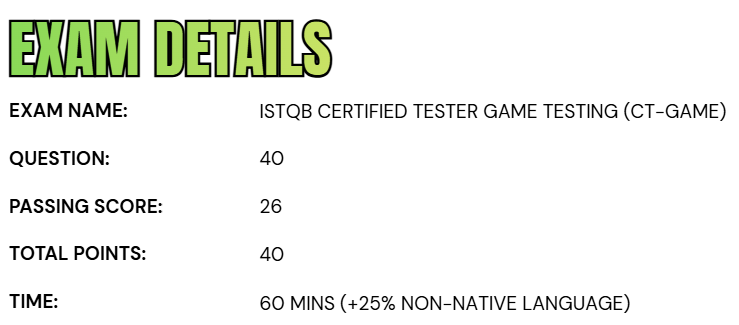
- The Certified Tester Game Testing (CT-GaMe) exam is a structured assessment designed to evaluate a candidate’s knowledge and practical understanding of game testing concepts.
- The exam consists of 40 questions, with each question contributing to a total of 40 points.
- To successfully pass the certification, candidates must achieve a minimum score of 26 points, demonstrating a solid grasp of the subject matter.
- The total duration of the exam is 60 minutes, providing sufficient time to carefully review and answer all questions.
- Candidates who are taking the exam in a non-native language are granted an additional 25% extra time, ensuring fairness and accessibility. This format ensures a balanced evaluation of both theoretical knowledge and applied testing skills within the context of game development.
Course Outline
The Certified Tester Game Testing (CT-GaMe) exam covers the following topics:
1. Understand the Specificity of Game Testing – 75 minutes (K2)
1.1 Game Testing Basics
- (K1) Recognize objectives and specifics of game testing
- (K2) Give examples of product risks in game software
- (K2) Give examples of specific defects related to game testing
- (K2) Summarize how the risks of game testing can be mitigated
- (K2) Compare the activities of game testing with those of playing
1.2 Typical Roles of the Game Development Team
- (K1) Recognize specific roles and tasks in the game development team
1.3 Testing Activities throughout the Game Software Development Lifecycle
- (K1) Recall testing activities throughout the game software development lifecycle
2. Learn the Testing Game Mechanics – 180 minutes (K3)
2.1 Game Mechanics
- (K2) Classify the types of game mechanics
- (K2) Differentiate the testing of gameplay mechanics and non-gameplay mechanics
- (K2) Differentiate the testing of core mechanics and meta mechanics
- (K2) Differentiate the testing of client, server, and client-server mechanics
- (K2) Give examples of defects in game mechanics
2.2 Approaches to Testing Game Mechanics
- (K2) Summarize main approaches and test objects at different stages of creating a game product
- (K2) Distinguish the importance of testing game mechanics
- (K2) Distinguish the importance of reviewing documentation describing game mechanics
- (K3) Apply the fundamental approaches of testing game mechanics
3. Overview of Graphics Testing – 165 minutes (K3)
3.1 Principles and Concepts of Game Graphics
- (K2) Explain features of the graphic content of a game product
- (K2) Classify the types of defects in graphic content
3.2 Approaches to Testing Graphics in Game Products
- (K2) Summarize the main approaches to artistic testing
- (K2) Summarize the main approaches to technical testing
- (K2) Summarize main approaches to gameplay testing
3.3 Graphics Test Execution
- (K3) Apply the fundamental approaches of graphics testing
- (K2) Explain the importance of testing graphics for historical validity
3.4 Tools Support for Graphics Testing
- (K2) Summarize the usage of graphics testing tools
4. Understand Sound Testing – 190 minutes (K3)
4.1 Features of the Sound Content of the Game Product
- (K1) Recall features of the sound content of a game product
4.2 Types of Defects in Sound Content
- (K1) Recall types of defects in sound content
- (K2) Classify the defects in sound content
4.3 Approaches to Testing Sound Content in Game Products
- (K2) Summarize the main approaches to content-auditory testing
- (K2) Summarize the main approaches for testing the mix of music and sounds
- (K2) Summarize the main approaches for testing music composition

4.4 Sound Test Execution
- (K2) Explain the levels of testing audio-music content
- (K1) Recall the features of integrating sounds into the client
- (K1) Recall areas of responsibility of sound testing
- (K3) Apply approaches to sound testing
4.5 Tools Support for Sound Testing
- (K2) Summarize the usage of sound testing tools
5. Learn about Game Level Testing – 65 minutes (K2)
5.1 Game Level Design Principles and Concepts
- (K1) Recall the components of the game level
- (K2) Classify the defects typical of game levels
5.2 Stages and Execution of Game Level Testing
- (K2) Summarize the tests carried out at various stages of the creation of game levels
- (K2) Compare the areas of responsibility of specialists who take part in testing the game level
5.3 Tools Support for Game Level Testing
- (K2) Summarize the usage of tools for testing game levels
6. Understand Game Controllers Testing – 95 minutes (K2)
6.1 Principles and Concepts of Game Controllers
- (K2) Classify typical input devices and specialized ones
- (K2) Give examples of different input devices in terms of their application
- (K1) Recall different types of game controllers
- (K2) Classify the defects in a game product related to the specifics of game controllers, and possible causes of their occurrence
6.2 Approaches to Testing Controllers in Game Products
- (K2) Give examples for test conditions to be covered when testing game controllers
- (K2) Classify tasks for UX specialists, testers, and game designers during game testing
6.3 Tools Support for Game Controllers Testing
- (K2) Summarize the usage of tools for testing the behavior of game controllers
7. Learn about Localization Testing – 155 minutes (K3)
7.1 Principles and Concepts of Localization Testing
- (K1) Recognize the localization test steps
- (K1) Recall the main objectives of internationalization and localization
- (K2) Compare internationalization and localization capabilities
7.2 Types of Localization Defects and their Causes
- (K2) Classify the localization defects and their causes
7.3 Localization Testing Approaches and Execution
- (K1) Recognize the full and partial localization testing
- (K3) Classify localization testing types
- (K2) Summarize testing tasks for a writer, editor, translator, and localization tester
7.4 Tools Support for Localization Testing
- (K2) Summarize the usage of tools for testing of game localization
ISTQB Certified Tester Game Testing (CT-GaMe) Exam FAQs
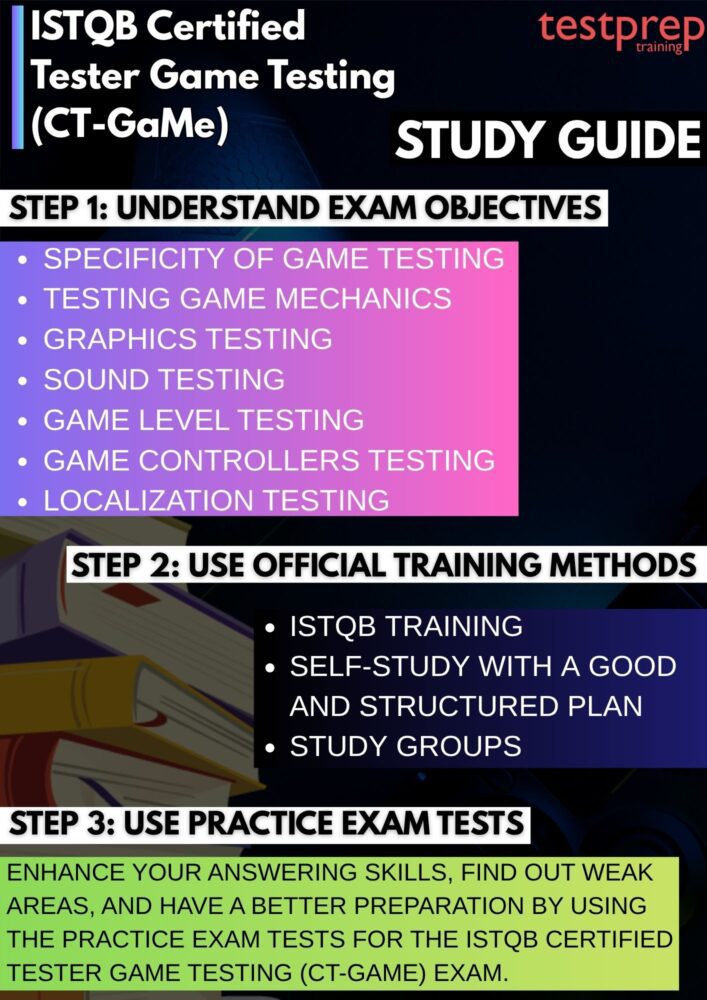
ISTQB Certified Tester Game Testing (CT-GaMe) Exam Study Guide
1. Analyze the Exam Structure and Learning Objectives
Start your preparation by carefully studying the official CT-GaMe syllabus and exam guidelines. Go beyond a surface-level review—analyze each learning objective, its cognitive level (e.g., recall vs. application), and the weightage assigned to different sections. Identify critical domains such as gameplay mechanics, graphics validation, sound testing, and localization. Understanding how questions are distributed helps you allocate your study time efficiently and ensures you focus on high-priority topics that are more likely to appear in the exam.
2. Enroll in Accredited Training Programs
Opting for training from ISTQB®-accredited providers can significantly streamline your preparation. These courses—whether classroom-based, live virtual sessions, or self-paced e-learning—are officially reviewed to ensure they align with the latest syllabus and industry practices. Accredited training often includes structured modules, real-world examples, instructor guidance, and practice questions, which can accelerate your understanding. It also reduces the risk of studying outdated or irrelevant material, giving you a more focused and reliable learning path.
3. Follow a Structured and Disciplined Self-Study Plan
Self-study remains a crucial component of exam success. Use the official syllabus as your roadmap and supplement it with recommended textbooks, blogs, and game testing case studies. Break the syllabus into smaller sections and assign timelines to each topic. Maintain concise notes, highlight key definitions, and summarize important testing techniques. Incorporating active learning methods—such as mind maps, flashcards, and quick quizzes—can improve retention and help you recall information more effectively during the exam.
4. Develop Practical Understanding with Real-World Scenarios
Game testing is highly experiential, so it’s important to connect theoretical concepts with practical gaming scenarios. For example, understand how testing differs when validating a game’s physics engine versus its UI responsiveness or sound synchronization. Explore how testers identify bugs related to game balance, player experience, and performance across devices. This practical perspective not only strengthens your conceptual clarity but also prepares you for scenario-based questions that assess your ability to apply knowledge rather than just recall facts.
5. Engage with Study Groups and Professional Communities
Joining study groups, online forums, and professional communities dedicated to ISTQB or game testing can provide valuable support throughout your preparation. These platforms allow you to discuss difficult topics, share resources, and learn from others’ experiences. You may also gain access to exam tips, curated notes, and real-world insights from professionals who have already completed the certification. Collaborative learning often exposes you to different perspectives, helping you deepen your understanding of complex topics.
6. Practice with Mock Exams and Evaluate Performance
Consistent practice is essential for mastering the exam format. Attempt full-length mock tests and topic-wise practice questions under timed conditions to simulate the actual exam environment. This helps you improve time management, question interpretation, and decision-making skills. After each test, perform a detailed analysis of your performance—identify patterns in mistakes, revisit weak areas, and understand why certain answers were incorrect. This feedback loop is critical for continuous improvement.
7. Perform Targeted Revision and Exam Readiness Preparation
As the exam date approaches, shift your focus toward strategic revision. Revisit your notes, key concepts, and frequently tested topics. Pay special attention to areas where you previously struggled, and reinforce your understanding through quick reviews and additional practice questions. Avoid learning entirely new topics at the last moment; instead, concentrate on consolidating your existing knowledge. Ensure you are comfortable with terminology, testing approaches, and practical applications, so you can approach the exam with confidence and clarity.
