
ISTQB Certified Tester Model-Based Tester (CT-MBT)
The ISTQB® Certified Tester Model-Based Testing (CT-MBT) certification introduces a modern and structured approach to software testing that leverages models for designing, generating, and managing test cases. Rather than relying solely on traditional manual techniques, this certification emphasizes the use of abstract representations (models) to improve both test effectiveness and efficiency. Model-Based Testing (MBT) enhances and extends well-established test design techniques such as:
- Equivalence Partitioning
- Boundary Value Analysis
- Decision Table Testing
- State Transition Testing
- Use Case Testing
By integrating these techniques into model-driven workflows, MBT enables testers to create more comprehensive, reusable, and maintainable test suites, making it a powerful approach for modern software systems.
Furthermore, earning the CT-MBT certification demonstrates your ability to contribute effectively to model-driven testing initiatives. It positions you as a professional capable of bridging the gap between traditional testing methods and modern, automation-driven approaches. Moreover, this certification serves as a stepping stone toward advanced ISTQB certifications, helping you grow into more specialized and strategic testing roles.
Who Should Consider CT-MBT Certification?
The CT-MBT certification is designed for a broad range of professionals involved in software development and testing. It is particularly valuable for individuals who want to deepen their understanding of structured testing methodologies and adopt advanced testing practices.
– Primary Audience
- Testers and Test Engineers
- Test Analysts and Technical Test Analysts
- Test Managers and QA Leads
- Software Developers and System Architects
– Secondary Audience
- Project Managers and Product Managers
- Quality Managers
- Business Analysts and Process Experts
- IT Leaders and Consultants
Additionally, this certification is suitable for anyone seeking a strong foundation in model-based testing concepts and their practical application in real-world projects.
Eligibility Criteria
To enroll in the CT-MBT certification, candidates must first hold the ISTQB® Certified Tester Foundation Level (CTFL) certification. This ensures that all participants have a solid understanding of fundamental software testing principles before advancing to model-based techniques.
Key Business Outcomes
Professionals who achieve the CT-MBT certification gain practical skills that can directly impact software quality and testing efficiency within an organization. A certified Model-Based Tester is able to:
- Collaborate Effectively in MBT Environments
- Work seamlessly within teams using standardized terminology, established MBT concepts, and structured processes.
- Integrate MBT into Test Processes
- Apply model-based testing approaches within existing testing frameworks to enhance coverage and streamline workflows.
- Develop and Maintain Test Models
- Design, refine, and manage test models using industry best practices to ensure accuracy and scalability.
- Generate High-Value Test Artifacts
- Create and maintain test cases and related artifacts derived from models, while considering risk, business value, and system priorities.
- Improve Quality Assurance Practices
- Support organizations in evolving their QA processes by introducing more efficient, systematic, and proactive testing strategies.
Exam Details
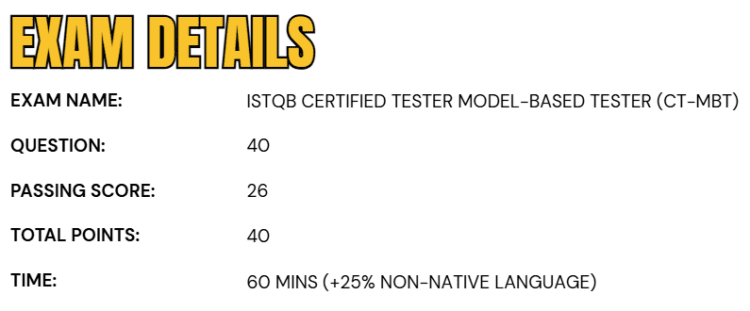
- The ISTQB Certified Tester Model-Based Tester (CT-MBT) exam is designed to evaluate a candidate’s understanding of model-based testing concepts and their practical application.
- The exam consists of 40 multiple-choice questions, with each question carrying one mark, making a total of 40 points.
- To successfully pass the exam, candidates must achieve a minimum score of 26 out of 40, which reflects a solid grasp of the subject matter.
- The standard exam duration is 60 minutes; however, candidates taking the exam in a non-native language are typically granted an additional 25% extra time, ensuring a fair opportunity to comprehend and respond to all questions effectively.
Course Outline
The ISTQB Certified Tester Model-Based Tester (CT-MBT) exam covers the following topics:
1. Overview of Model-Based Testing – 90 minutes (K2)
1.1 Objectives and Motivations for MBT
- (K2) Describe expected benefits of MBT
- (K2) Describe misleading expectations and pitfalls of MBT
1.2 MBT Activities and Work Products in the Test Process
- (K2) Summarize the activities specific to MBT when deployed in a test process
- (K1) Recall the essential MBT work products (inputs and outputs)
1.3 Integrating MBT into the Software Development Lifecycle
- (K2) Explain how MBT integrates into software development lifecycle processes
- (K2) Explain how MBT supports requirements engineering
2. Understand MBT Modeling – 250 minutes (K3)
2.1 MBT Modeling
- (K3) Develop a simple MBT model for a test object and predefined test objectives using a workflow-based modeling language (refer to section 8.1 – “simple” means less than 15 modeling elements)
- (K3) Develop a simple MBT model for a test object and predefined test objectives using a state transition-based modeling language (refer to section 8.2 – “simple” means less than 15 modeling elements)
- (K2) Provide examples of MBT models describing the system, the environment or the test
- (K2) Give examples of how an MBT model depends on the test objectives
2.2 Languages for MBT Models
- (K1) Recall examples of modeling language categories commonly used for MBT
- (K2) Give examples of good fits between test objectives and modeling language categories for different systems and project objectives
2.3 Good Practices for MBT Modeling Activities
- (K1) Recall quality characteristics for MBT models
- (K2) Describe classic mistakes and pitfalls during modeling activities for MBT
- (K2) Explain the advantages of linking requirements and process related information to the MBT model
- (K2) Explain the necessity of guidelines for MBT modeling
- (K2) Provide examples where reuse of existing models (from requirements phase or development phase) is or is not appropriate
- (K1) Recall tool types supporting specific MBT modeling activities
- (K2) Summarize iterative MBT model development, review and validation
3. Learn Selection Criteria for Test Case Generation – 205 minutes (K3)
3.1 Classification of MBT Test Selection Criteria
- (K2) Classify the various families of test selection criteria used for test generation from models
- (K3) Generate test cases from an MBT model to achieve given test objectives in a given context
- (K2) Provide examples of model coverage, data-related, pattern- and scenario-based and project-based test selection criteria
- (K2) Recognize how MBT test selection criteria relate to ISTQB Foundation Level test techniques
3.2 Applying Test Selection Criteria
- (K1) Recall degrees of test work product generation automation
- (K3) Apply given test selection criteria to a given MBT model
- (K2) Describe good practices of MBT test selection criteria

4. Concept of MBT Test Implementation and Execution – 120 minutes (K3)
4.1 Specifics of MBT Test Implementation and Execution
- (K2) Explain the difference between high-level and low-level test cases in the MBT context
- (K2) Explain the different kinds of test execution in the MBT context
- (K3) Perform updates of an MBT model and test generation caused by changes in requirements, test objects or test objectives
4.2 Activities of Test Adaptation in MBT
- (K2) Explain which kind of test adaptation may be necessary for test execution in MBT
5. Understand Evaluating and Deploying an MBT Approach – 60 minutes (K2)
5.1 Evaluate an MBT Deployment
- (K2) Describe ROI factors for MBT introduction
- (K2) Explain how the objectives of the project are related to the characteristics of the MBT approach
- (K1) Recall selected metrics and key performance indicators to measure the progress and results of MBT activities
5.2 Manage and Monitor the Deployment of an MBT Approach
- (K1) Recall good practices for test management, change management and collaborative work when deploying MBT
- (K1) Recall cost factors of MBT
- (K1) Recall the necessity of integrating the MBT tool with configuration management, requirements management, test management and test automation tools
ISTQB Certified Tester Model-Based Tester (CT-MBT) Exam FAQs

ISTQB Certified Tester Model-Based Tester (CT-MBT) Exam Study Guide
1. Master the Syllabus and Exam Objectives
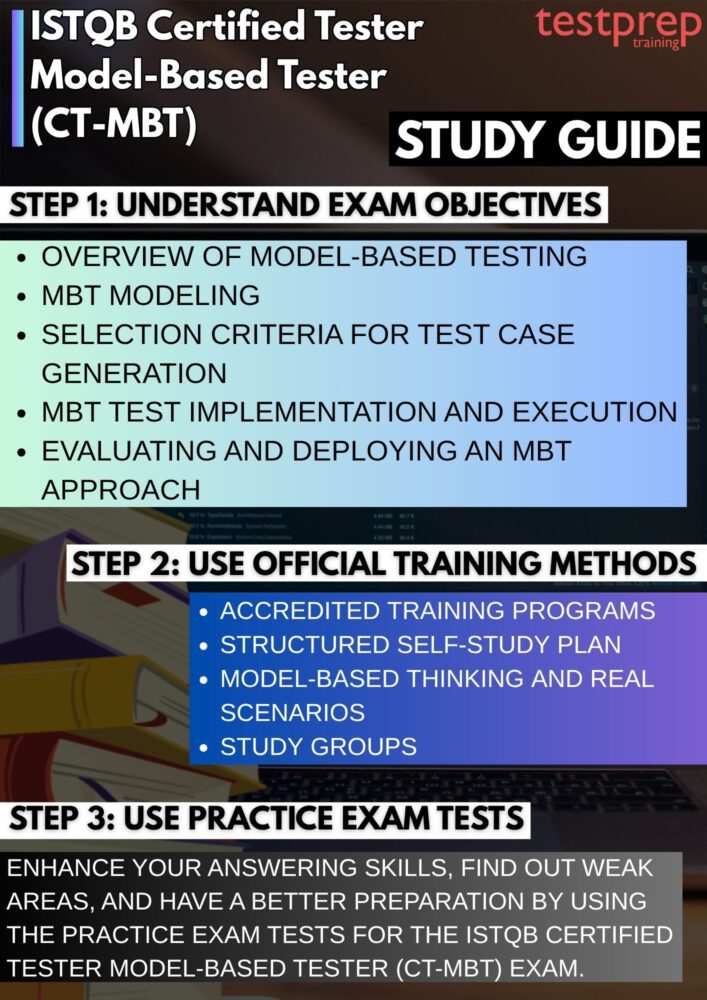
Start with a deep dive into the official CT-MBT syllabus, as it is the single most important document for your preparation. Carefully review each chapter, learning objective, and cognitive level (K1–K4) to understand the depth of knowledge required. Pay close attention to high-weightage areas such as modeling concepts, test generation strategies, coverage criteria, and MBT process integration.
Break the syllabus into smaller sections and create a study plan that allocates time based on topic complexity. Instead of just reading, aim to interpret concepts in your own words, create short notes, and map how different topics are interconnected. This structured approach ensures you are studying with purpose and alignment to exam expectations.
2. Enroll in Accredited Training Programs
Accredited Training Providers (ATPs) offer structured learning experiences that are specifically aligned with the CT-MBT syllabus. These programs are available in classroom, live virtual sessions, and self-paced e-learning formats, making them accessible for different learning preferences.
The key advantage of accredited training is that the course material is reviewed and approved by ISTQB® Member Boards, ensuring consistency, accuracy, and exam relevance. Trainers often bring real-world experience, helping you understand how MBT concepts are applied in actual projects. Additionally, training programs usually include practice questions, case studies, and exam-focused tips, which can significantly accelerate your preparation.
3. Build a Strong Foundation Through Self-Study
Self-study is essential to reinforce and expand upon what you learn in training. Use the syllabus as your roadmap and supplement it with recommended books, technical articles, and industry resources. Focus on understanding the “why” behind each concept—for example, why certain modeling techniques are preferred in specific scenarios.
Create concise notes, diagrams, and summary sheets for topics like state models, decision models, and test coverage techniques. Revisiting these notes regularly will improve retention. Allocate time for revision cycles to ensure concepts are not forgotten. A disciplined self-study routine helps you develop both conceptual clarity and long-term retention.
4. Practice Model-Based Thinking and Real Scenarios
CT-MBT is not just theoretical—it requires you to think in terms of models and abstractions. Practice creating different types of models such as state transition diagrams, flowcharts, or decision tables based on simple real-world systems (e.g., login systems, e-commerce workflows).
Once you create a model, practice deriving test cases, identifying coverage criteria, and analyzing potential defects. This hands-on approach will help you understand how models drive test design and improve test coverage. The more you practice, the more comfortable you will become in translating requirements into structured models, which is a critical skill for the exam.
5. Join Study Groups and Professional Communities
Learning in isolation can limit your understanding, especially for advanced topics like MBT. Joining study groups, online forums, or professional communities allows you to interact with other learners and experienced professionals. Engaging in discussions helps clarify doubts, exposes you to different problem-solving approaches, and keeps you motivated throughout your preparation journey. You can also exchange study materials, participate in group quizzes, and learn from others’ experiences. This collaborative environment often makes complex topics easier to grasp and improves overall confidence.
6. Attempt Practice Tests and Analyze Performance
Practice tests are crucial for evaluating your readiness. Regularly attempt mock exams and sample questions that simulate the actual test environment. This helps you become familiar with the question style, difficulty level, and time management requirements. After each test, don’t just check your score—analyze your mistakes in detail. Identify whether errors are due to conceptual gaps, misinterpretation of questions, or time pressure. Maintain a log of weak areas and revisit those topics during your study sessions. Over time, this iterative improvement process will significantly enhance your accuracy and confidence.
7. Revise Strategically and Prepare for Exam Day
In the final stage of preparation, focus on structured revision rather than learning new topics. Review your notes, key definitions, modeling techniques, and important concepts such as coverage criteria and MBT workflows. Practice quick recall of important terms and revisit challenging questions. Plan your exam strategy in advance—decide how much time to allocate per question and how to handle difficult ones.
Ensure you are well-rested before the exam and approach it with a calm, focused mindset. A strong revision strategy not only reinforces your knowledge but also ensures you enter the exam with clarity, confidence, and readiness to perform at your best.
