
Microsoft Certified Azure AI Apps and Agents Developer Associate (AI-103)
The Microsoft Certified: Azure AI Apps and Agents Developer Associate (AI-103) certification is designed for professionals who want to build intelligent applications and AI-powered agents using Microsoft Azure technologies and Microsoft Foundry. This certification validates the skills required to design, develop, deploy, and manage modern AI solutions that leverage generative AI, machine learning capabilities, and Azure AI services.
Professionals pursuing this certification are expected to understand how AI applications integrate with cloud-based services and how intelligent agents can automate tasks, improve user experiences, and support business operations across industries.
Who Should Take This Certification?
This certification is ideal for Azure AI engineers, AI application developers, cloud developers, and technology professionals who are involved in creating AI-driven solutions. It is particularly suitable for candidates who want to work with generative AI models, intelligent agents, natural language processing, computer vision, and information extraction technologies within the Azure ecosystem.
Candidates should have hands-on development experience and a solid understanding of Azure services, AI concepts, and application deployment strategies.
Required Skills and Technical Knowledge
To successfully prepare for the AI-103 certification exam, candidates should possess practical experience in developing applications using Python. A strong understanding of AI development workflows and cloud-based AI services is also important. Candidates are expected to be familiar with:
- General artificial intelligence concepts and workflows
- Generative AI technologies and large language model capabilities
- Microsoft Azure AI services and cloud solutions
- AI application deployment and management processes
- Integration of intelligent agents into business applications
Practical experience with Azure tools, APIs, and AI service integration can significantly improve exam readiness and real-world implementation skills.
Core Responsibilities of an Azure AI Engineer
Professionals working in this role are responsible for designing, implementing, and maintaining AI-powered solutions within Azure environments. Their responsibilities often include both development and operational tasks related to AI systems.
- Planning and Managing Azure AI Solutions
- Azure AI engineers are responsible for planning AI architectures, selecting appropriate Azure AI services, managing cloud resources, and ensuring AI solutions meet business and technical requirements. This includes configuring environments, monitoring performance, and maintaining scalable AI systems.
- Implementing Generative AI and Agentic Solutions
- One of the key focus areas of the AI-103 certification is the development of generative AI applications and intelligent agents. Candidates should understand how to build AI-powered assistants, automate workflows, integrate large language models, and create conversational experiences using Azure AI technologies.
- Implementing Computer Vision Solutions
- Candidates should know how to develop applications that analyze and interpret visual data. This includes image recognition, object detection, facial analysis, OCR capabilities, and other computer vision-related tasks using Azure AI Vision services.
- Implementing Text Analysis Solutions
- Text analysis is another important skill area covered in the certification. Azure AI engineers should understand how to process and analyze text data for sentiment analysis, language detection, entity recognition, summarization, and conversational AI solutions.
- Implementing Information Extraction Solutions
- Professionals are also expected to implement solutions that extract structured information from unstructured data sources. This may include document intelligence, form processing, data extraction, and automated content analysis workflows.
- Collaboration and Cross-Functional Work
- Azure AI engineers rarely work in isolation. In real-world environments, they collaborate closely with multiple teams and stakeholders to successfully deliver AI solutions. These professionals often work alongside:
- Business stakeholders to understand organizational requirements
- Solution architects to design scalable AI systems
- Data scientists to integrate machine learning models
- DevOps engineers to manage deployment pipelines and infrastructure
- Cloud security engineers to maintain compliance and security standards
- Azure AI engineers rarely work in isolation. In real-world environments, they collaborate closely with multiple teams and stakeholders to successfully deliver AI solutions. These professionals often work alongside:
Why This Certification Matters
The demand for AI-powered applications and intelligent automation continues to grow rapidly across industries. Organizations are increasingly investing in generative AI, intelligent agents, and cloud-based AI services to improve efficiency and customer experiences.
Earning the Microsoft Certified: Azure AI Apps and Agents Developer Associate (AI-103) certification demonstrates your ability to build and manage modern AI solutions using Microsoft Azure technologies. It can help strengthen your professional credibility, improve career opportunities, and validate your expertise in one of the fastest-growing areas of cloud computing and artificial intelligence.
Exam Details
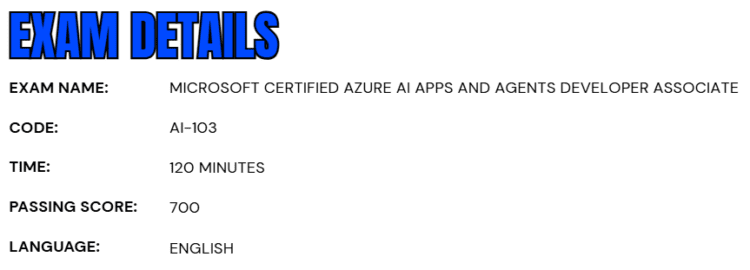
- The AI-103: Developing AI Apps and Agents on Azure certification exam is an intermediate-level Microsoft certification designed for professionals working in AI engineering and application development roles. This exam validates a candidate’s ability to design, build, deploy, and manage AI-powered applications and intelligent agents using Microsoft Azure technologies and AI services.
- To successfully pass the AI-103 exam, candidates must achieve a minimum score of 700 or higher.
- The total duration of the assessment is 120 minutes, during which candidates may encounter a combination of theoretical and practical questions designed to evaluate both technical knowledge and real-world implementation skills.
- This certification exam is conducted under a proctored environment to maintain exam integrity and security standards. Additionally, the exam may include interactive components, allowing candidates to complete hands-on tasks or scenario-based activities that simulate real-world AI development workflows.
- Microsoft also provides support for candidates who require accommodations during the exam process. Individuals using assistive technologies, requiring additional time, or needing modifications to the exam experience can request appropriate accommodations in advance according to Microsoft’s certification policies.
- Currently, the AI-103 exam is available in English.
Course Outline
The AI-103: Developing AI Apps and Agents on Azure certification exam covers the following topics:
1. Learn about Planning and managing an Azure AI solution (25–30%)
Choosing the appropriate Foundry services for generative AI and agents
- Choosing an appropriate model for each task, including large language models (LLMs), small language models, multimodal models, and Foundry Tools (Microsoft Documentation: Microsoft Foundry Models overview (classic), What are multimodal LLMs?, Azure Language in Foundry Tools)
- Choosing the appropriate Foundry services for generative tasks, grounding, vector search, agent workflows, or multimodal processing (Microsoft Documentation: Foundry Agent Service, Agent tools overview for Foundry Agent Service)
- Selecting an appropriate method for retrieval and indexing (Microsoft Documentation: Retrieval augmented generation (RAG) and indexes)
- Choosing appropriate memory, tool, and knowledge integration services for agent solutions
Setting up AI solutions in Foundry
- Designing Azure infrastructure for AI apps and agent-based solutions (Microsoft Documentation: Azure AI apps and agents)
- Choosing appropriate deployment options (Microsoft Documentation: Deployment types for Microsoft Foundry Models)
- Configuring model and agent deployments (Microsoft Documentation: Configure and deploy agents from the Agent Library)
- Integrating Foundry projects with continuous integration and continuous deployment (CI/CD) pipelines
Managing, monitoring, and securing AI systems
- Managing quotas, scaling, rate limits, and cost footprints for model and agent workloads (Microsoft Documentation: Manage and increase quotas for resources with Microsoft Foundry, Microsoft Foundry Models quotas and limits)
- Monitoring model performance, drift, safety events, and grounding quality (Microsoft Documentation: Monitor the performance of models deployed to production, Azure Machine Learning model monitoring)
- Monitoring data ingestion quality, search index health, and relevance performance
- Configuring security, including managed identity, private networking, keyless credentials, and role policies (Microsoft Documentation: Configure secure access with managed identities and virtual networks)
Implementing responsible AI across generative AI and agentic systems
- Configuring safety filters, guardrails, risk detection, and content moderation (Microsoft Documentation: What is Azure AI Content Safety?, Content filtering for Microsoft Foundry Models, Guardrails and controls overview in Microsoft Foundry)
- Applying responsible AI instrumentation, including evaluators, safety evaluations, and explanation tooling
- Implementing auditing through trace logging, provenance metadata, and approval workflows
- Governing agent behavior with oversight modes, constraints, and tool-access controls (Microsoft Documentation: Governance and security for AI agents across the organization, AI governance and security)
2. Understand about Implementing generative AI and agentic solutions (30–35%)
Building generative applications by using Foundry
- Deploying and consuming LLMs, small models, code models, and multimodal models (Microsoft Documentation: What are multimodal LLMs, Microsoft Foundry Models overview)
- Implementing retrieval-augmented generation (RAG) in an application (Microsoft Documentation: Retrieval augmented generation (RAG) and indexes, Retrieval-augmented generation (RAG) in Azure AI Search, Build advanced retrieval-augmented generation systems)
- Designing workflows, tool-augmented flows, and multistep reasoning pipelines
- Evaluating models and apps, including detecting fabrications, relevance, quality, and safety
- Integrating generative workflows into applications by using Foundry SDKs and connectors (Microsoft Documentation: Integrate Microsoft Foundry with your applications, Microsoft Foundry SDKs and Endpoints)
- Configuring an application to connect to a Foundry project (Microsoft Documentation: Configure a connection to use Microsoft Foundry Models in your AI project, Add a new connection to your project)
Building agents by using Foundry
- Defining agent roles, goals, conversation-tracking approach, and tool schemas (Microsoft Documentation: AI agent orchestration patterns, Microsoft Agent Framework)
- Building agents that integrate retrieval, function-calling, and conversation memory
- Integrating agent tools, including APIs, knowledge stores, search, content understanding, and custom functions (Microsoft Documentation: Create a knowledge base in Azure AI Search, Agent tools overview, Azure Content Understanding)
- Implementing orchestrated multi-agent solutions (Microsoft Documentation: Explore multi-agent orchestration patterns)
- Building autonomous or semiautonomous workflows with safeguards and approval flow controls
- Integrating monitoring into deployed agents, evaluate agent behavior, and perform error analysis (Microsoft Documentation: Evaluate your AI agents)
Optimizing and operationalizing generative AI systems
- Tuning generation behavior, such as prompt engineering and adjusting model parameters (Microsoft Documentation: Model fine-tuning concepts, Prompt engineering techniques)
- Implementing model reflection, chain-of-thought evaluations, and self-critique loops (Microsoft Documentation: Chain of thought prompting)
- Setting up observability by implementing tracing, token analytics, safety signals, and latency breakdowns (Microsoft Documentation: Set up tracing in Microsoft Foundry, Observability for Generative AI and agentic AI systems)
- Orchestrating multiple models, flows, or hybrid LLM and rules engines (Microsoft Documentation: What is orchestration workflow?)
3. Implementing computer vision solutions (10–15%)
Designing and implementing image- and video-generation solutions
- Implementing a solution that generates images from text prompts and reference media (Microsoft Documentation: Generate images from text using AI)
- Implementing a solution that generates videos from text prompts and reference media (Microsoft Documentation: Generate videos with Microsoft Foundry)
- Configuring image-editing workflows, including inpainting, mask‑based edits, and prompt‑driven modifications (Microsoft Documentation: Azure OpenAI image generation models)
- Implementing workflows to edit generated videos
- Selecting and applying appropriate generation and editing controls provided by the platform
Designing and implementing multimodal understanding workflows
- Building a solution that analyzes visual context by using multimodal models
- Configuring apps to produce concise or detailed captions for single or multiple images
- Implementing a solution that enables question‑answering grounded in visual evidence (Microsoft Documentation: What is custom question answering?)
- Configuring generation of alt‑text and extended image descriptions aligned to accessibility guidelines (Microsoft Documentation: Generate image alt text with Image Analysis)
- Implementing visual understanding by configuring Azure Content Understanding in Foundry Tools to extract visual characteristics (Microsoft Documentation: Azure Content Understanding in Foundry Tools document solutions, What is Azure Content Understanding in Foundry Tools?, What is a Content Understanding analyzer?)
- Implementing video analysis workflows to process and interpret video segments (Microsoft Documentation: AudioVisual analysis: extracting structured content, Automate video analysis)
- Configuring single‑task and pro‑mode Content Understanding pipelines (Microsoft Documentation: Create Content Understanding Standard and Pro tasks)
- Implementing solutions that identify objects, components, or regions within images or video (Microsoft Documentation: Object detection (version 4.0), What is Image Analysis?)
Implementing responsible AI for multimodal content
- Implementing filters to classify unsafe or disallowed visual content (Microsoft Documentation: Content filtering for Microsoft Foundry Models, Configure content filters)
- Detecting and mitigating indirect prompt injection by using embedded text in images
- Enforcing visual policy rules, such as applying watermarks, flagging prohibited symbols, upholding brand usage requirements, and detecting potentially inappropriate content

4. Learn Implement text analysis solutions (10–15%)
Applying language model text analysis
- Implementing solutions to extract entities, topics, summaries, and structured JSON outputs by using generative prompting and Foundry Tools (Microsoft Documentation: Extract entities using Azure OpenAI structured outputs mode, How to use structured outputs for chat models)
- Configuring detection of sentiment, tone, safety issues, and sensitive content
- Building solutions that translate text by using Azure Translator in Foundry Tools or LLM‑powered translation flows (Microsoft Documentation: Azure Translator in Foundry Tools, What is Azure Text translation in Foundry Tools?)
- Customizing language model outputs for domain tasks, such as compliance summarization and domain extraction
- Implementing workflows to convert speech to text and text to speech for agentic interactions (Microsoft Documentation: What is speech to text?)
- Integrating speech as an agent modality, including custom speech models (Microsoft Documentation: What is custom speech?)
- Enabling multimodal reasoning from audio inputs
- Translating speech into other languages by using language models and Foundry Tools (Microsoft Documentation: What is speech translation?, How to recognize and translate speech, Azure Translator in Foundry Tools language support)
5. Implementing information extraction solutions (10–15%)
Building retrieval and grounding pipelines
- Ingesting and indexing content, such as documents, images, audio, and video (Microsoft Documentation: What is Azure Content Understanding in Foundry Tools?, Multimodal search in Azure AI Search, Azure Content Understanding in Foundry Tools, Azure Content Understanding skill)
- Configuring semantic search, hybrid search, and vector search for grounding (Microsoft Documentation: Hybrid search using vectors and full text in Azure AI Search, Vector search in Azure AI Search)
- Implementing enrichment by using custom or built-in skills for text, images, and layout (Microsoft Documentation: Use AI enrichment with image and text processing, AI enrichment in Azure AI Search, Extract text and information from images by using AI enrichment, Document Layout skill, Skillset concepts in Azure AI Search)
- Configuring RAG ingestion flow, including documents and using optical character recognition (OCR) (Microsoft Documentation: Retrieval-Augmented Generation with Azure Document Intelligence in Foundry Tools, Prebuilt analyzers in Azure Content Understanding)
- Connecting retrieval pipelines directly to workflows and agent tools (Microsoft Documentation: Agentic retrieval in Azure AI Search)
Extracting content from documents
- Extracting information by using multimodal pipelines that combine OCR, layout analysis, and field extraction
- Producing clean, grounded representations to use with agents and RAG by using Content Understanding (Microsoft Documentation: What is Azure Content Understanding in Foundry Tools?)
- Implementing analyzers for generating structured or markdown outputs for downstream reasoning by using Content Understanding (Microsoft Documentation: What is a Content Understanding analyzer?, What’s new in Azure Content Understanding in Foundry Tools?, What is Azure Content Understanding in Foundry Tools?)
Microsoft Certified Azure AI Apps and Agents Developer Associate (AI-103) Exam FAQs
Microsoft Certification Exam Policies
Microsoft follows a structured certification policy framework to ensure fairness, security, and consistency across all certification exams. Candidates are encouraged to review these policies before scheduling an exam attempt to avoid unexpected issues during the certification process.
– Exam Retake Policy
If a candidate does not pass an exam on the first attempt, they must wait 24 hours before scheduling a second attempt. After the second attempt, a mandatory 14-day waiting period applies between additional retakes. Microsoft also limits candidates to a maximum of five attempts for the same exam within a 12-month period starting from the first exam attempt.
Candidates cannot retake an exam they have already passed unless the certification has expired or requires renewal. Additionally, each retake typically requires a new exam payment unless covered by an exam voucher or promotional offer.
– Rescheduling and Cancellation Policy
Candidates who need to reschedule or cancel an exam appointment must do so at least 24 hours before the scheduled exam time. Failing to meet this requirement may result in the loss of the exam fee or voucher.
If a candidate misses the scheduled appointment without prior cancellation, the exam may be marked as a “no-show,” and additional charges or penalties could apply depending on the booking type and exam provider policies.
Microsoft Certified Azure AI Apps and Agents Developer Associate (AI-103) Exam Study Guide
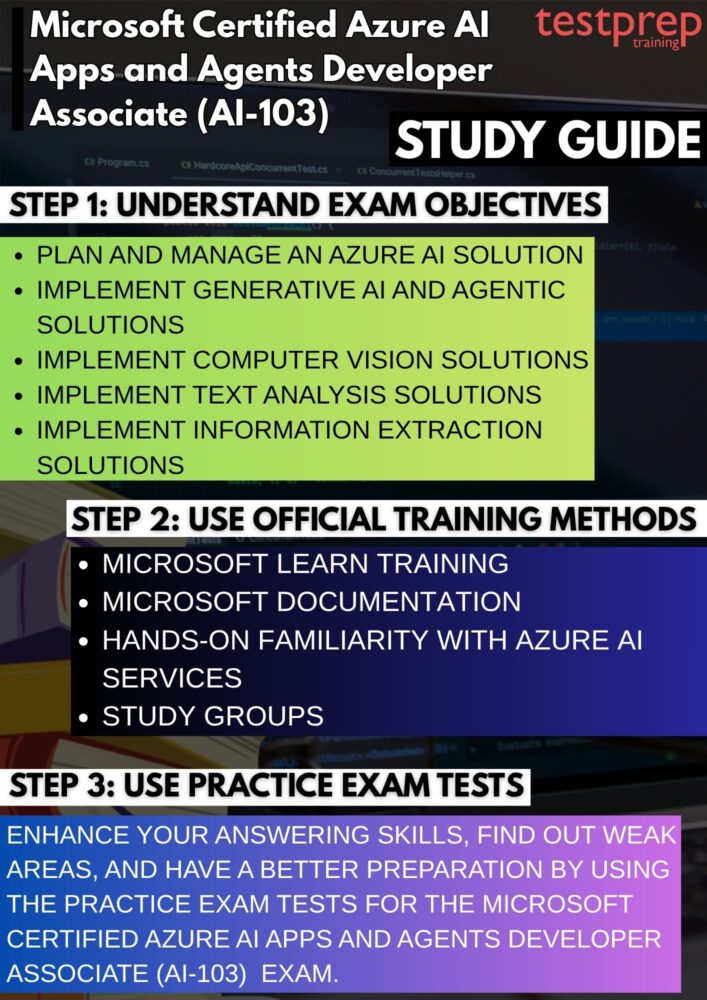
1. Review the Official Exam Objectives Carefully
The first step in preparing for the AI-103 certification exam is to thoroughly understand the official exam skills outline and objectives provided by Microsoft. The exam guide explains the domains covered in the certification, including Azure AI services, generative AI implementation, computer vision, text analysis, intelligent agents, and AI solution management.
By reviewing the exam objectives early, candidates can identify important topics, understand the weighting of each section, and create a structured preparation plan focused on the areas that require the most attention.
2. Follow Microsoft Learn Training Paths
Microsoft Learn provides official learning paths specifically designed for the AI-103 certification exam. These interactive modules include hands-on exercises, guided tutorials, and real-world examples that help candidates build practical knowledge of Azure AI technologies.
The training content is regularly updated to align with current Azure services and exam requirements, making it one of the most reliable preparation resources for certification candidates. Completing the recommended learning paths can also improve familiarity with Azure tools, AI workflows, and cloud-based development practices. However, the related training course includes:
– Course: AI-103T00-A – Develop AI Apps and Agents on Azure
The AI-103T00-A: Develop AI Apps and Agents on Azure course is designed for software developers and AI engineers who want to create intelligent applications powered by Microsoft Azure and Microsoft Foundry technologies. The course focuses on building modern AI-driven solutions that incorporate generative AI, intelligent agents, and advanced automation capabilities within cloud-based environments.
This training program is particularly suitable for professionals involved in developing, deploying, and maintaining AI solutions using Azure services. Candidates are expected to have experience with Python programming and a foundational understanding of working with APIs, SDKs, and cloud-based development environments. By completing this course, learners gain practical knowledge of how to build scalable AI applications, integrate Azure AI services, and develop intelligent systems capable of supporting advanced business and automation scenarios.
3. Study Microsoft Documentation and Product Resources
In addition to training modules, candidates should spend time exploring Microsoft’s official technical documentation. Azure AI documentation provides deeper insights into service configurations, APIs, deployment models, security considerations, and best practices for building AI-powered applications. Reading official documentation helps strengthen conceptual understanding while also improving practical knowledge required for real-world implementation scenarios that may appear in the exam.
4. Gain Hands-On Experience with Azure AI Services
Practical experience is one of the most important parts of AI-103 exam preparation. Candidates should actively work with Azure AI services by creating projects, testing APIs, deploying AI models, and experimenting with generative AI and agent-based solutions.
Hands-on practice allows learners to understand how Azure services behave in real environments, troubleshoot common issues, and build confidence in managing AI workloads within the Azure ecosystem.
5. Join Study Groups and Professional Communities
Participating in study groups and online communities can significantly improve the learning experience. Certification communities often share preparation tips, study strategies, resource recommendations, and discussions about challenging exam topics. Engaging with other learners and professionals also provides exposure to practical insights, real-world use cases, and industry trends related to Azure AI technologies and generative AI development.
6. Use Practice Tests and Exam Simulations
Practice tests are highly valuable for evaluating readiness before taking the actual certification exam. They help candidates become familiar with question formats, time management, and scenario-based problem-solving approaches commonly used in Microsoft certification exams.
Reviewing incorrect answers and understanding the reasoning behind each question can help identify weak areas that require additional study. Repeated practice also improves confidence and reduces exam-day pressure.
7. Build a Consistent Study Plan and Revision Strategy
A structured study schedule is essential for effective preparation. Candidates should divide topics into manageable sections, set weekly goals, and allocate time for revision and hands-on practice. Regular revision of key concepts such as generative AI, Azure AI services, security considerations, and intelligent agent development can improve long-term retention.
Combining theory, practical implementation, documentation review, and practice assessments creates a balanced preparation strategy that increases the chances of successfully passing the AI-103 certification exam.
