
Microsoft Certified: Machine Learning Operations (MLOps) Engineer Associate ( AI-300)
The Microsoft Certified: Machine Learning Operations (MLOps) Engineer Associate (AI-300) certification is designed for professionals who specialize in deploying, managing, and optimizing AI solutions on Microsoft Azure. This exam validates your ability to operationalize both traditional machine learning models and modern generative AI applications through robust, scalable, and automated workflows—collectively referred to as AI Operations (AIOps).
As an AI-300 certified professional, you are expected to design and manage end-to-end AI operational environments. This includes building and maintaining infrastructure for MLOps and GenAIOps, ensuring that AI solutions are production-ready, reliable, and continuously improving. You will work extensively with Azure Machine Learning for traditional ML workloads and Microsoft Foundry for generative AI applications, focusing on deployment, monitoring, evaluation, and optimization across the lifecycle.
Recommended Skills and Background
To succeed in this certification, candidates should bring a balanced mix of data science and DevOps knowledge. A strong foundation in Python programming is essential, along with familiarity with command-line tools and version control systems.
An entry-level understanding of DevOps practices is also expected, particularly in areas such as automation, CI/CD pipelines, and workflow orchestration using tools like GitHub Actions.
Core Technical Expertise
Candidates should demonstrate practical experience and knowledge in the following areas:
- Machine Learning Operations (MLOps): Managing the lifecycle of machine learning models, including training, deployment, monitoring, and retraining.
- Generative AI Operations (GenAIOps): Deploying and maintaining generative AI solutions, including prompt engineering, evaluation, and performance tuning.
- Azure Machine Learning & Microsoft Foundry: Leveraging Azure-native tools for building scalable AI solutions.
- CI/CD Pipelines: Implementing automated workflows using tools such as GitHub Actions.
- Infrastructure as Code (IaC): Using technologies like Bicep and Azure CLI to provision and manage cloud infrastructure efficiently.
Key Responsibilities
Professionals preparing for the AI-300 exam are expected to handle a wide range of responsibilities in real-world scenarios:
- Designing and Implementing MLOps Infrastructure
- Build scalable and secure environments to support machine learning workflows, ensuring smooth integration with development and deployment pipelines.
- Managing the Machine Learning Lifecycle
- Oversee the entire ML lifecycle—from data preparation and model training to deployment, monitoring, and continuous improvement.
- Designing and Implementing GenAIOps Solutions
- Create robust infrastructure for generative AI applications, enabling seamless deployment and management of AI agents and models.
- Ensuring Quality and Observability in Generative AI
- Implement evaluation frameworks, monitoring systems, and logging mechanisms to ensure reliability, accuracy, and transparency of generative AI outputs.
- Optimizing Model and System Performance
- Continuously improve model performance through tuning, testing, and resource optimization to meet business and technical requirements.
In this role, you will collaborate closely with data scientists, DevOps engineers, and business stakeholders. Your primary goal is to deliver AI solutions that are not only scalable and efficient but also fully automated and well-monitored, ensuring long-term success in production environments. This certification is ideal for professionals looking to bridge the gap between data science and operations, enabling them to play a critical role in deploying next-generation AI solutions in enterprise environments.
Exam Details
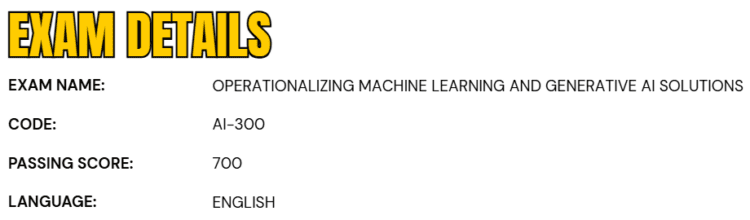
- The Exam AI-300: Operationalizing Machine Learning and Generative AI Solutions is part of the Microsoft Certified: Machine Learning Operations (MLOps) Engineer Associate certification, designed to validate your ability to manage and operationalize AI solutions on Azure.
- To successfully pass the exam, candidates must achieve a minimum score of 700.
- The exam is proctored, ensuring a secure testing environment, and may include interactive components that assess practical, scenario-based skills.
- If a candidate does not pass on the first attempt, they can retake the exam after 24 hours, while any additional retake attempts may require a longer waiting period as per Microsoft’s retake policy.
- Currently, the exam is available in English, making it accessible to a global audience preparing for roles in MLOps and AI operations.
Course Outline
The Exam AI-300: Operationalizing Machine Learning and Generative AI Solutions covers the following topics:
1. Learn About Designing and implementing an MLOps infrastructure (15–20%)
Create and manage resources in a Machine Learning workspace
- Create and manage a workspace
- Create and manage datastores
- Create and manage compute targets
- Configure identity and access management for workspaces
Create and manage assets in a Machine Learning workspace
- Create and manage data assets
- Create and manage environments
- Create and manage components
- Share assets across workspaces by using registries
Implement IaC for Machine Learning
- Configure GitHub integration with Machine Learning to enable secure access
- Deploy Machine Learning workspaces and resources by using Bicep and Azure CLI
- Automate resource provisioning by using GitHub Actions workflows
- Restrict network access to Machine Learning workspaces
- Manage source control for machine learning projects by using Git
2. Understand about implementing machine learning model lifecycle and operations (25–30%)
Orchestrating model training
- Configuring experiment tracking with MLflow
- Using automated machine learning to explore optimal models
- Using notebooks for experimentation and exploration
- Automating hyperparameter tuning
- Running model training scripts
- Managing distributed training for large and deep learning models
- Implementing training pipelines
- Comparing model performance across jobs
Implementing model registration and versioning
- Packaging a feature retrieval specification with the model artifact
- Registering an MLflow model
- Evaluating a model by using responsible AI principles
- Managing model lifecycle, including archiving models
Deploying machine learning models for production environments
- Deploy models as real-time or batch endpoints with managed inference options
- Test and troubleshoot model endpoints
- Implement progressive rollout and safe rollback strategies
Monitor and maintain machine learning models in production
- Detect and analyze data drift
- Monitor performance metrics of models deployed to production
- Configure retraining or alert triggers when thresholds are exceeded
3. Designing and implementing a GenAIOps infrastructure (20–25%)
Implementing Foundry environments and platform configuration
- Create and configure Foundry resources and project environments
- Configure identity and access management with managed identities and role-based access control (RBAC)
- Implement network security and private networking configurations
- Deploy infrastructure using Bicep templates and Azure CLI
Deploy and manage foundation models for production workloads
- Deploy foundation models by using serverless API endpoints and managed compute options
- Select appropriate models for specific use cases
- Implement model versioning and production deployment strategies
- Configure provisioned throughput units for high-volume workloads
Implement prompt versioning and management with source control
- Design and develop prompts
- Create prompt variants and compare performance across different prompts
- Implement version control for prompts by using Git repositories
4. Implementing generative AI quality assurance and observability (10–15%)
Configure evaluation and validation for generative AI applications and agents
- Create test datasets and data mapping for comprehensive model evaluation
- Implement AI quality metrics, including groundedness, relevance, coherence, and fluency
- Configure risk and safety evaluations for harmful content detection
- Set up automated evaluation workflows by using built-in and custom evaluation metrics

Implement observability for generative AI applications and agents
- Examine continuous monitoring in Foundry
- Monitor performance metrics, including latency, throughput, and response times
- Track and optimize cost metrics, including token consumption and resource usage
- Configure detailed logging, tracing, and debugging capabilities for production troubleshooting
5. Optimizing generative AI systems and model performance (10–15%)
Optimize retrieval-augmented generation (RAG) performance and accuracy
- Optimize retrieval performance by tuning similarity thresholds, chunk sizes, and retrieval strategies
- Select and fine-tune embedding models for domain-specific use cases and accuracy improvements
- Implement and optimize hybrid search approaches combining semantic and keyword-based retrieval
- Evaluate and improve RAG system performance by using relevance metrics and A/B testing frameworks
Implement advanced fine-tuning and model customization
- Design and implement advanced fine-tuning methods
- Create and manage synthetic data for fine-tuning
- Monitor and optimize fine-tuned model performance
- Manage a fine-tuned model from development through production deployment
Microsoft Machine Learning Operations (MLOps) Engineer Associate ( AI-300) Exam FAQS
Microsoft Exam Policies
Microsoft maintains a well-defined set of exam policies to ensure fairness, reliability, and consistency across its certification programs. For candidates preparing for Microsoft exams, it is important to understand these guidelines, particularly those related to retake rules and scoring practices, as they directly impact exam planning and performance expectations.
– Retake Policy
Microsoft’s retake policy applies to all major certification categories, including role-based, specialty, and fundamentals exams. It is structured to encourage proper preparation between attempts rather than repeated immediate retries. If a candidate does not pass on the first attempt, they must wait at least 24 hours before scheduling a retake. For any additional attempts beyond the second, a 14-day waiting period is required between each try.
Candidates are allowed a maximum of five attempts within a 12-month period, starting from the date of their first exam attempt. If all five attempts are used without achieving a passing score, the candidate must wait 12 months from the initial attempt date before becoming eligible to try again. Once an exam has been successfully passed, it cannot be retaken unless the certification has expired. It is also important to note that exam fees apply to each attempt, including retakes.
– Scoring Methodology
Microsoft certification exams follow a scaled scoring system that ranges from 1 to 1,000, with 700 as the standard passing score for most exams. This scoring model does not correspond to a simple percentage of correct answers. Instead, it reflects a candidate’s overall proficiency level by considering factors such as the difficulty of questions, the specific version of the exam, and the skills being measured.
For Microsoft Office certification exams, the same scoring scale is used; however, the required passing score may differ depending on the exam. This approach ensures that all candidates are evaluated fairly and consistently, regardless of variations in exam format or complexity, providing a more accurate representation of real-world knowledge and capabilities.
Microsoft AI-300: Operationalizing Machine Learning and Generative AI Solutions Exam Study Guide
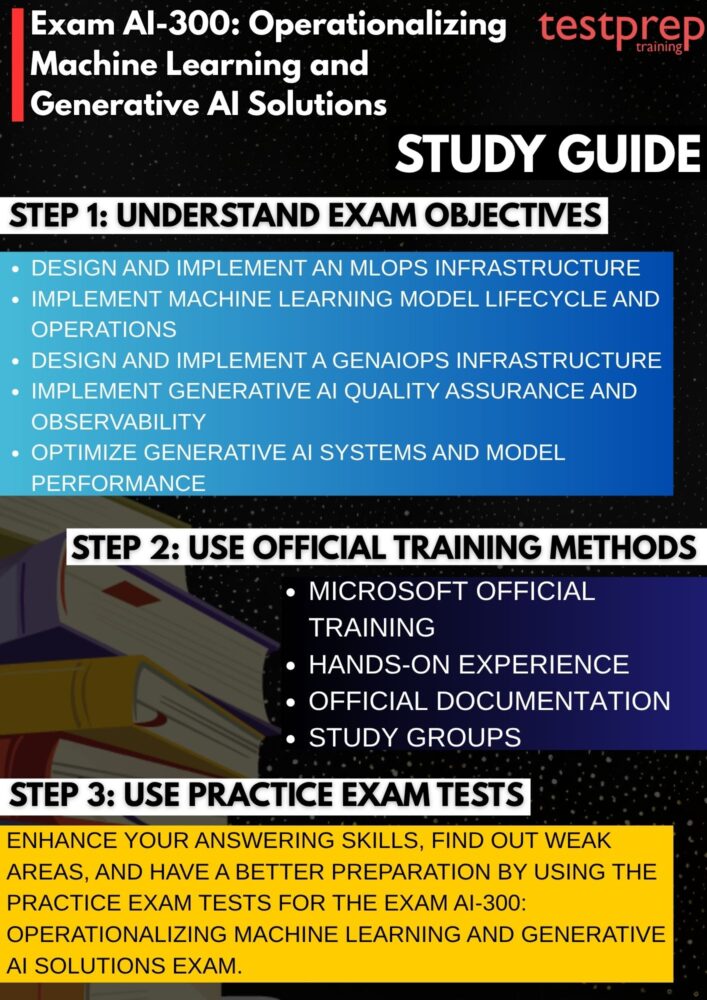
1. Review the Exam Guide and Objectives in Detail
Your preparation should begin with a deep understanding of the official exam objectives. Carefully analyze each domain to identify what skills are being measured, such as designing MLOps infrastructure, managing the machine learning lifecycle, implementing generative AI solutions, and optimizing model performance. Pay close attention to the weightage of each section, as this will help you prioritize high-impact topics. Break down each objective into subtopics and map them to real-world tasks, ensuring you clearly understand not just what to study, but how it applies in practical scenarios.
2. Follow Microsoft Official Training and Learning Paths
Microsoft’s official learning paths are structured to align closely with the exam requirements. These modules typically include conceptual explanations, guided exercises, and scenario-based learning. As you progress, focus on understanding how different Azure services integrate within MLOps pipelines and generative AI workflows. Avoid passive learning—take notes, summarize key concepts, and revisit complex topics. Supplement these learning paths with instructor-led training or video courses if needed to strengthen your understanding of advanced areas. However, the related training path includes:
– Operationalize Machine Learning and Generative AI Solutions
The AI-300T00-A course is designed to help learners build and manage Machine Learning Operations (MLOps) and Generative AI Operations (GenAIOps) solutions on Microsoft Azure. It focuses on creating secure, scalable, and efficient AI systems that support both traditional machine learning models and modern generative AI applications.
In this course, learners gain practical knowledge of managing the full machine learning lifecycle using Azure Machine Learning, including model training, deployment, and monitoring. It also covers how to deploy and optimize generative AI applications and agents using Microsoft Foundry, with a focus on evaluation, performance tuning, and observability.
The course introduces key operational practices such as automation, CI/CD pipelines, and Infrastructure as Code (IaC) using tools like GitHub Actions, Azure CLI, and Bicep. Additionally, it emphasizes collaboration between data science and DevOps teams to deliver reliable, production-ready AI solutions.
This course is suitable for data scientists, machine learning engineers, and DevOps professionals who want to design and operate AI solutions on Azure. It is best suited for individuals with experience in Python, a basic understanding of machine learning concepts, and familiarity with DevOps practices such as version control, CI/CD, and command-line tools.
3. Explore Microsoft Documentation for In-Depth Understanding
Official Microsoft documentation is essential for mastering the finer technical details. It provides comprehensive insights into service capabilities, configuration options, limitations, and best practices. While studying, focus on areas such as Azure Machine Learning pipelines, model deployment options, monitoring tools, and generative AI evaluation techniques. Documentation also helps you stay updated with the latest features and changes, which is particularly important for a rapidly evolving domain like AI. Make it a habit to cross-reference topics from your training modules with documentation to deepen your understanding.
4. Gain Hands-On Experience with Azure Tools
Practical experience is one of the most critical success factors for the AI-300 exam. Work directly with Azure services to build, deploy, and manage machine learning and generative AI solutions. Practice creating end-to-end workflows, including data preparation, model training, versioning, deployment, and monitoring. Experiment with CI/CD pipelines using tools like GitHub Actions, and implement infrastructure as code using Bicep or Azure CLI. Try to simulate real-world scenarios, such as troubleshooting failed deployments or optimizing model performance, as this will prepare you for scenario-based questions in the exam.
5. Join Study Groups and Professional Communities
Collaborating with others can significantly enhance your preparation. Joining study groups, forums, or online communities allows you to exchange ideas, discuss challenging topics, and gain insights from individuals who may already have exam experience. These communities often share useful resources, preparation strategies, and updates about exam patterns. Engaging in discussions can also help reinforce your knowledge, as explaining concepts to others improves your own understanding.
6. Use Practice Tests to Assess Your Readiness
Practice tests are essential for evaluating your progress and identifying knowledge gaps. Regularly attempt mock exams to become familiar with the structure, timing, and types of questions you may encounter. Focus not only on your score but also on understanding why certain answers are correct or incorrect. This approach helps strengthen your conceptual clarity and improves your problem-solving ability. Over time, practice tests will help you build confidence and reduce exam-day anxiety.
7. Review, Revise, and Strengthen Weak Areas
Consistent revision is key to long-term retention and exam success. Allocate time to revisit important topics, especially those you find challenging. Use your practice test results to identify weak areas and focus on improving them through targeted study and additional hands-on practice. Create short notes or summaries for quick revision before the exam. A well-rounded revision strategy ensures that you retain critical concepts and approach the exam with confidence and clarity.
