
PMI Green Project Manager – Basic (GPM-b)
The PMI Green Project Manager – Basic (GPM-b) certification is a collaborative initiative between the Project Management Institute (PMI) and Green Project Management (GPM). This partnership is designed to advance sustainability within the project management profession and equip practitioners with the skills required to deliver environmentally responsible and socially conscious outcomes.
Through this certification, PMI aims to empower project professionals to integrate sustainability principles into their work while maintaining a strong balance between business objectives and long-term environmental and social impact.
Purpose and Significance of Sustainable Project Management
Modern project management extends beyond delivering outputs within scope, time, and budget. A truly successful project also generates long-term value for stakeholders and society. Sustainable project management focuses on:
- Environmental responsibility and resource efficiency
- Social equity and stakeholder well-being
- Economic viability and long-term value creation
In practice, this means project managers are expected to lead initiatives that not only achieve business goals but also contribute positively to communities and the environment, fostering trust and stronger stakeholder relationships.
Foundation of the GPM-b Certification
The GPM-b certification is built upon globally recognized sustainability frameworks, including:
- The GPM P5 Standard for Sustainability in Project Management
- Sustainable Project Management: The GPM Practice Guide 3.0
The P5 Standard provides practical guidance on identifying, measuring, and integrating sustainability dimensions into project activities. It ensures that sustainability is not treated as an add-on but as a core component of project planning and execution. The Practice Guide 3.0 introduces a structured and iterative approach to managing sustainability-focused and regenerative projects, helping professionals apply sustainability principles effectively across project lifecycles.
While the Sustainable Development Goals (SDGs) serve as a global framework, the GPM-b approach goes further by addressing the root causes of sustainability challenges. Instead of only aligning with outcomes, this certification encourages professionals to:
- Identify systemic issues behind sustainability challenges
- Implement meaningful, long-term solutions
- Promote regenerative practices that restore and improve systems
Target Audience
The GPM-b certification is specifically designed for individuals who already possess foundational project management knowledge and/or experience. It is ideal for professionals seeking to strengthen their ability to incorporate sustainability into project delivery.
Certification Eligibility Requirements
To qualify for the GPM-b certification, candidates must meet specific educational and professional prerequisites.
1. Qualifying Certification or Academic Degree
Applicants must hold one of the following certifications or qualifications:
- Project Management Certifications:
- CAPM, PMP, PfMP, or PgMP
- PRINCE2, MSP, or MoP
- APM PMQ, ChPP, RegPM, MPLSC
- AIPM CPPM, CPSPM, or RegPM
- Academic Qualification:
- A Master’s degree in Project or Program Management from an accredited institution
2. Project Knowledge and Experience
Candidates must demonstrate one of the following:
- A qualifying certification or degree (as listed above), or
- Active certification in good standing such as CAPM, PMP, PgMP, or PfMP
3. Sustainability Education Requirement
Applicants must complete 12 hours of formal education in Sustainability in Project Management, ensuring a foundational understanding of sustainability principles in professional practice.
Training Requirements
To be eligible for the certification exam, candidates must complete one of the following training pathways:
- Sustainable Project Management for Certified Practitioners e-learning course, or
- An approved Authorized Training Partner (ATP) course
Exam Details
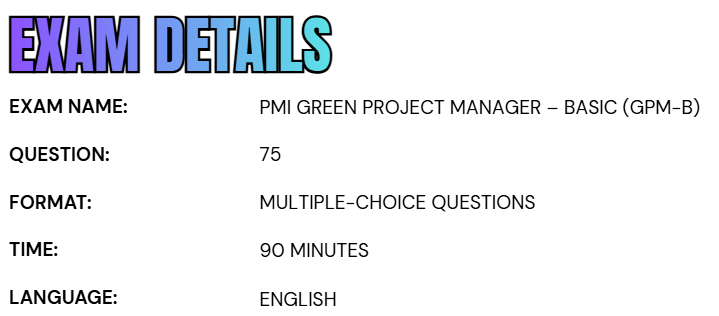
- The PMI Green Project Manager – Basic (GPM-b) certification exam is designed to assess a candidate’s understanding of sustainable project management principles through a structured multiple-choice format.
- The examination consists of 75 multiple-choice questions that evaluate both conceptual knowledge and applied understanding of sustainability in project environments.
- Candidates are allotted a total of 90 minutes to complete the exam, requiring efficient time management and a clear grasp of key topics.
- The assessment is currently conducted in the English language only.
- At present, the GPM-b exam is offered exclusively through a remotely proctored online format. Candidates must complete mandatory system compatibility checks and a detailed identity verification process before the exam begins. It is important to allocate additional time prior to the scheduled exam to ensure all check-in requirements are completed smoothly.
- Please note that the exam is not available at physical test centers at this time, and all attempts must be completed through the online proctored system.
Course Outline
The PMI Green Project Manager – Basic (GPM-b) certification exam covers the following topics:
Domain 1: Understand Sustainable Methods – 70%
- Identifying the sustainability initiatives and fundamentals
- Explaining the PRiSM method fundamentals
- Identifying sustainability, sustainable projects, and sustainable project management practices
- Determining the PRiSM supporting processes
- Explaining the sustainability ethics, principles, and values
- Understanding the governance practices, processes, and frameworks
- Explaining the standard’s different processes, categories, subcategories, and elements
- Identifying the product impact lenses’ practices
- Determining the process impact lenses’ practices
- Explaining the social impacts
- Recognizing the environmental impacts
- Determining the prosperity impacts

Domain 2: Learn Delivery Methods – 30%
- Explaining the PRiSM fundamentals delivery methods
- Recognizing the management activities of a PRiSM project life cycle phase
- Determining the PRiSM supporting processes delivery methods
- Explaining the delivery methods of sustainability ethics, principles, and values
- Understanding the governance practices, processes, and frameworks’ delivery methods
- Identifying sustainability, sustainable projects, and sustainable project management practices’ delivery methods
- Explaining the social impacts’ delivery methods
PMI Green Project Manager – Basic (GPM-b) Exam FAQs
Maintaining Your GPM-b Certification
The PMI Green Project Manager – Basic (GPM-b) certification remains valid for a period of five years and does not require any ongoing maintenance activities or renewal fees during this timeframe. This allows certified professionals to focus on applying sustainable project management practices without the need for periodic reporting or continuing education requirements.
Once the five-year validity period expires, candidates can maintain their certification status by retaking the GPM-b examination. There is no requirement to complete the training course again, making the renewal process straightforward and efficient.
Exam Retake Policy
If a candidate does not successfully pass the exam on the first attempt, they are encouraged to continue their preparation and reattempt the test. Within the six-month eligibility period, candidates are permitted to take the exam up to three times, with each attempt subject to an applicable fee.
In the event that all three attempts are unsuccessful, a waiting period of one year from the date of the last attempt is required before reapplying for the certification. This policy is implemented to maintain the integrity and security of the examination process while ensuring a fair assessment environment for all candidates.
PMI Green Project Manager – Basic (GPM-b) Exam Study Guide
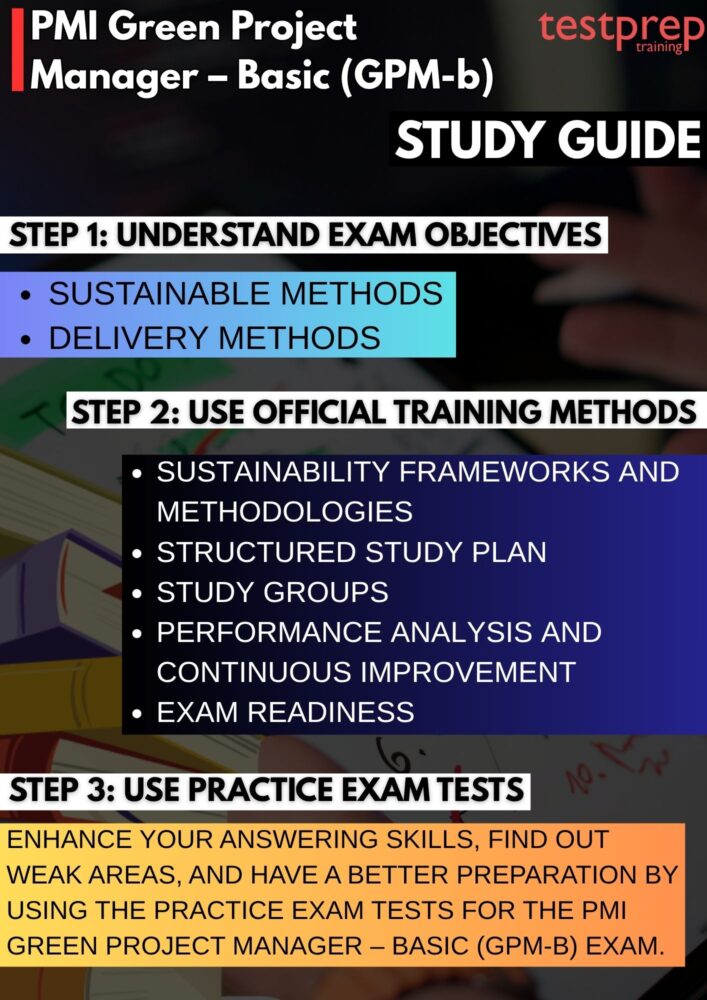
1. Develop a Clear Understanding of the Exam Framework
Start by carefully reviewing the official exam overview provided by the Project Management Institute. The GPM-b exam is not a traditional project management test—it is designed to evaluate how effectively you can integrate sustainability into project decision-making and delivery. The exam focuses on applied understanding rather than theoretical recall. You should become comfortable with how sustainability considerations influence:
- Project initiation and business case development
- Risk identification, especially environmental and social risks
- Decision-making trade-offs between cost, impact, and long-term value
- Stakeholder communication with sustainability transparency
2. Build Depth in Sustainability Frameworks and Methodologies
To perform well, you need more than surface-level familiarity with concepts—you must understand how to apply them in realistic scenarios. The exam heavily draws from frameworks such as the P5 Standard and PRiSM methodology developed by Green Project Management. Focus on developing the ability to:
- Interpret sustainability impacts across People, Planet, Profit, Process, and Product (P5 dimensions)
- Evaluate project decisions through a sustainability lens rather than purely financial metrics
- Understand lifecycle thinking, including long-term environmental and societal effects
- Apply regenerative and restorative approaches, not just “less harmful” practices
This level of understanding enables you to handle situational questions where multiple answers may appear correct, but only one aligns best with sustainable project principles.
3. Create a Structured and Progressive Study Plan
A disciplined study approach is essential due to the conceptual depth of the exam. Instead of random study sessions, organize your preparation into progressive phases that build upon each other. In the initial phase, focus on understanding sustainability concepts and terminology. Gradually transition into applying these concepts within project scenarios, and finally dedicate time to consolidation and revision. An effective study plan should include:
- Dedicated time blocks for theory, application, and revision
- Integration of real-world examples to contextualize concepts
- Periodic self-assessment checkpoints to measure progress
4. Engage Actively with Study Groups and Professional Communities
Preparing in isolation can limit your perspective, especially for a subject that requires critical thinking. Engaging with study groups—whether through professional forums, LinkedIn communities, or certification-focused groups—can significantly enhance your preparation. Active participation allows you to:
- Explore different interpretations of sustainability concepts
- Discuss scenario-based questions and reasoning approaches
- Stay updated on exam trends and candidate experiences
- Gain practical insights from professionals already applying sustainable project practices
More importantly, explaining concepts to others reinforces your own understanding and highlights areas where your knowledge may still be incomplete.
5. Practice with High-Quality Mock Exams and Scenario-Based Questions
Practice is not just about testing knowledge—it is about developing exam readiness. The GPM-b exam includes questions that require analytical thinking, so exposure to realistic question patterns is critical. When practicing, focus on:
- Understanding why an answer is correct, not just identifying it
- Recognizing subtle differences between similar answer choices
- Managing time effectively across all questions
- Building confidence in interpreting scenario-based questions
Simulating real exam conditions during practice sessions can significantly improve your performance under time constraints.
6. Perform In-Depth Performance Analysis and Continuous Improvement
One of the most overlooked aspects of preparation is post-practice analysis. Simply taking multiple tests without reviewing them limits your progress. Adopt a structured review process where you:
- Analyze incorrect answers to identify conceptual gaps
- Detect patterns in mistakes, such as misreading questions or misunderstanding sustainability principles
- Revisit weak areas with targeted study rather than general revision
Maintaining a performance log can help you track improvement over time and ensure that your preparation becomes increasingly focused and efficient.
7. Focus on Strategic Revision and Exam Readiness
As you approach the exam, shift your focus from learning new material to reinforcing existing knowledge. At this stage, clarity and confidence are more valuable than additional information. Your revision should emphasize:
- Key sustainability frameworks and their practical application
- Decision-making approaches that balance business and sustainability goals
- Common traps in multiple-choice questions
- Mental readiness and time management strategies
Additionally, ensure that you are familiar with the online proctored exam environment, including system checks and procedures, to avoid last-minute technical issues.
