
PMI Project Management Office Certified Professional (PMI-PMOCP)
The PMI Project Management Office Certified Professional (PMI-PMOCP) is a specialized credential designed for experienced professionals who are involved in establishing, managing, or transforming Project Management Offices (PMOs). This certification validates your ability to align PMO functions with organizational strategy and deliver measurable business value.
Unlike general project management certifications, PMI-PMOCP focuses on the strategic and operational effectiveness of PMOs, emphasizing adaptability, governance, and value delivery across diverse business environments.
What the PMI-PMOCP Certification Demonstrates
Earning the PMI-PMOCP certification confirms your capability to design and lead PMOs that are tailored to the specific needs, culture, and maturity level of an organization. It highlights your expertise in:
- Establishing and evolving PMO frameworks
- Aligning PMO objectives with business strategy
- Driving governance, standardization, and performance improvement
- Delivering consistent value across projects and programs
- Adapting PMO structures to different industries and organizational models
This certification positions you as a strategic contributor who can influence decision-making and enhance organizational efficiency through a well-structured PMO.
Who Should Consider This Certification
The PMI-PMOCP is ideal for professionals who are directly involved in PMO functions or aspire to take on leadership roles within this domain. It is particularly suited for:
- PMO Leaders and Directors
- PMO Analysts and Team Members
- Project Managers and Coordinators transitioning into PMO roles
Eligibility Requirements
To apply for the PMI-PMOCP certification, candidates must meet specific educational and professional experience criteria. All project-related experience must have been completed within the last eight years prior to application submission.
– Educational Qualification
- A secondary degree (high school diploma, associate degree, or global equivalent)
– Project Management Experience
- Minimum 36 months (3 years) of project-related experience within the last 8 years
OR - Hold a PMP (Project Management Professional) certification in good standing
– PMO Education
- At least 10 hours of formal education related to Project Management Offices (PMO)
Key Focus of the Certification
The PMI-PMOCP certification stands out for its emphasis on flexibility and customization. Instead of promoting a one-size-fits-all approach, it encourages professionals to design PMOs that are:
- Scalable and adaptable
- Aligned with organizational goals
- Focused on continuous improvement and value realization
Why PMI-PMOCP Matters
As organizations increasingly rely on PMOs to drive strategic initiatives, the demand for skilled PMO professionals continues to grow. The PMI-PMOCP certification not only enhances your professional credibility but also equips you with the knowledge and skills required to:
- Maximize PMO impact within an organization
- Improve project success rates
- Strengthen governance and oversight
- Enable data-driven decision-making
Exam Details
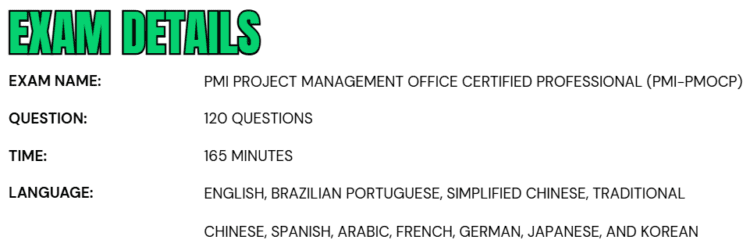
- The PMI Project Management Office Certified Professional (PMI-PMOCP) examination is designed to comprehensively assess a candidate’s ability to manage and lead PMO functions effectively.
- The exam consists of 120 questions, which include a mix of multiple-choice and multiple-response formats, ensuring a well-rounded evaluation of both conceptual understanding and practical application.
- Out of the total questions, 100 are scored, while 20 are unscored pretest questions. These pretest items are randomly distributed throughout the exam and are used by PMI to validate future exam content. Although they do not impact your final score, they are indistinguishable from scored questions, requiring candidates to treat every question with equal importance.
- Candidates are given a total of 165 minutes (2 hours and 45 minutes) to complete the examination. While this duration is sufficient for most test-takers, some may finish earlier depending on their preparation and familiarity with the subject matter.
- The exam is offered in multiple languages to accommodate a global audience, including English, Brazilian Portuguese, Simplified Chinese, Traditional Chinese, Spanish, Arabic, French, German, Japanese, and Korean.
- Additionally, the exam is divided into two sections of 60 questions each. After completing the first section and reviewing your responses, you are provided with an optional 10-minute break. It is important to note that once you begin the break, you cannot return to the previous section, making it essential to finalize your answers before proceeding.
Course Outline
The PMI Project Management Office Certified Professional (PMI-PMOCP) exam covers the following topics:
Domain I Understand Organizational Development and Alignment – 16%
Task 1 Elevating Organizational Project Management
- Conducting a comprehensive assessment of current OPM competencies across the organization
- Developing a tailored OPM competency framework aligned with industry standards and organizational needs
- Creating individual and team development plans to enhance specific OPM competencies
- Implementing targeted training programs and workshops for different competency levels
- Establishing a mentoring program pairing experienced professionals with developing professionals
- Integrating OPM competencies into performance management and career progression systems
- Regularly assessing and updating the competency framework to reflect evolving industry trends and organizational requirements
Task 2 Shaping the Organizational Project Management Culture
- Assessing the current organizational culture and its alignment with OPM principles
- Developing a clear vision and set of values that support project culture
- Engaging leadership in championing OPM practices and demonstrating commitment
- Implementing change management strategies to facilitate cultural shift
Task 3 Driving Organizational Project Management Maturity
- Conducting a comprehensive OPM maturity assessment using established models
- Developing a roadmap for OPM maturity improvement with clear milestones and targets
- Developing and implementing key performance indicators (KPIs) to measure OPM maturity progress
- Providing targeted training and development programs to address specific maturity gaps
- Regularly benchmark OPM practices against industry standards and best practices
Task 4 Cultivating Organizational Project Management Capabilities
- Identifying and prioritizing key OPM capabilities required for organizational success
- Assessing current OPM capabilities against desired future state to identify gaps
- Developing a capability development plan addressing people, processes, and technology
- Identifying risk categories
- Coach/mentor team on risk management best practices (servant leadership)
- Lead stakeholders to adopt the risk strategy
Domain II Learn about PMO Strategic Elements – 18%
Task 1 Architecting PMO Strategy
- Assessing the current state of project management and organizational needs
- Defining the PMO’s vision, mission, and strategic objectives
- Developing a PMO strategy that aligns with organizational goals and addresses key pain points
- Developing a risk management plan for the PMO
- Creating a roadmap for PMO implementation or enhancement with clear milestones
- Developing a communication plan to articulate PMO value and engage stakeholders
- Implementing performance metrics to measure PMO value and strategic impact
Task 2 Steward the PMO Mandate
- Clearly defining the scope and authority of the PMO within the organization
- Establishing the PMO’s roles and responsibilities in relation to projects and stakeholders
- Developing a PMO charter that outlines the PMO’s purpose, objectives, and key functions
- Secure executive sponsorship and support for the PMO mandate
- Implementing a stakeholder engagement plan to build buy-in for the PMO’s mandate
- Creating a framework for regularly reviewing and updating the PMO mandate
Task 3 Establishing and Maintaining PMO Governance
- Establishing a governance framework that defines PMO oversight and decision-making processes
- Establishing reporting structures and communication channels for effective governance
- Developing escalation procedures
- Implementing regular governance reviews to ensure effectiveness and adapt to changing needs
Domain III Understand PMO Design and Structuring – 18%
Task 1 Managing Potential and Current PMO Customers
- Identifying and categorizing potential and current PMO customers within the organization
- Developing customer personas to understand different needs and expectations
- Establishing regular check-ins and feedback mechanisms with key customers
- Developing a strategy to promote PMO services to potential customers
Task 2 Orchestrating Solutions to Address Customer’ Needs
- Conducting regular surveys and interviews to assess PMO customer needs
- Developing a systematic approach for capturing and analyzing PMO customer expectations and requirements
- Creating a prioritization framework for addressing PMO customer needs based on strategic importance
- Developing a feedback loop to continuously improve PMO services based on PMO customer input
Task 3 Articulate and Evolve PMO Value Proposition
- Clearly articulating the benefits and value that the PMO brings to the organization
- Creating case studies and success stories that demonstrate PMO impact
- Implementing a system to measure and quantify the PMO’s contribution to organizational success
- Regularly reviewing and updating the value proposition to align with changing organizational needs
- Developing targeted messaging for different customer groups to communicate PMO value
- Establishing a continuous improvement process to enhance the PMO’s value delivery

Task 4 Designing and implementing PMO Services
- Conducting a needs assessment to identify required PMO services
- Creating tailored service offerings to meet the diverse needs of different customer groups
- Creating standardized processes for each PMO service
- Developing a service catalog detailing PMO offerings and their benefits
- Implementing a service level agreement SLA) framework for PMO offerings
- Establishing a mechanism for continuous service improvement based on feedback and performance
Domain IV Learn about PMO Operation and Performance – 15%
Task 1 Onboarding PMO Services
- Developing a structured onboarding process for new PMO service customers
- Creating documentation and user guides for PMO services
- Implementing a training program to educate customers on PMO services and processes
- Establishing a support system for assisting users during the onboarding phase
- Developing a communication plan to introduce new services to potential customers
- Creating a feedback mechanism to gather insights during the onboarding process
Task 2 Managing PMO Services
- Implementing a phased approach for rolling out complex or high-impact services
- Establishing clear service delivery processes and workflows for each PMO offering
- Implementing a resource allocation system to ensure efficient service delivery
- Developing quality control measures to maintain consistency in service delivery
- Creating a customer feedback system to continuously improve service delivery
- Implementing performance metrics to track and optimize service delivery efficiency
- Establishing escalation procedures for handling service delivery issues
Task 3 Managing PMO Resources
- Developing a resource management plan aligned with PMO service demands
- Implementing a skills matrix to match PMO resources with required competencies
- Establishing a capacity planning process to optimize resource utilization
- Establishing a process for managing external resources and contractors
Domain V Understand PMO Enhancement and Effectiveness – 18%
Task 1 Optimizing PMO Service Performance
- Developing key performance indicators (KPIs) for each PMO service
- Implementing a performance measurement system to track service effectiveness
- Establishing regular performance review cycles for PMO services
- Creating a dashboard for real-time monitoring of service performance
- Developing a process for addressing performance gaps and implementing improvements
- Establishing a feedback loop to incorporate customer satisfaction into performance evaluations
Task 2 Assessing and Improving PMO Services Maturity
- Developing a PMO services maturity model or adopt an existing framework
- Conducting regular maturity assessments of PMO services
- Creating a roadmap for advancing PMO services maturity
- Implementing continuous improvement initiatives based on maturity assessment results
- Implementing a change management process to support maturity improvement initiatives
Task 3 Assessing and Improving PMO Team Competencies
- Developing a competency framework specific to PMO roles and responsibilities
- Conducting regular skills assessments of PMO team members
- Creating individual development plans for PMO staff
- Implementing a training and certification program to enhance PMO competencies
- Establishing mentoring and coaching initiatives within the PMO team
- Developing a knowledge sharing platform to facilitate peer learning
- Implementing a performance management system that incorporates competency development
Task 4 Optimizing PMO Value
- Developing metrics to quantify the PMO’s contribution to organizational success
- Implementing a value tracking system to monitor PMO impact over time
- Conducting regular customer surveys to assess perceived PMO value
- Creating case studies demonstrating PMO contributions to the organization
- Establishing a continuous improvement process focused on enhancing PMO value delivery
- Developing a communication strategy to articulate PMO value to key customers
- Implementing a benchmarking process to compare PMO value against industry standards
Domain VI Overview of People – 15%
Task 1 Enabling a Value-Driven Mindset
- Analyzing Data for Informed Decision-Making
- Driving Continuous Process Improvement
- Making Strategic Decisions
- Drive Innovation
- Solving Problems
- Think Strategically
Task 2 Fostering Customer-Centricity to Drive Improved Interpersonal Relationships
- Foster Collaboration
- Communicate Effectively
- Managing Conflicts
- Focus on Customers
- Applying Interpersonal Intelligence
- Negotiate Skillfully
- Promote Teamwork
- Building Relationships
- Managing Stakeholders
Task 3 Elevating Personal Impact and Effectiveness
- Ensuring Accuracy
- Demonstrating Adaptability
- Uphold Integrity and Ethics
- Maintaining Objectivity
- Act Proactively
- Building Resilience
- Managing Time Effectively
Task 4 Leveraging Technical Skills to Deliver Results
- Optimize Processes
- Manage Projects
- Respond to Risks
- Delivering Training
Task 5 Shaping Organizational Direction
- Applying Business Acumen
- Demonstrating Cultural Awareness
- Lead and Empower Teams
- Influence Strategic Direction
PMI Project Management Office Certified Professional (PMI-PMOCP) Exam FAQs
Maintaining Your PMI-PMOCP Certification
Achieving the PMI-PMOCP certification marks a significant professional milestone, but maintaining it requires an ongoing commitment to learning and development. PMI emphasizes continuous improvement to ensure certified professionals stay aligned with evolving industry practices and PMO standards.
To keep your certification active, you must earn 30 Professional Development Units (PDUs) within a three-year renewal cycle. Each PDU represents one hour of professional development activity. These activities can include expanding your knowledge through structured learning, sharing expertise by teaching or presenting, engaging in self-study such as reading, contributing through volunteering, or creating relevant professional content. This flexible approach allows you to choose activities that best support your career growth while meeting certification requirements.
Retaking the PMI-PMOCP Exam
If you are unable to pass the PMI-PMOCP exam on your first attempt, you have the opportunity to retake it. PMI allows candidates to attempt the exam up to three times within a one-year eligibility period. This provides sufficient time to reassess your preparation, strengthen your understanding, and improve your performance.
In the event that you do not pass after three attempts, you must wait one full year from your last exam attempt before reapplying for the certification. This policy helps maintain the integrity and security of the examination process. During this waiting period, you are still eligible to pursue other PMI certifications if desired. If your one-year eligibility window expires before you successfully pass the exam, you will need to submit a new application to continue pursuing the PMI-PMOCP credential.
PMI Project Management Office Certified Professional (PMI-PMOCP) Exam Study Guide
1. Develop a Deep Understanding of the Exam Content Outline
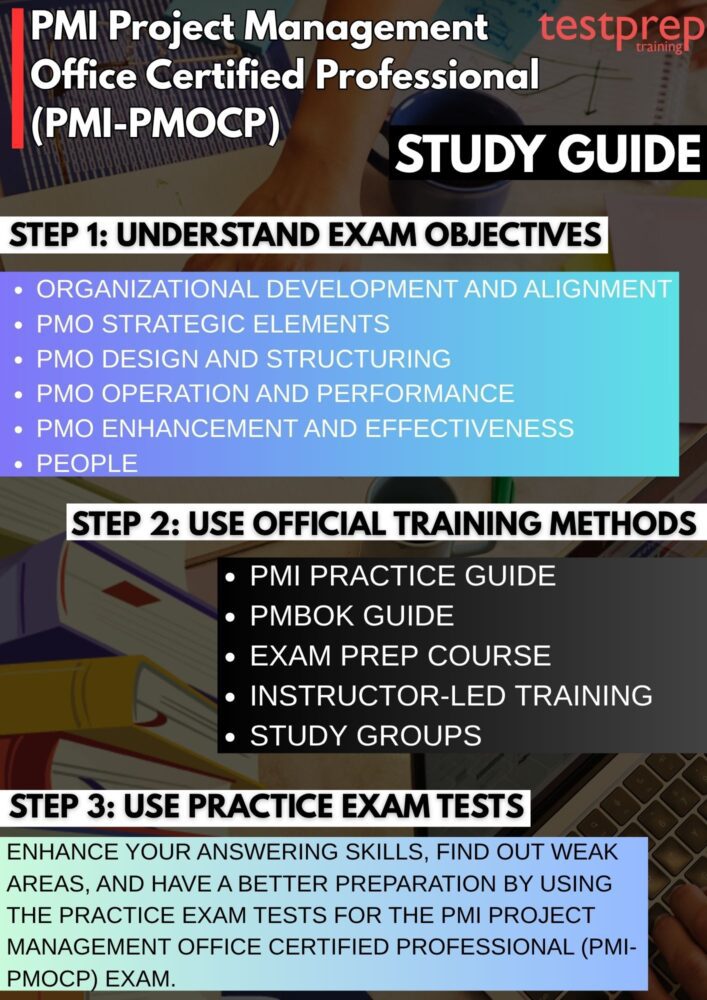
Your preparation should begin with a comprehensive analysis of the official PMI-PMOCP exam content outline. This document is not just a syllabus—it defines the competencies, tasks, and performance domains expected from a certified PMO professional. Carefully study each domain to understand how PMI evaluates PMO-related capabilities such as governance, value delivery, and organizational alignment.
Break down the outline into manageable sections and map each topic to your study resources. This approach ensures that your preparation remains aligned with exam expectations and helps you avoid spending time on irrelevant or low-priority areas.
2. Master PMO Concepts Through the PMI Practice Guide
The Project Management Offices: A Practice Guide is a cornerstone resource for this certification. It provides detailed coverage of PMO types, maturity models, governance structures, and value measurement frameworks. While studying, focus on how PMOs differ across organizations and how they evolve based on business needs.
Pay particular attention to concepts such as centralized vs. decentralized PMOs, performance metrics, and stakeholder alignment. The exam often tests your ability to apply these concepts in practical scenarios, so aim to understand not just “what” a PMO does, but “why” and “how” it delivers strategic value.
3. Reinforce Foundational Knowledge with the PMBOK Guide
Although the PMI-PMOCP certification is PMO-centric, it is deeply rooted in core project management principles outlined in the PMBOK Guide. Strengthening your understanding of these fundamentals is essential, as PMOs rely on standardized processes, governance frameworks, and performance measurement techniques.
Focus on areas such as stakeholder management, risk management, benefits realization, and organizational governance. Understanding how these elements integrate within a PMO environment will help you answer scenario-based questions more effectively and demonstrate a higher level of professional judgment.
4. Leverage the Official PMI-PMOCP Exam Prep Course
The official PMI-PMOCP Exam Prep Course offers a structured and exam-focused learning path. It is designed to align closely with the exam blueprint and provides curated content, case studies, and practical insights into PMO operations.
Use this course to validate your understanding of key topics and to gain clarity on complex areas such as PMO transformation, performance optimization, and strategic alignment. The course also helps you bridge the gap between theory and real-world application, which is critical for success in this certification.
5. Enhance Learning Through Instructor-Led Training
Instructor-led PMOCP training programs provide an opportunity to learn directly from experienced professionals and certified instructors. These sessions go beyond textbook knowledge by incorporating real-world case studies, industry practices, and interactive discussions.
Engaging in such training allows you to ask questions, clarify doubts, and gain deeper insights into how PMOs function in different organizational contexts. This level of engagement can significantly improve your conceptual clarity and prepare you for complex, scenario-based exam questions.
6. Participate in Study Groups and Professional Communities
Collaborative learning plays a crucial role in mastering advanced certifications like PMI-PMOCP. Joining study groups or professional communities enables you to exchange ideas, discuss challenging topics, and learn from the experiences of other candidates and practitioners.
Active participation in discussions can expose you to different perspectives on PMO implementation and governance. It also helps reinforce your learning, identify knowledge gaps, and stay motivated throughout your preparation journey.
7. Validate Your Readiness with Practice Tests and Continuous Review
Practice tests are an essential component of your preparation strategy. They help you become familiar with the exam format, question patterns, and time constraints. Regularly attempting mock exams allows you to assess your performance, identify weak areas, and refine your approach.
Go beyond simply answering questions—analyze your mistakes to understand the reasoning behind correct answers. Focus on improving your decision-making skills, especially for scenario-based questions that require strategic thinking. Consistent review and practice will enhance your accuracy, boost confidence, and ensure you are fully prepared for the actual exam.
