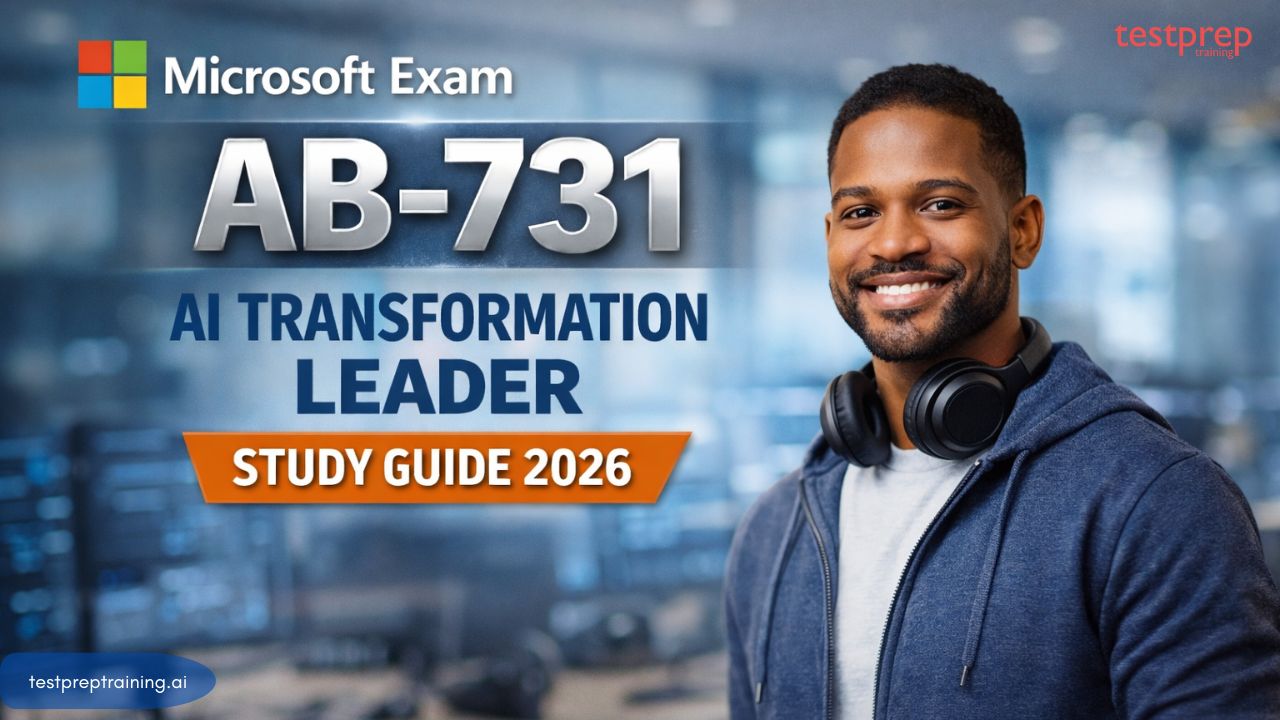
In 2026, artificial intelligence has moved far beyond experimentation and pilot projects. Organizations are now embedding AI into core business processes, decision-making frameworks, and employee workflows. This shift has elevated AI from a technical initiative to a strategic priority one that requires informed leadership, not just technical execution. As a result, enterprises increasingly seek professionals who can guide AI adoption responsibly while delivering measurable business outcomes.
About Microsoft AB-731: AI Transformation Leader Exam
The Microsoft AI Transformation Leader certification, validated through Exam AB-731, directly responds to this demand. It reflects the reality that AI success today depends on leadership capabilities such as vision setting, value assessment, governance, and organizational alignment.
A Certification Designed for Decision-Makers, Not Developers
Microsoft AB-731 stands apart from traditional AI and cloud certifications by focusing on strategic ownership rather than technical implementation. It does not assess coding skills or model training expertise. Instead, it evaluates a candidate’s ability to:
- Identify where AI creates real business value
- Select appropriate AI solutions for organizational needs
- Guide enterprise-wide adoption and change
- Make informed, risk-aware decisions
This makes the certification particularly relevant for business leaders, transformation managers, consultants, and senior professionals who operate at the intersection of technology and strategy.
Generative AI at the Center of Enterprise Transformation
One of the most defining aspects of AB-731 is its emphasis on generative AI in enterprise environments. As AI-powered assistants and copilots become embedded into productivity platforms, leaders must understand how these tools influence efficiency, creativity, and decision quality. The exam focuses on evaluating generative AI capabilities from a business perspective examining benefits, limitations, cost considerations, and operational impact.
Rather than asking how generative AI is built, AB-731 challenges candidates to determine when it should be used, how it should be governed, and how its success should be measured.
Responsible AI as a Leadership Responsibility
In 2026, AI adoption is inseparable from accountability. Issues such as data privacy, bias, transparency, and security are no longer abstract risks—they are executive concerns. Microsoft AB-731 integrates Responsible AI principles as a core leadership competency, emphasizing the importance of ethical decision-making and governance frameworks.
The certification recognizes that sustainable AI transformation requires leaders who can balance innovation with trust, compliance, and long-term organizational integrity.
Why AB-731 Matters in Today’s Career Landscape?
As roles related to AI strategy, innovation, and digital transformation continue to grow, professionals need credentials that validate their ability to lead, not just understand technology. AB-731 addresses this gap by offering a certification that aligns with real-world responsibilities—strategic planning, stakeholder alignment, and enterprise adoption. For professionals aiming to influence AI direction within their organizations, this certification signals readiness to take ownership of AI-driven transformation initiatives in a structured and responsible manner.
Microsoft AB-731 Exam Overview
The Microsoft AI Transformation Leader certification (Exam AB-731) is designed to validate leadership-level expertise in adopting and scaling artificial intelligence within modern organizations. Unlike technical AI certifications, this exam focuses on strategic decision-making, organizational readiness, and business impact rather than implementation or coding.
Microsoft created this certification to recognize that successful AI transformation depends heavily on leadership vision, governance, and alignment with business goals—not just technology. The AB-731 exam is structured as a scenario-driven assessment, emphasizing real-world decision-making rather than theoretical knowledge. Candidates can expect:
- Business-focused multiple-choice questions
- Scenario-based problem statements
- Questions that require evaluation, prioritization, and justification of AI strategies
The exam follows Microsoft’s standardized certification scoring model, with a scaled score used to determine pass or fail status. Questions vary in complexity and weight, reflecting the importance of leadership judgment in AI transformation scenarios. Performance is evaluated based on the ability to select solutions that align with business goals, responsible AI principles, and long-term organizational impact.
What the Exam Focuses On?
The AB-731 exam evaluates your ability to assess how AI can be applied enterprise-wide to drive efficiency, innovation, and competitive advantage. It emphasizes:
- Identifying AI-driven transformation opportunities
- Aligning AI initiatives with organizational strategy
- Planning and guiding enterprise-wide AI adoption
- Optimizing business processes using AI solutions
- Supporting innovation with Microsoft AI tools
The exam measures judgment, planning, and leadership skills, not technical execution.
– Key Skills and Knowledge Areas
As a candidate, you are expected to demonstrate strong AI fluency and strategic thinking. Core knowledge areas include:
- Evaluating AI opportunities within business workflows
- Selecting appropriate AI tools and platforms
- Driving adoption using Microsoft 365 Copilot and Azure AI services
- Encouraging innovation while maintaining governance and compliance
- Promoting responsible and ethical AI practices
Hands-on coding skills are not required for this certification.
– Experience and Prerequisites
To succeed in the AB-731 exam, candidates should have:
- Experience with business transformation or change management
- Familiarity with Microsoft 365 services and AI-powered productivity tools
- Awareness of Microsoft Foundry and general AI capabilities
- The ability to align AI investments with measurable business outcomes
Although the exam does not require programming or system configuration skills, candidates are expected to have:
- A conceptual understanding of artificial intelligence and generative AI
- Awareness of enterprise productivity platforms and AI-enabled services
- The ability to evaluate AI solutions in terms of value, cost, risk, and adoption readiness
Who should take the Microsoft AB-731 Exam?
The Microsoft AI Transformation Leader (AB-731) certification is designed for professionals who are responsible for guiding, influencing, or enabling artificial intelligence adoption at an organizational level. It is not intended for individuals focused on hands-on development or model engineering. Instead, this certification targets those who shape AI strategy, evaluate business impact, and ensure that AI initiatives are implemented responsibly and at scale. If your role involves decision-making, governance, or leadership in AI-driven transformation, AB-731 is a strong strategic fit.
Business and Technology Leaders Driving AI Direction
AB-731 is highly relevant for senior professionals who oversee or contribute to AI-related decisions without directly building technical solutions. This includes executives, department heads, and senior managers who must understand how AI aligns with business objectives, operational efficiency, and long-term competitiveness. The exam validates the ability to assess AI opportunities, prioritize initiatives, and make informed leadership decisions rather than focusing on technical execution.
Digital Transformation and Innovation Professionals
Professionals leading digital transformation programs will find AB-731 particularly valuable. These roles often require balancing innovation with organizational readiness, cost constraints, and change management. The certification confirms that a candidate can evaluate AI as part of a broader transformation roadmap, ensuring that adoption is sustainable, measurable, and aligned with enterprise goals.
Product Owners and Program Managers
AB-731 is well suited for product owners, program managers, and delivery leads who are responsible for introducing AI-enabled capabilities into business processes or platforms. These professionals must coordinate between stakeholders, evaluate AI-driven enhancements, and manage adoption across teams. The certification reinforces skills related to value identification, risk assessment, and stakeholder alignment in AI initiatives.
Consultants and Advisory Professionals
Consultants who advise organizations on AI strategy, modernization, or operational improvement can benefit significantly from AB-731. The certification demonstrates an ability to guide clients through AI decision-making frameworks, identify high-impact use cases, and recommend responsible adoption strategies. It adds credibility when advising executives and senior stakeholders on enterprise AI transformation.
Professionals Transitioning into AI Leadership Roles
AB-731 is also suitable for experienced professionals seeking to move into AI-focused leadership positions. Individuals with backgrounds in business strategy, operations, IT leadership, or analytics who want to formalize their AI transformation expertise will find this certification an effective way to validate readiness for expanded responsibilities in AI governance and strategy.
AB-731 Skills Measured: The Official Microsoft Blueprint
The Microsoft AI Transformation Leader (AB-731) exam evaluates a candidate’s ability to lead artificial intelligence initiatives from a strategic, business-focused perspective. Rather than testing technical implementation skills, the exam measures how effectively a professional can identify AI opportunities, assess value and risk, and guide responsible adoption across an organization. The skills assessed reflect real-world leadership responsibilities in enterprise AI transformation, where decision-making, governance, and alignment with business objectives are critical. The blueprint for AB-731 is structured around three core capability areas, each representing a key phase in the AI transformation lifecycle.
1. Identifying the business value of generative AI solutions (35–40%)
Identifying the foundational concepts of generative AI
- Describing the differences between generative AI and other types of AI
- Selecting a generative AI solution to meet a business need
- Describing the differences between AI models, including fine-tuned and pretrained models
- Explaining the cost drivers in generative AI usage, including tokens and return-on-investment (ROI) considerations
- Identifying the challenges of using generative AI solutions, including fabrications, reliability, and bias
- Identifying when generative AI solutions can provide business value, including scalability and automation
Identifying the benefits and capabilities of generative AI solutions
- Describing the impact of prompt engineering
- Understanding techniques of prompt engineering
- Identifying business requirements for grounding solutions
- Understanding how retrieval-augmented generation (RAG) is used for AI solutions
- Understanding the impact of data on AI solutions, including data type, data quality, and representative datasets
- Describing the importance of secure AI
- Identifying scenarios when machine learning adds value
- Describing the lifecycle of a machine learning solution
- Identifying security considerations for AI systems, including application security, data security, and authentication requirements

2. Understanding benefits, capabilities, and opportunities for Microsoft’s AI apps and services (35–40%)
Identifying the benefits and capabilities of Microsoft 365 Copilot and Microsoft Copilot
- Mapping business processes and use cases to Copilot
- Understanding differences in capabilities between versions of Copilot
- Understand the capabilities of Microsoft 365 Copilot Chat web and mobile experiences
- Understanding capabilities of the Copilot experience in various Microsoft 365 apps
- Understanding the capabilities of Microsoft Copilot Studio
- Understand capabilities of Microsoft Graph
- Identifying the benefits and capabilities of an integrated Microsoft AI solution, including risk mitigation and safety benefits
- Mapping business processes and use cases to Microsoft’s AI apps and services
- Identifying when to use Researcher or Analyst in Copilot
- Identifying when to build, buy, or extend, including the Microsoft 365 Copilot extensibility framework
Identifying benefits and capabilities of Azure AI services
- Mapping business processes and use cases to Azure AI services
- Identifying capabilities of Azure AI services, including Azure AI Vision, Azure AI Search, and Azure AI Foundry
- Matching an AI model to a business need
- Identifying the benefits of Azure AI services for generative AI, including scalability and security
3. Identifying an implementation and adoption strategy for Microsoft’s AI apps and services (20–25%)
Aligning an AI strategy with Microsoft’s responsible AI policies
- Explaining the importance of responsible AI
- Establishing governance principles for AI use
- Establishing an AI council to guide strategy, oversight, and cross-functional alignment
- Ensuring that AI solutions meet responsible AI standards, including fairness, reliability, safety, privacy, security, inclusiveness, transparency, and accountability
Planning for AI adoption across the organization
- Establishing an adoption team
- Identifying common barriers to adoption
- Establishing an AI champions program
- Understand potential impacts to data, security, privacy, and cost
- Understanding Copilot license types, including pay-as-you go, monthly, and included with Microsoft 365 subscription
- Understanding Azure AI services subscription models, including pay-as-you-go and prepaid
Strategic Study Path: How to pass the Microsoft AB-731 Exam?
Preparing for the Microsoft AI Transformation Leader (AB-731) exam requires a methodical, leadership-oriented study approach. Because the exam evaluates strategic judgment rather than technical execution, successful candidates plan their preparation in structured phases that mirror the AI transformation lifecycle—understanding concepts, evaluating value, planning adoption, and practicing decision-making. A 6–8 week preparation timeline is ideal for most professionals balancing study with work commitments.
Week 1: Establish AI and Generative AI Fundamentals
The first week focuses on building a strong conceptual foundation. Candidates should develop clarity around artificial intelligence from a business and leadership perspective rather than a technical one.
Key focus areas:
- Core AI and generative AI concepts
- Differences between traditional AI, automation, and generative AI
- Common enterprise use cases and limitations of generative AI
- Key terminology used in AI strategy and leadership discussions
The goal of Week 1 is not depth but clarity. By the end of this week, candidates should be comfortable discussing AI concepts in business terms and understanding how AI fits into organizational strategy.
Week 2: Understanding Business Value and AI Use Case Evaluation
In Week 2, preparation shifts from foundational knowledge to value identification. This is a critical phase, as a large portion of the AB-731 exam focuses on evaluating where AI delivers meaningful business impact.
Key focus areas:
- Identifying AI opportunities aligned with business objectives
- Evaluating productivity gains, efficiency improvements, and innovation potential
- Understanding cost considerations and value trade-offs
- Recognizing risks such as unreliable outputs or misaligned use cases
Candidates are expected to assess use cases based on measurable outcomes such as efficiency gains, cost optimization, and user experience improvements. The exam also evaluates awareness of common challenges associated with generative AI, including reliability, bias, data quality concerns, and cost implications. Rather than technical depth, the emphasis is on judgment—knowing when generative AI is appropriate and when alternative approaches may be more effective.
Week 3: Microsoft AI Ecosystem and Enterprise Capabilities
Week 3 is dedicated to understanding how Microsoft’s AI capabilities support enterprise transformation. The focus is not on technical configuration but on capability awareness and strategic fit.
Key focus areas:
- AI-enabled productivity and collaboration tools
- Enterprise AI services and their business applications
- Evaluating when integrated AI solutions provide more value than standalone tools
- Understanding how AI fits into existing workflows and platforms
By the end of this week, candidates should be able to map business needs to appropriate AI capabilities and explain why a particular approach makes strategic sense.
Week 4: Responsible AI and Governance Strategy
Responsible AI is a defining element of the AB-731 exam, and Week 4 should be fully dedicated to governance, ethics, and risk management.
Key focus areas:
- Ethical considerations in AI adoption
- Fairness, transparency, privacy, and security principles
- Establishing governance frameworks and oversight structures
- Managing organizational risk and compliance concerns
Successful candidates develop the ability to balance innovation with accountability—an essential leadership skill tested throughout the exam.
Week 5: AI Adoption, Change Management, and Organizational Readiness
Week 5 focuses on the human and organizational side of AI transformation. Candidates explore how AI initiatives are adopted, scaled, and sustained across enterprises.
Key focus areas:
- Organizational readiness and stakeholder alignment
- Change management strategies for AI adoption
- Training, communication, and adoption planning
- Overcoming resistance and operational barriers
This week reinforces the idea that AI success depends on people, processes, and leadership—not just technology.
Week 6: Scenario-Based Practice and Decision Frameworks
Week 6 is dedicated to applying knowledge through scenario-based preparation. Candidates practice interpreting exam-style questions that simulate real leadership decisions.
Key focus areas:
- Breaking down complex business scenarios
- Identifying constraints, priorities, and risks
- Selecting AI strategies aligned with business goals
- Justifying decisions based on value, governance, and adoption readiness
The focus is on structured reasoning rather than speed or memorization.
Week 7: Review, Gap Analysis, and Strategic Reinforcement
Week 7 is used to identify weak areas and reinforce key themes. Candidates revisit challenging topics and ensure consistency in decision-making logic.
Key focus areas:
- Reviewing governance and responsible AI concepts
- Strengthening understanding of AI value assessment
- Refining adoption and leadership strategies
- Revisiting difficult scenarios and missed questions
This week ensures that candidates are confident and consistent across all exam domains.
Week 8 (Optional): Final Revision and Exam Readiness
For candidates with additional time, Week 8 serves as a final polish phase. The focus is on calm review rather than intensive study.
Key focus areas:
- Light revision of core concepts
- Reviewing frameworks and leadership principles
- Practicing time management and exam pacing
- Ensuring readiness for scenario-based reasoning
This final phase helps candidates enter the exam with clarity, confidence, and strategic focus.
Recommended Microsoft AB-731 Official Study Resources
Preparing effectively for the Microsoft AI Transformation Leader (AB-731) exam requires reliance on authoritative and up-to-date learning materials. Because the certification evaluates leadership judgment, strategic reasoning, and responsible AI adoption, candidates benefit most from resources that emphasize conceptual clarity, real-world scenarios, and enterprise use cases. Microsoft’s official learning ecosystem provides the most reliable foundation for this preparation, ensuring alignment with exam objectives and assessment style.
1. Microsoft Learn Learning Paths
Microsoft Learn serves as the primary and most trusted resource for AB-731 preparation. Its structured learning paths are designed to build understanding progressively, starting with AI fundamentals and extending into enterprise-level adoption and governance concepts. This cover training courses with modules helping candidates:
- Develop a business-focused understanding of AI and generative AI
- Explore how AI solutions support productivity, collaboration, and decision-making
- Understand responsible AI principles in a practical, leadership-oriented context
The course includes:
– Course AB-731T00-A: Driving AI Transformation in the Organization
This course focuses on building leadership-level understanding of how artificial intelligence can be adopted effectively across an enterprise. The course helps learners identify high-impact AI opportunities, make informed investment decisions, and align AI initiatives with business goals.
Designed for non-technical leaders, the course emphasizes strategic thinking, responsible AI adoption, and organizational readiness rather than technical implementation. Through practical business scenarios, learners gain the confidence to lead AI-driven change and drive innovation using Microsoft’s AI ecosystem. Ideal for business leaders, decision-makers, and emerging leaders, this course prepares participants to plan, govern, and scale AI initiatives while ensuring measurable and sustainable outcomes.
2. Official Exam Study Guide and Skills Outline
The official study guide for AB-731 provides a clear breakdown of the skills measured in the exam. This resource is essential for aligning study efforts with exam expectations. Candidates should use the skills outline to:
- Identify high-priority topic areas
- Understand how skills are grouped and weighted
- Ensure balanced preparation across value assessment, AI capabilities, and adoption strategy
Rather than treating the guide as a checklist, successful candidates use it as a strategic map for organizing their preparation plan.

3. Microsoft Documentation and Product Overviews
Official Microsoft documentation related to AI-enabled services and productivity tools plays an important supporting role in exam preparation. While deep technical detail is not required, candidates should be familiar with the purpose, capabilities, and business relevance of Microsoft’s AI offerings. These resources help candidates:
- Understand how AI integrates into enterprise workflows
- Recognize the strategic benefits of AI-powered platforms
- Develop confidence in evaluating solution fit at an organizational level
4. Exam Readiness and Assessment Experience
Microsoft provides exam readiness resources that help candidates become familiar with the structure and expectations of certification assessments. These resources are valuable for understanding how questions are framed and what level of reasoning is required. Candidates benefit by:
- Practicing scenario-based reasoning
- Learning how to interpret complex business contexts
- Building comfort with the exam interface and pacing
This preparation reduces uncertainty and allows candidates to focus on decision quality during the exam.
5. Microsoft Community and Knowledge Sharing Platforms
Engaging with Microsoft’s official community channels and knowledge platforms can further strengthen preparation. These spaces provide insights into common challenges, interpretation of exam objectives, and practical perspectives from other professionals preparing for or holding the certification. Participating in study groups, discussion forums, and professional communities can greatly strengthen your learning journey.
Collaboration with peers helps reinforce key concepts, clarify doubts, and expose you to varied viewpoints on AI transformation. These interactions often surface real-world challenges, exam insights, and practical scenarios that connect theoretical knowledge with effective leadership decision-making. Furthermore, community engagement helps candidates:
- Validate their understanding of exam topics
- Gain alternative perspectives on AI leadership scenarios
- Stay informed about evolving AI practices and expectations
Microsoft Exam AB-731 Study Plan & Preparation Tips
A successful preparation strategy for the Microsoft AI Transformation Leader (AB-731) exam goes beyond reading content or memorizing definitions. Because the exam evaluates strategic thinking, leadership judgment, and real-world decision-making, candidates must follow a structured study plan that emphasizes understanding, application, and consistency. An effective approach balances conceptual learning with scenario analysis, ensuring readiness for the exam’s business-focused assessment style.
1. Create a Goal-Driven Study Framework
Begin by clearly defining your preparation goals. Successful candidates align their study efforts with the exam’s skill areas rather than attempting to cover AI topics broadly. This ensures time is invested where it matters most—business value assessment, AI capability evaluation, and adoption strategy.
Recommended actions:
- Review the official skills outline before starting
- Identify personal strengths and gaps
- Allocate study time based on topic complexity and weight
A focused framework prevents over-preparation in low-impact areas and under-preparation in critical domains.
2. Adopt a Business-First Learning Approach
AB-731 is designed for leaders, not implementers. When studying any topic, approach it from a business and organizational perspective. Effective candidates consistently ask:
- What problem does this AI solution address?
- How does it create measurable value?
- What risks or limitations should leaders consider?
This mindset helps align answers with the exam’s expectations and avoids overly technical reasoning.
3. Prioritize Scenario-Based Understanding
Scenario-driven questions form the core of the AB-731 exam. These questions assess how well candidates can evaluate situations involving multiple stakeholders, constraints, and competing priorities. Preparation tips:
- Practice breaking scenarios into key components: goal, constraint, risk, and outcome
- Focus on the best strategic response rather than a technically correct one
- Look for answers that emphasize alignment, governance, and sustainability
4. Integrate Responsible AI Throughout Your Study
Responsible AI principles should not be studied in isolation. Successful candidates integrate ethical considerations, governance, and compliance thinking into every topic. Key focus areas:
- Fairness, transparency, privacy, and security
- Accountability and oversight models
- Trust and long-term impact of AI initiatives
During preparation, regularly evaluate AI decisions through a responsible AI lens, as this perspective is embedded throughout the exam.
5. Use Active Learning Techniques
Passive reading alone is rarely sufficient. High-performing candidates reinforce learning through active techniques that improve retention and reasoning. Effective methods include:
- Summarizing concepts in your own words
- Creating decision frameworks or checklists
- Explaining AI scenarios as if advising a leadership team
6. Plan Regular Review and Self-Assessment
Ongoing review is essential for identifying gaps and reinforcing critical concepts. Rather than waiting until the end, schedule periodic self-assessments throughout your study plan. Recommended practices:
- Weekly recap of studied topics
- Revisiting incorrect or uncertain areas
- Refining decision logic based on feedback
7. Avoid Common Preparation Pitfalls
Many candidates struggle not because of lack of knowledge, but due to misaligned preparation. Common mistakes to avoid:
- Over-focusing on technical details
- Ignoring governance and adoption topics
- Rushing through scenarios without structured reasoning
Awareness of these pitfalls allows candidates to adjust their approach early and maintain exam-focused preparation.
Microsoft AB-731 Common Challenges Exam
While the Microsoft AI Transformation Leader (AB-731) exam does not require deep technical expertise, many candidates underestimate its complexity. The challenge lies not in recalling information, but in applying sound judgment across business, ethical, and organizational dimensions. Understanding the most common obstacles—and how to address them strategically—can significantly improve both preparation quality and exam performance.
Challenge 1: Treating the Exam as a Technical Assessment
One of the most frequent mistakes candidates make is approaching AB-731 like a traditional AI or cloud certification. Over-focusing on technical details such as models, architecture, or implementation methods often leads to incorrect answers.
How to overcome it: Reframe your mindset from “how AI works” to “how AI should be used.” When studying or answering questions, prioritize business outcomes, organizational impact, and leadership responsibility over technical accuracy. Choose answers that demonstrate strategic alignment rather than technical depth.
Challenge 2: Difficulty Interpreting Scenario-Based Questions
Scenario-based questions often present multiple plausible options, making it difficult to determine the best response. Candidates may rush through scenarios or focus on isolated details rather than the broader context.
How to overcome it: Adopt a structured approach to every scenario:
- Identify the primary business objective
- Recognize constraints such as risk, cost, or adoption readiness
- Evaluate options based on alignment, sustainability, and responsibility
This method helps eliminate choices that may be technically correct but strategically misaligned.
Challenge 3: Underestimating Responsible AI and Governance
Some candidates treat Responsible AI as a supporting topic rather than a core leadership skill. This often results in missed questions related to ethics, compliance, and governance.
How to overcome it: Integrate Responsible AI thinking into all aspects of your preparation. Practice evaluating AI initiatives through the lens of fairness, transparency, privacy, and accountability. In the exam, favor answers that demonstrate long-term trust and governance over short-term gains.
Challenge 4: Struggling to Link AI to Measurable Business Value
AB-731 consistently tests the ability to justify AI initiatives based on tangible outcomes. Candidates who cannot clearly connect AI decisions to business value often select weaker answers.
How to overcome it: Train yourself to articulate value in concrete terms. When reviewing topics, ask how AI improves productivity, efficiency, decision quality, or customer experience. In scenarios, choose responses that clearly define value and success metrics rather than vague innovation goals.
Challenge 5: Overlooking Organizational Readiness and Change Management
AI transformation often fails due to lack of adoption rather than lack of capability. Candidates who ignore organizational readiness may misjudge scenario outcomes.
How to overcome it: Factor in people and processes when evaluating AI initiatives. Consider training needs, stakeholder alignment, communication strategies, and resistance to change. Strong exam answers account for how AI will be adopted and sustained across the organization.
Challenge 6: Time Pressure and Overthinking
Some candidates spend too much time analyzing individual questions, leading to rushed decisions later in the exam.
How to overcome it: Practice pacing during preparation. Learn to identify the intent of a question quickly and eliminate options that conflict with business alignment or responsible AI principles. Trust structured reasoning over perfection.
Post-Exam Guidance
Completing the Microsoft AI Transformation Leader (AB-731) exam marks an important professional milestone, but the value of the certification extends well beyond the test itself. Post-exam actions play a critical role in transforming exam success into long-term career impact. Whether the result is a pass or an opportunity to reattempt, a structured post-exam strategy ensures continued growth, credibility, and alignment with AI leadership roles.
1. Interpreting Your Exam Outcome
After receiving your results, review the performance breakdown carefully. This analysis highlights strengths and identifies areas requiring further development. Even successful candidates should treat the score report as a diagnostic tool rather than a conclusion. Use this feedback to:
- Validate your understanding of AI strategy and governance
- Identify gaps in leadership or value-driven decision-making
- Refine your approach to future executive-level certifications
2. Next Steps After Passing the Exam
Passing AB-731 positions you as a credible contributor to AI transformation initiatives. To maximize its impact, take deliberate steps to integrate the certification into your professional profile. Recommended actions include:
- Updating your résumé and professional profiles with a concise description of your AI leadership capabilities
- Communicating certification value to stakeholders, managers, or clients in business-focused language
- Seeking opportunities to participate in AI planning, governance discussions, or transformation roadmaps
This certification is most powerful when demonstrated through leadership actions, not just credentials.
3. If You Did Not Pass on the First Attempt
An unsuccessful attempt should be viewed as a learning checkpoint rather than a setback. Many candidates underestimate the scenario-driven and judgment-based nature of AB-731. A focused recovery strategy should include:
- Revisiting weak domains highlighted in the score report
- Practicing scenario evaluation with emphasis on business alignment and responsibility
- Allowing sufficient reflection time before scheduling a retake
Refined strategic thinking often leads to significantly stronger performance in subsequent attempts.
4. Applying Knowledge in Real-World Contexts
The AB-731 exam is designed to influence real decision-making, not theoretical understanding. Candidates should actively apply learned principles to organizational challenges. Post-exam application may include:
- Assessing current AI initiatives for alignment with business goals
- Contributing to Responsible AI discussions and governance frameworks
- Supporting executive teams in evaluating AI investment decisions
5. Long-Term Career Development
AB-731 serves as a foundation for broader leadership growth in AI-driven organizations. It complements roles such as AI strategy lead, digital transformation manager, product owner, and executive advisor. To sustain momentum:
- Stay informed on evolving AI governance and regulatory trends
- Continue developing cross-functional communication and leadership skills
- Consider advanced certifications or executive programs aligned with AI strategy
The certification signals readiness for responsibility, but continued learning ensures relevance.
6. Positioning Yourself as an AI Transformation Leader
The true success of AB-731 lies in how effectively you translate certification knowledge into influence, trust, and decision-making authority. By taking a deliberate post-exam approach, candidates can move beyond certification and confidently step into leadership roles shaping the future of AI-enabled organizations.
Expert Corner
The Microsoft Exam AB-731: AI Transformation Leader represents more than a certification it reflects a shift in how organizations expect leaders to approach artificial intelligence in 2026 and beyond. As AI continues to influence strategy, operations, and decision-making at every level, the demand for professionals who can bridge business vision with responsible AI adoption is rapidly increasing. AB-731 is specifically designed to validate that capability.
This study guide has positioned AB-731 as a leadership-oriented credential, not a technical one. Success in this exam depends on strategic thinking, ethical awareness, value assessment, and the ability to guide AI initiatives with clarity and accountability. Candidates who approach preparation with a structured plan, official resources, and scenario-based thinking are best equipped to meet the exam’s expectations.
More importantly, the certification’s long-term value lies in how its principles are applied after the exam—shaping AI roadmaps, influencing executive decisions, and fostering trust in AI-driven transformation. For professionals aiming to lead AI conversations rather than simply participate in them, AB-731 serves as a strong, future-proof foundation.
As organizations continue their AI journeys, certified AI Transformation Leaders will play a pivotal role in ensuring that innovation remains aligned with business outcomes, governance standards, and human impact. Preparing for AB-731 is therefore not just an exam goal—it is an investment in leadership relevance in the AI-first era.
