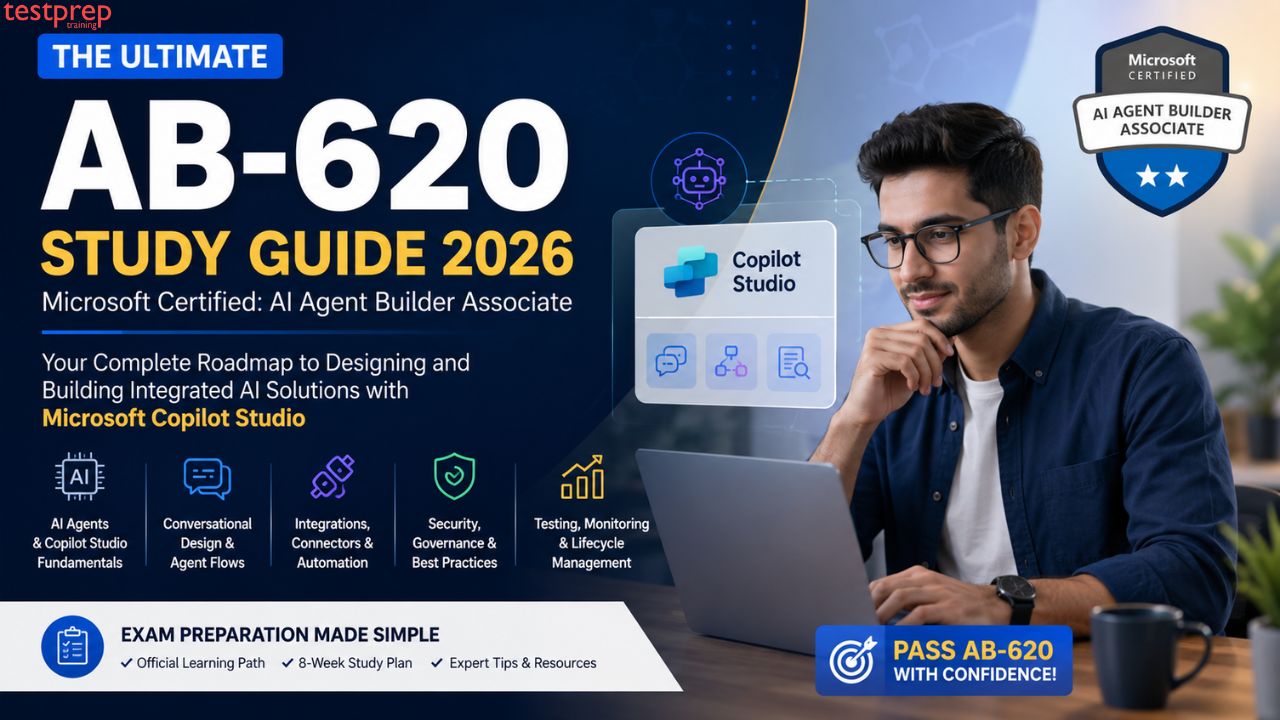
As organizations increasingly adopt AI-powered assistants and intelligent agents, the demand for professionals who can design, build, and manage these solutions continues to grow. Microsoft Exam AB-620, Designing and Building Integrated AI Solutions with Microsoft Copilot Studio, validates the skills needed to create enterprise-ready AI agents that can automate tasks, interact with business data, and integrate with various Microsoft and third-party services.
The certification focuses on practical capabilities such as planning agent solutions, configuring topics and agent flows, connecting knowledge sources, integrating APIs and tools, implementing multi-agent scenarios, and managing the lifecycle of AI solutions. Candidates are also expected to understand emerging concepts such as Retrieval-Augmented Generation (RAG), Model Context Protocol (MCP), and Agent-to-Agent (A2A) communication.
This study guide provides a structured roadmap for preparing for the AB-620 exam. It covers the certification objectives, recommended learning resources, study strategies, hands-on practice recommendations, and key concepts you should master to build confidence and improve your chances of passing the exam on your first attempt.
What is the Microsoft AB-620 Certification?
Microsoft Exam AB-620, Designing and Building Integrated AI Solutions with Microsoft Copilot Studio, was created to validate the skills required to develop modern AI-powered agents that support real-world business processes and enterprise environments. The AB-620 exam serves as the requirement for earning the Microsoft Certified: AI Agent Builder Associate credential. This certification is designed for professionals who want to demonstrate their ability to design, build, extend, test, and manage AI agents using Microsoft Copilot Studio and related Microsoft technologies.
Rather than focusing solely on conversational AI, the certification emphasizes the creation of integrated AI solutions that can interact with organizational data, external systems, business applications, and other AI agents.
Understanding the Purpose of the Certification
The primary objective of the AB-620 certification is to validate a candidate’s ability to transform business requirements into functional AI agent solutions. Modern organizations increasingly rely on AI agents to automate repetitive tasks, assist employees, improve customer experiences, and streamline decision-making processes. As a result, professionals must understand not only how to build agents but also how to connect them securely to enterprise systems and manage them throughout their lifecycle.
Microsoft developed this certification to address the growing demand for specialists who can work with emerging agentic AI technologies. Successful candidates demonstrate the ability to create solutions that combine generative AI capabilities with business data, workflows, APIs, and enterprise governance requirements.
Technologies Covered in the AB-620 Certification
The certification is centered around Microsoft Copilot Studio, Microsoft’s platform for building and customizing AI agents. However, candidates are also expected to understand how Copilot Studio interacts with other technologies across the Microsoft ecosystem. Some of the key technologies and services associated with the certification include:
- Microsoft Copilot Studio
- Microsoft Power Platform
- Microsoft Dataverse
- Microsoft Fabric
- Microsoft Foundry
- Azure AI services
- Azure AI Search
- Microsoft 365 services
- Custom APIs and connectors
- Enterprise knowledge sources
Who Should Consider Taking the AB-620 Exam?
The certification is intended for professionals who actively participate in designing or implementing AI-driven business solutions. It is particularly valuable for developers, solution architects, consultants, Power Platform professionals, and technology specialists who want to expand their expertise in Microsoft’s rapidly growing AI ecosystem.
Candidates are expected to have practical experience with Microsoft Copilot Studio and should be comfortable working with business processes, data sources, connectors, and AI-powered workflows. Familiarity with concepts such as Power Platform environments, Dataverse, APIs, and generative AI technologies can significantly improve preparation efforts.
While the certification is accessible to motivated learners, it is most beneficial for individuals who already possess a foundational understanding of cloud services, application integration, and modern AI concepts.
Skills Validated by the Certification
AB-620 focuses on practical, job-role-oriented skills rather than purely theoretical knowledge. Microsoft expects certified professionals to be capable of planning AI agent solutions, configuring conversational experiences, integrating external tools, and managing deployments in enterprise environments. The exam objectives are organized around three major areas:
- Planning and configuring agent solutions, which includes designing agent architectures, creating agent flows, configuring topics, implementing governance requirements, and preparing solutions for organizational use.
- Integrating and extending agents, which involves connecting enterprise knowledge sources, adding tools and actions, working with connectors and APIs, implementing multi-agent collaboration scenarios, and integrating Azure-based AI services.
- Testing and managing agents, which covers evaluating agent performance, monitoring effectiveness, managing deployments, and supporting application lifecycle management processes.
Why the AB-620 Certification Matters
Organizations are moving from simple automation toward intelligent systems that can reason, access information, perform tasks, and collaborate with users in more sophisticated ways. Microsoft Copilot Studio plays a central role in this transformation, making skilled AI agent builders highly valuable across industries.
Earning the AB-620 certification demonstrates that a professional understands how to design and implement AI solutions that align with Microsoft’s best practices and modern enterprise requirements. It also provides a structured pathway for learning advanced concepts such as Retrieval-Augmented Generation (RAG), Model Context Protocol (MCP), Agent-to-Agent (A2A) communication, enterprise integrations, and multi-agent architectures.
AB-620 Exam Details at a Glance
Before beginning your preparation journey, it is important to understand the structure and requirements of the AB-620 certification exam. Having a clear understanding of the exam format, duration, scoring model, and Microsoft certification policies can help you create a realistic study plan and avoid surprises on exam day. While mastering the technical skills measured is essential, knowing what to expect from the certification process itself is equally valuable.
AB-620 Exam Overview
The AB-620: Designing and Building Integrated AI Solutions with Microsoft Copilot Studio exam is the assessment required to earn the Microsoft Certified: AI Agent Builder Associate credential. The certification validates a candidate’s ability to design, build, integrate, test, and manage AI-powered agent solutions using Microsoft Copilot Studio and related Microsoft technologies.
Unlike certifications that focus primarily on theoretical concepts, AB-620 evaluates practical skills used in real-world business environments. Candidates are expected to demonstrate their ability to create intelligent agents, connect enterprise data sources, integrate external tools and APIs, implement multi-agent solutions, and manage the lifecycle of AI-driven applications.
| Exam Detail | Information |
|---|---|
| Exam Code | AB-620 |
| Certification Earned | Microsoft Certified: AI Agent Builder Associate |
| Skill Level | Associate |
| Exam Duration | 120 Minutes |
| Passing Score | 700 out of 1000 |
| Exam Delivery | Online Proctored or Authorized Testing Center |
| Primary Technology | Microsoft Copilot Studio |
| Certification Provider | Microsoft |
| Recommended Experience | Hands-on experience with Copilot Studio and AI agent development |
Understanding the Exam Format
Microsoft uses a variety of question formats to assess whether candidates can apply their knowledge in practical situations. Rather than testing memorization alone, the AB-620 exam focuses on decision-making, problem-solving, and solution implementation within enterprise AI environments.
Candidates may encounter traditional multiple-choice questions alongside scenario-based questions, case studies, drag-and-drop activities, and other interactive formats commonly used in Microsoft role-based certifications. Many questions present business requirements and ask candidates to determine the most appropriate architecture, integration method, configuration option, or management approach.
Because the certification emphasizes integrated AI solutions, understanding how different Microsoft technologies work together is often more important than memorizing individual features.
Exam Duration and Time Management
Candidates are allocated 120 minutes to complete the exam. During this time, they may need to work through a combination of straightforward knowledge-based questions and more complex scenario-driven questions that require careful analysis.
Effective time management plays an important role in exam success. Some questions may involve reviewing business requirements, evaluating multiple solution options, or identifying the best approach for integrating AI agents with enterprise systems. Candidates who have hands-on experience with Copilot Studio and related technologies often find it easier to navigate these scenarios efficiently.
When preparing for the exam, it is helpful to practice reading technical scenarios carefully and identifying key requirements quickly, as this closely reflects the style of many Microsoft certification questions.

Passing Score and Scoring Methodology
To earn a passing result, candidates must achieve a score of 700 or higher on a scale of 1 to 1000. Microsoft uses a scaled scoring system rather than a simple percentage-based model, meaning not all questions necessarily contribute equally to the final score.
Because the scoring process considers various statistical factors, candidates should focus on developing competency across all measured skill areas instead of attempting to calculate a specific percentage required to pass. A balanced understanding of planning, integration, implementation, testing, and management concepts provides the strongest foundation for success.
Exam Delivery Options
Microsoft provides flexibility in how certification exams are taken. Candidates can choose to complete the exam through an online proctored environment or at an authorized testing center, depending on availability in their region.
Online proctoring allows candidates to take the exam remotely while complying with Microsoft’s security and identification requirements. Testing center delivery remains a preferred option for individuals who want a controlled testing environment and dedicated exam facilities.
Regardless of the chosen delivery method, candidates should review Microsoft’s identification requirements, testing rules, and technical prerequisites before scheduling the exam.
Important Microsoft Certification Policies
Before registering for AB-620, candidates should familiarize themselves with Microsoft’s certification policies. These policies cover exam scheduling, rescheduling, cancellations, identification requirements, exam security procedures, accommodations, and retake eligibility.
Understanding these policies in advance can help prevent avoidable issues during registration or on exam day. Because certification policies, exam requirements, and registration procedures can be updated periodically, candidates should verify the most current details through Microsoft Learn before scheduling their exam.
Beta Exams and Certification Updates
As AI technologies evolve rapidly, Microsoft periodically updates certification exams to ensure they remain aligned with current products and industry practices. In some cases, new exams may initially be released in beta form before becoming generally available.
Candidates who participate in beta exams often gain early access to new certifications, although score reporting may take longer while Microsoft validates exam content and scoring models. For any certification, including AB-620, it is a good practice to review the latest skills measured document before starting your preparation, as exam objectives can be updated to reflect changes in Microsoft Copilot Studio and the broader AI ecosystem.
Understanding the Ideal Candidate Profile
One of the most common questions candidates ask before beginning their preparation is whether they possess the right background for the AB-620 certification. Unlike entry-level Microsoft certifications that focus primarily on foundational concepts, the Microsoft Exam AB-620: Designing and Building Integrated AI Solutions with Microsoft Copilot Studio is intended for professionals who are actively involved in creating, extending, and managing AI-powered business solutions. Understanding Microsoft’s recommended candidate profile can help you identify knowledge gaps early and focus your preparation efforts more effectively.
Who is the AB-620 Certification Designed For?
- The AB-620 exam supports the AI Agent Builder Associate role and is intended for professionals responsible for developing intelligent agents that solve business problems through automation, conversational AI, enterprise integrations, and generative AI capabilities.
- The certification is particularly relevant for developers, Power Platform specialists, technical consultants, solution architects, and technology professionals who work with Microsoft Copilot Studio. It is also valuable for individuals responsible for implementing AI solutions that interact with organizational data, business applications, workflows, and external systems.
- Rather than focusing solely on coding or chatbot development, the certification targets professionals who can design complete AI agent solutions from planning and implementation through testing, deployment, and ongoing management.
Technical Knowledge Expected Before Taking the Exam
Microsoft does not require candidates to hold a specific prerequisite certification before attempting AB-620. However, successful candidates typically possess a solid understanding of several Microsoft technologies and application development concepts.
- A strong familiarity with Microsoft Copilot Studio is particularly important because it serves as the primary platform covered throughout the exam. Candidates should develop an understanding of how AI agents are set up, how conversational workflows are structured, how external knowledge sources are linked, and how actions and capabilities are incorporated into agent interactions.
- Knowledge of the Microsoft Power Platform ecosystem is also beneficial. Since Copilot Studio integrates closely with Power Platform services, candidates should be comfortable working with environments, solutions, connectors, and related administration concepts. Understanding Microsoft Dataverse can also provide a significant advantage because many AI solutions rely on structured business data stored within Dataverse environments.
In addition, candidates should have a practical understanding of API integrations and external services. Many enterprise AI solutions require connecting agents to third-party applications, internal systems, and business workflows, making integration knowledge an important part of the overall skill set.
Understanding the AI and Agentic AI Concepts Involved
The AB-620 certification goes beyond traditional chatbot development and introduces candidates to modern agentic AI architectures. Microsoft expects candidates to understand how AI agents can reason, retrieve information, interact with tools, and collaborate with other agents to complete complex tasks.
- One important concept is Retrieval-Augmented Generation (RAG), which enables agents to use organizational knowledge sources to generate more relevant and accurate responses. Candidates should understand how knowledge retrieval improves generative AI experiences and supports enterprise use cases.
- The exam also introduces concepts such as Model Context Protocol (MCP) and Agent-to-Agent (A2A) communication, which support interactions between AI agents and external tools or services. Although candidates are not required to have the expertise of AI researchers, they should understand the role these technologies play in creating scalable, integrated, and efficient AI-driven solutions.
In addition, familiarity with prompt engineering, generative AI fundamentals, responsible AI principles, and enterprise governance considerations can help candidates navigate many of the scenarios presented throughout the exam.
Practical Experience Microsoft Recommends
- Although theoretical knowledge is important, Microsoft places significant emphasis on practical experience. Candidates should ideally have hands-on exposure to building and managing agents within Copilot Studio before attempting the certification exam.
- This experience may include creating topics, configuring agent flows, connecting enterprise knowledge sources, integrating APIs and connectors, testing agent behavior, and monitoring solution performance. Working with real-world business scenarios helps candidates develop the decision-making skills that are frequently evaluated during the exam.
- Candidates who have experience implementing AI solutions across multiple Microsoft services often find it easier to understand how Copilot Studio fits into broader enterprise architectures. Exposure to technologies such as Microsoft Fabric, Azure AI services, Microsoft Foundry, and Power Platform integrations can provide valuable context when studying advanced exam topics.
Business and Solution Design Skills Matter Too
- A common misconception is that AB-620 is exclusively a technical implementation exam. In reality, Microsoft expects candidates to think like solution designers as well as builders. Many exam objectives require understanding business requirements, selecting appropriate integration approaches, designing secure architectures, and ensuring that AI solutions align with organizational goals.
- As a result, successful candidates often possess a combination of technical expertise and problem-solving skills. They can evaluate requirements, identify constraints, recommend suitable technologies, and design solutions that balance functionality, security, scalability, and maintainability.
Assessing Your Readiness Before Starting Preparation
- If you already have experience working with Copilot Studio, Power Platform services, business workflows, APIs, and generative AI concepts, you are likely well-positioned to begin preparing for AB-620. Candidates who are newer to these technologies should consider spending time building hands-on projects and exploring Microsoft’s official learning resources before scheduling the exam.
- The goal is not to become an expert in every Microsoft AI service but to develop enough practical knowledge to confidently design, integrate, and manage enterprise AI agent solutions. Once you understand the ideal candidate profile and expected skill set, the next step is examining the specific skills measured by the exam and how Microsoft allocates weight across each objective domain.
Complete AB-620 Skills Measured Breakdown
Understanding the skills measured is one of the most important steps when preparing for the Microsoft AB-620 certification exam. Rather than studying every feature within Microsoft Copilot Studio and related services, candidates should focus their efforts on the specific objectives Microsoft has identified as critical for the AI Agent Builder Associate role. The official skills outline provides a roadmap of the knowledge and practical abilities that candidates are expected to demonstrate during the exam.
The AB-620 exam is organized into three major domains that collectively cover the full lifecycle of designing, building, integrating, testing, and managing AI agent solutions. Each domain carries a different weighting, making it important to prioritize study time according to the percentage of questions likely to appear from each area.
Domain 1: Planning and Configuring Agent Solutions
The first domain focuses on the foundational stages of creating AI-powered agent solutions. Candidates are expected to understand how to translate business requirements into well-designed agent architectures while considering security, governance, scalability, and user experience requirements.
– Planning an Agent Solution
- Before building an agent, professionals must determine how it will fit within the organization’s existing systems and processes. Microsoft expects candidates to understand how to evaluate business requirements and select appropriate implementation approaches using Copilot Studio.
- This includes planning authentication and authorization strategies, determining how agents will access enterprise data, identifying integration requirements, and designing solutions that align with organizational governance standards. Candidates should also understand how responsible AI principles influence solution design and how security considerations affect architecture decisions.
- A strong understanding of deployment channels, user interaction models, and enterprise integration requirements is particularly important because many exam questions may involve selecting the most appropriate design approach for a specific business scenario.
– Creating and Managing Agent Flows
- Agent flows play a critical role in controlling how agents perform actions and interact with users and systems. Candidates should understand how to design, configure, and manage agent flows that support business processes and automation requirements.
- Microsoft expects candidates to know how inputs and outputs are handled, how conditions and logic are implemented, and how workflows can be designed to support efficient task execution. Knowledge of error handling, exception management, and monitoring approaches is also important because enterprise-grade AI solutions must remain reliable and maintainable.
- Another key area involves implementing human-in-the-loop processes where agent actions require review, approval, or intervention from users before completing critical tasks.
– Configuring Topics and Conversational Experiences
- Topics form the foundation of many conversational experiences within Copilot Studio. Candidates should understand how topics are structured, how conversations are triggered, and how agents guide users toward successful outcomes.
- The exam may assess the ability to design topic structures that support business objectives while maintaining clear and effective user interactions. Candidates should also understand how generative AI capabilities can enhance conversational experiences through dynamic responses and contextual information retrieval.
- Additional knowledge areas include working with Adaptive Cards, configuring prompts, using variables, and integrating external services through HTTP requests and other connection methods.
Study Focus for Domain 1
Candidates should concentrate on understanding how business requirements translate into agent architectures. Hands-on experience with designing conversational topics, building agent workflows, applying governance and compliance controls, and configuring production-ready conversational solutions can be especially beneficial when preparing for this domain.

Domain 2: Integrating and Extending Agents in Copilot Studio
This is the largest section of the exam and represents the core technical capabilities expected from an AI Agent Builder Associate. Candidates must demonstrate their ability to extend agent functionality, connect enterprise systems, and build solutions that operate across multiple platforms and services.
– Connecting Enterprise Knowledge Sources
- Microsoft expects candidates to understand how knowledge sources can be connected and utilized to provide accurate, context-aware responses.
- This includes working with enterprise content repositories, structured data sources, and information stored across Microsoft services. Candidates should understand how agents retrieve information and how knowledge grounding contributes to more reliable generative AI experiences.
– Extending Agents with Tools and Actions
- A major advantage of modern AI agents is their ability to perform actions rather than simply provide information. Candidates should understand how tools can be added to agents and how those tools enable interaction with business systems and external applications.
- The exam may evaluate a candidate’s ability to configure custom actions, use connectors, integrate APIs, and extend agent functionality through external services. Understanding how agents securely interact with other systems is particularly important in enterprise environments.
- Microsoft also expects familiarity with capabilities such as custom connectors, REST-based integrations, and tool invocation mechanisms that enable agents to complete tasks on behalf of users.
– Implementing Multi-Agent Solutions
- One of the more advanced areas covered in AB-620 involves multi-agent architectures. Instead of relying on a single agent, organizations may deploy multiple specialized agents that collaborate to achieve business objectives.
- Candidates should understand how agent collaboration is implemented and how information is exchanged between agents. This includes familiarity with emerging technologies such as Agent-to-Agent (A2A) communication and Model Context Protocol (MCP).
- Understanding the benefits, design considerations, and use cases for multi-agent solutions can help candidates successfully answer scenario-based questions in this area.
– Integrating with Microsoft AI Services
- Microsoft Copilot Studio does not operate in isolation. Enterprise AI solutions frequently integrate with services across Microsoft’s broader AI ecosystem.
- Candidates should understand how Copilot Studio agents can interact with services such as Azure AI Search, Microsoft Foundry, Microsoft Fabric, and other Azure-based AI capabilities. The exam may assess whether candidates can identify the most appropriate service for specific business requirements and understand how those services contribute to overall solution functionality.
- Knowledge of monitoring, observability, and performance tracking through Microsoft tools is also valuable because organizations need visibility into how AI solutions operate after deployment.
Study Focus for Domain 2
Since this domain carries the highest weighting, candidates should dedicate a significant portion of their preparation time to integration and extension scenarios. Hands-on experience connecting data sources, building custom actions, integrating APIs, and experimenting with multi-agent architectures can provide a substantial advantage during the exam.
Domain 3: Testing and Managing Agents
The final domain emphasizes ensuring solution reliability and overseeing AI agents throughout their entire operational lifecycle. Developing an agent is just the beginning—organizations must also monitor its effectiveness, implement updates, and continuously refine its performance to meet evolving business and user requirements.
– Evaluating Agent Performance
- Microsoft expects candidates to understand how agent quality can be measured and improved over time. This includes creating evaluation strategies, analyzing agent behavior, reviewing outcomes, and identifying areas for optimization.
- Candidates should understand how testing datasets are used, how performance metrics are interpreted, and how evaluation processes support continuous improvement efforts. Since enterprise AI solutions often interact directly with users, monitoring quality and reliability is an important operational responsibility.
– Managing Deployment and Lifecycle Processes
- Application Lifecycle Management (ALM) plays a significant role in enterprise AI environments. Candidates should understand how solutions move from development environments to testing and production environments while maintaining consistency and governance.
- The exam may include questions related to solution management, environment configuration, deployment processes, and change management practices. Familiarity with Power Platform Pipelines, environment variables, and deployment best practices can help candidates navigate these scenarios effectively.
- Understanding how organizations manage updates, versioning, and ongoing maintenance ensures that AI solutions remain secure, scalable, and aligned with business requirements.
Study Focus for Domain 3
Although this domain carries a smaller weighting than integration-focused topics, it should not be overlooked. Candidates should spend time understanding evaluation methodologies, monitoring practices, deployment processes, and lifecycle management concepts. These topics frequently appear in scenario-based questions that assess operational decision-making rather than technical implementation alone.
Microsoft Copilot Studio (AB-620) Concepts You Must Master
Successfully passing the AB-620 certification exam requires more than memorizing the skills measured document. Candidates must develop a solid understanding of the core concepts that power Microsoft Copilot Studio and modern AI agent solutions. These concepts appear throughout the exam objectives and form the foundation of designing, integrating, and managing intelligent agents in enterprise environments.
While the exam covers a wide range of technologies, several Copilot Studio concepts appear repeatedly across planning, implementation, integration, and operational scenarios. Developing confidence in these areas will not only improve exam readiness but also help candidates build practical skills that can be applied in real-world projects.
1. Agent Architecture Fundamentals
- At the heart of every Copilot Studio solution is the agent architecture. Before building any AI agent, candidates must understand how different components work together to create a functional and scalable solution.
- An agent typically combines conversational capabilities, knowledge retrieval, business logic, tools, actions, and external integrations to help users accomplish specific tasks. Rather than acting as a standalone chatbot, modern agents serve as intelligent assistants capable of accessing data, executing actions, and interacting with enterprise systems.
- For the AB-620 exam, candidates should understand how agents process requests, retrieve information, invoke tools, and generate responses. They should also be familiar with architectural decisions involving security, governance, scalability, and user experience. Microsoft frequently evaluates whether candidates can select the most appropriate architecture for a given business requirement rather than simply identifying individual platform features.
2. Topics and Conversation Design
- Topics play a central role in shaping how users interact with agents. They define conversational pathways and help agents understand user intent while guiding interactions toward meaningful outcomes.
- Candidates should understand how topics are structured, how conversation triggers work, and how conversational logic is implemented within Copilot Studio. Effective topic design involves more than creating question-and-answer flows; it requires anticipating user behavior, handling unexpected responses, and maintaining a natural conversation experience.
- The exam may assess how topics support different business processes, how variables are managed throughout conversations, and how conversational flows can be optimized for efficiency and usability. Understanding best practices for topic organization can help candidates address scenario-based questions involving user engagement and agent effectiveness.
3. Knowledge Sources and Grounded Responses
- One of the defining capabilities of modern AI agents is their ability to retrieve information from trusted organizational data sources. This concept is often referred to as knowledge grounding and plays a major role in ensuring response accuracy.
- Candidates should understand how Copilot Studio agents connect to knowledge sources and how retrieved information is incorporated into generated responses. Knowledge may originate from structured databases, enterprise repositories, documents, websites, or other connected systems.
- A strong understanding of Retrieval-Augmented Generation (RAG) is particularly valuable because many enterprise AI solutions rely on retrieval mechanisms to provide accurate and context-aware answers. Instead of depending solely on a language model’s training data, agents use current organizational information to improve response quality and relevance.
- Questions related to knowledge source selection, configuration, and optimization are common within integration-focused exam objectives.
4. Actions, Tools, and External Integrations
- Modern AI agents are expected to perform tasks, not simply provide information. This is achieved through actions and tools that enable agents to interact with business applications, APIs, workflows, and external services.
- Candidates should understand how tools extend agent functionality and how actions are used to automate business processes. Examples may include retrieving customer information, updating records, initiating workflows, or interacting with third-party applications.
- The AB-620 exam places significant emphasis on integration capabilities. As a result, candidates should be comfortable with concepts such as connectors, API-based integrations, custom actions, and external service communication. Understanding when and why to use a specific integration approach is often more important than memorizing individual configuration steps.
5. Adaptive Cards and User Interaction Design
- Enterprise AI agents frequently need to present information in a structured and interactive format. Adaptive Cards provide a flexible way to display data, collect user input, and improve overall user experiences.
- Candidates should understand how Adaptive Cards enhance conversations by providing visual elements such as forms, buttons, approval requests, and data summaries. Rather than relying entirely on text-based interactions, agents can use Adaptive Cards to simplify complex workflows and support more efficient decision-making.
- For exam purposes, understanding the role of Adaptive Cards within conversational experiences and business workflows is more important than memorizing detailed implementation syntax.
6. Generative AI and Dynamic Responses
- Generative AI capabilities are a major reason organizations adopt Copilot Studio. Instead of relying exclusively on predefined responses, agents can generate contextual answers based on user requests and available knowledge.
- Candidates should understand how generative responses differ from traditional scripted conversations and how they contribute to more flexible user experiences. This includes understanding prompt design principles, response generation behavior, and techniques for improving output quality.
- Microsoft also expects candidates to appreciate the importance of responsible AI practices when using generative capabilities. Topics such as accuracy, transparency, security, and content governance may appear throughout the exam, particularly within solution design scenarios.
7. Agent Flows and Process Automation
- Agent flows allow agents to perform tasks and execute business logic beyond conversational interactions. They help bridge the gap between user requests and operational processes by enabling automation within AI-powered solutions.
- Candidates should understand how agent flows are designed, how information moves through workflows, and how business processes can be automated using Copilot Studio. This includes handling inputs and outputs, managing conditional logic, implementing approvals, and integrating with external systems.
- Another important area involves human-in-the-loop processes, where users review or approve actions before an agent completes a task. Understanding when human oversight is required is particularly relevant for enterprise implementations involving compliance, governance, or business-critical operations.
8. Multi-Agent Architectures
- One of the more advanced topics covered in AB-620 involves multi-agent collaboration. Organizations increasingly deploy specialized agents that work together rather than relying on a single agent to perform every task.
- Candidates should understand the benefits of multi-agent systems, including improved scalability, specialization, and operational efficiency. They should also understand how agents communicate, share information, and coordinate activities to achieve business objectives.
- Microsoft’s introduction of concepts such as Agent-to-Agent (A2A) communication and Model Context Protocol (MCP) reflects the growing importance of interconnected AI ecosystems. While the exam does not require deep research-level knowledge, candidates should understand how these technologies support collaboration across agents, tools, and services.
9. Enterprise Integration Strategies
- Most enterprise AI solutions operate within larger business ecosystems. As a result, candidates should understand how Copilot Studio integrates with technologies such as Microsoft Dataverse, Microsoft Power Platform, Microsoft Fabric, Azure AI services, Microsoft Foundry, and external business applications.
- The exam frequently evaluates a candidate’s ability to identify the most appropriate integration approach based on business requirements. Questions may involve selecting data sources, connecting services, managing authentication, or designing scalable enterprise architectures.
- Developing a strong understanding of how these Microsoft technologies complement Copilot Studio can significantly improve performance in integration-focused exam objectives.
10. Monitoring, Evaluation, and Analytics
- Building an AI agent is only the beginning of the solution lifecycle. Organizations must continuously monitor performance, evaluate effectiveness, and identify opportunities for improvement.
- Candidates should understand how agent behavior can be measured, how evaluation processes support quality assurance, and how monitoring tools provide visibility into operational performance. This includes analyzing usage patterns, identifying conversation issues, tracking outcomes, and assessing overall solution effectiveness.
- Knowledge of testing methodologies and evaluation strategies is particularly valuable because Microsoft increasingly emphasizes responsible deployment and continuous improvement of AI-powered solutions.
Official Microsoft Learning Path for Microsoft AB-620
A well-structured study plan is one of the most important factors in successfully preparing for the AB-620 certification exam. While there are numerous third-party courses and community resources available, Microsoft’s official training materials should serve as the foundation of your preparation strategy. These resources are created by the same organization that develops the certification exam and are closely aligned with the published skills measured document.
For candidates pursuing the Microsoft Certified: AI Agent Builder Associate credential, Microsoft provides official training content designed to build both conceptual understanding and practical experience with Microsoft Copilot Studio and integrated AI solutions. Following these learning resources helps ensure that your preparation remains focused on the technologies, workflows, and scenarios most relevant to the exam.
Why Microsoft’s Official Training Matters
One common mistake candidates make is relying exclusively on study notes or practice questions without developing a deeper understanding of the underlying technologies. The AB-620 exam evaluates a candidate’s ability to apply knowledge in realistic business scenarios rather than simply recall definitions or platform features. Microsoft’s learning resources are designed to address this challenge by combining technical concepts with practical implementation guidance. Throughout the training experience, learners are introduced to solution design principles, enterprise integration strategies, agent development workflows, and operational management practices that closely reflect the responsibilities of an AI Agent Builder.
Because Microsoft continuously updates its AI technologies, official learning content is often one of the most reliable sources for understanding current platform capabilities and recommended implementation approaches.
Understanding the AB-620T00-A Official Course
The primary instructor-led training course associated with the certification is AB-620T00-A: Microsoft Copilot Studio – Designing and Building Integrated AI Solutions. This course is specifically designed to help learners develop the skills required to create intelligent agents that interact with users, business systems, enterprise data, and external services. Rather than focusing solely on conversational AI development, the course explores the broader ecosystem required to build enterprise-ready AI solutions.
The training combines conceptual learning with hands-on activities that demonstrate how modern AI agents can be designed, extended, and managed within Microsoft environments. Candidates gain exposure to real-world implementation scenarios that closely align with the exam objectives. For many candidates, this course serves as a bridge between theoretical knowledge and practical experience by demonstrating how individual platform capabilities come together within complete business solutions.
Key Learning Areas Covered in the AB-620 Official Training
The official Microsoft course is structured around the major responsibilities of an AI Agent Builder and mirrors many of the domains found within the certification exam.
1. Designing Agent Solutions
- The course introduces learners to the planning and design considerations involved in creating AI-powered solutions. Candidates learn how to evaluate business requirements, determine appropriate agent architectures, and identify integration opportunities within enterprise environments.
- Special attention is given to designing solutions that are scalable, secure, and aligned with organizational governance requirements. Understanding these design principles is important because many exam questions require candidates to choose the most appropriate implementation approach for a given scenario.
2. Building Agents with Microsoft Copilot Studio
- A significant portion of the training focuses on developing agents within Copilot Studio. Learners explore how conversational experiences are created, how topics are structured, and how agents interact with users to accomplish business objectives.
- The training also examines how generative AI capabilities enhance traditional conversational workflows and how organizations can leverage these capabilities to create more intelligent and flexible user experiences.
- Candidates preparing for AB-620 should pay close attention to the practical exercises in this area because conversational design and agent configuration appear throughout the certification objectives.
3. Working with Knowledge Sources
- Modern AI agents rely heavily on access to organizational information. The official learning path introduces strategies for connecting and utilizing enterprise knowledge sources within Copilot Studio.
- Learners gain an understanding of how information retrieval supports grounded responses and how Retrieval-Augmented Generation (RAG) techniques improve response quality. The training also demonstrates how enterprise data can be incorporated into AI-driven interactions while maintaining accuracy and relevance.
- Since knowledge integration is a recurring theme throughout the exam, this section is particularly valuable for candidates seeking to understand how AI agents provide context-aware assistance.
4. Extending Agents Through Tools and Integrations
- One of the defining characteristics of enterprise AI agents is their ability to perform actions across systems and applications. The official training explores how agents can be extended using tools, connectors, APIs, and other integration mechanisms.
- Candidates learn how agents interact with external services, automate business processes, and execute tasks that go beyond basic conversational interactions. These capabilities are heavily represented within the largest exam domain covering agent integration and extension.
5. Exploring Multi-Agent Solutions
As organizations increasingly adopt advanced AI architectures, multi-agent collaboration is becoming more common. Microsoft’s training introduces concepts related to agent orchestration and collaboration, helping learners understand how specialized agents can work together to achieve business objectives.
Candidates are exposed to emerging technologies and design approaches that support agent-to-agent communication and coordinated task execution. These concepts play an important role in several advanced exam objectives and are increasingly relevant within Microsoft’s evolving AI ecosystem.
6. Testing, Monitoring, and Lifecycle Management
- The training does not stop after deployment. Learners also explore how AI solutions are evaluated, monitored, and maintained throughout their lifecycle.
- Topics include testing methodologies, performance evaluation, deployment processes, environment management, and ongoing optimization strategies. Understanding these operational responsibilities is important because Microsoft expects certified professionals to manage AI solutions beyond their initial implementation.
- This area aligns closely with the exam’s final domain, which focuses on testing and managing agents in enterprise environments.
Getting the Most Value from Microsoft Learn
- In addition to instructor-led training, Microsoft provides extensive self-paced learning resources through Microsoft Learn. These modules allow candidates to explore topics at their own pace while reinforcing concepts covered in the official course.
- The most effective approach is to use Microsoft Learn as an ongoing companion throughout your preparation journey rather than treating it as a one-time activity. Reading the learning modules, completing exercises, reviewing documentation, and experimenting with Copilot Studio features creates a stronger understanding than passive study alone.
- Candidates should also revisit modules related to AI agent design, enterprise integrations, Power Platform services, Microsoft Fabric, Azure AI capabilities, and governance topics because these technologies frequently appear within the exam objectives.
Combining Instructor-Led Training with Hands-On Practice
- Although the official course provides a strong learning foundation, practical experience remains essential for AB-620 success. The certification focuses heavily on implementation decisions and real-world scenarios, making hands-on practice a critical component of exam readiness.
- As you work through Microsoft’s learning materials, try to build sample agents, configure topics, connect knowledge sources, experiment with agent flows, and create integrations using available services. Practical experimentation reinforces theoretical concepts and helps candidates develop the confidence needed to answer scenario-based exam questions effectively.
- Many successful candidates treat the official learning path as a framework for building real-world projects rather than simply a collection of study materials. This approach creates a deeper understanding of the technologies and workflows that Microsoft expects AI Agent Builders to master.
Recommended Study Roadmap (8-Week Preparation Plan)
Preparing for the Microsoft AB-620 certification requires more than simply reading documentation or watching training videos. The exam evaluates your ability to design, build, integrate, test, and manage AI agent solutions using Microsoft Copilot Studio and related technologies. Because the objectives span multiple technical domains, a structured preparation plan can help ensure balanced coverage of all skills measured while providing enough time for hands-on practice.
The following eight-week roadmap is designed for candidates who already possess basic familiarity with Microsoft technologies and can dedicate consistent study time each week. The goal is to gradually build knowledge, reinforce concepts through practical exercises, and develop the confidence required to handle scenario-based exam questions.
Week 1: Building Your Foundation in Copilot Studio and Agentic AI
- The first week should focus on understanding the broader AI agent ecosystem and Microsoft’s vision for agent-based solutions. Before exploring advanced integrations and architectures, candidates need a clear understanding of how Copilot Studio fits within Microsoft’s AI platform.
- During this stage, spend time learning the Copilot Studio interface, navigation structure, agent creation process, and core platform capabilities. Familiarize yourself with the concepts of agents, topics, conversations, actions, and knowledge sources.
- You should also begin studying fundamental AI concepts that appear throughout the certification objectives, including generative AI, large language models, responsible AI, and enterprise AI governance. The objective is to develop a strong conceptual foundation before moving into implementation-focused topics.
- By the end of the week, you should be comfortable navigating Copilot Studio and understanding the role AI agents play within modern business environments.
Week 2: Master Conversational Design and Agent Configuration
- Once the foundational concepts are clear, the next step is understanding how conversational experiences are designed within Copilot Studio.
- Focus on creating topics, configuring conversation flows, managing triggers, working with variables, and handling user interactions. Study how agents guide users through conversations and how conversational logic influences the overall user experience.
- This is also a good time to explore Adaptive Cards, prompt configuration, and generative response capabilities. Understanding how conversational experiences are structured will help prepare you for many of the planning and configuration objectives covered in the exam.
- Hands-on practice is especially valuable during this phase. Build multiple sample agents and experiment with different conversation designs to understand how various configurations affect user interactions.
Week 3: Learn Knowledge Sources and Retrieval-Augmented Generation (RAG)
- Modern AI agents depend heavily on access to organizational knowledge. During the third week, focus on understanding how agents retrieve, process, and present information from enterprise data sources.
- Study how knowledge sources are connected within Copilot Studio and how Retrieval-Augmented Generation (RAG) improves response quality by grounding AI-generated answers in trusted business information.
- Candidates should also explore how enterprise content repositories, documents, websites, and structured data sources contribute to knowledge-driven agent experiences. Understanding knowledge integration is particularly important because it appears throughout both the exam objectives and real-world implementations.
- At this stage, create practical exercises involving knowledge sources so you can observe how agents retrieve and use information during conversations.
Week 4: Focus on Agent Flows and Business Process Automation
- The fourth week should concentrate on agent flows and workflow automation. This area represents a significant component of enterprise AI implementations because organizations increasingly use agents to automate repetitive tasks and business processes.
- Study how agent flows are designed, how inputs and outputs are managed, and how logic is applied within workflows. Pay particular attention to conditional processing, exception handling, approval mechanisms, and human-in-the-loop scenarios.
- Understanding how agents move beyond conversations and interact with operational business processes is essential for success in both the exam and real-world projects.
- Practical exercises should include creating workflows that trigger actions, process information, and integrate with external systems where possible.
Week 5: Explore Connectors, APIs, and Enterprise Integrations
- Integration is the largest domain within the AB-620 exam, making this one of the most important weeks in your preparation plan.
- Begin by studying how Copilot Studio agents connect to external systems through connectors, APIs, and custom integrations. Learn how agents interact with business applications, enterprise data sources, and third-party services.
- You should also spend time understanding authentication concepts, secure data access, and integration design considerations. The exam frequently presents business scenarios that require selecting the most appropriate integration strategy rather than simply identifying platform features.
- Hands-on practice should focus on connecting agents to external services and exploring how actions can be used to extend functionality beyond conversational interactions.

Week 6: Study Multi-Agent Solutions and Advanced AI Architectures
- As Microsoft continues expanding its AI ecosystem, multi-agent collaboration has become an increasingly important topic. Week six should focus on understanding how specialized agents work together to accomplish business objectives.
- Study concepts such as multi-agent orchestration, Agent-to-Agent (A2A) communication, Model Context Protocol (MCP), Microsoft Foundry integrations, and Microsoft Fabric-related AI capabilities.
- Candidates should understand the advantages of distributed agent architectures and how organizations can leverage multiple specialized agents instead of relying on a single solution for every task.
- Although these topics may initially seem advanced, they represent an important part of Microsoft’s long-term AI strategy and are increasingly reflected within certification objectives.
Week 7: Testing, Monitoring, and Application Lifecycle Management
- Many candidates spend most of their preparation time on building solutions while overlooking operational management topics. However, the AB-620 exam also evaluates your ability to test, deploy, monitor, and maintain AI agents.
- During this week, focus on evaluation methodologies, testing strategies, monitoring approaches, and solution optimization techniques. Learn how organizations assess agent effectiveness and continuously improve performance after deployment.
- You should also review Application Lifecycle Management (ALM) concepts, including environment management, solution deployment, environment variables, and Power Platform Pipelines.
- Understanding how AI solutions are managed across development, testing, and production environments is essential for answering many scenario-based questions within the exam.
Week 8: Final Review and Exam Readiness Assessment
- The final week should be dedicated to consolidating knowledge and identifying any remaining weak areas. Rather than learning entirely new topics, focus on reinforcing concepts that appear most frequently within the skills measured document.
- Review all three exam domains and revisit Microsoft Learn modules related to topics where you feel less confident. Pay special attention to integration scenarios, governance considerations, multi-agent concepts, and lifecycle management topics because these areas often require deeper understanding.
- This is also the ideal time to complete practice assessments, review notes, revisit hands-on projects, and simulate exam-style thinking. When reviewing questions, focus on understanding why a particular solution is correct rather than simply memorizing answers.
- Candidates should also familiarize themselves with Microsoft’s exam experience, question styles, and time management strategies so they feel comfortable navigating the 120-minute exam environment.
The 8-Week Microsoft AB-620 Study Roadmap at a Glance
| Week | Focus Area | Key Topics to Cover | Primary Goal |
|---|---|---|---|
| Week 1 | Copilot Studio Foundations | AI agent fundamentals, Copilot Studio interface, generative AI concepts, responsible AI, enterprise AI basics | Build a strong understanding of the Microsoft AI ecosystem and agent architecture |
| Week 2 | Conversational Design & Topics | Topics, conversation flows, triggers, variables, prompts, Adaptive Cards, generative responses | Learn how to design effective conversational experiences |
| Week 3 | Knowledge Sources & RAG | Knowledge integration, Retrieval-Augmented Generation (RAG), enterprise content sources, grounded responses | Understand how agents retrieve and use organizational knowledge |
| Week 4 | Agent Flows & Automation | Agent flows, workflow design, approvals, human-in-the-loop processes, business automation | Learn how agents execute tasks and automate business processes |
| Week 5 | Connectors & Integrations | Connectors, APIs, custom actions, authentication, enterprise system integration | Master the largest exam domain focused on extending agent capabilities |
| Week 6 | Multi-Agent Solutions | Agent-to-Agent (A2A), Model Context Protocol (MCP), Microsoft Foundry, Microsoft Fabric, orchestration concepts | Understand advanced agent collaboration architectures |
| Week 7 | Testing & Lifecycle Management | Agent evaluation, monitoring, analytics, Application Lifecycle Management (ALM), Power Platform Pipelines | Learn how to manage and optimize AI solutions after deployment |
| Week 8 | Final Revision & Exam Preparation | Skills measured review, practice assessments, weak-area improvement, exam strategy | Consolidate knowledge and prepare for exam day |
Recommended Weekly Time Commitment
| Experience Level | Suggested Study Time |
|---|---|
| Beginner to Copilot Studio | 10–15 Hours per Week |
| Intermediate Microsoft Professional | 8–12 Hours per Week |
| Experienced Power Platform / AI Professional | 5–8 Hours per Week |
Common Challenges when Preparing for the Microsoft AB-620 Exam
Preparing for the Microsoft AB-620 certification can be highly rewarding, but many candidates encounter obstacles that slow their progress or create confusion during their studies. Unlike traditional certification exams that focus primarily on a single technology or product, AB-620 covers a combination of AI concepts, agent design, enterprise integrations, automation workflows, governance considerations, and lifecycle management practices. As a result, candidates often need to develop both technical and solution-design skills simultaneously.
Understanding the most common preparation challenges can help you avoid potential pitfalls and create a more effective study strategy from the beginning.
| Challenge | Why It Can Be Difficult | Recommended Approach |
|---|---|---|
| Understanding Agentic AI Concepts | Concepts such as Retrieval-Augmented Generation (RAG), Model Context Protocol (MCP), and Agent-to-Agent (A2A) communication are relatively new and may be unfamiliar to many IT professionals. | Focus on understanding the purpose and business value of each concept rather than memorizing technical definitions. Use Microsoft Learn modules and practical examples to reinforce learning. |
| Designing Effective Agent Architectures | Candidates often struggle to determine the most appropriate design approach for different business requirements and scenarios. | Practice evaluating real-world use cases and identifying how agents, knowledge sources, actions, and integrations work together to solve business problems. |
| Working with Enterprise Integrations | Integrating agents with APIs, connectors, business applications, and external services can be complex, especially for candidates with limited integration experience. | Gain hands-on experience with connectors, custom actions, and API-based integrations within Copilot Studio whenever possible. |
| Understanding Knowledge Sources and RAG | Many candidates understand conversational AI but have limited experience with knowledge grounding and retrieval-based responses. | Create sample agents that use enterprise content and observe how retrieved information improves response accuracy and relevance. |
| Configuring Agent Flows and Automation | Designing workflows, approval processes, and human-in-the-loop scenarios can be challenging without practical exposure. | Build simple automation projects and gradually increase complexity to understand workflow behavior and logic implementation. |
| Learning Multi-Agent Architectures | Multi-agent collaboration introduces additional concepts related to orchestration, communication, and specialization. | Study Microsoft’s examples and focus on understanding when multi-agent solutions provide advantages over single-agent implementations. |
| Managing Security and Governance Requirements | Candidates often focus on building solutions while overlooking security, compliance, and governance considerations. | Review authentication, authorization, data access controls, and responsible AI principles as part of every solution design exercise. |
| Testing and Evaluating Agent Performance | Understanding how agents are measured, tested, and optimized can be difficult for those with limited operational experience. | Explore evaluation methods, monitoring tools, and performance metrics used to assess agent effectiveness after deployment. |
| Application Lifecycle Management (ALM) Concepts | Deployment pipelines, environment variables, and solution management may be unfamiliar to candidates who have not worked extensively with Power Platform environments. | Spend time studying deployment processes and environment management practices alongside technical implementation topics. |
| Handling Scenario-Based Exam Questions | Many candidates know the technology but struggle when applying concepts to complex business scenarios. | Practice identifying business requirements first, then evaluate which solution best aligns with Microsoft’s recommended approaches. |
Balancing Theory and Practical Experience
One of the biggest challenges candidates face is relying too heavily on theoretical study. Reading documentation and completing training modules are important, but the AB-620 exam frequently evaluates how well candidates can apply knowledge in realistic situations. Questions often require candidates to analyze business requirements, compare implementation options, and select the most effective solution.
For this reason, hands-on experience with Microsoft Copilot Studio can significantly improve exam readiness. Even small practice projects can help reinforce concepts that may seem complex when studied only from documentation.
Keeping Up with Rapidly Evolving AI Technologies
The AI landscape is evolving quickly, and Microsoft continues to enhance Copilot Studio and related AI services. Candidates may occasionally encounter differences between older learning materials and current platform capabilities.
To minimize confusion, prioritize Microsoft’s official learning resources, certification study guides, product documentation, and training content. Staying aligned with official resources helps ensure that your preparation reflects the technologies and capabilities most relevant to the current version of the exam.
Developing an Exam-Focused Mindset
Another challenge is studying too broadly. Because AI is such a large field, candidates sometimes spend excessive time learning topics that fall outside the exam objectives. The most successful candidates use the official skills measured document as their primary roadmap and continuously map their study activities back to the published exam domains.
Best Resources for the Microsoft AB-620 Exam Preparation
Choosing the right study resources can significantly impact your preparation experience and exam results. Because the Microsoft AB-620 certification focuses on designing and building integrated AI solutions with Microsoft Copilot Studio, candidates need resources that not only explain technical concepts but also demonstrate how those concepts are applied in real-world scenarios. A combination of official Microsoft learning materials, hands-on practice environments, technical documentation, and community resources can help create a well-rounded preparation strategy.
Rather than relying on a single course or study guide, successful candidates typically use multiple resources to strengthen both theoretical understanding and practical implementation skills.
1. Start with the Official AB-620 Study Guide
- The most important resource for any certification candidate is the official skills measured document published by Microsoft. This guide serves as the blueprint for the exam and identifies the exact knowledge areas Microsoft expects candidates to master.
- Before beginning your preparation, review the official study guide carefully and use it to organize your study plan. The document outlines each exam domain, associated objectives, and the percentage weighting assigned to different skill areas. Using the study guide as your primary roadmap helps prevent spending excessive time on topics that are not directly relevant to the certification.
- Candidates should revisit the study guide regularly throughout their preparation to ensure all objectives have been adequately covered.
2. Use Microsoft Learn as Your Primary Learning Platform
Microsoft Learn should be the foundation of your AB-620 preparation strategy. Microsoft continuously updates its learning content to reflect changes in Copilot Studio, AI technologies, and certification objectives. The learning modules introduce core concepts gradually while providing practical exercises and guided learning experiences. Unlike many third-party resources, Microsoft Learn is designed specifically around Microsoft’s recommended implementation approaches and best practices. Candidates should focus on learning paths related to:
- Microsoft Copilot Studio
- AI agent development
- Generative AI fundamentals
- Power Platform integrations
- Microsoft Fabric
- Azure AI services
- Application lifecycle management
- Responsible AI principles
The interactive nature of Microsoft Learn makes it particularly useful for reinforcing concepts that may appear in scenario-based exam questions.
3. Complete the Official AB-620T00-A Training Course
- Microsoft’s official instructor-led course, AB-620T00-A: Microsoft Copilot Studio – Designing and Building Integrated AI Solutions, is one of the most direct preparation resources available.
- The course closely aligns with the certification objectives and covers the major responsibilities of an AI Agent Builder. It provides structured instruction on agent design, knowledge integration, automation, multi-agent collaboration, enterprise integrations, testing, and deployment practices.
- For candidates who prefer guided learning and hands-on demonstrations, the official course can significantly accelerate understanding of complex topics that may be difficult to learn solely from documentation.
4. Study Microsoft Copilot Studio Documentation
While training courses provide structured learning, Microsoft’s product documentation offers deeper technical detail. The Copilot Studio documentation explains platform capabilities, configuration options, integration methods, and implementation guidance that may not be covered extensively in certification-focused materials. Candidates should become familiar with documentation related to:
- Agent creation and configuration
- Topics and conversational design
- Agent flows
- Knowledge sources
- Generative AI capabilities
- Connectors and actions
- Security and governance
- Multi-agent implementations
Documentation is especially valuable when exploring advanced topics that require a deeper understanding beyond exam preparation.
5. Explore Azure AI and Microsoft AI Ecosystem Resources
- Although Copilot Studio is the primary technology covered by AB-620, many exam objectives involve integration with other Microsoft AI services. Candidates should spend time reviewing resources related to the broader Microsoft AI ecosystem.
- Understanding how Copilot Studio works alongside Azure AI services, Azure AI Search, Microsoft Foundry, and Microsoft Fabric can provide valuable context for integration-focused exam scenarios.
- Many certification questions evaluate solution design decisions, making it important to understand which Microsoft services are most appropriate for different business requirements.
6. Build Hands-On Projects in a Practice Environment
No study resource can fully replace practical experience. Because the AB-620 exam focuses heavily on implementation and decision-making, hands-on practice should be a major part of your preparation strategy. Candidates should create sample projects that allow them to experiment with:
- Building AI agents
- Designing topics
- Creating agent flows
- Connecting knowledge sources
- Implementing actions
- Using connectors
- Integrating APIs
- Testing and monitoring solutions
Even relatively simple projects can help reinforce concepts and improve understanding of how different platform components interact. Practical experience is particularly helpful when preparing for scenario-based questions that require evaluating real-world business requirements.
7. Participate in Microsoft Community Resources
The Microsoft community provides valuable opportunities to learn from professionals who are actively working with Copilot Studio and related technologies. Engaging with community discussions can expose candidates to implementation challenges, best practices, troubleshooting techniques, and emerging trends that may not appear in formal training materials. Useful community resources include:
- Microsoft Learn Community
- Microsoft Q&A forums
- Microsoft Tech Community
- Power Platform Community
- Community blogs and technical articles
These platforms can be especially useful when seeking clarification on complex topics or learning from real-world deployment experiences.
8. Use Practice Assessments Strategically
- Practice assessments can help identify weak areas and measure overall readiness, but they should be used as a validation tool rather than the primary learning method.
- Candidates sometimes make the mistake of repeatedly taking practice tests without strengthening their understanding of the underlying concepts. A more effective approach is to review incorrect answers, identify knowledge gaps, and revisit official learning materials to reinforce those topics.
- Practice assessments are most valuable during the final stages of preparation when you are evaluating readiness rather than learning entirely new content.
9. Create a Personal Reference Library
As your studies progress, consider building your own collection of notes, diagrams, architecture examples, and implementation summaries. Creating personalized study materials helps reinforce learning and provides a quick review resource during the final days before the exam. Many successful candidates maintain notes covering:
- Agent architecture concepts
- RAG workflows
- MCP and A2A communication
- Integration approaches
- Security considerations
- ALM processes
- Multi-agent scenarios
- Governance best practices
The process of organizing information often improves retention more effectively than passive reading alone.
Exam Day Preparation Tips
After weeks of studying Microsoft Copilot Studio, practicing integrations, reviewing AI concepts, and completing hands-on exercises, the final step is preparing for the actual exam experience. Even well-prepared candidates can lose valuable points due to poor time management, rushing through questions, or overlooking important details in scenario-based questions. A solid exam-day strategy can help you remain focused, manage your time effectively, and maximize your chances of success.
The AB-620 exam evaluates your ability to apply knowledge in practical situations rather than simply recall facts. As a result, preparation during the final days should focus on reinforcing key concepts and building confidence rather than attempting to learn entirely new topics.
Focus on Revision During the Final Week
The week before the exam should be dedicated to reviewing concepts you have already studied rather than expanding into new subject areas. At this stage, your goal is to strengthen retention and identify any remaining weak areas. Pay particular attention to the three exam domains:
- Planning and configuring agent solutions
- Integrating and extending agents in Copilot Studio
- Testing and managing agents
Because the integration domain carries the highest weighting, it is worth spending additional time reviewing connectors, APIs, enterprise integrations, multi-agent concepts, and knowledge source configurations.
Review your notes, architecture diagrams, and practice exercises to reinforce how different technologies work together within a complete AI solution.
Revisit Key Concepts Frequently Tested
Certain topics appear repeatedly throughout the exam objectives and deserve special attention during your final review. These include:
| High-Priority Topic | Why It Matters |
|---|---|
| Microsoft Copilot Studio Architecture | Forms the foundation of most exam objectives |
| Topics and Agent Flows | Core components of conversational and automation solutions |
| Retrieval-Augmented Generation (RAG) | Essential for knowledge-driven agent experiences |
| Knowledge Sources | Frequently tested in integration scenarios |
| Connectors and APIs | Critical for extending agent capabilities |
| Agent-to-Agent (A2A) Communication | Important for advanced multi-agent solutions |
| Model Context Protocol (MCP) | Emerging technology within Microsoft’s AI ecosystem |
| Microsoft Fabric and Microsoft Foundry Integrations | Common in enterprise AI architectures |
| Agent Evaluation and Monitoring | Important for operational management scenarios |
| Application Lifecycle Management (ALM) | Relevant to deployment and solution maintenance |
Rather than memorizing definitions, focus on understanding how these technologies solve business problems and when they should be used.
Understand the Question Style
Many candidates underestimate the importance of understanding Microsoft’s question format. The AB-620 exam is designed to assess practical decision-making, meaning questions often present business requirements and ask you to select the most appropriate solution. Instead of asking what a feature does, questions frequently ask:
- Which solution best satisfies a requirement?
- Which integration approach should be used?
- How should an agent be configured?
- Which service is most appropriate for a specific scenario?
Reading questions carefully is essential because multiple answers may appear technically correct, but only one aligns best with Microsoft’s recommended approach.
Manage Your 120 Minutes Effectively
The AB-620 exam provides 120 minutes to complete the assessment. While this is generally sufficient, scenario-based questions may require more time than straightforward knowledge-based questions. A practical approach is to:
- Read each question carefully before reviewing the answer choices.
- Identify the business requirement being tested.
- Eliminate clearly incorrect options.
- Select the best solution based on Microsoft’s recommended practices.
- Avoid spending excessive time on a single question.
Maintaining a steady pace throughout the exam helps reduce pressure during the final portion of the assessment.
Pay Attention to Business Requirements
One of the most common mistakes candidates make is focusing on technology names instead of business objectives. Microsoft often structures questions around organizational needs such as:
- Improving customer service
- Automating workflows
- Integrating enterprise systems
- Enhancing knowledge retrieval
- Implementing governance controls
- Supporting multi-agent collaboration
The correct answer is typically the option that best addresses the stated business requirement while following Microsoft’s recommended design principles. Always identify the problem before evaluating potential solutions.
Avoid Common Exam Mistakes
Several recurring mistakes can negatively affect exam performance, even for technically strong candidates.
- Rushing Through Scenario-Based Questions
- Longer questions often contain important details that influence the correct answer. Missing a single requirement can lead to selecting an otherwise reasonable but incorrect solution.
- Ignoring Security and Governance Considerations
- Microsoft places significant emphasis on security, responsible AI, compliance, and governance. When multiple solutions appear viable, the answer that aligns best with enterprise governance requirements is often the correct choice.
- Overthinking Simple Questions
- Not every question is intended to be complex. Sometimes the most straightforward answer is the correct one. Avoid searching for hidden meanings when the requirement is clearly stated.
- Relying Solely on Memorization
- The exam is designed to test application of knowledge. Candidates who understand how technologies work together generally perform better than those who memorize isolated facts.
Prepare Your Testing Environment
If you are taking the exam through online proctoring, verify your testing environment well before your scheduled appointment.
Ensure that:
- Your computer meets system requirements.
- Your webcam and microphone function correctly.
- Your internet connection is stable.
- Your identification documents are ready.
- Your workspace complies with Microsoft’s testing policies.
Addressing these requirements in advance helps prevent unnecessary stress on exam day.
Maintain a Clear and Focused Mindset
The final 24 hours before the exam should be focused on light revision rather than intensive study. Reviewing key notes, architecture concepts, and major exam domains is generally more productive than attempting to cover large amounts of new material.
A calm and confident approach often produces better results than last-minute cramming. Remember that the exam is designed to validate practical skills and decision-making abilities. If you have completed the official learning resources, practiced within Copilot Studio, and followed a structured study plan, you have already built a strong foundation for success.
Conclusion
The Microsoft AB-620 certification represents an excellent opportunity for professionals looking to build expertise in one of the fastest-growing areas of technology: AI agents and intelligent business automation. As organizations increasingly adopt Microsoft Copilot Studio and agent-based solutions to improve productivity, streamline operations, and enhance user experiences, the demand for skilled AI Agent Builders continues to rise.
Successfully preparing for the AB-620 exam requires more than reviewing documentation or memorizing concepts. Candidates should focus on developing a strong understanding of agent design, conversational experiences, knowledge integration, workflow automation, enterprise connectivity, multi-agent architectures, and lifecycle management practices. Combining Microsoft’s official learning resources with hands-on practice in Copilot Studio is often the most effective way to build both exam readiness and practical skills.
Throughout this guide, we explored the certification objectives, exam structure, skills measured, recommended learning resources, study roadmap, common preparation challenges, and exam-day strategies. By following a structured preparation plan and gaining real-world experience with the technologies covered in the exam, you can approach the certification with greater confidence and a clearer understanding of Microsoft’s AI ecosystem. With consistent study, practical experimentation, and a strong focus on the official exam objectives, you will be well-positioned to earn the Microsoft Certified: AI Agent Builder Associate certification and contribute to the next generation of AI-powered business solutions.
