The world is moving beyond chatbots. Businesses are now exploring AI agents that can retrieve enterprise data, use tools, coordinate workflows, and support complex business processes. But building an AI agent is only one part of the challenge. Designing a solution that is secure, scalable, integrated with existing systems, and capable of delivering measurable business value requires a different level of expertise. This is where the Microsoft AB-100 certification comes into focus. The Microsoft Certified: Agentic AI Business Solutions Architect Expert credential is designed for professionals who want to architect AI-powered business solutions using Microsoft’s evolving AI and business technology ecosystem. It brings together business strategy, solution design, agent orchestration, enterprise integration, security, governance, and deployment.
Whether you are an experienced solution architect, a Microsoft technology professional, or an AI consultant looking to expand your expertise, understanding AB-100 can help you assess the skills required to work on the next generation of intelligent business solutions. In this guide, we’ll explore what the Microsoft AB-100 certification covers, its exam domains and prerequisites, the technologies you should understand, and how to prepare for a career designing agentic AI business solutions in 2026.
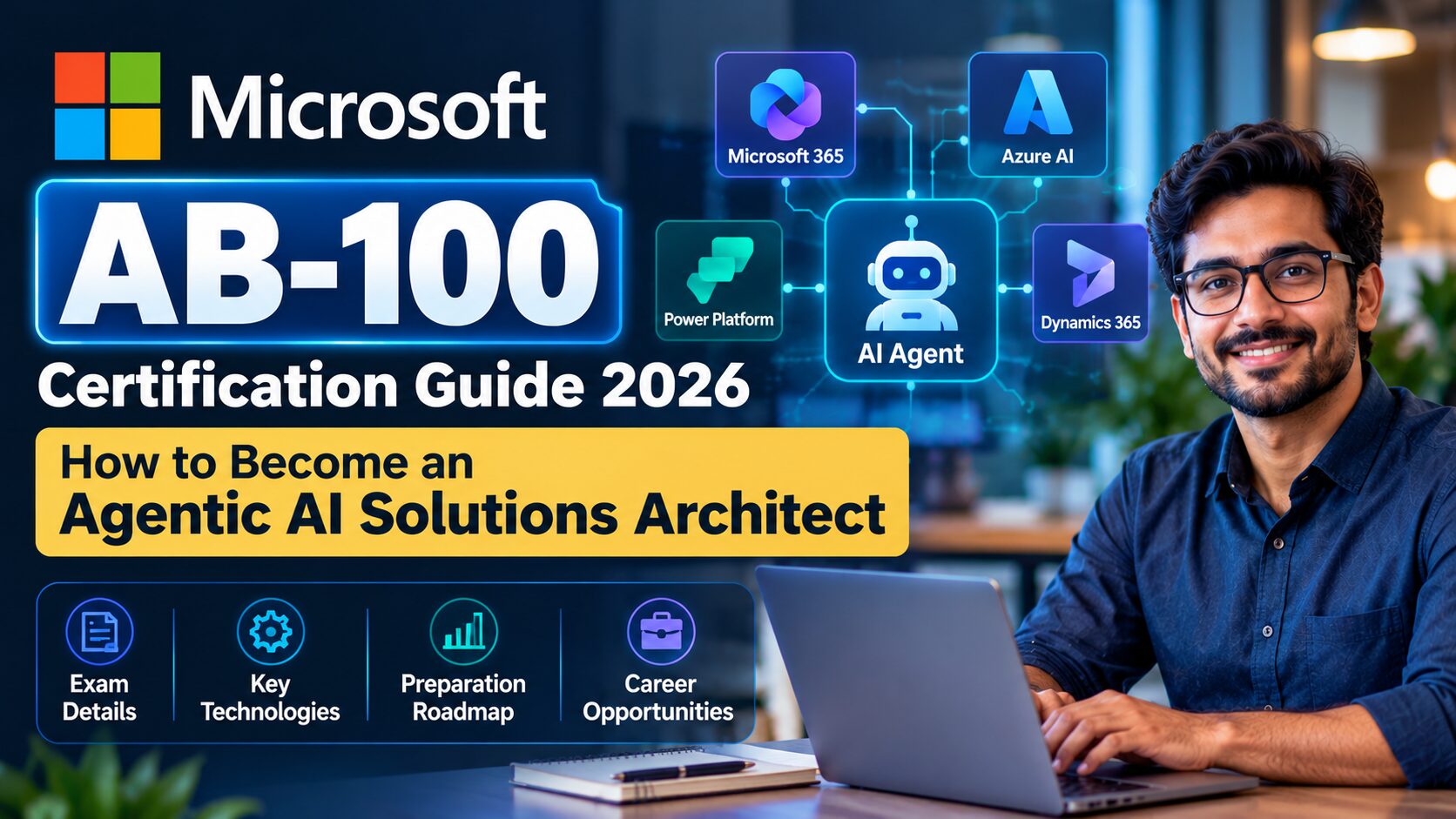
Microsoft AB-100 Certification Guide 2026: How to Become an Agentic AI Solutions Architect
Understand the AB-100 exam, Microsoft’s agentic AI ecosystem, prerequisite credentials, architecture skills, and how to prepare for designing secure, scalable AI-powered business solutions.
Agentic AI architecture · concept view
AB-100 at a glance
Agentic AI is moving beyond isolated prompts and chat interfaces. In a business setting, agents may retrieve enterprise knowledge, use approved tools, coordinate multi-step work, and support decisions or actions inside established processes. This creates a new architecture challenge: the solution must be useful and integrated, but also governed, observable, secure, and measurable.
The AB-100 exam assesses the ability to plan, design, and deploy AI-powered business solutions across Microsoft’s business and AI ecosystem. It blends business analysis, solution architecture, agent design, integration, data grounding, security, lifecycle management, monitoring, and value measurement.
Business alignment
Assess requirements, data readiness, use cases, adoption, cost, and return on investment.
Solution architecture
Select agent patterns, models, knowledge sources, integration methods, and extensibility options.
Operational readiness
Test, govern, monitor, tune, and manage the lifecycle of AI-powered solutions.
This is not simply a test of whether you recognize Microsoft product names. Architects must weigh options: configure a prebuilt capability or build a custom agent? Use low-code or code-first development? Which data should ground an answer? How will permissions, evaluation, monitoring, and human approval work?
What does an Agentic AI Business Solutions Architect do?
The architect connects business outcomes to technical decisions. They identify processes worth improving, map users and systems, assess risk, and define where AI can add value. Then they design the agent’s responsibilities, tools, knowledge sources, data permissions, escalation paths, integrations, and operational controls.
From prompt to business process
A basic generative AI feature might summarize a document. An agentic workflow may retrieve records, interpret a request, call approved tools, coordinate steps across applications, and report a result. That extra capability also increases the need for boundaries: least-privilege access, validation, approval gates, audit trails, fallback behavior, and clear handling of uncertainty.
Typical responsibilities
Responsibilities may include developing an AI adoption roadmap, making build/buy/extend decisions, designing single-agent and multi-agent patterns, integrating Dynamics 365, Microsoft Power Platform, Microsoft 365 and AI services, defining security and governance, planning application lifecycle management (ALM), and tracking quality, reliability, adoption, and ROI.
The Microsoft technology stack to understand
Learn the purpose of each technology area and how it fits into an architecture rather than studying products as disconnected lists.
| Technology area | Architectural relevance |
|---|---|
| Microsoft Copilot Studio | Build and extend agents, configure topics and actions, connect knowledge sources, and design agent flows. |
| Microsoft Foundry | Support custom AI and agent solutions, model choices, evaluation, orchestration, and extensibility. |
| Microsoft 365 Copilot and agents | Bring agent experiences into workplace productivity and collaboration scenarios. |
| Dynamics 365 | Integrate AI into customer experience, service, finance, supply chain, and other business processes. |
| Microsoft Power Platform | Connect business apps, automation, data, and AI-enabled workflows. |
| Azure AI services | Provide AI capabilities for tailored model and service integration. |
| MCP and A2A | Understand protocols for tool/context integration and agent-to-agent interoperability. |
| Security and telemetry | Control access, investigate failures, observe behavior, and improve reliability. |
Microsoft product names and capabilities evolve. Use the current official exam study guide to confirm the scope and terminology that apply to your exam date.
AB-100 prerequisites and eligibility
Passing AB-100 alone does not complete the Expert certification requirements. Microsoft requires the exam plus at least one eligible prerequisite Associate-level certification. The current list spans Dynamics 365, Power Platform, Azure AI, and AI agent or intelligent application roles.
Examples listed by Microsoft include PL-400 (Power Platform Developer Associate), AI-103 (Azure AI Apps and Agents Developer Associate), AI-300 (Machine Learning Operations Engineer Associate), AB-620 (AI Agent Builder Associate), and multiple Dynamics 365 credentials. The list can change, so verify your exact credential on Microsoft’s official certification page before booking.
Who should consider AB-100?
The exam is intended for experienced solution architects who can design integrated, secure, scalable AI-powered solutions. Enterprise application, cloud architecture, data, integration, security, ALM, and stakeholder-management experience are useful foundations. Candidates new to architecture should build those fundamentals and pursue an appropriate Associate-level path first.
AB-100 exam domains and weighting
Microsoft’s published study guide groups the exam into three broad skill areas with these approximate weightings.
Plan AI-powered business solutions
Analyze requirements and data readiness, define AI strategy and use cases, select suitable approaches, and evaluate costs, benefits, and ROI.
Design AI-powered business solutions
Design agents and AI components, select services and integration patterns, extend business applications, and plan agent-enabled workflows.
Deploy AI-powered business solutions
Manage testing, monitoring, tuning, telemetry, and ALM for agents, models, connectors, and AI-enabled applications.
Deployment is the largest domain, so do not focus exclusively on product definitions and architecture diagrams. Be prepared to reason about test strategy, validation criteria, monitoring metrics, telemetry, tuning, and lifecycle decisions.
Core skills to build before taking AB-100
Business and solution architecture
Translate business problems into requirements, constraints, architecture decisions, and measurable outcomes. Understand stakeholders, process boundaries, data dependencies, integration points, total cost of ownership, and ROI.
Agent patterns and orchestration
Understand task-oriented, autonomous, prompt-and-response, and multi-agent approaches. Know when to use a prebuilt agent, extend an existing Copilot, or create a custom solution. Consider tool calling, grounding, fallback behavior, approvals, and failure handling.
Data grounding and knowledge quality
Assess data accuracy, relevance, freshness, cleanliness, permissions, and availability. Understand how knowledge sources are selected and how access controls remain effective when agents retrieve information.
Security and responsible AI
Consider identity, least privilege, data residency, sensitive information, prompt injection, connector vulnerabilities, audit trails, change control, and human oversight. Responsible AI is an architectural concern throughout the solution.
Testing, observability, and ALM
Define acceptance criteria and test normal paths, edge cases, unsafe requests, tool failures, access boundaries, and multi-step workflows. Monitor latency, task completion, errors, feedback, cost, and business outcomes, then use evidence to tune the solution.
How to prepare for Microsoft AB-100
Use a structured plan that links Microsoft’s objectives to hands-on architecture practice. Adapt the pace to your experience; this is a practical sequence, not an official Microsoft timetable.
Read the official study guide
Map each objective to your experience. Separate topics you can explain from topics you only recognize by name.
Map the Microsoft ecosystem
Create a reference linking Copilot Studio, Microsoft Foundry, Microsoft 365 Copilot, Dynamics 365, Power Platform, and AI services to best-fit use cases.
Practice architecture trade-offs
Compare prebuilt versus custom, low-code versus code-first, single-agent versus multi-agent, and extend versus replace. Document the reasoning.
Design a secure agent workflow
Define data sources, tools, permissions, approval gates, error paths, fallback behavior, and audit requirements for a business scenario.
Build a test and monitoring plan
Specify quality metrics, test cases, telemetry, incident handling, feedback loops, and rollback criteria.
Review weak domains
Return to the objectives and explain your proposed architecture as if presenting to business, security, and engineering stakeholders.
Recommended study resources
Prioritize the official AB-100 exam page, the AB-100 study guide, and Microsoft Learn documentation for Copilot Studio, Microsoft Foundry, Power Platform, Dynamics 365, and relevant AI services. Use product documentation to answer objective-level questions instead of trying to learn every feature in the ecosystem.
Practical project ideas for architect-level preparation
Practice connects product knowledge to design judgment. These are learning scenarios, not official exam questions.
Customer service agent
Design an agent that retrieves approved knowledge, summarizes a case, suggests next steps, and escalates sensitive or uncertain requests.
Supply chain exception workflow
Propose a process that detects an exception, retrieves relevant records, presents options, and requires approval before consequential actions.
Multi-agent workflow
Model agent collaboration, context exchange, tool permissions, and how conflicting recommendations or failures are resolved.
Artifacts to create for each project
Architecture
Context diagram, component choices, and decision records.
Controls
Threat assessment, data permissions, approvals, and risk controls.
Operations
Test plan, telemetry proposal, tuning approach, and rollback plan.
Career relevance: why agentic AI architecture matters
Organizations exploring AI agents need people who connect technical capabilities with operational reality. An architect does more than select a model or demonstrate a prototype: they design a solution that fits existing systems, respects enterprise controls, can be tested and maintained, and produces measurable value.
AB-100 aligns most closely with experienced solution architects and professionals working across enterprise applications, business process transformation, and AI solution design. Related roles may include AI solutions architect, business solutions architect, enterprise applications architect, Power Platform solution architect, or AI transformation consultant. Certification alone does not guarantee a job; demonstrated architecture judgment and delivery experience remain important.
Show employers how you think
Build a portfolio with a context diagram, key design decisions, a risk assessment, a test strategy, a monitoring plan, and a simple ROI model. Explain trade-offs and limitations clearly. That evidence demonstrates applied thinking beyond a list of tools.
Common AB-100 preparation mistakes
Memorizing product names instead of decisions
Learn capabilities, but practice choosing between approaches based on requirements, constraints, risk, and operations.
Ignoring deployment and operations
Testing, monitoring, telemetry, tuning, and ALM make up the largest listed domain. Include them in every practice design.
Designing agents without boundaries
Give agents a defined purpose, controlled tools, appropriate permissions, and a safe response when they cannot complete a task. Use approval gates for high-impact actions.
Relying on outdated information
Third-party pages can lag behind official changes. Verify objectives, prerequisites, language, and certification requirements directly with Microsoft before booking.
Frequently asked questions
What is Microsoft AB-100?
AB-100 is the exam for Microsoft Certified: Agentic AI Business Solutions Architect Expert. It assesses planning, design, and deployment of AI-powered business solutions using Microsoft technologies.
Does passing AB-100 alone earn the Expert certification?
No. Microsoft requires passing AB-100 and holding at least one eligible prerequisite Associate-level certification. Check the current official page for the complete list.
What are the main AB-100 exam domains?
The published guide lists planning (25–30%), designing (25–30%), and deploying AI-powered business solutions (40–45%). Check the current guide for your exam date.
Is AB-100 suitable for beginners?
It is aimed at experienced solution architects. Beginners should build cloud, business application, AI, integration, and architecture fundamentals first.
Which Microsoft technologies should I study?
Follow the current study guide. Topics include Copilot Studio, Microsoft Foundry, Microsoft 365 Copilot, Dynamics 365, Power Platform, AI services, agent extensibility, security, monitoring, and ALM.
Has the exam changed in 2026?
Microsoft’s study guide notes an update to the English exam version on October 14, 2026. Review the latest official guide before scheduling.
Build your AB-100 preparation plan
Start with the official objectives, identify your weakest domains, and rehearse secure design, deployment, monitoring, and business-value decisions through realistic scenarios.

