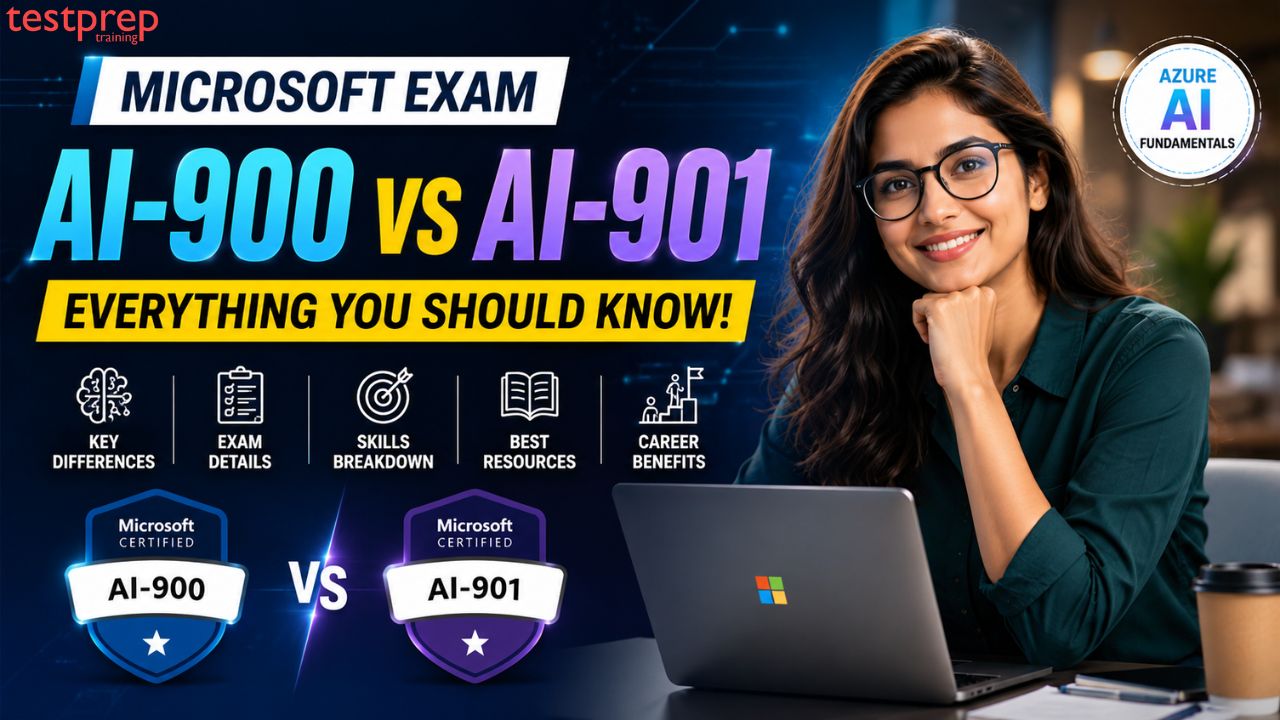
As artificial intelligence continues to reshape industries, the demand for foundational AI knowledge has grown rapidly. To address this need, Microsoft offers entry-level certifications that help learners, professionals, and students build a solid understanding of AI concepts and their real-world applications on Azure. With this evolution, AI-901 (Microsoft Azure AI Fundamentals) has been introduced as the new, forward-looking certification, designed to align with modern AI practices and real-world implementation.
Unlike earlier approaches that focused primarily on theory, AI-901 emphasizes practical understanding, such as working with Azure AI services, prompt engineering, and integrating AI into applications, making it more relevant for today’s learners and aspiring developers. Before AI-901, the AI-900 (Microsoft Azure AI Fundamentals) exam served as the traditional starting point for beginners. It focused on core AI concepts, responsible AI principles, and a high-level introduction to Azure AI services, making it ideal for those with little to no technical background.
However, with AI-900 set to retire in 2026 and AI-901 emerging as its successor, many learners are now faced with an important question:
Which exam should you choose—and how different are they really? In this guide, we’ll break down everything you need to know about AI-900 vs AI-901, including their structure, skills measured, difficulty level, and which one aligns best with your career goals.
What Is Microsoft AI-900?
The Microsoft AI-900: Azure AI Fundamentals certification is designed as an entry point into the world of artificial intelligence within the Azure ecosystem. Offered by Microsoft, this exam introduces candidates to essential AI concepts and demonstrates how these concepts are applied through Azure AI services in real-world scenarios. It is intentionally structured to be accessible, making it suitable for both technical and non-technical audiences seeking to build a foundational understanding of AI without prior hands-on development experience.
Certification Purpose and Positioning
AI-900 serves as a foundational certification, meaning it focuses on conceptual clarity rather than deep technical implementation. The goal is not to train candidates to build complex AI models, but to help them understand what AI can do, how it is applied, and how Azure enables those capabilities.
This makes it particularly valuable for individuals in roles such as business analysis, project management, sales, or early-stage IT careers—where understanding AI concepts is important, even if direct coding is not part of daily responsibilities. The certification also acts as a stepping stone toward more advanced Azure certifications, especially those focused on AI engineering and data science.
Core Knowledge Areas Covered
The AI-900 exam evaluates a candidate’s understanding across several key domains that represent the fundamental pillars of artificial intelligence on Azure.
- AI Workloads and Responsible AI
- Candidates are expected to understand common AI workloads such as anomaly detection, forecasting, and computer vision. In addition, there is a strong emphasis on responsible AI principles, including fairness, reliability, privacy, inclusiveness, transparency, and accountability—ensuring that AI solutions are developed and deployed ethically.
- Machine Learning Fundamentals
- This section introduces the basic ideas behind machine learning, including different types of learning such as regression, classification, and clustering. Rather than focusing on algorithms in depth, the exam emphasizes understanding how machine learning models are trained and used within Azure Machine Learning.
- Computer Vision Workloads
- AI-900 covers how machines interpret visual data using Azure services. This includes capabilities like image classification, object detection, optical character recognition (OCR), and facial analysis—highlighting how these services can be integrated into applications.
- Natural Language Processing (NLP)
- Candidates explore how AI systems process and understand human language. Topics include sentiment analysis, language detection, key phrase extraction, and conversational AI, all powered by Azure AI services.
- Generative AI Concepts
- A newer and increasingly important area, generative AI introduces candidates to large language models and tools available within Azure. This includes basic understanding of prompt-based interactions and how generative AI can be used to create content, automate tasks, and enhance user experiences.
Exam Structure and Requirements
The AI-900 exam is designed to assess conceptual understanding rather than technical execution. It typically includes a mix of question formats such as multiple-choice, drag-and-drop, and scenario-based questions.
- A passing score is 700 out of 1000, which aligns with standard Microsoft certification benchmarks.
- The exam is available in multiple languages and can be taken online or at authorized testing centers.
- Importantly, there are no formal prerequisites for this certification. However, Microsoft recommends that candidates have:
- A basic understanding of cloud computing concepts
- Familiarity with general IT concepts such as applications and services
No programming or data science background is required, making it highly accessible to beginners.

Who Should Consider AI-900?
AI-900 is best suited for individuals who are beginning their journey into AI or looking to build AI literacy without diving into technical complexity. It is particularly relevant for:
- Students exploring careers in technology
- Professionals transitioning into cloud or AI-related roles
- Non-technical stakeholders who work with AI-driven projects
- Anyone seeking a recognized credential to validate foundational AI knowledge
Because of its broad and accessible nature, it is often considered one of the most approachable certifications in the Azure certification pathway.
What is Microsoft AI-901?
The Microsoft AI-901: Azure AI Fundamentals (Next Generation) certification represents the evolving direction of foundational AI learning within the Azure ecosystem. Introduced by Microsoft, AI-901 builds upon the conceptual groundwork of earlier certifications and shifts the focus toward practical understanding and real-world application of AI services. It is designed for learners who not only want to understand AI concepts but also gain clarity on how those concepts are implemented using modern Azure tools and workflows.
Certification Purpose and Evolution
AI-901 has been positioned as the successor to AI-900, reflecting the growing industry expectation that even entry-level professionals should have some exposure to implementation—not just theory. While it still qualifies as a fundamentals certification, its scope introduces candidates to the operational side of AI, including how AI models are deployed, integrated, and used within applications.
This evolution aligns with the broader shift in the tech industry, where understanding AI concepts alone is no longer sufficient. Organizations increasingly value professionals who can connect conceptual knowledge with practical usage, especially within cloud platforms like Azure.
Core Competency Areas
The AI-901 exam is divided into two core sections, integrating conceptual knowledge with hands-on understanding.
- Understanding AI Concepts and Responsible Practices
- Candidates are expected to demonstrate a clear understanding of AI workloads, similar to AI-900, but with added depth in areas such as governance, risk considerations, and responsible AI implementation. This includes recognizing how ethical principles are applied in real-world systems, not just defined theoretically.
- Generative AI also plays a more prominent role, requiring familiarity with how large language models function in practice, including prompt design and output evaluation.
- Implementing AI Solutions Using Azure Services
- A defining aspect of AI-901 is its emphasis on implementation. Candidates are introduced to how AI solutions are built using Azure’s ecosystem, including Azure AI services and Azure AI Foundry. This involves understanding workflows such as model selection, deployment, and integration into applications via APIs.
- Rather than writing complex code, the focus is on interpreting how systems are configured and used, making it accessible while still more technical than AI-900.
Technical Expectations and Prerequisites
Unlike its predecessor, AI-901 introduces a light expectation of technical familiarity. While it does not require advanced programming skills, candidates benefit from:
- Basic understanding of APIs and application workflows
- Familiarity with simple programming concepts, particularly in Python
- Awareness of how cloud services are consumed and managed
These expectations ensure that candidates can better interpret real-world AI scenarios rather than relying solely on memorization of concepts.
Exam Structure and Assessment Approach
The AI-901 exam follows Microsoft’s standard certification format, incorporating multiple-choice, case-based, and scenario-driven questions. However, the nature of these questions tends to be more contextual and application-oriented, requiring candidates to think through how Azure AI services would be used in specific situations.
The scoring model remains consistent, with a passing score of 700 out of 1000. The exam is delivered online or through authorized centers and is available in multiple languages, ensuring accessibility to a global audience.

Who Should Consider AI-901?
AI-901 is ideal for those looking to move past basic theory and start exploring how AI solutions are implemented in cloud-based settings. It is especially suited for:
- Aspiring AI or cloud developers
- Entry-level engineers working with Azure services
- Students aiming to build practical AI skills early in their careers
- Professionals transitioning into technical roles involving AI integration
It effectively bridges the gap between beginner-level awareness and intermediate-level implementation, making it a strategic choice for those planning to pursue more advanced Azure certifications.
Microsoft Azure Fundamentals AI-900 vs AI-901: Major Differences
As Microsoft continues to refine its certification ecosystem to match industry expectations, the transition from AI-900 to AI-901 reflects more than just a version update—it represents a shift in how foundational AI knowledge is defined and assessed. While both certifications fall under the Azure AI Fundamentals category, they differ significantly in depth, focus, and practical orientation. Grasping these distinctions is key to selecting the most suitable entry point for your certification path.
1. Evolution from Conceptual Learning to Practical Application
The most fundamental difference lies in how each exam approaches AI learning.
- AI-900 is built around conceptual understanding. It introduces candidates to AI workloads, machine learning basics, and Azure AI services from a high-level perspective. The emphasis is on recognizing use cases and understanding terminology rather than applying knowledge in realistic scenarios.
- AI-901, by contrast, represents a practical-first approach. While it retains foundational concepts, it extends into how these concepts are implemented using Azure tools. Candidates are expected to interpret workflows, understand deployment processes, and recognize how AI services are integrated into applications. This makes AI-901 more aligned with real-world usage rather than theoretical awareness.
2. Differences in Technical Depth
Another key distinction is the level of technical engagement expected from candidates.
- AI-900 is intentionally non-technical. It does not require programming knowledge, and questions are generally framed in a way that allows candidates from non-IT backgrounds to succeed. The focus is on clarity of concepts rather than system-level understanding.
- AI-901 introduces a moderate technical layer. While it still does not demand advanced coding skills, it assumes familiarity with basic programming concepts, APIs, and cloud-based workflows. Candidates may encounter scenarios involving Python usage, service configuration, or AI model deployment concepts, making it more suitable for learners with some technical exposure.
3. Shift in Skill Measurement and Exam Structure
The structure of skills measured also highlights a clear progression.
- AI-900 distributes its focus across multiple foundational domains such as machine learning, computer vision, NLP, and generative AI—each covered at a high level.
- AI-901 consolidates and restructures these into broader, more applied domains. A significant portion of the exam is dedicated to implementing AI solutions using Azure services, which includes understanding tools like Azure AI Foundry, service integration, and prompt engineering. This indicates a move toward scenario-based evaluation, where candidates must apply knowledge rather than recall definitions.
4. Generative AI and Modern Tooling Focus
Both exams include generative AI, but the depth differs considerably.
- In AI-900, generative AI is introduced as a conceptual topic. Candidates gain a general understanding of large language models and how they can be applied in broad, practical contexts.
- In AI-901, generative AI becomes operational. Candidates should be familiar with how generative AI operates within Azure environments, including crafting prompts, interpreting results, and incorporating it into applications. This highlights the growing role of generative AI in contemporary software development.
5. Audience and Career Alignment
The intended audience for each exam also highlights their differences.
- AI-900 is designed for broad accessibility. It is suitable for students, business professionals, and individuals exploring AI for the first time. Its value lies in building awareness and foundational literacy.
- AI-901 targets a more career-oriented and technical audience. It is better suited for aspiring developers, cloud engineers, and individuals who plan to work directly with AI services. It is better suited to roles that involve practical, hands-on use of Azure AI tools, even at a beginner level.
6. Certification Lifecycle and Relevance
One of the most important distinctions is their position in Microsoft’s certification roadmap.
- AI-900 is scheduled to retire in 2026, marking the end of its lifecycle as the primary fundamentals exam. Although it remains valid for those who earn it before it is retired, its long-term relevance is gradually declining.
- AI-901, on the other hand, is positioned as the future standard for Azure AI Fundamentals. It reflects current industry practices and is designed to stay relevant as AI technologies continue to evolve.
Side-by-Side Comparison Overview
| Aspect | AI-900 | AI-901 |
|---|---|---|
| Certification Positioning | Entry-level, concept-first certification introducing AI fundamentals | Next-generation fundamentals certification with an application-oriented approach |
| Learning Approach | Focused on understanding AI concepts, terminology, and use cases | Focused on applying concepts in Azure environments and interpreting real-world scenarios |
| Technical Depth | Minimal technical depth; designed for non-technical audiences | Moderate technical depth with exposure to workflows, services, and configurations |
| Programming Knowledge | No coding knowledge required | Basic familiarity with programming (especially Python) is beneficial |
| Cloud & Azure Exposure | High-level introduction to Azure AI services | Practical understanding of how Azure AI services are used, integrated, and configured |
| Generative AI Coverage | Conceptual overview of large language models and use cases | Practical usage including prompt engineering, output evaluation, and service integration |
| AI Workloads Coverage | Broad introduction to ML, computer vision, and NLP workloads | Consolidated understanding with focus on how workloads are implemented in Azure |
| Responsible AI | Introduction to responsible AI principles and definitions | Deeper understanding of governance, risk considerations, and applied responsible AI practices |
| Exam Question Style | Primarily knowledge-based (definitions, recognition, basic scenarios) | Scenario-driven and application-focused requiring decision-making and interpretation |
| Skills Measured Structure | Distributed across multiple foundational domains | Structured around two major areas: AI concepts and AI solution implementation |
| Tools and Platforms | General awareness of Azure AI services | Emphasis on Azure AI ecosystem including Azure AI Foundry and service APIs |
| Hands-on Orientation | No hands-on or workflow-based expectations | Indirect hands-on understanding (deployment flow, integration logic, service usage) |
| Target Audience | Students, business professionals, and beginners exploring AI | Aspiring developers, cloud engineers, and technically inclined learners |
| Career Alignment | Builds AI awareness and foundational literacy | Prepares for practical roles involving AI integration and cloud-based solutions |
| Difficulty Level | Easier; suitable for first-time certification candidates | Slightly more challenging due to applied and scenario-based questions |
| Exam Readiness Focus | Memorization and conceptual clarity | Understanding workflows, interpreting use cases, and applying knowledge |
| Certification Lifecycle | Scheduled to retire in 2026 | Active certification and future-focused replacement |
| Long-Term Relevance | Valuable as a foundational credential but gradually phasing out | More aligned with current industry expectations and evolving AI practices |
Detailed Microsoft AI-900 Exam Outline Breakdown
Understanding the structure of the AI-900 exam is essential for effective preparation. The certification is designed by Microsoft to validate foundational AI knowledge across key domains, with a clear emphasis on conceptual clarity rather than technical execution. Each section of the exam reflects how artificial intelligence is categorized and delivered through Azure services, ensuring candidates develop a well-rounded perspective on AI capabilities.
1. AI Workloads and Responsible AI
This section establishes the conceptual backbone of the exam by introducing common AI workloads and the principles that govern their ethical use. Candidates are expected to recognize different types of AI solutions, such as:
- Predictive systems used in forecasting and recommendation engines
- Anomaly detection systems for identifying unusual patterns
- Conversational AI applications like chatbots
Beyond identifying workloads, a significant portion of this domain focuses on Responsible AI. This includes understanding Microsoft’s core principles—fairness, reliability and safety, privacy and security, inclusiveness, transparency, and accountability—and how they influence the design and deployment of AI systems. Rather than testing definitions alone, questions often evaluate whether candidates can identify responsible AI practices in given scenarios, such as recognizing bias risks or ensuring data privacy in AI models.
2. Machine Learning Fundamentals on Azure
Machine learning forms a central pillar of AI-900, but it is presented at a high-level, conceptual layer. Candidates are expected to understand:
- The distinction between supervised and unsupervised learning
- Common model types such as regression (predicting values) and classification (predicting categories)
- The concept of training, validation, and evaluation of models
Additionally, the exam introduces how these concepts are applied within Azure, particularly through services like Azure Machine Learning. However, the focus remains on understanding workflows rather than building models. A key expectation is the ability to match business problems with appropriate machine learning approaches, such as identifying when classification is suitable versus regression.
3. Computer Vision Workloads
This domain explores how AI systems interpret and process visual information. Candidates are introduced to the capabilities of Azure’s computer vision services and how they are used in practical scenarios. Core concepts include:
- Image classification for identifying objects or scenes
- Object detection for locating multiple items within an image
- Optical Character Recognition (OCR) to capture and convert text from images
- Facial detection and analysis for identifying attributes or verifying identities
The emphasis is on understanding what each capability does and when it should be used, rather than how it is implemented technically. Questions typically present scenarios where candidates must select the appropriate computer vision solution based on requirements.
4. Natural Language Processing (NLP) Workloads
Natural Language Processing focuses on how AI systems interact with and interpret human language. This section introduces candidates to the core functionalities of Azure’s language services. Key areas include:
- Sentiment analysis to determine emotional tone
- Language detection and translation for multilingual applications
- Key phrase extraction and entity recognition for summarizing and structuring text data
- Conversational AI for building chatbots and virtual assistants
Candidates are expected to understand how these capabilities are applied in real-world use cases, such as customer support automation or content analysis. The exam tests the ability to map business needs to NLP solutions, reinforcing practical understanding at a conceptual level.

5. Generative AI Fundamentals
As AI continues to advance, generative AI has emerged as a core component of the AI-900 syllabus. This section introduces candidates to the basic principles behind large language models and content generation. Topics covered include:
- The concept of generative AI models and how they produce text, images, or other outputs
- The role of prompts in guiding AI-generated responses
- An overview of Azure-based generative AI services, including integration with OpenAI models
Unlike more advanced certifications, the focus here is introductory. Candidates are not required to design prompts or deploy models but should understand how generative AI fits into modern applications and business scenarios.
Detailed AI-901 Exam Skills Breakdown
The AI-901 exam represents a modernized interpretation of foundational AI knowledge, where understanding concepts is no longer sufficient without recognizing how they are applied in real-world environments. Designed by Microsoft, the certification evaluates a candidate’s ability to connect AI theory with Azure-based implementation, making it more aligned with practical industry expectations.
Unlike earlier fundamentals exams, AI-901 organizes its skills into broader, application-driven domains, with a clear emphasis on how AI solutions are designed, deployed, and integrated. This structure ensures that candidates develop both conceptual awareness and operational understanding.
1. Understanding AI Concepts and Responsible Practices
This domain forms the conceptual foundation of the exam but extends beyond definitions into real-world interpretation of AI usage. Candidates are expected to understand common AI workloads—such as machine learning, computer vision, and natural language processing—but with a stronger emphasis on how these workloads are selected and applied in practical scenarios. Instead of simply identifying what a workload is, candidates must recognize when and why it should be used.
A significant component of this section focuses on Responsible AI in practice. This includes not only understanding principles like fairness, privacy, and transparency but also identifying how these principles are enforced in real deployments. Candidates may encounter scenarios involving biased datasets, model reliability concerns, or compliance requirements, and must determine appropriate mitigation strategies. Generative AI is also integrated more deeply within this domain. Candidates are expected to understand:
- How large language models function in applied settings
- The importance of prompt structure and clarity
- How outputs should be evaluated for accuracy, safety, and relevance
This reflects the growing importance of generative AI as a practical tool rather than just a conceptual innovation.

2. Implementing AI Solutions Using Azure Services
This is the most defining domain of AI-901 and distinguishes it clearly from AI-900. It focuses on how AI solutions are built, configured, and consumed within the Azure ecosystem. Candidates are introduced to Azure AI services and Azure AI Foundry, which serve as central platforms for developing and managing AI solutions. The expectation is not to write complex code, but to understand the end-to-end workflow of AI implementation, including:
- Selecting appropriate AI services based on requirements
- Configuring and deploying models or services
- Integrating AI capabilities into applications using APIs
- Managing inputs, outputs, and service interactions
A key aspect of this domain is understanding how different Azure services work together. For example, candidates may need to interpret how a language service integrates with a chatbot or how a vision service processes image data within an application pipeline. Prompt engineering also becomes a practical skill in this section.
Candidates should understand how prompts influence generative AI outputs and how they can be refined to achieve desired results in application scenarios. Additionally, there is an expectation of familiarity with basic development workflows, particularly involving Python or similar environments. While coding itself is not heavily tested, understanding how developers interact with AI services is important.
Applied Understanding of AI Workflows
One of the distinguishing features of AI-901 is its focus on workflow-level thinking. Rather than testing isolated knowledge areas, the exam often presents scenarios that require candidates to follow the lifecycle of an AI solution—from problem identification to deployment. This includes:
- Recognizing the appropriate AI approach for a given business need
- Understanding how data flows through AI systems
- Identifying the role of APIs, endpoints, and service configurations
- Evaluating outputs and refining solutions
This approach ensures that candidates develop a systems-level perspective, which is essential for working with AI in real-world environments.
Nature of Questions and Assessment Style
AI-901 introduces a more context-driven assessment model compared to traditional fundamentals exams. Questions are often scenario-based, requiring candidates to analyze situations and determine the most appropriate solution using Azure AI services. Instead of asking “what is this concept,” the exam is more likely to ask:
- Which service should be used in a given scenario
- How an AI solution should be configured
- What considerations must be addressed before deployment
This shift reflects the exam’s goal of assessing practical decision-making rather than theoretical recall.

Integration of Generative AI in Modern Contexts
Generative AI is not treated as a separate topic but is woven throughout the exam. Candidates must understand how it fits into broader AI solutions, including:
- Enhancing applications with conversational capabilities
- Automating content generation
- Supporting decision-making processes
There is also an expectation to recognize limitations and risks, such as hallucinations, bias, and misuse, reinforcing the importance of responsible AI practices in generative systems.
Which Certification Should You Choose?
Choosing between AI-900 and AI-901 is less about which exam is “better” and more about which one aligns with your current skill level, career direction, and learning objectives. Both certifications are offered by Microsoft under the Azure AI Fundamentals track, and both validate foundational knowledge—but they do so with different expectations and outcomes.
Understanding the Decision Context
At its core, the decision comes down to how you want to engage with AI. If your goal is to build awareness and understand terminology, AI-900 offers a structured introduction. If your objective is to begin working with AI systems—even at a basic level—AI-901 provides a more relevant pathway.
This distinction is important because the two certifications are not simply sequential—they represent different learning philosophies: one focused on conceptual clarity, the other on practical readiness.
When AI-900 Is the Right Choice
AI-900 is most suitable for individuals who are at the very beginning of their AI journey or who require AI knowledge in a non-technical capacity. It works particularly well if:
- You are new to both AI and cloud computing and want a low-barrier entry point
- Your role involves understanding AI rather than building or integrating it (e.g., business, management, or sales roles)
- You prefer a certification that focuses on concepts, use cases, and terminology without technical complexity
- You are looking to gain a quick foundational credential before exploring deeper technical paths
Additionally, with AI-900 scheduled to retire in 2026, it remains a viable option for those who want to secure a recognized certification within a shorter preparation window.
When AI-901 Becomes the Better Fit
AI-901 is designed for learners who are ready to move beyond theory and start understanding how AI is applied within real systems. It is the stronger choice if:
- You are aiming for a technical or semi-technical role, such as a cloud engineer, developer, or AI practitioner
- You are comfortable with basic programming concepts or are willing to learn them alongside your preparation
- You want exposure to Azure AI services, workflows, and integration patterns
- You prefer learning through practical scenarios rather than abstract definitions
AI-901 also aligns more closely with current industry expectations, where even entry-level professionals are expected to understand how AI solutions are implemented and used.
Career-Oriented Perspective
From a career standpoint, the choice reflects how you intend to position yourself in the job market.
- AI-900 supports roles that require AI awareness and communication, helping professionals understand how AI fits into business processes. It is particularly useful for building credibility in cross-functional teams where AI is involved.
- AI-901, on the other hand, supports roles that require interaction with AI systems, even if not at an advanced engineering level. It prepares candidates to participate in solution design discussions, understand service configurations, and collaborate more effectively with technical teams.
This makes AI-901 a stronger foundation for progressing toward role-based certifications, such as AI engineering or data-focused paths within Azure.
Considering the Transition Timeline
An important factor in your decision is the certification lifecycle. AI-900 is gradually being phased out, while AI-901 is positioned as its long-term replacement. Although both certifications ultimately represent Azure AI Fundamentals, choosing AI-901 ensures that your learning aligns with the most current tools, workflows, and industry practices. It also reduces the need to revisit foundational concepts later when transitioning to more advanced certifications.
A Strategic Way to Decide
Rather than viewing the choice as a simple either-or decision, it can be helpful to think in terms of learning progression:
- If you need a gentle introduction, AI-900 provides clarity and confidence
- If you are ready to engage with real-world AI usage, AI-901 offers a more future-ready foundation
In many cases, learners who start directly with AI-901 can still succeed, provided they are comfortable adapting to a slightly more technical and scenario-based exam style.
| Decision Factor | Choose AI-900 | Choose AI-901 |
|---|---|---|
| Primary Learning Goal | Build foundational understanding of AI concepts and terminology | Develop practical understanding of how AI is implemented using Azure |
| Current Skill Level | Complete beginner with little to no exposure to AI or cloud | Beginner to early-intermediate with basic technical awareness |
| Technical Comfort | Prefer non-technical learning; no coding required | Comfortable with basic programming concepts (e.g., Python, APIs) |
| Learning Style Preference | Concept-driven, theory-focused learning | Scenario-based, application-oriented learning |
| Career Direction | Business roles, management, sales, or non-technical positions | Technical or semi-technical roles such as developer, cloud engineer, AI practitioner |
| Use of Azure Services | High-level awareness of Azure AI capabilities | Understanding of how to use, configure, and integrate Azure AI services |
| Generative AI Exposure | Introductory knowledge of generative AI concepts | Practical understanding of prompts, outputs, and integration |
| Exam Complexity | Easier, focused on recognition and understanding | Moderately challenging, focused on decision-making and real-world scenarios |
| Preparation Effort | Shorter preparation time; suitable for quick certification | Slightly longer preparation due to applied concepts and workflows |
| Industry Relevance | Strong foundational value but gradually phasing out | More aligned with current and future industry expectations |
| Certification Status | Retiring in 2026 | Active and future-focused certification |
| Long-Term Value | Good starting point for absolute beginners | Better foundation for progressing into advanced Azure AI certifications |
| Best For | Learners seeking clarity before diving deeper into AI | Learners aiming to work with AI systems and tools in real environments |
Best Resources to Prepare for Microsoft AI-901 Exam
A well-structured preparation strategy for AI-900 and AI-901 goes beyond simply reviewing concepts—it requires a combination of official guidance, practical exposure, and exam-focused practice. Since both certifications are designed by Microsoft, the most effective approach is to begin with Microsoft’s own learning ecosystem and then reinforce that knowledge with supplementary resources that improve clarity and application.
1. Official Certification Pages and Study Guides
The foundation of your preparation should always begin with the official Microsoft certification pages and study guides. These resources define the exact scope of each exam, including the skills measured, topic weighting, and any updates to the syllabus.
These documents should not be treated as optional references; instead, they should guide your entire preparation plan. By aligning your study efforts with these outlines, you ensure that your focus remains on relevant and exam-aligned topics, avoiding unnecessary distractions.
2. Microsoft Learn and Guided Learning Paths
To complement the study guides, Microsoft provides structured learning through its official training platform. These learning paths are specifically designed for AI-900 and AI-901, combining theory with interactive elements. For AI-900, the modules focus on building clear conceptual understanding of AI workloads and Azure services. For AI-901, the content progresses into practical workflows, helping learners understand how AI solutions are configured, deployed, and integrated.
What makes Microsoft Learn particularly effective is its use of hands-on sandbox environments, allowing learners to explore Azure services without requiring a paid subscription. This bridges the gap between theoretical knowledge and practical familiarity, which is especially important for AI-901.
3. Practice Assessments and Exam Readiness
Once foundational learning is complete, practice assessments become essential. Microsoft provides official practice tests that simulate the structure, tone, and difficulty level of the actual exam. These assessments are not just evaluation tools—they are learning tools. They help you understand how questions are framed, especially the scenario-based questions that are more prominent in AI-901.
Regular practice also improves your ability to interpret requirements, eliminate incorrect options, and make informed decisions under time constraints. For candidates preparing for AI-901, this step is particularly important, as success depends heavily on application-oriented thinking rather than memorization.
4. Instructor-Led Training and Structured Courses
For learners who prefer guided instruction, instructor-led training can provide additional clarity and structure. These programs, often delivered by Microsoft-certified trainers or learning partners, break down complex topics into digestible explanations supported by real-world examples. This approach is especially valuable for:
- Learners transitioning from non-technical backgrounds
- Candidates preparing for AI-901 who need help understanding workflows and integration concepts
- Individuals who benefit from interactive learning and structured timelines
While not mandatory, such training can accelerate understanding and reduce the time required to grasp more applied topics.
5. Community Insights and Peer Discussions
In addition to official resources, community platforms can offer practical perspectives that are often not covered in structured learning materials. Platforms such as Reddit host discussions where candidates share preparation strategies, exam experiences, and commonly encountered challenges. These insights can help you identify:
- Frequently tested topics
- Areas that require deeper focus
- Real-world interpretations of exam questions
However, it is important to approach community content critically. These platforms should be used to supplement—not replace—official resources, ensuring that your preparation remains accurate and reliable.
6. Video-Based Learning for Reinforcement
Video content serves as an effective reinforcement tool, particularly for revising complex topics or gaining a different perspective on key concepts. High-quality tutorials often simplify explanations and demonstrate how Azure AI services work in practice. These resources are best used after completing official learning paths, as they help reinforce understanding rather than replace structured study.
7. Structuring an Effective Preparation Approach
A successful preparation strategy integrates these resources in a logical progression. Starting with the official study guides ensures clarity on exam expectations. This should be followed by completing Microsoft Learn modules to build foundational knowledge. Practice assessments then help validate understanding and improve exam readiness, while community insights and video content provide additional depth and perspective.
For AI-900, the emphasis should remain on clear understanding of concepts and use cases. For AI-901, preparation should extend further into interpreting real-world scenarios, understanding service workflows, and recognizing how Azure AI tools are applied in practice.
Real Candidate Feedback and Community Insights
While official documentation explains the structure of AI-900 and AI-901, real candidate experiences provide a different perspective—one that highlights how these exams feel in practice, which topics catch learners off guard, and how preparation strategies perform under actual exam conditions. Community discussions across platforms such as Reddit reveal a consistent pattern: AI-900 is widely viewed as approachable and conceptual, whereas AI-901 is increasingly perceived as a more technical and implementation-focused certification.
Candidate Experiences with AI-900
Most learners describe AI-900 as a beginner-friendly certification that focuses heavily on understanding AI terminology, Azure AI workloads, and foundational concepts. Candidates from non-technical backgrounds frequently mention that the exam helped them gain confidence in AI without requiring programming expertise. Community discussions often highlight AI-900 as:
- A strong entry point into Azure certifications
- Easier to prepare for compared to role-based certifications
- Suitable for students and business-oriented professionals
Many candidates also note that the exam rewards conceptual understanding rather than memorization alone, especially in areas such as responsible AI and identifying appropriate AI workloads for business scenarios.
At the same time, some learners point out that AI-900 remains relatively high-level and does not deeply explore how Azure AI services are implemented in real environments. This limitation is one reason many candidates are now considering AI-901 for longer-term relevance.
Community Reactions to AI-901
Feedback surrounding AI-901 has been notably different. Candidates consistently describe it as a significant shift from the traditional “fundamentals-only” format associated with AI-900. Several learners who appeared for the beta exam reported that AI-901 includes:
- A stronger focus on Azure AI Foundry
- More scenario-based and workflow-oriented questions
- Greater emphasis on Python familiarity and SDK-related concepts
- Practical understanding of AI deployment and integration workflows
One recurring observation from candidates is that AI-901 feels closer to an implementation-focused certification than a purely conceptual fundamentals exam. Many learners who expected a simple successor to AI-900 were surprised by the technical depth involved, particularly around prompts, AI service integration, and application workflows.
Commonly Reported Challenging Areas
Across multiple discussions, candidates repeatedly identify a few topics as unexpectedly important in AI-901.
- Python and SDK Familiarity
- A large number of candidates mention that Python-related questions appeared more frequently than anticipated. Even though the certification does not require advanced coding ability, learners felt that understanding basic syntax and workflow logic was beneficial.
- Azure AI Foundry
- Another commonly discussed topic is Azure AI Foundry. Candidates report that understanding Foundry concepts, deployment workflows, and service integration plays a central role in the exam. Learners who focused only on older AI-900-style materials often felt underprepared in this area.
- Responsible AI and Generative AI
- Community feedback also suggests that responsible AI principles are assessed more deeply in AI-901, particularly through scenario-based questions. Generative AI concepts, prompt engineering, and evaluating AI-generated responses are frequently mentioned as important preparation areas.
Preparation Advice Shared by Successful Candidates
Candidates who performed well consistently recommend building preparation around official Microsoft resources first before moving to supplementary materials. Many learners emphasize:
- Completing Microsoft Learn modules thoroughly
- Practicing with scenario-based questions regularly
- Understanding workflows rather than memorizing definitions
- Exploring Azure AI Foundry concepts early in preparation
Some candidates specifically warn against relying entirely on passive learning methods such as watching videos without hands-on exploration. According to community feedback, AI-901 rewards learners who understand how services interact in practical scenarios, not just what each service does individually.
The Shift in Perception Between AI-900 and AI-901
One of the strongest patterns across community discussions is the perception that AI-901 represents a broader industry shift. Candidates frequently describe AI-900 as a certification focused on “understanding AI,” while AI-901 is viewed as focused on “working with AI systems.” This perception has influenced how learners approach certification planning:
- Non-technical learners often prefer completing AI-900 before retirement
- Technical learners increasingly move directly toward AI-901 for future relevance
- Candidates aiming for advanced Azure AI certifications see AI-901 as a more practical stepping stone
What Students Can Learn from Community Feedback
The value of community feedback lies not in replacing official guidance, but in helping students understand the real-world expectations behind the exam objectives. These discussions reveal that successful candidates typically combine:
- Official Microsoft learning paths
- Practice assessments
- Workflow-based understanding
- Practical awareness of Azure AI tools
For students preparing today, the broader message from the community is clear: conceptual understanding remains important, but practical familiarity with modern AI workflows is becoming equally essential—especially within the evolving Azure certification ecosystem.
Final Words
When comparing AI-900 and AI-901, the key takeaway is not which certification is “better,” but which one aligns with the direction of your learning and career goals. Both certifications, offered by Microsoft, validate foundational knowledge in Azure AIbut they do so with different expectations and long-term value. AI-900 represents the traditional entry point into artificial intelligence. It is structured to build confidence, introduce essential terminology, and help learners understand how AI is used across different domains. For those completely new to AI or coming from non-technical backgrounds, it provides a smooth and accessible starting experience.
AI-901, on the other hand, reflects the evolution of industry expectations. It moves beyond awareness and introduces learners to how AI systems are actually used within cloud environments. With its emphasis on Azure AI services, workflows, and scenario-based thinking, it prepares candidates for a more practical engagement with AI technologies. From a strategic perspective, the shift from AI-900 to AI-901 signals a broader change: foundational certifications are no longer just about understanding concepts—they are increasingly about understanding usage and application.
With AI-900 approaching retirement and AI-901 positioned as the forward-looking certification, the choice ultimately depends on how quickly you want to transition from learning about AI to working with AI in real-world scenarios. Rather than viewing them as competing options, it is more useful to see them as two different starting points on the same path—one focused on understanding, the other on application.
