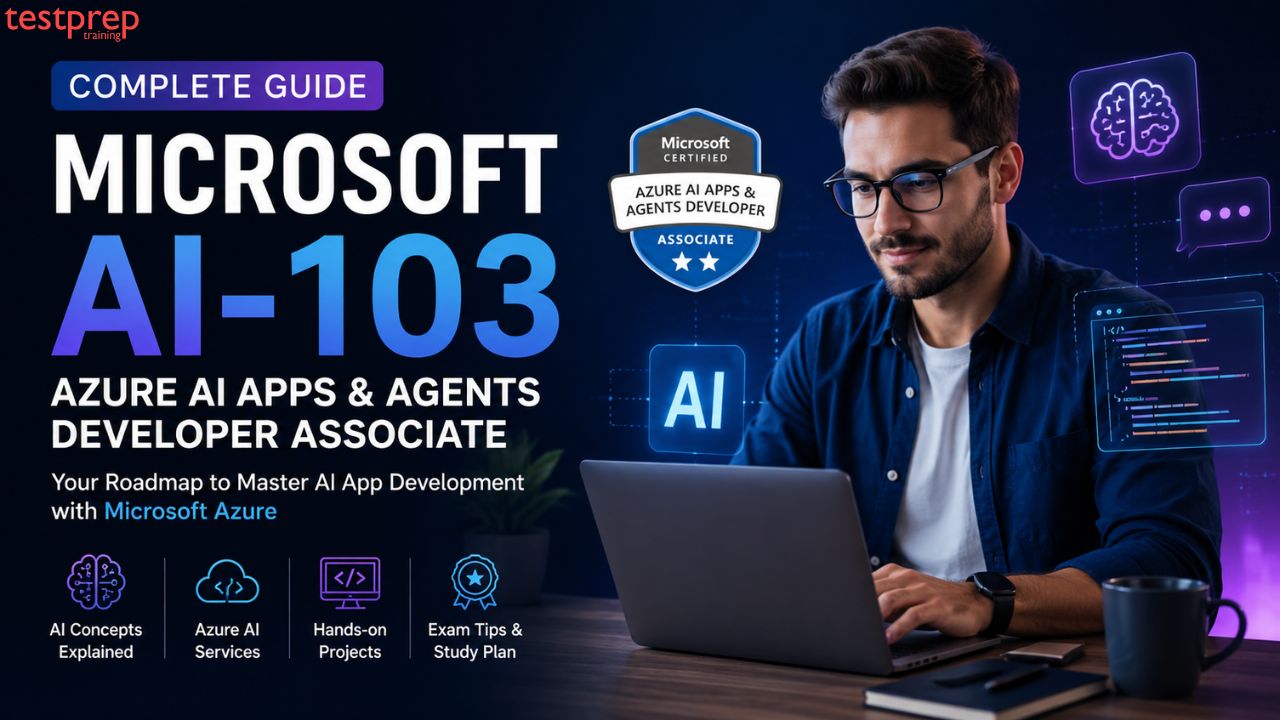
Artificial intelligence development is evolving rapidly, and Microsoft is now shifting its certification ecosystem toward the next generation of AI-powered applications and autonomous agents. To align with this industry transformation, Microsoft has introduced the new AI-103 certification: Developing AI Apps and Agents on Azure. This certification focuses on building modern AI solutions using generative AI, Azure AI services, retrieval-augmented generation (RAG), multimodal AI, orchestration workflows, and intelligent AI agents powered by Microsoft’s expanding Azure AI ecosystem.
Unlike traditional AI certifications that mainly focused on machine learning models or basic cognitive services, AI-103 is designed for developers who want to create production-ready AI applications capable of reasoning, retrieving information, automating tasks, and interacting intelligently with users and enterprise systems. The certification strongly emphasizes practical implementation skills, cloud-native AI development, and responsible AI practices, making it one of Microsoft’s most future-focused certifications for 2026.
The growing adoption of generative AI technologies across industries has significantly increased demand for developers who understand large language models (LLMs), prompt engineering, vector search, AI orchestration, and multimodal experiences. Organizations are no longer looking only for AI researchers — they now need developers who can integrate AI capabilities into real business applications securely and efficiently. Microsoft AI-103 aims to validate exactly these skills.
In this complete AI-103 Exam Guide and Study Plan (2026), you will learn:
- What the AI-103 certification covers
- Skills measured in the exam
- Important Azure AI services to study
- Recommended preparation resources
- Hands-on project ideas
- A structured 6–8 week study plan
- Common mistakes to avoid
- Career benefits of becoming a certified Azure AI Apps and Agents Developer
Whether you are transitioning into generative AI development or upgrading your existing Azure AI skills, this guide will help you understand how to prepare effectively for Microsoft’s newest AI developer certification.
What Is the Microsoft AI-103 Certification?
Microsoft has introduced the AI-103 certification to validate modern AI development skills within the Azure ecosystem. Officially titled Developing AI Apps and Agents on Azure, this certification is designed for developers who want to build enterprise-ready AI applications using Microsoft’s latest AI technologies, including Azure AI Foundry, Azure OpenAI Service, AI Search, multimodal AI services, and agent orchestration frameworks.
Microsoft designed this certification for professionals who are expected to work directly with modern AI application architectures rather than only consuming prebuilt AI APIs. Candidates preparing for AI-103 are required to understand how to design, deploy, secure, optimize, and monitor AI-powered systems that can operate reliably in real-world cloud environments. The certification emphasizes practical implementation skills required to create intelligent applications capable of reasoning, retrieving information, automating workflows, analyzing multimodal data, and interacting naturally with users through advanced language models and AI agents.
A Certification Focused on Modern AI Application Development
The AI-103 certification represents Microsoft’s transition toward agentic AI and production-level generative AI engineering. Modern organizations are increasingly deploying AI solutions that combine multiple Azure AI services into unified intelligent systems. Because of this, Microsoft now expects developers to understand not only how to use AI models, but also how to integrate retrieval systems, orchestration workflows, grounding techniques, responsible AI controls, and scalable cloud infrastructure. The certification strongly focuses on:
- Generative AI applications
- Retrieval-Augmented Generation (RAG)
- AI agent development
- Azure AI Foundry workflows
- Multimodal AI solutions
- AI orchestration and automation
- Enterprise AI governance and security
- Intelligent document and information extraction systems
This makes AI-103 far more implementation-oriented than many earlier Azure AI certifications. Candidates are expected to work with practical development scenarios involving APIs, SDKs, prompts, vector search systems, agent tools, and cloud deployment strategies.
Furthermore, the exam is intended for developers who build, manage, and optimize AI-powered applications and agents using Azure AI services and related cloud technologies. The certification aligns closely with modern enterprise demand for generative AI engineering skills and cloud-native AI development practices.
Technologies and Services Covered in AI-103
One of the biggest reasons the AI-103 certification stands out is its broad coverage of Microsoft’s evolving AI ecosystem. Instead of focusing on a single AI service, the certification combines multiple Azure AI technologies that are commonly used together in production environments. Students preparing for the exam are expected to become familiar with services such as:
- Azure OpenAI Service
- Azure AI Foundry
- Azure AI Search
- Azure AI Vision
- Azure AI Speech
- Azure AI Language
- Azure AI Document Intelligence
- Content Understanding and information extraction services
The certification also introduces candidates to modern AI engineering concepts such as vector databases, semantic retrieval, prompt orchestration, grounding strategies, multimodal interactions, and AI safety controls. These areas are becoming increasingly important as businesses move beyond simple chatbots and begin building intelligent AI agents capable of performing complex workflows and task automation.
Exam Structure and Certification Details
The AI-103 exam is structured around real-world development responsibilities rather than purely theoretical AI concepts. Microsoft evaluates how effectively candidates can design and implement AI solutions using Azure services while also considering security, responsible AI, scalability, monitoring, and operational efficiency. The exam includes scenario-based questions that test:
- AI solution architecture decisions
- Generative AI implementation workflows
- AI service integration
- Retrieval and search pipelines
- AI agent orchestration
- Multimodal AI processing
- Monitoring and optimization strategies
Candidates may face multiple-choice questions, case-study scenarios, drag-and-drop activities, and practical technical challenges that reflect real-world enterprise development situations. Microsoft recommends that candidates have:
- Experience with Python programming
- Familiarity with REST APIs and JSON
- Understanding of Azure cloud services
- Knowledge of generative AI fundamentals
- Basic experience with AI application development
The certification exam is delivered through Pearson VUE and follows Microsoft’s standard certification delivery process. Microsoft may also update exam objectives over time to reflect rapid changes in AI technologies and Azure AI capabilities.

How AI-103 Differs from Earlier Azure AI Certifications?
One of the key reasons the AI-103 certification is gaining interest is that it aligns with Microsoft’s evolving approach to AI technologies. Earlier certifications such as AI-102 focused heavily on cognitive services and traditional AI integration patterns. AI-103 expands beyond that approach by introducing modern AI application engineering concepts that align with current industry adoption trends. The certification places much stronger emphasis on:
- Agentic AI systems
- Retrieval-Augmented Generation
- AI workflow orchestration
- Intelligent automation
- Prompt engineering
- Grounded AI applications
- Multimodal AI experiences
This transition mirrors how enterprises are increasingly using large language models and AI agents within business operations, customer support systems, document workflows, enterprise search platforms, and intelligent assistants.
Rather than treating AI as an isolated feature, AI-103 focuses on building complete AI ecosystems capable of interacting with enterprise data, external tools, APIs, and users in dynamic ways.
Why Microsoft Introduced the AI-103 Exam?
The launch of Microsoft’s AI-103 certification represents more than just a new addition to the Azure certification ecosystem. It reflects a major shift in how artificial intelligence is being developed, deployed, and managed across modern enterprises. As generative AI, AI agents, and intelligent automation rapidly become part of mainstream business operations, Microsoft recognized the need for a certification that validates practical AI application development skills aligned with current industry demands.
Traditional AI certifications were largely designed around cognitive services, machine learning fundamentals, and isolated AI integrations. However, enterprise AI development has evolved significantly over the past few years. Organizations are now building advanced AI systems capable of reasoning, retrieving organizational knowledge, automating workflows, processing multimodal data, and interacting dynamically with users through conversational interfaces and intelligent agents. AI-103 was introduced to address this transformation directly.
The Industry Shift Toward Generative AI and AI Agents
One of the biggest reasons behind the introduction of AI-103 is the explosive growth of generative AI technologies and autonomous AI systems. Businesses are no longer experimenting with AI only for prediction models or simple automation tasks. Instead, enterprises are deploying AI copilots, retrieval-augmented generation (RAG) systems, intelligent assistants, multimodal applications, and AI agents that can interact with tools, APIs, databases, and enterprise workflows. Microsoft’s broader AI ecosystem has also expanded rapidly with services such as:
- Azure OpenAI Service
- Azure AI Foundry
- Azure AI Search
- Azure AI Content Understanding
- Agent orchestration frameworks
- Multimodal AI services
As these technologies became central to enterprise AI adoption, Microsoft needed a certification capable of validating real-world implementation skills rather than only theoretical AI knowledge.
AI-103 was introduced specifically to prepare developers for this new era of AI engineering, where understanding prompts, orchestration, vector retrieval, agent workflows, grounding techniques, and responsible AI practices is becoming essential for production-ready development.
Microsoft also emphasized this transition in its Skills Hub announcement, where the company highlighted growing demand for developers capable of building intelligent AI applications and agents using Azure technologies.
Moving Beyond Traditional AI Certifications
AI-103 also reflects Microsoft’s attempt to modernize its certification pathway for AI professionals. Earlier certifications such as AI-102 were primarily focused on integrating Azure Cognitive Services into applications. While those certifications remain valuable, the AI landscape has changed considerably since the widespread adoption of large language models and generative AI systems. Modern AI development now requires:
- Retrieval pipelines connected to enterprise data
- Semantic and vector search systems
- Multi-agent orchestration
- Conversation memory handling
- Prompt optimization
- Responsible AI controls
- AI monitoring and governance
- Workflow automation using intelligent agents
Because of this, Microsoft introduced AI-103 as a more implementation-focused certification aligned with how organizations actually build AI systems today.
Rather than focusing only on consuming AI APIs, AI-103 emphasizes designing complete AI application architectures capable of operating securely and efficiently at enterprise scale. This approach better reflects current hiring trends where companies are looking for developers who can build full AI-powered business solutions instead of isolated AI demos.
Alignment With Azure AI Foundry and Microsoft’s AI Ecosystem
Another major reason for the creation of AI-103 is Microsoft’s growing investment in Azure AI Foundry and integrated AI development environments. Microsoft is increasingly positioning Azure AI Foundry as a central platform for building, orchestrating, evaluating, and deploying AI applications and agents across enterprise environments. The AI-103 certification introduces candidates to this ecosystem by covering workflows related to:
- AI model deployment
- Agent development
- Prompt flow orchestration
- Evaluation pipelines
- AI safety and monitoring
- Knowledge grounding
- Multimodal AI integration
This makes the certification highly relevant for developers working with Microsoft’s latest AI infrastructure and cloud-native AI services.
Responding to Enterprise Demand for Practical AI Skills
The introduction of AI-103 is also closely tied to changing hiring requirements across the technology industry. Many organizations are now actively searching for professionals who can move beyond AI experimentation and build secure, scalable, production-ready AI applications. Employers increasingly expect developers to understand:
- AI orchestration
- Retrieval-Augmented Generation
- Enterprise search integration
- AI agent workflows
- Responsible AI implementation
- Cloud-based AI deployment
- Cost optimization and monitoring
Microsoft introduced AI-103 to validate these practical capabilities in a structured and industry-recognized way. Instead of focusing mainly on academic AI concepts, the certification prioritizes real-world development scenarios that reflect modern enterprise projects. This practical orientation is one of the reasons AI-103 is expected to become particularly valuable for:
- Azure developers
- AI engineers
- cloud application developers
- generative AI developers
- enterprise solution architects
- professionals transitioning into AI engineering roles
Microsoft’s Transition Toward Agentic AI Development
A particularly important aspect of AI-103 is its strong emphasis on AI agents and autonomous workflows. Microsoft has increasingly integrated AI copilots and intelligent agents into products such as Microsoft 365, GitHub, Dynamics, and Azure AI services. This broader company-wide strategy strongly influenced the direction of the certification. AI-103 introduces concepts related to:
- AI agents
- tool calling
- autonomous workflows
- reasoning pipelines
- orchestration systems
- grounded AI interactions
These technologies represent the next stage of enterprise AI development, where AI systems are expected not only to generate responses but also to take actions, retrieve information, interact with systems, and assist users with complex workflows.
By introducing AI-103, Microsoft is effectively preparing developers for the growing shift toward agentic AI systems that are likely to become standard across enterprise environments in the coming years.
Preparing Developers for the Future of AI Engineering
Microsoft’s decision to launch AI-103 ultimately reflects the rapid evolution of the AI industry itself. The certification was introduced to bridge the gap between traditional cloud development and modern AI engineering by combining Azure infrastructure skills with generative AI implementation, orchestration workflows, multimodal services, and intelligent automation.
For students and professionals preparing for AI-focused careers, AI-103 serves as a roadmap to the technologies and development practices that are shaping the future of enterprise AI. The certification not only validates technical skills but also introduces developers to the broader architecture patterns and operational responsibilities involved in deploying modern AI systems at scale.
Who should take the AI-103 Exam?
Microsoft’s AI-103 certification is designed for developers and AI professionals who want to build modern AI-powered applications using Azure technologies. As enterprises increasingly adopt generative AI, intelligent automation, and AI agents, the demand for professionals who can design and implement these solutions continues to grow rapidly. The AI-103 exam was introduced to validate the practical skills required to work with modern AI application architectures, cloud-based AI services, and enterprise AI workflows.
Unlike beginner-level certifications that focus mainly on AI theory or cloud fundamentals, AI-103 is intended for individuals who want to work directly with real-world AI implementations. The certification places strong emphasis on developing, integrating, deploying, and maintaining AI solutions through Azure AI services, Azure OpenAI, AI Search, AI Foundry, and agent orchestration technologies. However, the target audience inlcude:
1. Developers Transitioning Into Generative AI Engineering
One of the primary target audiences for AI-103 is software developers who want to transition into AI engineering roles. Many developers already have experience building web applications, APIs, or cloud-based systems but may not yet have structured experience with generative AI technologies and AI agents. AI-103 helps bridging the gap by introducing developers to:
- Large language model integration
- Retrieval-Augmented Generation (RAG)
- AI orchestration workflows
- Prompt engineering
- Semantic search systems
- Multimodal AI services
- AI deployment and monitoring
Developers with backgrounds in Python, backend development, REST APIs, or cloud application development will often find the certification especially relevant because many of the concepts align closely with modern AI application workflows.
The certification is particularly valuable for developers who want to move beyond traditional software engineering and begin building AI-enhanced enterprise applications capable of intelligent reasoning, automation, and conversational interaction.
2. Azure Professionals Expanding Into AI Solutions
AI-103 is also highly suitable for professionals already working within the Microsoft Azure ecosystem. Cloud developers, Azure administrators, and Azure solution engineers are increasingly expected to understand how AI services integrate into enterprise cloud architectures. Since the certification focuses heavily on Azure-native AI services, professionals with existing Azure experience can use AI-103 to expand their expertise into:
- Azure AI Foundry
- Azure OpenAI Service
- AI Search and vector retrieval
- AI orchestration pipelines
- AI governance and monitoring
- Secure AI deployments
3. AI Engineers and Enterprise AI Developers
Professionals already working with AI technologies can also benefit significantly from AI-103 because the certification focuses on modern enterprise AI implementation rather than only machine learning theory. Many AI engineers understand model training and machine learning workflows but may not yet have extensive experience with:
- Agentic AI systems
- AI workflow orchestration
- Retrieval grounding
- Vector search architectures
- Prompt pipelines
- Multimodal AI integration
- Responsible AI controls within production systems
AI-103 introduces these practical enterprise-focused areas that are becoming increasingly important as organizations deploy AI applications at scale. The certification can therefore help AI professionals align their skills with the growing demand for production-ready generative AI systems and enterprise AI infrastructure.
4. Developers Interested in AI Agents and Intelligent Automation
A unique aspect of AI-103 is its strong focus on AI agents and orchestration workflows. This makes the certification particularly valuable for developers interested in building autonomous or semi-autonomous AI systems capable of interacting with users, tools, APIs, and enterprise data sources. Microsoft’s broader AI strategy increasingly revolves around intelligent copilots and AI agents integrated into business workflows. Because of this, developers interested in:
- AI assistants
- enterprise copilots
- workflow automation
- autonomous reasoning systems
- intelligent business applications
- conversational AI systems
will find the certification highly relevant for future career growth.
The exam introduces concepts related to tool calling, orchestration frameworks, memory handling, retrieval grounding, and multi-step AI reasoning workflows — all of which are becoming foundational skills for next-generation AI application development.
Recommended Technical Background Before Attempting AI-103
Although AI-103 is not strictly limited to experienced AI professionals, Microsoft expects candidates to have a solid technical foundation before taking the exam. Candidates are generally expected to understand:
- Basic Azure cloud concepts
- Python programming fundamentals
- REST APIs and JSON
- Application development workflows
- Authentication and security basics
- Cloud deployment concepts
In addition, familiarity with generative AI concepts can significantly improve preparation efficiency. Candidates should ideally have basic exposure to:
- Large language models (LLMs)
- Prompt engineering
- Vector databases
- Retrieval-Augmented Generation
- AI chat applications
- Semantic search systems
Hands-on experience using Azure services is particularly valuable because many exam topics focus on practical implementation scenarios rather than purely conceptual theory.
Skills Measured in the Microsoft AI-103 Exam
The Microsoft AI-103 certification is designed to validate the practical skills required to build, deploy, and manage modern AI-powered applications and intelligent agents using Azure technologies. Unlike traditional certification exams that focus mainly on theoretical AI concepts, AI-103 evaluates how effectively candidates can work with real-world AI development workflows, enterprise AI services, retrieval systems, orchestration pipelines, and multimodal AI applications.
Microsoft structured the exam around the responsibilities developers are expected to handle when building production-ready AI solutions in cloud environments. Candidates are not only tested on how AI models work, but also on how to integrate those models into scalable, secure, and enterprise-grade applications using Azure AI services and Azure AI Foundry.
The exam objectives are divided into several major domains, each representing a critical area of modern AI application development.
1. Planning and Managing an Azure AI Solution
One of the largest portions of the AI-103 exam focuses on planning, deploying, and managing AI solutions within Azure environments. Microsoft expects candidates to understand how enterprise AI systems are architected, monitored, secured, and optimized throughout the application lifecycle. This section goes beyond simple AI model usage and introduces responsibilities commonly associated with production AI operations and cloud-native AI development. Candidates are expected to understand how to:
- Select appropriate Azure AI services for specific business requirements
- Design scalable AI application architectures
- Configure AI deployments using Azure AI Foundry
- Manage authentication and secure access
- Implement monitoring and logging strategies
- Optimize AI workloads for cost and performance
- Configure networking and governance policies
- Apply responsible AI principles within enterprise systems
A strong emphasis is placed on operational decision-making. Students should understand when to use different AI services, how to balance cost with performance, and how to maintain compliance and security standards for enterprise AI deployments. This domain also introduces concepts related to:
- Managed identities
- Private endpoints
- API management
- Role-based access control
- AI workload monitoring
- Scaling strategies
- Resource management
Microsoft increasingly expects AI developers to understand the operational side of AI systems, making this section particularly important for candidates coming from pure software development backgrounds.
2. Implementing Generative AI and Agentic Solutions
This is the most important and highest-weighted section of the AI-103 exam because it reflects Microsoft’s growing focus on generative AI and intelligent AI agents. Candidates are expected to understand how to build applications powered by large language models (LLMs) using Azure OpenAI Service and related Azure AI tools. The exam measures both conceptual understanding and practical implementation skills required to create enterprise-ready AI applications. Key areas covered include:
- Prompt engineering techniques
- Retrieval-Augmented Generation (RAG)
- Grounding AI responses with enterprise data
- Agent orchestration workflows
- Tool calling and API integration
- Conversation memory handling
- Multi-step reasoning workflows
- AI response evaluation and optimization
- Safety and moderation controls
Microsoft also places significant emphasis on intelligent agent systems capable of interacting with external tools, enterprise databases, APIs, and knowledge retrieval systems. Students preparing for this section should understand how modern AI agents operate using:
- Orchestration frameworks
- Prompt flows
- Retrieval pipelines
- Semantic search systems
- Vector embeddings
- Context management
Practical implementation knowledge is especially important because many exam scenarios focus on designing AI applications that can retrieve accurate information, automate workflows, and provide grounded responses instead of hallucinated outputs. This section also reflects Microsoft’s broader shift toward agentic AI development and enterprise copilots integrated across Azure and Microsoft platforms.

3. Implementing Computer Vision Solutions
The AI-103 exam also evaluates the ability to work with computer vision and multimodal AI capabilities within Azure environments. Modern AI applications increasingly combine text, image, speech, and video understanding into unified intelligent systems. Because of this, Microsoft expects developers to understand how visual AI services can be integrated into enterprise applications. Topics in this section include:
- Image analysis
- Object detection
- OCR workflows
- Visual caption generation
- Image moderation
- Video understanding
- Multimodal AI integration
- Image generation and editing workflows
Candidates may also encounter scenarios involving accessibility-focused AI features such as automatic image descriptions and visual content interpretation. The exam tests understanding of how computer vision services integrate with broader AI workflows, particularly within generative AI systems and multimodal applications. Students should also be familiar with content safety practices, including:
- Unsafe image detection
- Visual moderation
- Responsible AI controls for media generation
- Prompt injection awareness within multimodal systems
As AI applications increasingly support image and video interactions, this domain reflects Microsoft’s focus on practical multimodal AI development rather than isolated computer vision theory.
4. Implementing Text Analysis Solutions
Natural language processing continues to play a vital role in enterprise AI solutions, and AI-103 features a dedicated section covering text analytics and language-based AI services. Candidates are expected to understand how Azure AI Language and related services can be used to process, analyze, and transform textual information within applications. Important skills covered include:
- Sentiment analysis
- Key phrase extraction
- Named entity recognition
- Language detection
- AI-powered summarization
- Translation workflows
- Speech-to-text systems
- Text-to-speech solutions
- Structured information extraction
This section also connects closely with generative AI workflows because many modern AI applications combine traditional NLP services with LLM-powered reasoning systems. Students should understand how to integrate text analysis services into larger AI pipelines for use cases such as:
- Customer support automation
- Enterprise document analysis
- AI search applications
- Intelligent assistants
- Real-time speech systems
Practical familiarity with Azure AI Language, Translator, and Speech services can significantly improve preparation for this domain.
5. Implementing Information Extraction Solutions
Another important domain within AI-103 focuses on intelligent information extraction and enterprise knowledge retrieval systems. As businesses increasingly rely on AI to process documents, enterprise records, and unstructured content, developers must understand how to build systems capable of extracting, indexing, retrieving, and grounding information accurately. This section covers:
- Document ingestion pipelines
- OCR integration
- Semantic search
- Hybrid retrieval systems
- Vector search implementation
- Knowledge indexing
- Content extraction workflows
- AI Search integration
- Structured data extraction
Candidates should understand how Retrieval-Augmented Generation systems use enterprise knowledge sources to improve AI response accuracy and reduce hallucinations. The exam also evaluates understanding of:
- Vector embeddings
- Search indexing strategies
- Chunking techniques
- Retrieval optimization
- Grounding workflows
- Search relevance tuning
Because enterprise AI systems increasingly depend on reliable knowledge retrieval, this section represents a core component of modern AI engineering workflows.
Best Learning Resources to Prepare for the Microsoft AI-103 Exam
Preparing for the Microsoft AI-103 certification requires more than simply reading theoretical notes or memorizing Azure service names. Since the certification focuses heavily on practical AI implementation, students need a combination of official Microsoft documentation, hands-on Azure experience, generative AI practice, and real-world application development exposure.
The AI-103 exam is designed around modern AI engineering workflows involving generative AI, AI agents, retrieval systems, multimodal services, and enterprise AI deployments. Because of this, the best preparation strategy is one that combines conceptual learning with practical experimentation using Azure AI services and development tools.
Microsoft’s official exam guide clearly emphasizes implementation-focused responsibilities such as planning AI solutions, building generative AI applications, integrating AI services, implementing retrieval systems, and managing AI workloads within Azure environments. Students preparing for the exam should therefore focus on learning resources that provide both technical depth and practical development experience.
1. Microsoft Learn: The Most Important Starting Point
The most reliable and recommended preparation resource for AI-103 is Microsoft Learn. Since the certification is directly aligned with Microsoft technologies and Azure AI services, Microsoft Learn provides the most accurate and up-to-date training material for exam preparation. Microsoft Learn offers:
- Structured learning paths
- Hands-on sandbox exercises
- Guided labs
- Azure AI tutorials
- Interactive technical modules
- Official implementation examples
Unlike many third-party courses that may become outdated quickly, Microsoft Learn content is regularly updated to reflect changes in Azure AI services, AI Foundry workflows, and generative AI technologies. However, the exam-related learning path course includes:
– Course: AI-103T00-A – Develop AI Apps and Agents on Azure
The AI-103T00-A: Develop AI Apps and Agents on Azure course is intended for developers and AI professionals aiming to design intelligent applications using Microsoft Azure and Microsoft Foundry technologies. It emphasizes the creation of modern AI-powered solutions that leverage generative AI, smart agents, and automation features within cloud environments.
This course is especially beneficial for professionals responsible for building, deploying, and managing AI-based solutions through Azure services. Participants are generally expected to possess Python programming experience along with a basic understanding of APIs, SDKs, and cloud development concepts. Through this training, learners develop practical skills for creating scalable AI applications, integrating Azure AI capabilities, and designing intelligent systems that support complex business operations and automation needs.
2. Azure Documentation and Technical References
One of the biggest mistakes students make while preparing for AI certifications is relying only on summarized notes or video tutorials. AI-103 is heavily implementation-focused, meaning students must understand how Azure AI services actually work in production environments. Reading official Azure documentation helps students:
- Understand real deployment workflows
- Learn configuration options
- Explore SDK examples
- Study API usage patterns
- Understand authentication and security models
- Learn best practices for scaling AI systems
The most important documentation areas for AI-103 preparation include:
- Azure OpenAI Service
- Azure AI Foundry
- Azure AI Search
- Azure AI Vision
- Azure AI Speech
- Azure AI Language
- Azure AI Document Intelligence
Students should especially focus on implementation examples involving:
- Retrieval-Augmented Generation (RAG)
- Semantic search
- Vector indexing
- Agent orchestration
- Prompt engineering
- Multimodal AI workflows
These topics appear frequently throughout the official skills outline and represent some of the most important practical areas within the exam.
3. Hands-On Azure Practice Is Essential
AI-103 cannot be prepared for effectively through theory alone. Since the exam focuses strongly on practical AI workflows, students should spend significant time working directly within Azure environments. Hands-on practice helps students understand:
- Resource deployment workflows
- AI model integration
- Authentication and API configuration
- AI orchestration pipelines
- Retrieval system implementation
- AI monitoring and evaluation
- Error handling and optimization
Students should ideally create and test:
- AI chat applications
- RAG-based search systems
- AI agents
- Document analysis workflows
- Speech-enabled AI applications
- Multimodal AI demos
Using the Azure portal alongside SDK-based implementations can significantly improve understanding of how enterprise AI systems are structured and managed. Practical experimentation is especially important for topics such as:
- Prompt flow orchestration
- AI Search indexing
- Vector retrieval
- Content filtering
- Responsible AI controls
- Tool calling and agent workflows
Because many AI-103 questions are scenario-based, candidates with hands-on experience usually perform much better than those relying only on memorization.
4. Learning Azure AI Foundry and Generative AI Workflows
Azure AI Foundry is one of the key focus areas candidates should prioritize while preparing for the AI-103 exam. Microsoft increasingly positions Azure AI Foundry as the central environment for building and managing AI applications and intelligent agents. Students should become familiar with:
- Prompt flow creation
- Model deployment workflows
- Agent orchestration
- AI evaluation pipelines
- Safety monitoring
- Grounding configurations
- Workflow testing and debugging
The certification strongly reflects Microsoft’s modern AI ecosystem, so understanding how Foundry integrates with Azure OpenAI, AI Search, and enterprise data sources is extremely important. Students should also practice working with:
- Large language models (LLMs)
- Prompt engineering
- RAG architectures
- AI memory handling
- Multi-agent workflows
- Semantic retrieval systems
These concepts form the foundation of modern enterprise AI engineering and represent some of the most important skills validated by AI-103.
5. Practice Assessments and Self-Evaluation
Microsoft also provides official practice assessments that help students evaluate their readiness before attempting the actual exam. Practice assessments are useful for:
- Understanding question patterns
- Identifying weak topics
- Improving time management
- Reviewing scenario-based questions
- Testing conceptual understanding
However, students should avoid depending entirely on practice questions because AI-103 emphasizes practical reasoning and implementation understanding rather than pure memorization. Students should use practice tests mainly as a progress-checking tool rather than their primary learning method.
6. Community Discussions and Developer Platforms
Although official Microsoft resources should remain the primary study source, community platforms can also help students understand how real developers are approaching AI-103 preparation. Useful platforms include:
- GitHub repositories
- Microsoft Tech Community discussions
- Azure AI developer forums
- Reddit certification discussions
- AI engineering communities
These communities often provide:
- Practical project ideas
- Implementation tips
- Troubleshooting guidance
- Azure deployment advice
- Exam preparation experiences
However, students should verify technical information using official Microsoft documentation because Azure AI services and exam objectives may evolve rapidly over time. Community discussions are most useful for:
- Understanding real-world AI workflows
- Exploring deployment strategies
- Learning practical optimization techniques
- Discovering common preparation mistakes

7. Building Real Projects During Preparation
One of the strongest preparation methods for AI-103 is building practical AI projects while studying. Since the certification focuses heavily on implementation, project-based learning helps students connect theoretical concepts with real AI engineering workflows. Students should consider creating:
- AI chatbots using Azure OpenAI
- Retrieval-Augmented Generation systems
- Document intelligence pipelines
- AI-powered search systems
- Speech-enabled assistants
- Image understanding applications
- Intelligent AI agents with tool calling capabilities
Project-based preparation improves:
- Problem-solving ability
- Azure deployment confidence
- Understanding of orchestration workflows
- API integration skills
- Enterprise AI architecture understanding
More importantly, hands-on projects help students prepare for the scenario-based nature of the AI-103 exam, where architectural reasoning and workflow understanding are often more important than memorizing definitions.
Suggested Microsoft AI-103 Study Plan
Preparing for the Microsoft AI-103 certification requires a structured approach because the exam covers multiple areas of modern AI engineering, including generative AI, AI agents, retrieval systems, multimodal services, orchestration workflows, and enterprise AI deployment. Since the certification focuses heavily on practical implementation rather than memorization, students should divide their preparation into progressive learning stages that combine theory, documentation reading, hands-on Azure practice, and project development.
A well-planned study schedule helps candidates avoid one of the most common preparation mistakes: spending too much time on theoretical concepts while neglecting practical implementation experience. Microsoft expects AI-103 candidates to understand how Azure AI services work together within real enterprise workflows, making hands-on practice just as important as conceptual learning.
The following 6–8 week study roadmap is designed for students with basic cloud or development knowledge who want to prepare consistently without rushing through important topics. Candidates already experienced with Azure or AI development may move faster through some sections, while beginners may extend certain weeks for additional practice.
Week 1: Build Your Azure AI Foundation
The first week should focus on understanding the overall Azure AI ecosystem and building a strong foundation before moving into advanced AI engineering topics. Many students attempt to jump directly into generative AI workflows without first understanding how Azure services, authentication, deployment models, and AI infrastructure operate together. During this stage, students should become familiar with:
- Azure AI services
- Azure resource management
- Azure OpenAI basics
- AI service deployment workflows
- REST APIs and SDK usage
- Responsible AI concepts
- Authentication and access control
This week is also the ideal time to review:
- Python fundamentals
- JSON structures
- API requests
- Cloud architecture basics
- Azure portal navigation
Students should spend time exploring Microsoft Learn modules and Azure documentation rather than relying only on video tutorials. The goal is to develop a clear understanding of how Microsoft structures AI services within Azure environments.
Hands-on practice during the first week should include creating Azure resources, deploying basic AI services, testing APIs, and becoming comfortable with the Azure environment.
Week 2: Focus on Generative AI and Azure OpenAI
The second week should concentrate heavily on generative AI concepts because this forms one of the largest and most important sections of the AI-103 exam. Students should begin working with:
- Azure OpenAI Service
- Prompt engineering
- Chat completion workflows
- System prompts
- Context handling
- Token usage
- AI response optimization
This week is particularly important because it introduces the practical foundation required for later topics such as AI agents, orchestration workflows, and Retrieval-Augmented Generation.
Instead of simply reading prompt engineering concepts, students should actively experiment with prompts and observe how different instructions affect model outputs. Understanding prompt behavior is essential for designing reliable AI applications. Students should also begin learning:
- Temperature and token settings
- Hallucination reduction techniques
- AI safety filtering
- Responsible AI controls
- Content moderation workflows
Practical exercises should include building simple AI chat applications using Azure OpenAI APIs and testing various prompt structures for different use cases.
Week 3: Learn Retrieval-Augmented Generation (RAG) and AI Search
The third week should focus on Retrieval-Augmented Generation, semantic retrieval systems, and Azure AI Search. These topics represent some of the most practical and enterprise-relevant areas within the AI-103 certification. Students should learn how modern AI systems retrieve enterprise data before generating responses. This includes understanding:
- Vector embeddings
- Semantic search
- Hybrid search
- Document chunking
- Search indexing
- Context grounding
- Vector retrieval pipelines
This week is where students should begin building their first real-world AI project, such as a RAG-based chatbot connected to custom documents or enterprise knowledge sources. Hands-on practice should include:
- Creating Azure AI Search indexes
- Uploading and chunking documents
- Generating embeddings
- Connecting search results with Azure OpenAI
- Testing grounded AI responses
Understanding why RAG systems are important for reducing hallucinations and improving response accuracy is extremely valuable for both the exam and real-world AI engineering.
Week 4: Study AI Agents and Orchestration Workflows
The fourth week should focus on one of the most modern areas of AI development: AI agents and orchestration systems. Microsoft’s AI-103 certification strongly reflects the industry shift toward intelligent AI agents capable of interacting with enterprise tools, APIs, workflows, and external systems. Students should therefore spend time understanding how modern agentic AI systems operate. Important topics include:
- AI agents
- Tool calling
- Function integration
- Prompt flow orchestration
- Workflow automation
- Multi-step reasoning
- Conversation memory
- Context management
Students should explore Azure AI Foundry workflows and experiment with building intelligent assistants capable of retrieving information or interacting with APIs. This week is also ideal for learning:
- Agent planning workflows
- Prompt chaining
- Evaluation pipelines
- Safety monitoring
- AI workflow debugging
Practical implementation experience is particularly valuable because many exam questions may involve choosing appropriate orchestration approaches for enterprise AI solutions.
Week 5: Cover Computer Vision, Speech, and Multimodal AI
The fifth week should focus on multimodal AI capabilities and Azure AI services related to vision, speech, and language processing. Students should study:
- OCR workflows
- Image analysis
- Speech-to-text systems
- Text-to-speech workflows
- Image captioning
- Object detection
- Translation services
- Multimodal AI interactions
This section of preparation is important because modern AI applications increasingly combine text, images, audio, and visual reasoning into unified user experiences. Hands-on exercises should include:
- Testing Azure Vision APIs
- Building speech-enabled assistants
- Performing OCR on documents
- Creating image understanding workflows
- Exploring multimodal AI prompts
Students should also understand responsible AI concerns related to visual and speech systems, including moderation and unsafe content detection.
Week 6: Information Extraction and Enterprise AI Workflows
By week six, students should move into enterprise-oriented AI workflows involving document intelligence and information extraction systems. This stage focuses on:
- Azure AI Document Intelligence
- Enterprise search systems
- Information extraction pipelines
- OCR processing
- Metadata extraction
- AI indexing workflows
- Knowledge grounding systems
Students should practice building document processing pipelines capable of:
- Extracting invoice data
- Analyzing contracts
- Processing scanned documents
- Structuring enterprise records
- Feeding data into AI retrieval systems
This week also reinforces earlier RAG and AI Search concepts by showing how enterprise documents are prepared and connected to AI systems.
Week 7: Revision, Practice Assessments, and Weak Area Analysis
After covering the technical domains, students should dedicate a full week to revision and self-assessment. Instead of rereading every topic equally, candidates should identify:
- Weak technical areas
- Services they struggle to configure
- Architecture concepts needing review
- Topics requiring more hands-on practice
This week should include:
- Practice assessments
- Scenario-based revision
- Reviewing Microsoft documentation
- Revisiting hands-on labs
- Improving project implementations
Students should also focus on understanding service selection scenarios because AI-103 frequently tests architectural reasoning rather than simple factual recall.
Optional Week 8: Final Review and Real Exam Simulation
Students who prefer a slower preparation pace can dedicate an additional week to final revision and exam readiness. This stage should focus on:
- Full-topic review
- Time management practice
- Reviewing architecture patterns
- Revisiting difficult workflows
- Practicing deployment scenarios
- Understanding AI governance concepts
Students should avoid learning entirely new topics during the final days before the exam. Instead, the focus should remain on reinforcing confidence, improving workflow understanding, and strengthening practical implementation reasoning.
Common Mistakes Students Make when Preparing for the Microsoft AI-103 Exam
Many candidates preparing for the Microsoft AI-103 certification spend too much time memorizing concepts while overlooking the practical implementation skills the exam is actually designed to test. Since AI-103 focuses heavily on real-world Azure AI workflows, students who combine theory with hands-on practice usually perform much better in scenario-based questions.
Understanding the following common mistakes early can help students prepare more efficiently and avoid unnecessary confusion during the final stages of preparation.
| Common Mistake | Why It Becomes a Problem | Better Approach |
|---|---|---|
| Focusing only on theory and notes | AI-103 is heavily implementation-focused and includes scenario-based questions that test practical reasoning. | Combine study material with hands-on Azure practice and real project development. |
| Ignoring Azure AI Foundry workflows | Many students prepare only Azure OpenAI basics and skip orchestration and agent workflows. | Practice prompt flows, AI orchestration, evaluation pipelines, and agent development within Azure AI Foundry. |
| Memorizing services without understanding use cases | Students may know service names but fail to select the correct architecture in exam scenarios. | Learn when and why to use each Azure AI service in real enterprise environments. |
| Skipping Retrieval-Augmented Generation (RAG) concepts | RAG is one of the most important modern AI implementation patterns covered in AI-103. | Practice vector search, document chunking, embeddings, grounding, and Azure AI Search integration. |
| Neglecting AI Search and vector retrieval systems | Enterprise AI applications increasingly depend on semantic retrieval and grounded responses. | Build small RAG projects connected to Azure AI Search and enterprise documents. |
| Relying only on video tutorials | Video courses often simplify concepts and may not cover updated Azure AI implementations. | Use official Microsoft documentation and Microsoft Learn alongside tutorials. |
| Avoiding documentation reading | Many configuration details and workflow concepts appear directly from official Azure documentation. | Regularly study Microsoft Learn modules and Azure AI service documentation. |
| Ignoring responsible AI and security topics | AI governance, safety filtering, and secure deployments are important exam objectives. | Study content moderation, authentication, managed identities, and AI safety controls carefully. |
| Not practicing prompt engineering | Poor prompt understanding can make generative AI workflows confusing during implementation questions. | Experiment with prompts, system instructions, grounding methods, and response optimization techniques. |
| Spending too much time on beginner concepts | Some students over-focus on Azure basics and never reach advanced AI implementation topics. | Build a strong foundation quickly, then prioritize AI workflows, orchestration, and enterprise scenarios. |
| Skipping multimodal AI topics | Students sometimes assume vision and speech services are less important because of smaller exam weightage. | Understand image analysis, OCR, speech workflows, and multimodal AI integration concepts. |
| Not building practical projects | Without implementation experience, enterprise AI workflows can feel overly theoretical and difficult. | Build AI chatbots, document intelligence systems, AI agents, and search-based applications during preparation. |
| Ignoring time management during practice assessments | Students may know the concepts but struggle to complete scenario-based questions efficiently. | Practice timed assessments and learn to identify important keywords in architecture-based questions. |
| Treating AI-103 like a memorization exam | The exam focuses more on workflow understanding and architectural reasoning than fact recall. | Focus on understanding how Azure AI services interact within real-world AI systems. |
| Not revising weak areas before the exam | Many candidates continue studying comfortable topics instead of improving weaker sections. | Use practice tests and project work to identify and strengthen weak technical areas. |
Final Thoughts
Microsoft’s AI-103 certification represents a major step forward in the evolution of Azure AI certifications. Instead of focusing only on traditional AI services or theoretical machine learning concepts, the certification is built around the practical skills required to develop modern AI-powered applications and intelligent agents within real enterprise environments.
As organizations increasingly adopt generative AI, Retrieval-Augmented Generation (RAG), multimodal AI, and autonomous AI workflows, developers are expected to understand far more than simple API integrations. They now need the ability to design scalable AI architectures, orchestrate intelligent workflows, connect enterprise knowledge systems, and manage responsible AI deployments securely within cloud environments. AI-103 is designed specifically to validate these modern AI engineering capabilities.
For students and professionals planning careers in Azure AI development, generative AI engineering, or enterprise AI solution design, this certification offers strong long-term value. The exam not only tests technical understanding of Azure AI services but also encourages practical thinking around AI implementation, orchestration, monitoring, governance, and optimization.
Success in AI-103 preparation ultimately depends on consistency and hands-on learning. Candidates who combine Microsoft Learn modules, Azure documentation, practical labs, and real-world AI projects usually develop a much deeper understanding of how modern AI systems operate. Building projects such as RAG chatbots, AI agents, document intelligence systems, and multimodal AI applications can significantly improve both exam readiness and real-world development confidence.
For developers willing to invest time in practical Azure AI learning, AI-103 can become an excellent foundation for entering the next generation of AI engineering and intelligent application development.
