
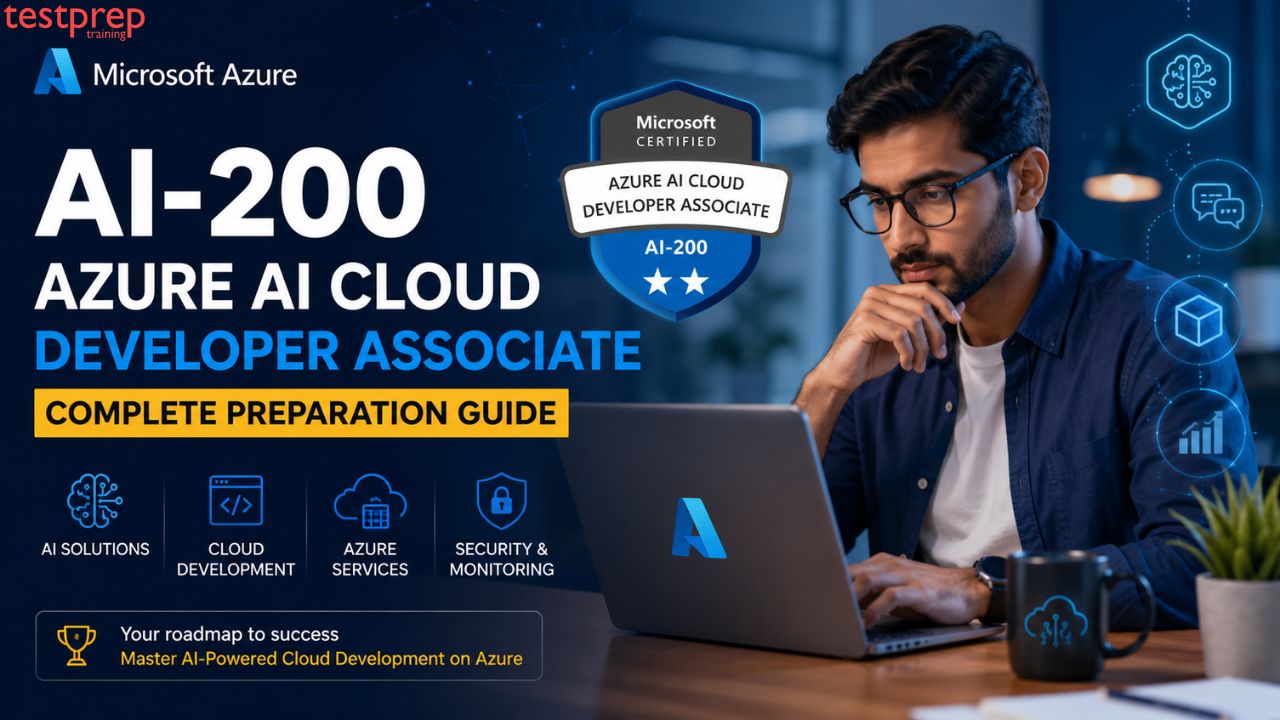
As artificial intelligence continues to transform software development, organizations are increasingly looking for developers who can build, deploy, secure, and manage AI-powered applications in cloud environments. To address this growing demand, Microsoft introduced the AI-200: Azure AI Cloud Developer Associate certification, a role-based credential designed for developers who want to demonstrate their ability to create modern AI solutions using Microsoft Azure.
The AI-200 exam is centered on practical cloud development skills. Candidates are expected to understand how to develop containerized applications, integrate Azure services, work with modern data platforms, implement event-driven architectures, and monitor and secure AI-enabled solutions. The certification validates the knowledge and hands-on abilities required to build production-ready AI applications that can operate reliably at scale.
One of the most common questions among aspiring candidates is: “How hard is the Microsoft AI-200 exam?” The answer depends largely on your background and experience. For professionals already working with Azure development services, containers, APIs, and cloud-native architectures, the exam may be a manageable challenge. However, for those who are new to Azure development or have limited hands-on experience with cloud technologies, the certification can be significantly more demanding than many other Microsoft associate-level exams.
In this guide, we will take a detailed look at the AI-200 Azure AI Cloud Developer Associate certification, analyze the skills measured, explore the topics that candidates often find most challenging, compare it with related Microsoft certifications, and provide practical preparation strategies to help you determine whether the exam is right for you and how to approach it successfully.
What is the Microsoft AI-200 Azure AI Cloud Developer Associate Certification?
The Microsoft Certified: Azure AI Cloud Developer Associate certification is a role-based credential designed for developers who build, deploy, secure, and maintain AI-powered applications on Microsoft Azure. Unlike traditional developer certifications that focus primarily on application development and cloud infrastructure, AI-200 emphasizes the skills required to create modern AI solutions that can operate reliably in production environments.
The certification focuses on the complete lifecycle of AI application development. Candidates are expected to contribute to requirements gathering, solution design, application development, deployment, security implementation, monitoring, and troubleshooting. Rather than concentrating solely on AI models, the certification evaluates how developers integrate AI capabilities into real-world cloud applications and services.
To earn the Azure AI Cloud Developer Associate certification, candidates must pass Exam AI-200: Developing AI Cloud Solutions on Azure. The exam assesses practical knowledge across several key areas, including containerized application development, Azure data management services, messaging and event-driven architectures, monitoring and observability, security implementation, and cloud-native AI solution design. Furthermore, a successful candidate is typically proficient in:
- Python programming
- Azure SDKs and development tools
- Azure data management services
- Azure messaging and eventing services
- Monitoring and troubleshooting Azure workloads
- Vector databases and semantic search technologies
- Containerized application development and deployment
One of the unique aspects of AI-200 is its focus on technologies that power modern AI applications. Candidates are expected to understand how to deploy containerized AI workloads, implement serverless AI processing solutions, integrate messaging services, work with vector-enabled databases for retrieval scenarios, and monitor AI systems running at scale. This makes the certification highly relevant for developers building next-generation cloud applications that incorporate artificial intelligence capabilities.
The certification is considered an associate-level credential and is intended for developers who already possess foundational Azure knowledge and software development experience. While it does not require a formal prerequisite certification, hands-on experience with Azure services, cloud-native development patterns, and modern application architectures can significantly improve a candidate’s chances of success.
| Certification Detail | Information |
|---|---|
| Certification Name | Microsoft Certified: Azure AI Cloud Developer Associate |
| Exam Code | AI-200 |
| Certification Level | Associate |
| Primary Role | Developer |
| Time | 120 minutes |
| Platform | Microsoft Azure |
| Focus Area | AI Cloud Application Development |
| Exam Duration | Approximately 100 minutes |
| Passing Score | 700 out of 1000 |
What skills does the Certification validate?
According to Microsoft’s official skills outline, AI-200 measures a candidate’s ability to develop and operate AI-powered cloud solutions using Azure services. The certification is not centered around training machine learning models; instead, it evaluates the practical development skills needed to build applications that leverage AI capabilities within a cloud-native architecture.
A successful candidate should understand how to work with containerized environments, serverless services, event-driven systems, cloud data platforms, monitoring tools, and security services. These capabilities are essential for building modern applications that can process data efficiently, interact with multiple Azure services, and scale according to business requirements. The certification validates knowledge in areas such as:
- Developing containerized solutions using Azure compute services
- Working with Azure data management platforms for AI workloads
- Connecting and consuming Azure services through APIs, events, and messaging systems
- Securing cloud applications and managing sensitive information
- Monitoring, diagnosing, and troubleshooting deployed solutions
- Designing scalable and reliable cloud-native architectures
Because these topics span multiple Azure services, candidates must understand not only individual technologies but also how they interact within a complete application ecosystem.

Focus on Real-World AI Application Development
One of the most distinctive aspects of AI-200 is its emphasis on practical application development. Many AI-related certifications focus heavily on concepts such as machine learning algorithms, neural networks, or data science methodologies. AI-200 takes a different approach by concentrating on the infrastructure, services, and development patterns that enable AI applications to function effectively in production environments.
For example, developers may need to deploy AI workloads within containers, store and retrieve application data efficiently, build event-driven workflows, secure application secrets, or monitor system performance after deployment. These responsibilities are often encountered in enterprise projects and represent the type of work Azure AI developers perform daily. As a result, the exam places significant importance on understanding cloud architecture, application integration, operational excellence, and platform management alongside AI-related development tasks.
Why Microsoft Introduced AI-200
The rapid adoption of generative AI, intelligent applications, vector databases, event-driven architectures, and cloud-native development practices has created a need for developers with specialized skills that extend beyond traditional software engineering. Organizations increasingly require professionals who can integrate AI capabilities into scalable business applications while maintaining security, reliability, and operational efficiency.
Microsoft introduced the Azure AI Cloud Developer Associate certification to validate these emerging skills and provide a structured pathway for developers working with modern AI solutions on Azure. The certification reflects the evolving responsibilities of cloud developers and aligns with the technologies organizations are actively implementing to support AI-driven innovation.
Who should take the Microsoft AI-200 Exam?
Choosing the right certification is just as important as preparing for it. While the AI-200 Azure AI Cloud Developer Associate certification is designed to validate skills related to AI-powered application development on Microsoft Azure, it is not intended for every technology professional. Understanding the target audience can help candidates determine whether the certification aligns with their current experience, career goals, and technical responsibilities.
Unlike foundational AI certifications that introduce basic concepts and terminology, AI-200 focuses on the practical implementation of cloud-native AI solutions. As a result, the certification is best suited for professionals who are actively involved in software development, cloud application design, service integration, deployment, and operational management within Azure environments.
1. Developers Building AI-Powered Applications on Azure
- The primary audience for AI-200 is software developers who are responsible for creating, deploying, and maintaining applications that leverage Azure services and AI capabilities. These professionals often work on backend services, APIs, cloud-native applications, and intelligent solutions that require integration between multiple Azure resources.
- Microsoft expects candidates to understand how different cloud services interact within a larger application architecture. Rather than focusing exclusively on coding, developers should also be comfortable working with deployment pipelines, cloud infrastructure, data services, security controls, and monitoring tools that support production workloads.
- For developers looking to demonstrate expertise in modern Azure application development while incorporating AI functionality, AI-200 provides a strong validation of those skills.
2. Azure Developers Expanding into AI Solutions
- Many professionals already hold experience with Azure development services but are now being asked to support AI-driven projects within their organizations. AI-200 is particularly valuable for these individuals because it builds upon existing cloud development knowledge while introducing technologies commonly used in modern AI applications.
- Candidates with experience in Azure Functions, Azure App Services, APIs, databases, containers, and messaging services will often find that many exam topics align with their current responsibilities. The certification allows them to expand their expertise beyond traditional cloud applications and into intelligent systems that utilize advanced Azure capabilities.
- For Azure developers seeking to remain competitive in a rapidly evolving technology landscape, AI-200 can serve as a natural progression toward AI-focused development roles.
3. Cloud Engineers and Solution Developers
- The certification is also relevant for cloud engineers and solution developers who design and implement scalable cloud architectures. AI-powered applications rarely operate as isolated systems; they depend on reliable data platforms, secure communication channels, monitoring frameworks, and event-driven workflows.
- Because AI-200 evaluates knowledge across these areas, professionals who contribute to solution architecture, platform integration, and cloud deployment strategies can benefit significantly from the certification. Understanding how AI workloads fit into broader enterprise architectures is becoming increasingly important as organizations adopt intelligent business applications.
4. Professionals Working with Modern AI Infrastructure
One of the unique aspects of AI-200 is its focus on technologies that support contemporary AI applications. Candidates encounter topics such as containerized deployments, vector-enabled databases, event-driven messaging systems, observability tools, and cloud security services. Professionals working with technologies such as:
- Docker containers
- Azure Container Apps
- Azure Kubernetes Service (AKS)
- Azure Cosmos DB
- Azure Database for PostgreSQL
- Azure Service Bus
- Azure Event Grid
- Azure Key Vault
- Azure Monitor
will find that many exam objectives directly relate to the technologies they use in real-world environments. The certification is particularly beneficial for developers supporting AI applications that must scale, integrate with multiple services, and operate securely in production.
Recommended Experience Before Attempting AI-200
Although Microsoft does not require a prerequisite certification, the official exam guidance indicates that candidates should possess practical development experience and familiarity with Azure services. The exam is designed around real implementation scenarios rather than theoretical concepts, making hands-on experience an important success factor. Candidates will generally be better prepared if they have experience with:
- Python programming and application development
- Azure development services and SDKs
- REST APIs and service integration
- Cloud deployment concepts
- Container technologies
- Data storage and retrieval solutions
- Application monitoring and troubleshooting
- Security and identity management practices
Who may find the AI-200 exam challenging?
- While AI-200 is accessible to motivated learners, certain candidates should be prepared for a steeper learning curve. Individuals who are completely new to Azure, cloud computing, or software development may find the exam difficult because many topics assume a working understanding of cloud architecture and application deployment concepts.
- Similarly, candidates whose experience is limited to AI fundamentals certifications may discover that AI-200 focuses far more on implementation, integration, and operational management than on AI theory. Understanding concepts such as messaging systems, container orchestration, monitoring frameworks, and secure cloud architectures requires practical knowledge that extends beyond introductory AI learning paths.
- For these candidates, gaining foundational Azure experience through hands-on projects and Microsoft Learn training can provide a stronger foundation before pursuing the certification.
Career Goals that Align Well with Microsoft AI-200 Exam
The AI-200 certification is particularly valuable for professionals pursuing roles that combine cloud development with AI technologies. As organizations continue to invest in intelligent applications, employers increasingly seek developers who can bridge the gap between software engineering and AI implementation.
Roles that can benefit from AI-200 preparation include Azure Developer, Cloud Application Developer, AI Application Developer, Backend Engineer, Cloud Solutions Developer, and professionals contributing to enterprise AI initiatives. The certification demonstrates an ability to work across multiple Azure services while building reliable, scalable, and secure AI-enabled solutions.
Is the Microsoft AI-200 Certification Exam Difficult?
One of the first questions candidates ask before investing time and effort into exam preparation is whether the certification is actually difficult. In the case of the AI-200 Azure AI Cloud Developer Associate exam, the answer depends largely on your existing experience with Azure development, cloud-native architectures, and application deployment. However, based on Microsoft’s official skills outline and the breadth of technologies covered, AI-200 should generally be viewed as a moderately difficult to difficult associate-level certification, particularly for professionals who lack hands-on Azure experience.
Unlike entry-level certifications that primarily assess conceptual understanding, AI-200 evaluates a candidate’s ability to apply technical knowledge across multiple Azure services and development scenarios. The exam is designed to validate real-world skills used by developers building AI-enabled cloud applications, which means candidates must understand not only individual services but also how those services work together within a production environment.
Why is the AI-200 Exam more challenging than other AI Certifications?
Many professionals approach AI-related certifications expecting questions about artificial intelligence concepts, machine learning terminology, or Azure AI services alone. AI-200 takes a broader and more practical approach. While AI-powered applications remain the focus, the certification places significant emphasis on cloud development, architecture, integration, deployment, security, and operational management.
Candidates are expected to understand how modern applications are built and maintained on Azure. This includes deploying containerized workloads, connecting distributed services, managing application data, implementing secure communication, and monitoring system health after deployment. Because these responsibilities often span multiple technologies, preparation requires a deeper level of understanding than simply memorizing service definitions or product features. The exam rewards candidates who have practical experience working within Azure environments rather than those relying solely on theoretical study materials.
The Breadth of Azure Services Increases the Difficulty
- One of the primary reasons candidates find AI-200 challenging is the wide range of Azure services included in the skills measured. Rather than focusing on a single product or technology, the certification covers multiple service categories that collectively support AI application development.
- Candidates may encounter topics related to containerized computing through Azure Container Apps and Azure Kubernetes Service (AKS), event-driven architectures using Azure Event Grid and Azure Service Bus, serverless development with Azure Functions, data management through Azure Cosmos DB and Azure Database for PostgreSQL, and security implementation using Azure Key Vault. In addition, monitoring and troubleshooting capabilities are assessed through services such as Azure Monitor and Application Insights.
- Success therefore requires an understanding of how these technologies interact within a complete solution rather than learning each service in isolation.
Real-World Development Scenarios Require Deeper Understanding
- Another factor that contributes to the exam’s difficulty is its strong emphasis on practical implementation scenarios. Microsoft designed AI-200 around the responsibilities of developers who build and maintain cloud-based AI applications. As a result, candidates should expect questions that evaluate decision-making, architecture selection, service integration, deployment strategies, and operational best practices.
- For example, rather than asking what a specific Azure service does, an exam question may present a business requirement and ask which combination of services provides the most scalable, secure, or cost-effective solution. This type of scenario-based assessment requires candidates to understand not only service capabilities but also the reasoning behind architectural choices.
- The ability to analyze requirements and identify the most appropriate implementation approach often becomes more important than simple factual recall.
Cloud-Native Architecture Knowledge is Essential
- AI-200 extends beyond application development and introduces concepts commonly associated with modern cloud architecture. Candidates must understand how distributed systems communicate, how workloads scale under demand, how event-driven systems process information, and how services maintain reliability in production environments.
- This architectural perspective can be particularly challenging for professionals whose experience has been limited to traditional application development. Understanding messaging patterns, asynchronous communication, container orchestration, observability practices, and cloud resilience strategies requires a broader technical foundation than many certification exams demand. Candidates who already work with cloud-native applications will generally find these topics more familiar, while newcomers may need additional preparation time.
Hands-On Experience Has a Major Impact on Success
- Among all factors affecting exam difficulty, practical experience is arguably the most important. Microsoft’s official course and study materials focus heavily on implementation activities, configuration tasks, deployment workflows, and service integration scenarios. Candidates who have previously worked with Azure services often recognize patterns and use cases that appear throughout the exam objectives.
- Hands-on experience helps develop a deeper understanding of concepts such as configuring containerized applications, securing secrets with Key Vault, creating event-driven workflows, monitoring application performance, and troubleshooting deployment issues. These are skills that are often difficult to master through reading alone.
- Candidates without practical exposure can still succeed, but they should expect to spend additional time working through labs, exercises, and real-world projects to reinforce their understanding.
Difficulty Based on Your Background
The perceived difficulty of AI-200 varies considerably depending on a candidate’s experience level.
| Candidate Profile | Expected Difficulty |
|---|---|
| Beginner with Limited Azure Experience | Very High |
| AI-901 Certified Candidate | High |
| Azure Administrator or Cloud Professional | Moderate to High |
| Azure Developer with Practical Experience | Moderate |
| Experienced Cloud Application Developer | Moderate |
For candidates already working with Azure development services, many exam objectives align closely with everyday responsibilities. For those coming from a purely AI or data-focused background, the cloud development and architecture components often represent the most significant learning curve.
What Makes Candidates Struggle Most?
- Based on the official skills measured, candidates often find difficulty not because of a single topic but because of the combination of technologies involved. The exam requires knowledge spanning application development, infrastructure, security, data platforms, messaging systems, and monitoring tools.
- Areas that typically require additional study include containerized deployments, Kubernetes concepts, event-driven architectures, vector-enabled databases, application observability, and cloud security implementation. These subjects often demand practical understanding rather than theoretical familiarity, making them more challenging to learn quickly.
For this reason, AI-200 is best approached as a professional development certification rather than a knowledge-based exam. Candidates who dedicate time to understanding how Azure services function together in real environments generally perform much better than those focusing exclusively on memorization.
Microsoft Azure AI Cloud Developer Associate (AI-200) Exam Course Outline
Understanding the skills measured is one of the most important steps when preparing for the AI-200 Azure AI Cloud Developer Associate exam. Many candidates make the mistake of studying individual Azure services without first understanding how Microsoft organizes the exam objectives. The official study guide reveals that AI-200 is designed to evaluate a developer’s ability to build, integrate, secure, and operate AI-powered cloud applications using Azure technologies.
Rather than testing isolated technical concepts, the exam focuses on how multiple Azure services work together within real-world solutions. Candidates are expected to understand application architecture, deployment strategies, service integration patterns, data management approaches, and operational best practices. This makes the exam significantly more practical than many traditional certification tests.
At a high level, Microsoft groups the skills measured into four major domains. Each domain represents a critical area of responsibility for Azure AI cloud developers and contributes to the overall difficulty of the certification.
Domain 1: Developing Containerized Solutions on Azure
Modern AI applications often require flexible deployment models that can scale efficiently and run consistently across different environments. For this reason, Microsoft dedicates an entire exam domain to containerized application development and deployment. Candidates are expected to understand how containers package applications and their dependencies into portable units that can be deployed across Azure services. The exam focuses on the practical implementation of containerized workloads rather than basic container theory.
A key area of study is Azure Container Apps, which allows developers to deploy and manage containerized applications without directly managing complex infrastructure. Candidates should understand deployment configurations, scaling options, networking considerations, revisions, and application lifecycle management. The certification also introduces Azure Kubernetes Service (AKS), Microsoft’s managed Kubernetes platform. While AI-200 is not a Kubernetes certification, candidates should understand how AKS supports container orchestration, workload scaling, resource management, and application deployment. Questions may assess the ability to select appropriate deployment approaches based on application requirements.
In addition to deployment technologies, developers should understand configuration management and secret handling within containerized environments. Applications frequently require access to sensitive information such as API keys, database credentials, and connection strings. Knowing how these configurations are securely managed within Azure environments is an important part of this domain. Because many modern AI solutions rely on microservices and distributed architectures, containerization serves as a foundational skill that supports several other exam domains.
Why This Domain Can Be Challenging
Candidates with limited exposure to Docker, containers, or Kubernetes often find this section difficult. Understanding how applications are packaged, deployed, scaled, and maintained in production environments requires practical experience that cannot always be gained through theory alone.
Domain 2: Developing AI Solutions Using Azure Data Management Services
Data forms the foundation of every AI application, which is why Microsoft places significant emphasis on Azure data platforms within AI-200. Developers must understand how to store, manage, retrieve, and optimize data for modern AI workloads. One of the primary technologies covered is Azure Cosmos DB, Microsoft’s globally distributed NoSQL database service. Candidates should understand how data is organized, queried, and optimized for high-performance applications. The exam may assess the ability to choose appropriate data structures, manage performance considerations, and support application scalability.
Another important area involves Azure Database for PostgreSQL, particularly in scenarios that support AI applications. As retrieval-augmented generation (RAG) and semantic search architectures become more common, developers increasingly work with vector-based data storage solutions. Understanding how PostgreSQL can support these workloads is becoming a valuable skill for Azure AI developers. The exam also covers Azure Managed Redis, which plays an important role in caching, high-speed data access, session management, and performance optimization. Developers should understand how caching strategies can improve application responsiveness while reducing load on backend services.
Beyond individual technologies, candidates must understand how data management decisions impact overall application performance. This includes selecting appropriate storage solutions, optimizing retrieval operations, designing scalable data architectures, and supporting efficient communication between application components.
Why This Domain Matters for AI Applications
Modern AI systems frequently process large volumes of information while delivering near real-time responses. Efficient data storage and retrieval mechanisms are therefore critical. Microsoft expects candidates to understand not only where data is stored but also how data architecture influences application performance and user experience.

Domain 3: Connecting and Consuming Azure Services
One of the defining characteristics of cloud-native applications is the ability to integrate multiple services into a unified solution. The third domain focuses on how applications communicate, exchange information, and respond to events across Azure environments. A major component of this domain is Azure Functions, Microsoft’s serverless computing platform. Candidates should understand how serverless workloads are triggered, executed, and integrated with other Azure services. Knowledge of triggers, bindings, and event-driven processing patterns is particularly important.
The exam also covers Azure Service Bus, a messaging service designed to support reliable communication between distributed systems. Developers should understand concepts such as queues, topics, message delivery, and asynchronous processing. These technologies are commonly used when applications need to exchange information without creating direct dependencies between components. Another key service is Azure Event Grid, which supports event-driven architectures. Modern applications frequently respond to events generated by cloud services, users, devices, or external systems. Candidates should understand how Event Grid facilitates event routing, subscriptions, filtering, and automated workflows.
In addition to messaging and eventing technologies, developers must understand how applications connect to Azure services through SDKs, APIs, and service integrations. Many exam scenarios require candidates to determine the most appropriate communication pattern based on business and technical requirements.
Why This Domain is Frequently Tested
Microsoft increasingly promotes event-driven and serverless architectures as best practices for cloud-native development. Since AI applications often rely on real-time processing and service integration, candidates should expect a strong emphasis on communication patterns and distributed application design.
Domain 4: Securing, Monitoring, and Troubleshooting Azure Solutions
Developing an application is only part of a developer’s responsibility. Once a solution is deployed, it must remain secure, observable, and reliable. The final domain focuses on operational excellence and production support. Security begins with protecting application secrets and sensitive configuration information. Candidates should understand how Azure Key Vault helps manage secrets, encryption keys, and certificates while reducing the risk of exposing sensitive credentials within application code.
The exam also evaluates a candidate’s ability to monitor application performance using Azure Monitor. Developers should understand how telemetry data, metrics, logs, and alerts provide visibility into application health and operational status. Effective monitoring helps organizations identify issues before they affect end users. Closely related is Application Insights, which provides detailed diagnostics and performance analytics for deployed applications. Candidates should understand how telemetry is collected, analyzed, and used to improve application reliability.
Troubleshooting is another important area within this domain. Developers must be able to investigate deployment failures, connectivity issues, performance bottlenecks, configuration errors, and service communication problems. Rather than focusing solely on identifying issues, the exam may assess a candidate’s ability to determine the most appropriate corrective action.
Why This Domain is Important
Organizations invest heavily in AI-powered applications, but those applications only deliver value when they remain available, secure, and performant. Microsoft therefore expects certified professionals to understand both development and operational responsibilities. This makes the security and monitoring domain one of the most practical areas of the entire certification.
How AI-200 Differs from Other Microsoft AI Certifications?
One of the biggest challenges for certification candidates is understanding where AI-200 fits within Microsoft’s rapidly evolving AI certification portfolio. With certifications ranging from foundational AI knowledge to advanced AI application development, many professionals struggle to determine which credential best aligns with their experience level and career goals.
The AI-200 Azure AI Cloud Developer Associate certification occupies a unique position within Microsoft’s certification ecosystem. While some certifications focus on AI concepts and others concentrate on implementing AI services, AI-200 emphasizes the development, deployment, integration, and operation of AI-powered cloud applications. Understanding these distinctions can help candidates choose the most appropriate learning path and set realistic expectations for exam preparation.
AI-200 vs AI-901: Azure AI Fundamentals
Before comparing these certifications, it is important to note that Microsoft has announced the retirement of AI-900 Azure AI Fundamentals on June 30, 2026. After that date, candidates seeking the Azure AI Fundamentals certification will earn it by passing AI-901 Azure AI Fundamentals, which serves as the updated replacement exam.
Although AI-901 introduces more modern AI concepts, including Microsoft Foundry, generative AI, and agent-based solutions, it remains a fundamentals-level certification intended to establish baseline AI knowledge rather than validate professional development skills.
| AI-901 | AI-200 |
|---|---|
| Fundamentals-level certification | Associate-level certification |
| Designed for beginners and newcomers | Designed for working developers |
| Focuses on AI concepts and Azure AI capabilities | Focuses on building AI-powered cloud applications |
| Introduces AI workloads, generative AI, and Foundry concepts | Covers deployment, integration, monitoring, and security |
| Requires limited technical experience | Requires practical Azure development experience |
| Provides foundational understanding | Validates job-role skills |
AI-901 is an excellent starting point for students, business professionals, and individuals entering the AI field. The certification helps candidates understand how AI solutions are built and consumed within Azure environments. AI-200, on the other hand, assumes that candidates already possess foundational knowledge and are ready to apply that knowledge within real-world development scenarios.
For candidates completely new to Azure AI, AI-901 can provide a useful introduction before progressing toward AI-200. However, it is not a prerequisite certification.
AI-200 vs AI-103: Azure AI App and Agent Developer
As part of Microsoft’s 2026 certification transformation, AI-103 is replacing AI-102 and introduces a stronger focus on AI applications, agents, Microsoft Foundry, and generative AI development. While both AI-103 and AI-200 belong to Microsoft’s modern AI certification track, they target different responsibilities.
| AI-103 | AI-200 |
|---|---|
| Focuses on AI applications and agent development | Focuses on AI cloud application infrastructure |
| Heavy emphasis on Microsoft Foundry and AI services | Heavy emphasis on Azure cloud architecture |
| Covers AI models, agents, prompts, and orchestration | Covers deployment, integration, monitoring, and operations |
| AI application implementation focus | AI platform and cloud development focus |
| Ideal for AI solution developers | Ideal for Azure AI cloud developers |
A useful way to think about these certifications is that AI-103 focuses on creating and integrating AI capabilities, while AI-200 focuses on building and operating the cloud environments that support those capabilities.
Organizations developing enterprise AI solutions often require both skill sets. Some professionals may eventually pursue both certifications depending on their job responsibilities.
AI-200 vs AI-300: Azure AI Engineer and MLOps-Focused Roles
AI-300 represents Microsoft’s next-generation certification path for professionals working with machine learning operations, model deployment, and AI lifecycle management. While AI-200 focuses on application development, AI-300 is more closely aligned with managing and operationalizing AI models at scale.
| AI-300 | AI-200 |
|---|---|
| Focuses on MLOps and AI operations | Focuses on AI application development |
| Model deployment and lifecycle management | Cloud-native AI application architecture |
| AI infrastructure governance | Application integration and deployment |
| Data science and machine learning operations focus | Developer-focused implementation focus |
| Best for AI engineers and MLOps professionals | Best for cloud developers building AI solutions |
Although both certifications involve Azure AI environments, their objectives differ substantially. AI-300 targets professionals responsible for maintaining machine learning systems, whereas AI-200 targets developers building the applications that consume and interact with those systems.
Which Certification Should You Choose?
The best certification depends on your current role and long-term career objectives.
Students and beginners who want to understand Azure AI concepts should typically start with AI-901. Developers already building cloud applications on Azure and looking to specialize in AI-enabled solutions will often find AI-200 the most relevant next step. Professionals focused on AI applications, generative AI solutions, and agent development may be better aligned with AI-103, while those responsible for machine learning operations and AI lifecycle management should explore AI-300.
Understanding these distinctions is important because AI-200 is often misunderstood as simply another AI certification. In reality, it is one of Microsoft’s most developer-focused credentials, combining cloud-native architecture, service integration, data management, security, and operational excellence within the context of modern AI-powered applications.
Microsoft AI-200 Azure AI Cloud Developer Associate: Important Exam Topics
One of the most common reasons candidates struggle with the AI-200 Azure AI Cloud Developer Associate exam is not necessarily the difficulty of the technologies themselves, but rather the tendency to underestimate certain exam objectives. Many students naturally spend most of their preparation time studying high-profile Azure services such as containers, databases, or AI-related technologies while overlooking supporting concepts that play an equally important role in real-world application development.
Because AI-200 is designed around practical cloud development scenarios, Microsoft expects candidates to understand how applications operate within a complete Azure ecosystem. This means that several seemingly secondary topics can have a significant impact on exam performance. Identifying these areas early can help candidates build a more balanced study plan and avoid surprises on exam day.
Event-Driven Architecture and Messaging Patterns
- Many candidates focus heavily on application deployment and data services but underestimate the importance of event-driven architectures. Modern cloud applications rarely operate as a single monolithic system. Instead, they often rely on multiple services communicating asynchronously through events and messages.
- Within AI-200, technologies such as Azure Service Bus, Azure Event Grid, and Azure Functions are not simply standalone services; they form the backbone of many scalable Azure solutions. Candidates should understand when to use queues versus topics, how event subscriptions work, how applications respond to triggers, and how distributed services communicate without creating tight dependencies.
- Questions may not directly ask about a specific service feature. Instead, they often present a business requirement and require candidates to identify the most appropriate communication pattern. This architectural perspective is what makes messaging-related topics more challenging than many students initially expect.
Vector Databases and Modern AI Data Architectures
- With the growing adoption of generative AI and retrieval-augmented generation (RAG) solutions, vector-based data storage has become increasingly important. However, many candidates approach AI-200 expecting traditional database questions and overlook this emerging area.
- Microsoft’s skills outline includes Azure data management services that support modern AI workloads, including vector-enabled storage capabilities. Candidates should understand why vector data is used, how semantic search differs from keyword-based search, and how modern AI applications retrieve relevant information to generate accurate responses.
- Even if exam questions do not dive deeply into vector mathematics, candidates should be comfortable with the architectural role vector databases play within AI applications. Understanding retrieval workflows and data storage strategies can be particularly valuable when evaluating solution design scenarios.
Monitoring and Observability
- Monitoring is often one of the last topics students review, yet it is a critical responsibility for cloud developers. Many candidates assume that once an application is deployed, their work is complete. In reality, maintaining visibility into application performance and health is essential for operating production workloads.
- AI-200 includes technologies such as Azure Monitor and Application Insights, both of which help organizations track application behavior, collect telemetry data, analyze performance trends, and identify operational issues.
- Candidates should understand how logs, metrics, alerts, and diagnostic data contribute to observability. More importantly, they should know how these tools help developers investigate performance bottlenecks, service failures, and unexpected application behavior.
Because monitoring is closely connected to troubleshooting and operational excellence, it often appears within scenario-based questions where candidates must determine the most effective way to identify or resolve an issue.
Security Beyond Basic Authentication
- Most candidates recognize that security is important, but many underestimate the depth of security-related knowledge required for AI-200. The exam focuses less on theoretical security principles and more on practical implementation within Azure environments.
- A common area of oversight is Azure Key Vault. Some students view Key Vault as a simple credential storage service, but Microsoft expects candidates to understand its role in securing application secrets, encryption keys, certificates, and sensitive configuration data.
- Candidates should also understand how secure development practices contribute to overall application reliability. Questions may involve protecting sensitive information, managing access to resources, or ensuring that applications follow security best practices throughout the deployment lifecycle.
- Because security requirements often appear as part of larger architecture scenarios, overlooking these concepts can lead to incorrect answer choices even when the rest of the scenario is well understood.
Container Operations and Scaling Concepts
- Most candidates recognize that containers are part of the exam, but many focus exclusively on deployment basics while overlooking operational considerations. Simply knowing what a container is will not be sufficient for AI-200.
- Microsoft expects developers to understand how containerized workloads behave in production environments. This includes scaling strategies, resource management, configuration handling, deployment updates, and application lifecycle considerations.
- Candidates should be familiar with services such as Azure Container Apps and Azure Kubernetes Service (AKS) from an architectural perspective. Understanding when a workload requires orchestration, how applications scale under varying demand, and how containerized services integrate with other Azure resources can significantly improve exam readiness.
- These operational topics often appear in scenario-based questions because they directly affect application performance and reliability.
Application Integration and Service Connectivity
- Another area frequently underestimated is service integration. Many Azure services are straightforward when studied individually, but the exam often evaluates how they interact within a complete solution.
- Developers should understand how applications communicate through APIs, SDKs, events, and messaging systems. They should also understand how to select appropriate integration methods based on scalability, performance, and reliability requirements.
- This area becomes particularly important because AI-powered applications typically consume multiple Azure services simultaneously. Candidates who study services in isolation sometimes struggle when presented with questions involving end-to-end workflows and interconnected architectures.
Troubleshooting and Operational Decision-Making
- A surprising number of candidates devote significant time to learning deployment procedures but spend very little time studying troubleshooting techniques. However, AI-200 expects developers to understand how to identify and resolve issues that occur after an application has been deployed.
- Questions may involve performance degradation, service communication failures, authentication problems, configuration issues, or unexpected application behavior. Rather than testing simple memorization, these scenarios evaluate a candidate’s ability to diagnose problems and determine the most effective corrective action.
This operational mindset reflects real-world development responsibilities and is one of the reasons AI-200 feels more practical than many certification exams.
Microsoft AI-200 Azure AI Cloud Developer Associate Study Resources
Preparing for the AI-200 Azure AI Cloud Developer Associate exam requires more than simply reading documentation or watching a few training videos. Because the certification focuses heavily on practical development skills, candidates should build a study strategy that combines official learning materials, hands-on exercises, service documentation, and real-world experimentation. The most successful candidates typically use multiple resources that complement one another rather than relying on a single source of information.
Microsoft provides a well-structured learning ecosystem for AI-200 preparation, and these official resources should form the foundation of every study plan. Once a strong understanding of the exam objectives has been established, candidates can expand their preparation through practical projects, technical documentation, and community learning resources.
1. Start with the Official AI-200 Certification Page
The first resource every candidate should review is the official AI-200 certification page. While many students immediately jump into technical content, understanding the certification requirements and target audience provides valuable context before beginning detailed study.
The certification page outlines the purpose of the credential, the role it targets, recommended experience levels, exam policies, registration information, and links to supporting preparation materials. Microsoft periodically updates certification information, making this page the most reliable source for current exam details. Students should revisit the certification page throughout their preparation journey to ensure they remain aligned with Microsoft’s latest guidance and expectations.
Why It Matters
Many candidates waste time studying technologies that are not directly relevant to the exam. The official certification page helps establish a clear understanding of what Microsoft expects from an Azure AI Cloud Developer and serves as the starting point for all other preparation activities.
2. Use the Official AI-200 Study Guide as Your Exam Blueprint
Among all available resources, the official AI-200 study guide is arguably the most important. Microsoft publishes the skills measured document specifically to define the knowledge and capabilities evaluated during the exam. Rather than functioning as a training course, the study guide serves as a blueprint that outlines every objective candidates should understand before exam day. The guide organizes the content into four major domains covering containerized solutions, data management services, service integration, and operational management.
A common mistake is treating the study guide as a simple checklist. Instead, candidates should use it as a framework for organizing their entire preparation strategy. Every topic studied should map directly back to one or more objectives listed within the skills measured document. As Microsoft updates technologies and exam requirements, the study guide may also change, making it essential to reference the latest version during preparation.
Best Practice
Review the study guide before beginning your studies, revisit it during preparation, and use it again before scheduling the exam to identify any remaining knowledge gaps.
3. Complete the Official AI-200T00 Training Course
Microsoft’s AI-200T00 training course was specifically created to support the Azure AI Cloud Developer Associate certification. Unlike general Azure training content, this course focuses directly on the technologies and development practices covered by the exam. The course introduces candidates to the core services, architectures, and development patterns associated with AI-powered cloud applications. Topics include containerized deployments, Azure data platforms, service integration, messaging systems, security implementation, monitoring, and troubleshooting.
One of the biggest advantages of the AI-200T00 course is that it presents technologies within realistic development scenarios rather than as isolated services. This mirrors the way Microsoft structures exam questions and helps students develop a deeper understanding of how Azure solutions operate in practice. Candidates should not view the course as a replacement for hands-on experience, but rather as a guided learning path that helps build the foundational knowledge required for practical implementation.
4. Leverage Microsoft Learn Learning Paths
Microsoft Learn provides free, self-paced training modules that cover many of the technologies appearing within the AI-200 skills outline. These learning paths allow candidates to explore services individually while gaining practical exposure through interactive exercises and guided labs. Microsoft Learn is particularly useful for strengthening knowledge in areas where candidates may have limited experience. Developers who are already comfortable with Azure Functions, for example, may spend less time reviewing serverless concepts and instead focus on containerization, messaging services, or monitoring tools.
The interactive nature of Microsoft Learn helps reinforce theoretical knowledge through hands-on practice, making it an effective companion to documentation and instructor-led training.
Areas Worth Prioritizing
Candidates should pay particular attention to learning content related to:
- Azure Container Apps
- Azure Kubernetes Service (AKS)
- Azure Functions
- Azure Service Bus
- Azure Event Grid
- Azure Cosmos DB
- Azure Database for PostgreSQL
- Azure Key Vault
- Azure Monitor
- Application Insights
These services appear repeatedly throughout the official skills measured document and play important roles within modern AI application architectures.
5. Study Azure Product Documentation Strategically
While training courses provide structured learning experiences, Azure documentation provides the depth necessary to understand implementation details. Microsoft documentation should not be read cover-to-cover. Instead, candidates should use it selectively to reinforce topics identified within the study guide.
Documentation becomes especially valuable when studying configuration options, deployment methods, service limitations, security recommendations, and architectural best practices. Many exam questions are based on practical scenarios where understanding these implementation details can help distinguish between multiple valid-looking answers. Candidates preparing for AI-200 should become comfortable navigating Azure documentation because the process itself develops familiarity with Azure terminology and service capabilities.
Focus on Understanding, Not Memorization
The goal is not to memorize documentation pages. Instead, candidates should understand how services behave, how they integrate with one another, and when a particular solution is most appropriate.
6. Build Hands-On Projects During Preparation
Because AI-200 emphasizes practical development skills, hands-on experience is often more valuable than additional reading. Students who actively build solutions typically retain information more effectively and develop a stronger understanding of Azure architectures. Practical projects provide opportunities to work with multiple services simultaneously, which mirrors the integrated nature of exam scenarios. Rather than studying Azure Functions, Cosmos DB, and Service Bus separately, candidates can combine them into a functioning application and observe how they interact in real environments.
Examples of useful practice projects include creating serverless APIs, deploying containerized applications, implementing event-driven workflows, integrating messaging systems, securing applications with Key Vault, and configuring monitoring solutions through Azure Monitor. These exercises help transform theoretical knowledge into practical skills while exposing candidates to common implementation challenges.

7. Use Azure Free Resources and Sandboxes
One concern many candidates have is the cost of gaining hands-on Azure experience. Fortunately, Microsoft provides several options that allow students to practice without significant financial investment. Microsoft Learn sandboxes enable temporary access to Azure environments for guided exercises, while Azure free account offerings provide limited access to many services used throughout the certification. These resources allow candidates to experiment with deployments, service configurations, monitoring tools, and application integrations in a controlled environment.
Practical experimentation is especially important for topics such as container deployment, event-driven workflows, and troubleshooting scenarios, where reading alone rarely provides sufficient understanding.
8. Learn from Community Discussions and Technical Blogs
Although official Microsoft resources should remain the primary source of preparation material, community discussions can provide valuable insights into common challenges, implementation strategies, and real-world experiences. Technical blogs, Azure-focused communities, developer forums, and certification discussion groups often highlight practical scenarios that complement Microsoft’s learning materials. These resources can help candidates understand how technologies are used in production environments and expose them to perspectives that may not appear in formal training content. However, community content should always be used to supplement—not replace—official Microsoft documentation and learning resources.
6-Week AI-200 Preparation Roadmap
Preparing for the AI-200 Azure AI Cloud Developer Associate exam can feel overwhelming because the certification spans multiple Azure services, cloud-native development concepts, data platforms, security controls, and operational practices. Rather than attempting to study everything at once, candidates should follow a structured roadmap that gradually builds knowledge across all four exam domains.
The following six-week study plan is designed for professionals who already possess basic Azure and development knowledge and can dedicate consistent study time throughout the week. The roadmap combines Microsoft Learn training, official documentation, hands-on labs, and practical exercises to help develop both conceptual understanding and real-world implementation skills.
Recommended 6-Week Study Schedule
| Week | Primary Focus Area | Key Topics to Study |
|---|---|---|
| Week 1 | Exam Foundations and Azure AI Development Overview | AI-200 skills measured, Azure architecture fundamentals, AI cloud developer responsibilities, Azure development tools, Python review |
| Week 2 | Containerized Solutions on Azure | Docker fundamentals, Azure Container Apps, Azure Kubernetes Service (AKS), deployment strategies, scaling, configuration management |
| Week 3 | Azure Data Management Services | Azure Cosmos DB, Azure Database for PostgreSQL, vector-enabled databases, Azure Managed Redis, AI data architectures |
| Week 4 | Service Integration and Event-Driven Architectures | Azure Functions, Azure Service Bus, Azure Event Grid, APIs, SDKs, messaging patterns, serverless computing |
| Week 5 | Security, Monitoring, and Troubleshooting | Azure Key Vault, Azure Monitor, Application Insights, diagnostics, logging, observability, troubleshooting scenarios |
| Week 6 | Final Review and Practice Testing | End-to-end architecture review, hands-on projects, weak area remediation, practice assessments, exam readiness review |
Week 1: Build a Strong Foundation
The first week should focus on understanding what Microsoft expects from an Azure AI Cloud Developer and how the exam is structured. Before diving into individual services, spend time reviewing the official skills measured document and understanding how the four exam domains connect within a modern AI application architecture.
Candidates should also refresh foundational Azure concepts, including resource groups, identity management, networking basics, and service integration patterns. If Python is not a daily part of your workflow, this is a good opportunity to review core development concepts and Azure SDK interactions.
By the end of Week 1, you should have a clear understanding of the certification objectives and how the major Azure services fit together within AI-powered cloud solutions.
Week 2: Focus on Containerized Application Development
Containerization represents one of the most important technical areas within AI-200. During the second week, concentrate on understanding how Azure supports containerized workloads and modern deployment models.
Study Docker fundamentals, container lifecycle management, image repositories, and deployment processes. From there, move into Azure Container Apps and Azure Kubernetes Service (AKS), paying particular attention to scaling, networking, application configuration, and workload management.
Hands-on practice is especially valuable during this stage. Deploying and managing actual containerized applications helps reinforce concepts that may otherwise remain theoretical.
Week 3: Master Azure Data Management Services
The third week should focus on the data platforms that support AI applications. Begin by exploring Azure Cosmos DB and understanding its role within highly scalable cloud architectures. Pay attention to data organization, querying approaches, and performance optimization concepts.
Next, study Azure Database for PostgreSQL and examine how modern AI applications leverage vector-enabled storage for semantic search and retrieval scenarios. Candidates should also understand where Azure Managed Redis fits within caching and performance optimization strategies.
Rather than studying databases independently, focus on how these services support application workflows and improve overall solution performance.
Week 4: Learn Service Integration and Event-Driven Development
During Week 4, shift your attention toward application connectivity and distributed system communication. This domain frequently appears in scenario-based questions because modern cloud applications rely heavily on service integration.
Study Azure Functions, triggers, bindings, and serverless processing patterns. Then explore Azure Service Bus and Azure Event Grid to understand asynchronous communication, event routing, message processing, and workflow automation.
Hands-on exercises become particularly important here because event-driven architectures are easier to understand when implemented rather than simply read about.
Week 5: Strengthen Security and Operational Skills
Security and observability are critical responsibilities for Azure AI Cloud Developers. During this week, focus on Azure Key Vault and learn how applications securely manage secrets, keys, and certificates.
Candidates should also spend significant time working with Azure Monitor and Application Insights. Understanding telemetry, logging, metrics, alerts, and diagnostics is essential because AI-200 evaluates operational knowledge in addition to development skills.
This is also an ideal time to review troubleshooting scenarios involving deployment failures, service communication issues, performance bottlenecks, and monitoring data analysis.
Week 6: Final Review and Exam Readiness Assessment
The final week should focus on consolidation rather than learning entirely new topics. Review the official study guide once more and evaluate your confidence across each exam domain.
Spend time building or revisiting end-to-end projects that combine multiple Azure services. For example, create a solution that uses Azure Functions, Service Bus, Cosmos DB, Key Vault, and Azure Monitor together. These integrated exercises often provide a clearer understanding of exam scenarios than studying services individually.
If practice assessments are available, use them to identify weak areas and prioritize final revision efforts. Focus particularly on services that appear across multiple exam domains, as these tend to have the greatest impact on overall performance.
Conclusion
The AI-200 Azure AI Cloud Developer Associate certification represents Microsoft’s vision of the modern cloud developer—someone who can do far more than write code. Today’s AI-powered applications require professionals who understand how to integrate services, manage data, deploy containerized workloads, secure cloud environments, monitor application health, and support scalable architectures that can operate reliably in production.
While the exam is undoubtedly challenging, its difficulty stems from the breadth of practical skills it validates rather than from complex theoretical concepts. Candidates are expected to think like real-world Azure developers, making architectural decisions, selecting appropriate services, troubleshooting issues, and implementing solutions that meet business requirements. This practical focus is what makes AI-200 particularly valuable for professionals looking to build or advance a career in cloud and AI application development.
Success in AI-200 is less about memorizing Azure features and more about understanding how Azure services work together within modern AI ecosystems. Candidates who combine official Microsoft learning resources with hands-on experience, real-world projects, and structured preparation are typically best positioned to perform well on the exam.
