
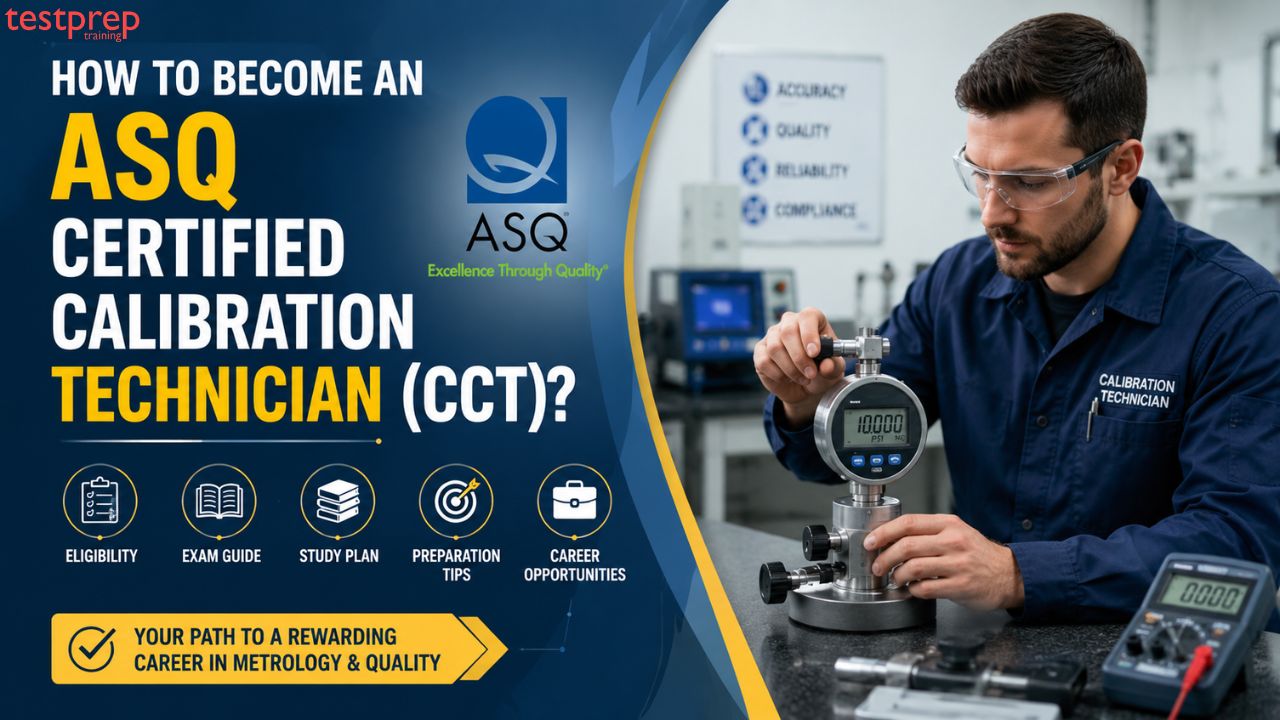
Calibration technicians play an important role in industries where measurement accuracy and equipment reliability are critical. From manufacturing and aerospace to healthcare and electronics, organizations rely on properly calibrated instruments to maintain quality, safety, and compliance standards. Because of this, skilled calibration professionals are in high demand across multiple industries. The American Society for Quality Certified Calibration Technician (CCT) certification is designed for professionals who work with testing, calibration, measurement systems, and related quality processes.
This certification validates your technical knowledge, practical skills, and understanding of calibration procedures, measurement standards, traceability, documentation, and quality systems. Earning the ASQ CCT certification can help improve your professional credibility, increase career opportunities, and strengthen your expertise in metrology and calibration practices. However, passing the exam requires proper preparation, a clear understanding of the official Body of Knowledge (BoK), and familiarity with the exam structure and technical concepts.
In this guide, you will learn everything you need to know about becoming an ASQ Certified Calibration Technician, including eligibility requirements, exam details, study resources, preparation tips, costs, and career opportunities.
What is the Certified Calibration Technician (CCT) Certification?
In today’s industries, precision is more than a technical necessity — it plays a vital role in ensuring product quality, operational reliability, and compliance with regulations. Whether an organization produces aircraft components, medical devices, laboratory equipment, automotive parts, or electronic systems, even minor measurement inaccuracies can result in manufacturing defects, regulatory issues, financial setbacks, or serious safety concerns. This is why organizations depend heavily on calibration professionals who can ensure that instruments and measurement systems perform accurately and consistently.
The American Society for Quality Certified Calibration Technician (CCT) certification is a globally recognized credential designed for professionals who work with calibration systems, testing equipment, measurement instruments, and quality assurance processes. The certification validates a technician’s ability to perform calibration activities, maintain measurement standards, interpret technical specifications, and support quality management systems in controlled industrial environments.
According to ASQ, the CCT certification is aimed at technicians who handle the calibration, testing, troubleshooting, inspection, and maintenance of measurement and test equipment used in multiple industries. These professionals often work with mechanical, electrical, electronic, electromechanical, analytical, and dimensional instruments that require high levels of accuracy and traceability. The certification is based on ASQ’s official Body of Knowledge (BoK), which covers both technical concepts and practical industry applications related to calibration and metrology.
Understanding the Role of a Certified Calibration Technician
- A calibration technician is responsible for ensuring that instruments and measurement devices produce accurate and reliable readings within defined tolerances. Their work supports quality control systems by helping organizations maintain confidence in their measurement processes. In many industries, calibration activities are directly linked to compliance standards such as ISO requirements, laboratory regulations, manufacturing specifications, and audit procedures.
- The responsibilities of a Certified Calibration Technician often include inspecting instruments, comparing measurement outputs against known standards, identifying deviations, adjusting equipment when necessary, documenting calibration results, and maintaining traceability records. In addition to performing technical measurements, technicians are also expected to understand environmental influences, uncertainty factors, equipment limitations, and safety procedures associated with calibration work.
- Unlike general maintenance roles, calibration technicians focus specifically on measurement integrity and precision. Their work ensures that testing equipment, gauges, sensors, meters, pressure devices, temperature instruments, and other measurement tools continue to operate within approved specifications.
ASQ CCT Certification Skills Validated
- The ASQ CCT certification is designed to demonstrate that a professional possesses industry-level knowledge in calibration principles, measurement systems, and quality practices. Candidates preparing for the certification are evaluated on multiple technical areas, including metrology fundamentals, calibration procedures, mathematics, measurement uncertainty, documentation practices, traceability concepts, and calibration system management.
- The certification also validates a technician’s understanding of how calibration activities fit within larger quality management systems. This includes maintaining proper records, following standardized procedures, supporting audits, and ensuring compliance with organizational and regulatory requirements.
- One of the key strengths of the CCT certification is its balance between theoretical understanding and practical application. ASQ focuses not only on technical definitions but also on how calibration processes are applied in real industrial environments. Because of this, the certification is respected by employers looking for professionals who can work effectively with precision measurement systems and support operational quality goals.
Industries Where CCT Professionals Work
- The ASQ CCT certification is recognized across multiple technical and manufacturing sectors where accurate measurements are essential.
- Calibration technicians are commonly employed in aerospace, automotive manufacturing, electronics production, pharmaceutical companies, healthcare laboratories, defense organizations, energy facilities, telecommunications, and industrial manufacturing plants.
- In these environments, certified professionals may work with pressure gauges, temperature sensors, oscilloscopes, micrometers, calipers, analytical equipment, electrical testing devices, torque instruments, and other specialized measurement tools.
- The increasing dependence on automation, precision manufacturing, and compliance-focused quality systems has made skilled calibration professionals even more essential in both manufacturing and laboratory environments.
Difference Between Calibration Technicians and Other Quality Roles
- Many students preparing for the certification initially confuse calibration technicians with general quality inspectors or maintenance technicians. While these roles may overlap in some operational areas, calibration technicians specialize specifically in measurement accuracy and traceability.
- A quality technician may focus on inspections, defect analysis, process monitoring, or production quality checks, whereas a calibration technician concentrates on verifying the accuracy of the instruments used during those processes.
- Similarly, maintenance technicians primarily repair or service equipment functionality, while calibration professionals evaluate measurement performance and ensure compliance with established standards.
- This specialization is one of the reasons the ASQ CCT certification carries significant value in technical industries. It highlights specialized knowledge in calibration science, measurement systems, and metrology practices instead of covering wider general quality management responsibilities.
Why the CCT Certification is Professionally Valuable?
For many technicians, the ASQ CCT certification serves as both a professional milestone and a career advancement opportunity. Employers often regard ASQ certifications as proof of consistent technical competence, especially since the certification is based on widely accepted industry knowledge standards and required professional experience.
- The certification can help professionals strengthen their credibility, qualify for advanced technical positions, improve promotion opportunities, and increase their competitiveness in industries where precision measurement is critical.
- It also provides structured validation of practical skills that technicians may already use daily in laboratory, manufacturing, or calibration environments.
- As industries continue to emphasize quality assurance, compliance, traceability, and precision engineering, certifications such as the ASQ CCT have become increasingly relevant for professionals who want to build long-term careers in calibration, metrology, and technical quality management.
Why Should You Become an ASQ CCT Certified Professional?
In industries where precision measurements directly affect product quality, operational safety, regulatory compliance, and manufacturing consistency, calibration professionals are considered an essential part of technical operations. As organizations continue adopting stricter quality standards and more advanced measurement systems, the demand for skilled technicians with verified expertise is steadily increasing. This is one of the main reasons why the American Society for Quality Certified Calibration Technician (CCT) certification has become highly valuable for professionals working in calibration, metrology, testing, instrumentation, and quality assurance environments.
The ASQ CCT certification is more than just a technical qualification. It acts as professional validation that a technician understands industry-standard calibration practices, measurement systems, traceability concepts, documentation procedures, and quality control requirements. For many professionals, earning this certification becomes an important step toward career growth, technical specialization, and long-term advancement within manufacturing and quality-focused industries.
1. Professional Recognition and Industry Credibility
- One of the biggest advantages of becoming an ASQ CCT certified professional is the credibility that comes with earning a globally recognized certification. ASQ certifications are widely respected because they are based on structured Body of Knowledge (BoK) requirements, practical industry experience, and standardized examination processes.
- Employers often prefer certified professionals because the certification demonstrates verified technical competency rather than only theoretical understanding. A certified calibration technician is expected to understand calibration procedures, instrument handling, measurement accuracy, uncertainty concepts, and compliance-related documentation in real-world working environments.
- In highly regulated industries, organizations also value certifications because they help strengthen internal quality systems and demonstrate commitment to professional standards. Having the ASQ CCT credential on a resume can immediately improve a candidate’s professional profile, especially when applying for technical quality or instrumentation-related roles.
2. Better Career Opportunities in Technical Industries
- Calibration and metrology skills are required in many industries that depend on accurate measurements and controlled processes. Because of this, certified professionals often have access to broader career opportunities compared to technicians without recognized credentials.
- The ASQ CCT certification is particularly valuable in industries such as aerospace, automotive manufacturing, electronics, pharmaceuticals, healthcare equipment manufacturing, telecommunications, industrial laboratories, defense systems, and precision engineering. In these sectors, even small measurement inaccuracies can affect production quality, product reliability, or compliance standards, making skilled calibration professionals highly important.
- Certified technicians may work in roles involving equipment calibration, laboratory testing, quality assurance, instrumentation maintenance, measurement analysis, audit preparation, and calibration system management. Some professionals also use the certification as a pathway toward advanced quality certifications and supervisory technical positions.
3. Increased Technical Knowledge and Practical Understanding
- Preparing for the ASQ CCT exam helps technicians build a much deeper understanding of calibration science and metrology principles. Many professionals working in technical environments gain hands-on experience over time, but certification preparation helps connect practical work with formal industry concepts and standardized methodologies.
- The official ASQ CCT Body of Knowledge includes areas such as measurement systems, traceability, calibration procedures, uncertainty calculations, statistics, mathematics, safety practices, quality systems, and calibration documentation. Studying these topics improves both technical confidence and problem-solving ability in real operational environments.
- This broader understanding becomes especially valuable when technicians work with complex measurement systems, regulated calibration environments, or audit-driven quality processes. Instead of only following procedures, certified professionals are better prepared to understand why calibration standards and measurement controls are critical to product quality and compliance.
4. Stronger Value During Audits and Compliance Activities
- Organizations operating under standards such as ISO-based quality systems often place significant importance on calibration management and measurement traceability. During audits, calibration records, instrument accuracy, traceability documentation, and equipment control processes are carefully reviewed because they directly affect quality assurance and compliance reliability.
- Certified calibration professionals can provide additional value in these situations because they understand how calibration activities fit into larger quality management systems. Their knowledge of documentation practices, standards interpretation, and calibration controls helps organizations maintain stronger compliance processes and reduce quality-related risks.
- This is one reason why employers frequently view ASQ-certified professionals as assets within regulated technical environments. The certification demonstrates that the technician understands both the operational and quality-related aspects of calibration work.
5. Competitive Advantage in the Job Market
- As technical industries become more specialized, employers increasingly look for candidates who can demonstrate verified expertise instead of only general work experience. The ASQ CCT certification helps professionals stand out in competitive hiring processes because it reflects a combination of technical knowledge, practical understanding, and professional commitment.
- For technicians already working in calibration or instrumentation roles, the certification can strengthen promotion opportunities and improve long-term career stability. For individuals entering the field, it provides structured validation that can help compensate for limited industry exposure.
- The certification also signals continuous professional development, which many employers value when selecting candidates for leadership, supervisory, or advanced technical roles within quality and metrology departments.
Who Should Consider the ASQ CCT Certification?
The ASQ CCT certification is especially beneficial for calibration technicians, instrumentation technicians, quality technicians, metrology professionals, laboratory personnel, maintenance specialists, and manufacturing professionals who regularly work with measurement systems and testing equipment.
It is also suitable for professionals who want to transition into quality assurance or calibration-focused careers, particularly in industries where precision measurements and compliance standards play a critical role. Individuals involved in testing, inspection, instrument verification, equipment control, or measurement analysis can benefit significantly from the structured technical knowledge covered in the certification process.
Eligibility Requirements for the ASQ CCT Exam
Before applying for the American Society for Quality Certified Calibration Technician (CCT) exam, candidates must meet specific eligibility requirements established by ASQ. These requirements are designed to ensure that individuals attempting the certification already possess a practical understanding of calibration environments, measurement systems, instrumentation processes, and related quality practices. Since the CCT certification focuses heavily on real-world calibration activities rather than only theoretical concepts, ASQ places significant importance on professional work experience.
Understanding the eligibility criteria early in the preparation process is important because many candidates underestimate how experience verification, education waivers, and job-role relevance are evaluated during the application stage. Reviewing these requirements carefully helps avoid delays, rejected applications, or misunderstandings regarding qualification status.
Required Work Experience for the ASQ CCT Certification
According to ASQ’s official certification requirements, candidates must have a minimum of five years of full-time paid work experience in one or more areas related to the Certified Calibration Technician Body of Knowledge (BoK). This experience should involve activities connected to calibration, measurement systems, instrumentation, testing equipment, metrology practices, quality systems, or technical support functions associated with measurement accuracy and calibration control.
- The work experience does not need to come from a single employer, but the combined experience must clearly demonstrate involvement in calibration-related responsibilities. Candidates working in manufacturing plants, laboratories, aerospace facilities, electronics production environments, automotive industries, healthcare equipment facilities, or industrial quality departments often qualify if their daily responsibilities align with calibration and measurement activities.
- ASQ generally expects candidates to have practical exposure to areas such as instrument calibration, equipment verification, documentation practices, measurement traceability, standards interpretation, calibration system management, or testing and inspection processes. Individuals who only perform unrelated maintenance or administrative duties without direct calibration involvement may not meet the intended experience requirements.
- >Another important point is that the experience must be paid professional experience. Internship programs, unpaid training, or classroom-only learning typically do not count toward the required experience total unless specifically recognized within ASQ guidelines.

Understanding Education Waivers
To make the certification more accessible for candidates with formal technical education, ASQ allows partial waivers of the work experience requirement based on completed academic qualifications. These waivers reduce the total number of years of required professional experience, but they do not completely eliminate the need for practical industry exposure.
The maximum waiver allowed depends on the highest level of completed education. However, ASQ only permits one education waiver, meaning candidates cannot combine multiple academic qualifications to reduce additional years from the requirement.
Education Waiver Structure
| Educational Qualification | Maximum Experience Waiver |
|---|---|
| Technical or Trade School Diploma | 1 year |
| Associate Degree | 2 years |
| Bachelor’s Degree | 4 years |
| Master’s or Doctorate Degree | 5 years |
For example, a candidate holding a bachelor’s degree would only need one additional year of related work experience instead of the full five years. Similarly, a candidate with a master’s degree or doctorate may fully satisfy the experience requirement through the educational waiver structure if the qualification meets ASQ’s criteria.
These waivers are particularly beneficial for students coming from engineering, instrumentation, electronics, industrial technology, manufacturing, or quality-related academic backgrounds. However, candidates should still ensure that their educational qualifications are properly documented during the application process.
Relevance of Work Experience to the Body of Knowledge
- One of the most important aspects of ASQ eligibility evaluation is whether the candidate’s experience aligns with the official CCT Body of Knowledge. Many applicants mistakenly assume that any technical or manufacturing experience automatically qualifies them for the exam, but ASQ specifically looks for calibration-related responsibilities connected to measurement systems and technical quality processes.
- Candidates are more likely to qualify if their work includes tasks such as calibrating instruments, maintaining traceability records, performing measurement verification, interpreting calibration procedures, handling testing equipment, documenting calibration activities, or supporting quality assurance systems related to measurement control.
- Professionals working in metrology laboratories, calibration centers, testing facilities, instrumentation departments, and regulated manufacturing environments often meet these requirements naturally because calibration activities are already integrated into their daily operations.
Experience Verification and Application Review
- ASQ may verify candidate experience as part of the certification application and audit process. Because of this, applicants should prepare accurate documentation regarding their employment history, job responsibilities, technical duties, and educational qualifications before submitting their application.
- Employers, supervisors, or managers may be contacted during verification procedures if additional clarification is needed. Candidates should therefore ensure that their job descriptions clearly reflect calibration-related activities rather than generic maintenance or operational tasks.
- It is also important to maintain consistency between resume details, application forms, and supporting documentation. Inaccurate or incomplete information can create unnecessary delays during eligibility review.
Common Confusion Students Face About Eligibility
- Many first-time applicants are uncertain whether their current job role qualifies for the certification, especially if they work in broader quality assurance or maintenance positions. In practice, eligibility often depends less on job titles and more on actual technical responsibilities related to measurement systems and calibration processes.
- For example, a technician whose responsibilities include testing instruments, maintaining calibration schedules, verifying measurement accuracy, or supporting traceability systems may qualify even if their official job title does not specifically mention calibration. On the other hand, professionals with purely administrative or production-focused duties may not meet the intended technical experience expectations.
- This is why it is strongly recommended to thoroughly review the ASQ CCT Body of Knowledge before applying. It helps candidates compare their real-world experience against the knowledge domains covered in the certification.
Understanding the ASQ CCT Body of Knowledge (BoK)
The Body of Knowledge (BoK) is a key resource for preparing for the ASQ Certified Calibration Technician (CCT) exam. Many candidates make the mistake of studying random calibration topics without properly understanding how ASQ structures the certification objectives. In reality, the BoK acts as the official blueprint for the exam and defines exactly what technical concepts, practical skills, and calibration-related knowledge areas candidates are expected to understand before attempting the certification.
The updated ASQ CCT Body of Knowledge outlines the core domains that calibration technicians commonly encounter in real industrial environments, including metrology fundamentals, calibration systems, measurement standards, uncertainty concepts, mathematics, quality systems, documentation practices, and safety procedures. Instead of focusing only on theoretical definitions, the BoK emphasizes practical industry application, which is why hands-on experience becomes highly valuable during preparation.
For students planning to pass the exam efficiently, understanding how the BoK is organized is essential because it helps prioritize study areas, identify technical weaknesses, and build a more structured preparation strategy.
Structure of the ASQ CCT Body of Knowledge
- The CCT Body of Knowledge is divided into several technical domains that collectively represent the responsibilities of a calibration technician working in quality-driven industries. Each section focuses on a different aspect of calibration science, measurement control, instrumentation, or quality assurance processes.
- ASQ also assigns cognitive levels to different topics within the BoK. Some areas only require candidates to remember or understand concepts, while others expect higher-level application, interpretation, analysis, or problem-solving ability. This means candidates should not rely entirely on memorization because many exam questions are designed to evaluate how well technical concepts can be applied in realistic calibration scenarios.
- The BoK is especially important because the exam is open-book, which often creates a false impression that preparation is easy. In practice, candidates who do not understand where topics are located within the BoK or how concepts connect together usually struggle with time management during the exam.
1. General Metrology and Measurement Fundamentals
One of the foundational sections of the BoK focuses on general metrology principles and measurement fundamentals. This section covers the fundamental principles of precise measurement, measurement systems, traceability, and standardized units.
- Candidates are expected to understand how measurement accuracy affects quality systems and why calibration activities are necessary in controlled technical environments. Topics such as SI units, reference standards, precision, accuracy, repeatability, reproducibility, and measurement variation are commonly included within this domain.
- This section also introduces the concept of traceability, which is critical in calibration science. Traceability ensures that measurement results can be linked back to recognized national or international standards through documented calibration chains. Understanding this concept is important because many industries depend on traceable measurements to maintain compliance and product reliability.
- Students who are new to metrology often underestimate this domain because the terminology appears simple initially, but ASQ frequently tests how these concepts apply in practical calibration situations rather than only asking direct definitions.
2. Calibration Systems and Program Management
Another major part of the Body of Knowledge focuses on calibration systems and calibration management practices. This domain evaluates how well candidates understand the operational side of managing calibration activities within an organization.
- Topics commonly covered include calibration scheduling, recall systems, interval determination, equipment tracking, labeling procedures, out-of-tolerance conditions, documentation controls, and record management. Candidates are also expected to understand how calibration programs support quality systems and compliance requirements.
- In many industries, calibration systems are directly connected to audit readiness and quality assurance operations. Because of this, the BoK emphasizes proper control of instruments, calibration records, and procedural consistency. Students preparing for the exam should therefore understand not only how calibration is performed, but also how calibration activities are documented, monitored, and maintained over time.
- This section becomes particularly important for technicians working in ISO-regulated manufacturing environments, laboratories, aerospace operations, and medical device industries where calibration control systems are heavily audited.
3. Measurement Standards and Calibration Equipment
- The BoK also includes detailed coverage of measurement standards, reference equipment, and instrument selection principles. Calibration technicians regularly work with various types of standards and measurement devices, so ASQ expects candidates to understand the purpose, limitations, and appropriate use of calibration equipment.
- Candidates may encounter topics involving electrical standards, dimensional measurement tools, pressure instruments, temperature devices, analytical instruments, and mechanical calibration systems. Environmental conditions such as humidity, vibration, contamination, and temperature variation are also important because they directly affect measurement accuracy and instrument stability.
- Understanding equipment resolution, sensitivity, tolerance limits, and standard hierarchy is critical in this section. ASQ often focuses on real operational understanding rather than isolated textbook theory, meaning candidates should be comfortable interpreting how measurement equipment behaves under actual working conditions.
4. Calibration Methods and Procedures
- This domain evaluates a candidate’s practical understanding of calibration techniques and procedural execution. Since calibration technicians work with multiple types of instruments and systems, the Body of Knowledge includes broad coverage of common calibration methods used across industries.
- Candidates may be tested on mechanical calibration procedures, dimensional measurements, pressure calibration, temperature calibration, electrical testing, and electronic measurement verification. In addition to performing calibration activities, technicians must understand procedural requirements such as setup verification, instrument stabilization, procedural sequencing, and result interpretation.
- This section also reinforces the importance of following documented calibration procedures accurately. In regulated environments, even small procedural deviations can affect compliance status, traceability validity, or product quality outcomes. Because of this, ASQ places strong emphasis on process consistency and controlled calibration practices.
5. Measurement Uncertainty and Statistical Concepts
- Measurement uncertainty is widely considered one of the most challenging sections of the CCT Body of Knowledge. Many students struggle with this domain because it combines technical measurements with mathematical and statistical reasoning.
- Candidates are expected to understand sources of measurement error, uncertainty estimation, confidence concepts, statistical variation, and data interpretation. Topics such as mean, range, standard deviation, precision analysis, and tolerance evaluation may also appear on the exam.
- The purpose of this domain is to ensure that calibration technicians understand the limitations of measurements rather than assuming instruments always provide perfectly exact results. Real-world calibration environments involve multiple variables that affect measurement accuracy, and technicians must understand how to evaluate and manage these influences properly.
- Students preparing for this section should focus on both conceptual understanding and calculation practice because ASQ often includes scenario-based questions requiring interpretation of measurement data.
6. Quality Systems, Documentation, and Compliance Practices
- Calibration activities are closely connected to broader quality management systems, which is why the BoK includes a dedicated focus on quality practices and documentation requirements.
- Candidates are expected to understand document control systems, calibration records, audit preparation, procedural compliance, nonconformance handling, corrective action concepts, and quality-related documentation standards. Familiarity with ISO-based quality systems and traceability documentation can also be helpful during preparation.
- This section highlights the fact that calibration is not only a technical process but also an important part of organizational quality assurance. Proper documentation ensures consistency, accountability, and regulatory compliance across calibration operations. Professionals working in audit-driven industries often find this domain highly relevant because calibration records are commonly reviewed during quality inspections and compliance evaluations.
7. Mathematics, Safety, and Practical Technical Skills
- The Body of Knowledge also includes mathematics and safety fundamentals required for calibration work. Candidates should be comfortable with basic algebra, unit conversions, ratios, percentages, graph interpretation, and practical calculations related to calibration measurements.
- Safety topics may include electrical safety practices, equipment handling procedures, laboratory precautions, and environmental awareness associated with calibration operations. While these areas may appear smaller compared to technical metrology sections, they still contribute to the overall exam structure and should not be ignored during preparation.
- One important observation many successful candidates mention is that the CCT exam rewards balanced preparation. Focusing only on advanced calibration procedures while neglecting documentation, mathematics, or quality systems can create weaknesses during the actual exam.
ASQ CCT Exam Structure and Details
Understanding the structure of the American Society for Quality Certified Calibration Technician (CCT) exam is an essential part of the preparation process. Many candidates focus heavily on studying technical topics but underestimate the importance of understanding how the exam is organized, timed, and delivered. Since the CCT certification evaluates both technical knowledge and practical calibration understanding, becoming familiar with the exam format can significantly improve preparation efficiency and overall exam performance.
The ASQ CCT exam is designed to measure a candidate’s competency across multiple calibration and metrology-related areas covered in the official Body of Knowledge (BoK). Questions are structured to test not only theoretical understanding but also the ability to apply calibration concepts, measurement principles, documentation practices, and quality system knowledge in realistic technical scenarios.
Because the exam follows an open-book format, candidates are expected to prepare strategically rather than rely entirely on reference materials during the examination. Understanding the exam structure early helps students build better study habits, improve time management, and approach the certification process with clearer expectations.
Computer-Delivered ASQ CCT Exam
The computer-delivered version of the ASQ CCT exam is currently the most commonly used testing format. It is administered through authorized testing providers and allows candidates to complete the examination electronically within a controlled testing environment.
| Exam Component | Details |
|---|---|
| Exam Format | Computer-Based Test (CBT) |
| Question Type | Multiple Choice |
| Total Questions | 135 Questions |
| Scored Questions | 125 Questions |
| Unscored Questions | 10 Questions |
| Total Appointment Time | 4 Hours 30 Minutes |
| Actual Exam Time | 4 Hours 18 Minutes |
| Exam Style | Open-Book |
| Language | English |
| Delivery Options | Prometric Testing Centers and Remote Proctoring |
| Exam Coverage | Based on the ASQ CCT Body of Knowledge |
- The additional unscored questions are included by ASQ for future exam development and statistical analysis. Candidates are not informed which questions are unscored, so every question should be treated seriously during the exam.
- The computer-based testing system allows candidates to move between questions, flag uncertain answers for review, and manage their pacing more efficiently throughout the exam session. Many candidates find this navigation flexibility useful, especially when handling technical calculations or scenario-based questions that require additional time.
- ASQ also offers remote proctoring options for eligible candidates depending on testing availability and scheduling requirements. However, candidates should carefully review all technical and environmental requirements before choosing the remote testing option.
Paper-and-Pencil ASQ CCT Exam
Although most candidates now choose the computer-delivered format, ASQ still provides a paper-and-pencil version of the CCT examination in certain situations or testing regions.
| Exam Component | Details |
|---|---|
| Exam Format | Paper-and-Pencil |
| Question Type | Multiple Choice |
| Total Questions | 125 Questions |
| Exam Duration | 4 Hours |
| Exam Style | Open-Book |
| Language | English |
| Delivery Method | Scheduled ASQ Testing Sessions |
| Exam Coverage | Based on the ASQ CCT Body of Knowledge |
The paper-and-pencil format follows the same Body of Knowledge and evaluates the same technical concepts as the computer-delivered version. However, the testing experience differs because candidates manually record answers instead of using an electronic interface.
Students selecting this option should be especially careful with time management since navigating between questions, reviewing marked answers, and organizing reference materials can sometimes take longer in a paper-based environment.
Understanding the Open-Book Format
- One of the most misunderstood aspects of the ASQ CCT certification exam is its open-book structure. Many first-time candidates assume that having access to books and notes automatically makes the exam easy, but experienced professionals often describe the exam as highly time-sensitive despite the open-book policy.
- The open-book format is intended to support quick verification of formulas, technical references, standards, and definitions rather than replace actual understanding of calibration concepts. Questions are often scenario-based and require interpretation, problem-solving ability, and practical understanding of measurement systems.
- Candidates who spend too much time looking up information in books during the exam often struggle with time management and pacing. Successful candidates typically organize their study materials carefully by using tabs, highlights, notes, or labeled reference sections before exam day. Familiarity with the Body of Knowledge structure becomes extremely important because quick access to formulas and technical concepts can save valuable time during the examination.
Question Style and Technical Difficulty
- The ASQ CCT exam is known for focusing on applied technical understanding rather than simple memorization. Questions may include real-world calibration scenarios, interpretation of measurement uncertainty, data analysis, instrument handling steps, documentation standards, or quality system situations.
- Some questions are straightforward and test basic knowledge, while others require candidates to analyze technical information carefully before selecting the best answer. Areas involving measurement uncertainty, statistical concepts, tolerance interpretation, and calibration procedures are commonly viewed as more challenging because they combine multiple technical concepts together.
- ASQ also designs questions based on varying cognitive levels outlined in the Body of Knowledge. Certain topics require basic recognition or understanding, while others evaluate higher-level application and analysis skills. This is why practical work experience often helps candidates perform better during the exam.
Calculator and Reference Material Policies
- Since the exam includes technical calculations related to mathematics, statistics, measurement interpretation, and uncertainty concepts, ASQ permits approved calculators during testing. Candidates should verify the latest calculator policy before exam day to ensure compliance with current testing requirements.
- Most candidates use standard scientific calculators capable of handling algebraic and statistical calculations without advanced communication or programmable features. Becoming comfortable with calculator usage beforehand is strongly recommended because calculation speed can affect overall time management during the exam.
- Candidates are also allowed to bring approved printed reference materials into the exam because of the open-book format. These may include textbooks, notes, standards references, handbooks, or organized study guides. However, electronic devices and prohibited materials are generally restricted within testing environments.
- Proper organization of reference materials is often one of the biggest advantages successful candidates have during the exam. Well-structured notes and clearly labeled sections can reduce search time significantly when handling technical questions.
Identification, Testing Rules, and Exam Administration
- Candidates must complete the ASQ registration and scheduling process before the examination date. For computer-delivered exams, appointments are typically scheduled through authorized testing providers such as Prometric. Testing centers follow strict identification and security procedures. Candidates are generally required to provide valid government-issued identification that exactly matches the registration information submitted during application.
- Personal belongings such as mobile phones, smart devices, bags, and unauthorized materials are usually not allowed inside the testing area. Arriving early is highly recommended because late arrivals may experience delays or testing restrictions depending on the policies of the testing provider. For remote proctored exams, candidates must ensure that their computer system, webcam, internet connection, and testing environment meet all ASQ and proctoring requirements before the scheduled session.
Scoring and Exam Results
ASQ uses a scaled scoring system instead of providing a fixed passing percentage for the CCT certification exam. Because different exam forms may vary slightly in difficulty, scaled scoring helps maintain fairness and consistency across testing sessions. Candidates taking the computer-delivered version often receive preliminary pass or fail results shortly after completing the examination. Official certification confirmation and detailed scoring information are then processed through ASQ according to their certification procedures.
Performance reports may also identify weaker Body of Knowledge areas for unsuccessful candidates, helping them focus their preparation more effectively for future attempts.
Best Study Materials for the ASQ CCT Exam
Preparing for the American Society for Quality Certified Calibration Technician (CCT) exam requires more than simply reading technical definitions or memorizing formulas. Because the certification focuses heavily on practical calibration knowledge, measurement systems, uncertainty concepts, documentation practices, and real-world quality applications, choosing the right study materials becomes extremely important. Many candidates struggle not because the exam is impossible, but because they study from scattered resources that do not align properly with the official ASQ Body of Knowledge (BoK).
A structured combination of official ASQ resources, metrology references, practice questions, mathematics preparation, and calibration-focused technical materials usually provides the best preparation approach. Since the exam follows an open-book format, study resources should also help candidates improve reference navigation and technical interpretation skills rather than only memorization.
The most effective preparation strategy is usually based on understanding the official Body of Knowledge first and then selecting supporting materials that directly match the exam domains.
1. Start With the Official ASQ CCT Body of Knowledge
- The official CCT Body of Knowledge should remain the main study resource for every candidate preparing for the exam. Many students make the mistake of collecting multiple books before fully understanding the BoK structure, which often leads to unfocused preparation.
- The Body of Knowledge outlines all major domains covered in the certification exam, including metrology fundamentals, calibration systems, measurement standards, calibration methods, uncertainty analysis, quality systems, mathematics, and safety practices. It also indicates the cognitive levels associated with different topics, helping candidates understand which concepts require deeper analytical preparation.
- Using the BoK as a study roadmap allows students to organize preparation systematically instead of studying random technical material that may never appear on the exam. Most successful candidates regularly compare their study progress against the BoK to ensure that all major domains are covered properly.
2. Official ASQ Study Resources
- ASQ provides several official preparation resources specifically designed for certification candidates. These materials are valuable because they align closely with the exam structure and technical expectations used within ASQ certification programs.
- One of the most commonly recommended resources is the ASQ certification handbook and official preparation guides related to calibration and metrology practices. These resources often help candidates understand how ASQ frames technical questions and interprets Body of Knowledge topics within the certification environment.
- ASQ also offers question banks, practice exams, and certification preparation training programs that can help students become familiar with the exam format and question style. While official resources may not replace hands-on technical understanding, they are useful for developing exam familiarity and identifying weak areas before the actual test.
- Candidates should also review ASQ’s official certification webpage regularly because exam structures, testing policies, and Body of Knowledge updates may change over time.
3. Metrology and Calibration Reference Books
- Because the CCT exam focuses heavily on practical calibration science and measurement systems, strong metrology references are highly valuable during preparation. Many experienced candidates recommend using detailed technical books that explain calibration principles, traceability concepts, uncertainty analysis, measurement standards, and instrumentation fundamentals in a practical manner.
- Metrology-focused books help bridge the gap between theoretical concepts and real industrial calibration practices. They are particularly beneficial for individuals with industry experience who may have limited formal knowledge of measurement science terminology and uncertainty calculations.
- Candidates working with dimensional, electrical, pressure, temperature, or analytical instruments may also benefit from technical manuals specific to their operational areas. Understanding how different measurement systems behave in practical environments can significantly improve exam performance, especially for scenario-based questions.
4. Practice Questions and Mock Exams
- Practice questions are one of the most important parts of ASQ CCT preparation because the certification exam tests interpretation and application skills rather than only factual memory. Many candidates understand concepts during reading sessions but struggle when applying them to technical scenarios under exam conditions.
- Timed practice exams help improve several important skills simultaneously, including question analysis, open-book navigation, pacing, formula usage, and technical decision-making. They also help students identify weak Body of Knowledge areas that require additional revision.
- When using practice questions, candidates should focus on understanding why an answer is correct instead of simply memorizing solutions. The ASQ CCT exam often changes question structures while testing similar technical principles, so conceptual understanding is far more valuable than memorized responses.
- Many professionals who passed ASQ certification exams also recommend reviewing incorrect answers carefully because mistakes often reveal gaps in understanding related to uncertainty interpretation, documentation requirements, or calibration procedures.
5. Mathematics and Statistics Preparation Materials
- Mathematics and statistical interpretation are important parts of the CCT Body of Knowledge, especially in areas related to uncertainty analysis, measurement variation, tolerance interpretation, and calibration calculations.
- Candidates who have been away from academic mathematics for several years often benefit from reviewing basic algebra, percentages, ratios, unit conversions, graph interpretation, mean calculations, standard deviation concepts, and statistical fundamentals before attempting advanced calibration calculations.
- Simple formula sheets, engineering mathematics references, and measurement calculation guides can be extremely helpful during preparation. Since the exam is open-book, many candidates also create organized reference sheets containing frequently used formulas, conversion tables, and statistical shortcuts for quick review during the exam.
6. Quality Systems and Documentation References
- The ASQ CCT certification does not focus only on instrument calibration. It also evaluates how calibration activities support larger quality systems and compliance requirements. Because of this, candidates should study quality documentation practices, traceability requirements, audit concepts, and controlled calibration procedures carefully.
- Resources related to ISO-based quality systems, document control, calibration records, nonconformance handling, and corrective action processes can help strengthen preparation in this area. Candidates working in regulated manufacturing or laboratory environments often find this section easier because they already interact with quality documentation systems regularly.
- Understanding the relationship between calibration activities and organizational quality assurance processes is especially important because many ASQ exam questions combine technical and procedural concepts together.
7. Organizing Study Materials for the Open-Book Exam
- Since the ASQ CCT exam is open-book, preparation should include not only studying concepts but also organizing materials effectively for fast navigation during the exam. Successful candidates often spend time tabbing important sections, labeling formulas, highlighting key concepts, and building quick-reference indexes before exam day.
- The ability to locate formulas, standards references, uncertainty concepts, or procedural details quickly can save significant time during the actual exam. Candidates who enter the exam with disorganized books and notes often struggle with pacing even if they understand the material well.
- Creating personalized notes based directly on the Body of Knowledge can also improve retention because candidates become more familiar with how topics connect across different calibration domains.
8. Online Communities and Professional Discussions
- Many students preparing for the CCT exam also benefit from calibration and metrology communities where professionals discuss exam experiences, technical concepts, and preparation strategies. These discussions can provide useful insights into commonly challenging topics such as uncertainty calculations, open-book management, documentation interpretation, and calibration troubleshooting.
- However, candidates should be careful not to rely entirely on unofficial exam dumps or memorized question collections. The most effective preparation approach remains understanding the underlying calibration concepts and applying them correctly within practical situations.
Step-by-Step Study Plan to Pass the ASQ CCT Exam
Preparing for the American Society for Quality Certified Calibration Technician (CCT) exam requires a structured and disciplined study approach. Many candidates already have practical calibration experience, but the certification exam evaluates much more than daily operational knowledge. It tests a candidate’s understanding of metrology principles, uncertainty concepts, calibration systems, quality documentation, mathematics, instrumentation practices, and the ability to apply these concepts in realistic technical scenarios.
One of the most common mistakes students make is studying without a proper plan. Because the CCT exam covers multiple technical domains and follows an open-book format, preparation must include both technical learning and exam strategy development. A well-organized study plan helps candidates manage time effectively, improve retention, identify weak areas early, and reduce last-minute preparation pressure. The most effective preparation strategies usually focus on steady progress over several weeks or months rather than rushed memorization shortly before the exam.
Step 1: Start With the Official Body of Knowledge
The first step in preparing for the ASQ CCT exam is carefully reviewing the official Body of Knowledge (BoK). This document acts as the blueprint for the entire certification exam and outlines every technical domain candidates are expected to understand. Before reading books or solving practice questions, candidates should study the structure of the BoK and understand how topics are divided across metrology fundamentals, calibration systems, uncertainty analysis, quality documentation, mathematics, safety practices, and calibration procedures.
This step is extremely important because it helps students avoid wasting time on unrelated material. Many candidates collect multiple technical resources but fail to study according to the actual ASQ exam objectives. Using the BoK as the primary roadmap keeps preparation aligned with the certification requirements. It is also helpful to identify which sections are already familiar through work experience and which areas require deeper study. Candidates with strong hands-on experience may still struggle with uncertainty calculations, statistics, or quality system concepts if these topics are not part of their daily responsibilities.
Step 2: Build a Realistic Study Schedule
Once the Body of Knowledge is understood, the next step is creating a realistic and manageable study schedule. Since many candidates prepare while working full-time technical jobs, study plans should focus on consistency rather than excessively long study sessions.
A structured weekly schedule usually works better than irregular preparation. Candidates often divide study time across different BoK domains throughout the week instead of focusing on a single topic for extended periods. This approach improves retention and reduces mental fatigue. The study plan should also include dedicated time for:
- Technical reading
- Formula review
- Practice questions
- Mathematics revision
- Open-book navigation practice
- Weak-area improvement
Candidates preparing for the exam over several months often perform better because they have more time to absorb technical concepts gradually instead of relying on short-term memorization.
Step 3: Focus on Core Technical Areas First
Some Body of Knowledge domains carry more technical complexity than others and usually require additional preparation time. Topics such as measurement uncertainty, calibration procedures, traceability concepts, metrology principles, and statistical interpretation are commonly considered among the more challenging areas of the exam.
Candidates should prioritize building strong understanding in these technical sections early in the preparation process. Instead of memorizing formulas mechanically, it is important to understand how measurements behave in practical calibration environments and why uncertainty, tolerance limits, and traceability are critical to quality systems. Students should also review:
- Instrument calibration procedures
- Measurement standards
- Environmental effects on calibration
- Calibration intervals
- Documentation requirements
- Quality control concepts
Professionals who already work with calibration systems may recognize many practical scenarios naturally, but the exam often requires broader technical interpretation than everyday operational tasks alone.
Step 4: Strengthen Mathematics and Statistical Skills
Mathematics preparation is one of the most overlooked parts of the ASQ CCT exam. Many candidates focus heavily on calibration procedures but struggle during the exam because they are uncomfortable with calculations, unit conversions, or statistical interpretation. The CCT Body of Knowledge includes topics involving:
- Basic algebra
- Ratios and percentages
- Unit conversions
- Mean and range calculations
- Standard deviation concepts
- Tolerance interpretation
- Uncertainty-related calculations
Candidates who have not worked with technical mathematics recently should dedicate regular study time to rebuilding these skills gradually. Repeated calculation practice improves both confidence and speed during the exam. Because the exam is time-sensitive, becoming comfortable with calculator usage is also important. Candidates should practice solving technical problems efficiently rather than relying entirely on reference materials during the actual examination.

Step 5: Practice Open-Book Exam Navigation
The ASQ CCT exam is open-book, but many candidates misunderstand what this actually means. The open-book format does not remove the need for preparation. Instead, it rewards candidates who can locate information quickly and already understand the concepts being tested. A major part of exam preparation should involve organizing study materials effectively. Successful candidates often:
- Tab important sections
- Highlight formulas
- Label calibration domains
- Create quick-reference notes
- Organize uncertainty equations
- Build formula indexes
The goal is to reduce search time during the exam. Candidates who spend too much time flipping through books often struggle to complete all questions within the allowed testing period. Practicing with organized materials during mock exams helps build familiarity and improves confidence under timed conditions.
Step 6: Solve Practice Questions Regularly
Practice questions are one of the most valuable preparation tools for the CCT exam because they train candidates to apply technical concepts under exam-style conditions. Reading alone is usually not enough for ASQ certifications since the exam focuses heavily on interpretation and practical application. Candidates should regularly solve:
- Multiple-choice technical questions
- Scenario-based calibration problems
- Mathematics exercises
- Uncertainty interpretation questions
- Documentation-related scenarios
Timed practice sessions are especially useful because they help improve pacing and concentration. After each practice session, candidates should review incorrect answers carefully to understand where conceptual gaps exist.
Many successful candidates recommend focusing more on understanding mistakes rather than simply tracking scores. Incorrect answers often reveal weak areas involving traceability, procedural interpretation, statistics, or quality system requirements.
Step 7: Review Weak Areas Continuously
As preparation progresses, candidates usually notice recurring weak areas that require additional attention. Some students struggle with uncertainty concepts, while others find quality documentation or statistical interpretation more difficult. Instead of avoiding difficult topics, successful preparation involves revisiting weak domains repeatedly until the concepts become comfortable. Technical understanding improves significantly through repetition and practical application rather than one-time reading.
Creating summary notes for difficult concepts can also help simplify revision during the final preparation phase. Many candidates prepare condensed formula sheets, calibration procedure summaries, or uncertainty calculation references specifically for quick review before exam day. This stage of preparation is also a good time to revisit the Body of Knowledge and confirm that every domain has been covered adequately.
Step 8: Simulate the Real Exam Environment
During the final preparation stage, candidates should attempt full-length timed practice sessions that closely resemble the actual ASQ CCT exam experience. This helps improve mental endurance, pacing strategy, concentration, and reference navigation under pressure. Candidates should practice:
- Managing long exam sessions
- Using reference materials efficiently
- Handling difficult questions calmly
- Flagging questions for review
- Balancing calculation-heavy sections
This step is particularly important because the actual exam duration is lengthy, and maintaining focus across technical questions for several hours can become mentally demanding without proper preparation. Students who complete realistic practice sessions before exam day are usually more confident and better prepared to manage the pressure of the certification environment.
Difficult Topics That Require Extra Practice
While preparing for the American Society for Quality Certified Calibration Technician (CCT) exam, many candidates discover that certain technical areas are significantly more challenging than others. This usually happens because the exam tests both theoretical understanding and practical application rather than simple memorization. Topics involving calculations, uncertainty interpretation, quality systems, and calibration analysis often require deeper conceptual understanding and repeated practice.
Understanding these difficult areas early can help students prepare more strategically and avoid spending excessive time on topics they already know well. The following table highlights the most commonly challenging sections of the ASQ CCT Body of Knowledge and explains why candidates often struggle with them.
| Difficult Topic | Why Students Struggle | Recommended Preparation Approach |
|---|---|---|
| Measurement Uncertainty | Combines mathematics, statistics, and calibration concepts together, making it difficult for candidates without strong analytical backgrounds. | Practice uncertainty calculations regularly and focus on understanding error sources, tolerance impact, and confidence concepts instead of memorizing formulas only. |
| Statistical Calculations | Many candidates have not used statistics for several years and struggle with concepts such as standard deviation, averages, variation, and data interpretation. | Revise basic statistics gradually using calibration-related examples and solve multiple practice problems under timed conditions. |
| Traceability Concepts | Students often understand the definition of traceability but struggle to apply it in practical calibration and documentation scenarios. | Study how measurement standards connect to national or international references and review real calibration record examples. |
| Calibration Procedures | Questions may involve procedural interpretation rather than direct definitions, especially for mechanical, electrical, or dimensional calibration methods. | Focus on understanding procedural flow, setup verification, environmental effects, and instrument handling practices. |
| Tolerance and Specification Interpretation | Many candidates confuse tolerance limits, accuracy requirements, and acceptable measurement variation. | Practice reading technical specifications and interpreting real measurement scenarios involving pass/fail decisions. |
| Quality Systems and Documentation | Candidates with strong technical skills sometimes underestimate documentation, audit readiness, and record-control requirements. | Study calibration records, controlled procedures, nonconformance handling, and quality system terminology carefully. |
| Unit Conversions and Mathematics | Small mathematical mistakes can affect technical questions involving measurement calculations and conversions. | Regularly practice formulas, unit conversions, ratios, percentages, and calculator usage before exam day. |
| Environmental Effects on Calibration | Students may overlook how temperature, humidity, contamination, or vibration influence measurement accuracy. | Study real-world calibration environments and understand how external conditions affect instrument stability and measurement reliability. |
| Open-Book Time Management | Many candidates rely too heavily on searching books during the exam and run out of time. | Organize study materials with tabs, notes, highlights, and formula indexes to improve navigation speed. |
| Scenario-Based Questions | ASQ often tests applied understanding instead of direct memorization, which can confuse candidates unfamiliar with practical interpretation. | Solve realistic practice questions regularly and focus on understanding why answers are correct rather than memorizing solutions. |
Common Mistakes to Avoid During Preparation
Preparing for the American Society for Quality Certified Calibration Technician (CCT) exam requires a balanced combination of technical understanding, practical experience, and smart preparation strategy. Many candidates struggle not because the certification is impossible, but because they make avoidable mistakes during their study process. Understanding these common preparation issues early can help students build a more effective study plan and improve their overall confidence before the exam.
1. Ignoring the Official Body of Knowledge
- One of the most common mistakes candidates make is studying without properly following the official ASQ CCT Body of Knowledge (BoK). Some students immediately begin reading random calibration materials or technical books without understanding how ASQ structures the certification objectives.
- The Body of Knowledge acts as the foundation of the exam and outlines all major domains candidates are expected to understand, including metrology principles, uncertainty analysis, calibration systems, mathematics, documentation practices, and quality concepts. Candidates who ignore the BoK often spend too much time on less important topics while missing critical exam areas entirely. Using the BoK as a structured roadmap helps keep preparation focused and aligned with the actual certification requirements.
2. Depending Only on Work Experience
- Many professionals working in calibration or instrumentation roles assume that practical job experience alone will be enough to pass the exam. While hands-on exposure is extremely valuable, the ASQ CCT certification also evaluates theoretical understanding, statistical concepts, quality systems, and technical interpretation skills that may not appear regularly in daily operational work.
- Experienced technicians sometimes underestimate areas such as uncertainty calculations, traceability concepts, or documentation systems because they rely too heavily on routine workplace familiarity. The exam often combines practical knowledge with analytical thinking, which is why structured study remains essential even for experienced professionals.
3. Misunderstanding the Open-Book Format
- The open-book format creates a false sense of confidence for many first-time candidates. Some students assume they can simply search for answers during the exam instead of preparing thoroughly beforehand.
- In reality, the exam is highly time-sensitive. Questions often require interpretation, calculations, and technical reasoning rather than direct lookups. Candidates who spend excessive time searching through books and notes usually struggle to complete all questions within the available time.
- Successful candidates typically organize their study materials carefully before exam day by using tabs, highlights, labeled formulas, and quick-reference sections. Efficient navigation of reference materials is just as important as technical knowledge during the exam.
4. Focusing on Memorization Instead of Understanding
Another major preparation mistake is relying entirely on memorization. ASQ certification exams are designed to test practical understanding and application of concepts rather than simple factual recall. Questions may involve calibration scenarios, measurement interpretation, tolerance analysis, or quality-related decision-making. Candidates who only memorize definitions often struggle when questions require deeper reasoning or applied technical judgment.
Understanding why calibration procedures are important, how measurement uncertainty affects results, and how traceability supports quality systems is far more valuable than memorizing isolated technical terms.
5. Neglecting Mathematics and Statistics
- Mathematics and statistical concepts are commonly ignored during the early stages of preparation because many candidates consider them difficult or uncomfortable. However, the CCT exam includes important calculation-based topics involving uncertainty, averages, variation, tolerances, percentages, and measurement interpretation.
- Waiting until the final weeks before the exam to review mathematics often creates unnecessary pressure and weakens confidence during technical calculations. Candidates usually perform better when they practice calculations consistently throughout their preparation rather than treating mathematics as a separate last-minute topic.
6. Ignoring Documentation and Quality Systems
- Some students focus heavily on calibration instruments and technical procedures while paying little attention to documentation practices and quality systems. This can become a serious weakness because calibration activities are closely connected to traceability, record control, compliance procedures, and audit readiness.
- The ASQ CCT exam evaluates how calibration supports broader quality management systems, not just instrument adjustment procedures. Candidates should therefore study calibration records, controlled documentation, procedural consistency, and quality terminology carefully during preparation.
7. Using Too Many Study Resources
- Collecting excessive books, random notes, unofficial materials, and inconsistent practice questions often creates confusion rather than improving understanding. Many candidates waste time switching between multiple resources without developing a focused study strategy.
- A smaller set of reliable resources aligned directly with the Body of Knowledge is usually far more effective than studying from too many unrelated sources. Structured preparation using official ASQ references, calibration materials, organized notes, and quality practice questions generally produces better long-term results.
8. Avoiding Weak Areas
- Candidates naturally prefer studying topics they already understand, but avoiding difficult areas can create major problems during the exam. Topics such as uncertainty analysis, statistical interpretation, traceability, and quality systems often require repeated revision before they become comfortable.
- Successful candidates usually identify their weakest domains early and spend extra time strengthening those areas gradually throughout preparation instead of ignoring them until the final revision stage.
9. Poor Time Management During Preparation
- Another common issue is inconsistent preparation scheduling. Some students study intensively for short periods and then stop for several days or weeks, which affects retention and continuity.
- The ASQ CCT exam is best approached through steady and consistent preparation over time. Smaller daily or weekly study sessions are often more effective than rushed last-minute studying because technical understanding improves gradually through repetition and practical review.
Career Opportunities After Becoming a Certified Calibration Technician
Earning the American Society for Quality Certified Calibration Technician (CCT) certification can open the door to a wide range of technical and quality-focused career opportunities. As industries continue adopting stricter quality standards, automated production systems, and precision-based manufacturing processes, the demand for professionals who understand calibration, metrology, and measurement accuracy continues to grow steadily.
Organizations today depend heavily on reliable measurement systems to maintain product consistency, regulatory compliance, operational safety, and customer confidence. Because of this, certified calibration professionals are considered valuable assets in industries where even small measurement errors can lead to product failures, financial losses, or compliance risks.
The ASQ CCT certification helps demonstrate that a professional possesses verified knowledge of calibration systems, measurement standards, uncertainty concepts, documentation practices, and quality-related technical procedures. This professional validation can significantly improve career growth opportunities for technicians working in calibration, instrumentation, testing, manufacturing, and quality assurance environments.
1. Opportunities in Manufacturing Industries
Manufacturing remains one of the largest employment sectors for calibration technicians. Modern production environments rely heavily on accurate measurement systems to maintain product quality and process consistency.
Certified calibration technicians are commonly involved in maintaining and verifying instruments such as pressure gauges, micrometers, calipers, torque tools, temperature devices, electrical testing equipment, and automated measurement systems. These professionals play a key role in ensuring that production equipment functions within established tolerances and regulatory compliance standards.
Industries such as automotive manufacturing, precision engineering, industrial equipment production, electronics assembly, and metal fabrication frequently employ calibration professionals to support quality control operations and maintain measurement traceability across production processes.
As manufacturing environments become more automated and quality-focused, organizations increasingly prefer technicians who understand both practical calibration work and formal quality system requirements.
2. Aerospace and Defense Sector Careers
The aerospace and defense industries place extremely high importance on precision measurements and traceability because product accuracy directly affects operational safety and regulatory compliance.
Certified calibration technicians working in these sectors may support aircraft systems, avionics equipment, dimensional measurement systems, pressure testing devices, electronic instrumentation, and laboratory calibration programs. Calibration records and traceability documentation are heavily audited in aerospace environments, making qualified calibration professionals especially valuable.
Many aerospace organizations prefer certified technicians because the ASQ CCT credential demonstrates structured understanding of measurement control systems, documentation practices, and calibration reliability.
3. Laboratory and Metrology Careers
Calibration and metrology laboratories provide another major career path for certified professionals. These environments specialize in measurement analysis, instrument verification, traceability management, and calibration services for external clients or internal industrial operations.
Laboratory calibration technicians may work with highly sensitive instruments involving dimensional, electrical, analytical, temperature, pressure, or mass measurements. In these environments, accuracy, procedural consistency, and uncertainty evaluation are critically important.
Professionals working in metrology labs often gain deeper exposure to advanced measurement systems, uncertainty calculations, national standards, and traceability chains, which can further strengthen long-term technical expertise and career advancement opportunities.
4. Pharmaceutical and Healthcare Equipment Industries
Pharmaceutical companies and healthcare equipment manufacturers also rely heavily on calibration professionals to maintain compliance with strict regulatory and quality standards.
Medical devices, laboratory instruments, environmental monitoring systems, sterilization equipment, and testing instruments must all operate within validated measurement ranges. Calibration technicians in these industries help ensure that equipment remains accurate, traceable, and compliant with operational requirements.
Because healthcare and pharmaceutical industries are heavily regulated, professionals who understand calibration documentation, controlled procedures, audit readiness, and quality systems are particularly valuable in these environments.
5. Electronics and Telecommunications Roles
The electronics and telecommunications sectors require accurate calibration of testing systems, signal measurement devices, oscilloscopes, analyzers, and electrical instrumentation.
Certified calibration technicians in these industries often support equipment used in manufacturing, testing, diagnostics, and communication infrastructure. Since electronic measurement systems require high precision and stability, organizations frequently seek technicians who understand calibration procedures, electrical standards, uncertainty concepts, and instrument performance analysis.
The growing expansion of communication networks, industrial electronics, and digital infrastructure continues to create demand for skilled instrumentation and calibration professionals.
6. Quality Assurance and Compliance Positions
Many professionals use the ASQ CCT certification as a pathway into broader quality assurance and compliance-related roles. Since calibration systems are closely connected to quality management processes, certified technicians often gain experience in documentation control, audit preparation, nonconformance analysis, and procedural compliance. Over time, calibration professionals may transition into positions such as:
- Quality Technician
- Metrology Specialist
- Calibration Coordinator
- Quality Assurance Inspector
- Instrumentation Specialist
- Compliance Technician
- Laboratory Quality Technician
- Measurement Systems Analyst
The certification can also support career progression toward supervisory or technical leadership positions within calibration and quality departments.
Opportunities for Career Growth and Specialization
One of the long-term advantages of becoming a certified calibration technician is the opportunity to specialize in specific technical areas. Some professionals focus on dimensional metrology, while others specialize in electrical calibration, pressure systems, analytical instrumentation, temperature calibration, or automated testing environments.
As technical expertise grows, professionals may also pursue additional certifications related to quality engineering, metrology systems, laboratory management, or quality auditing. The ASQ CCT certification often serves as a strong foundational credential for professionals planning long-term careers in technical quality and measurement sciences.
Experienced calibration professionals may eventually move into training, consulting, laboratory supervision, or quality systems management roles depending on their industry exposure and technical specialization.
Conclusion
Becoming an American Society for Quality Certified Calibration Technician (CCT) is more than simply earning a professional credential. It represents a strong understanding of calibration systems, measurement accuracy, metrology principles, quality practices, and the technical responsibilities required in precision-driven industries. As organizations continue placing greater emphasis on compliance, traceability, and reliable measurement systems, certified calibration professionals are becoming increasingly valuable across manufacturing, aerospace, healthcare, electronics, laboratory, and industrial environments.
The ASQ CCT certification process requires dedication, structured preparation, and a clear understanding of the official Body of Knowledge. Candidates must balance technical study with practical application while developing strong familiarity with calibration procedures, uncertainty concepts, documentation systems, and open-book exam strategies. Although some topics may initially appear challenging, consistent preparation and organized study habits can make the certification journey far more manageable.
One of the biggest advantages of this certification is that it validates both technical competency and professional credibility. Whether you are an experienced technician looking to advance your career or a professional planning to enter the calibration and metrology field, the CCT certification can help strengthen your industry profile and open the door to broader career opportunities. Success in the ASQ CCT exam is rarely based on memorization alone. Candidates who understand the concepts deeply, practice regularly, organize their study materials properly, and approach preparation strategically usually perform far better during the actual exam.
