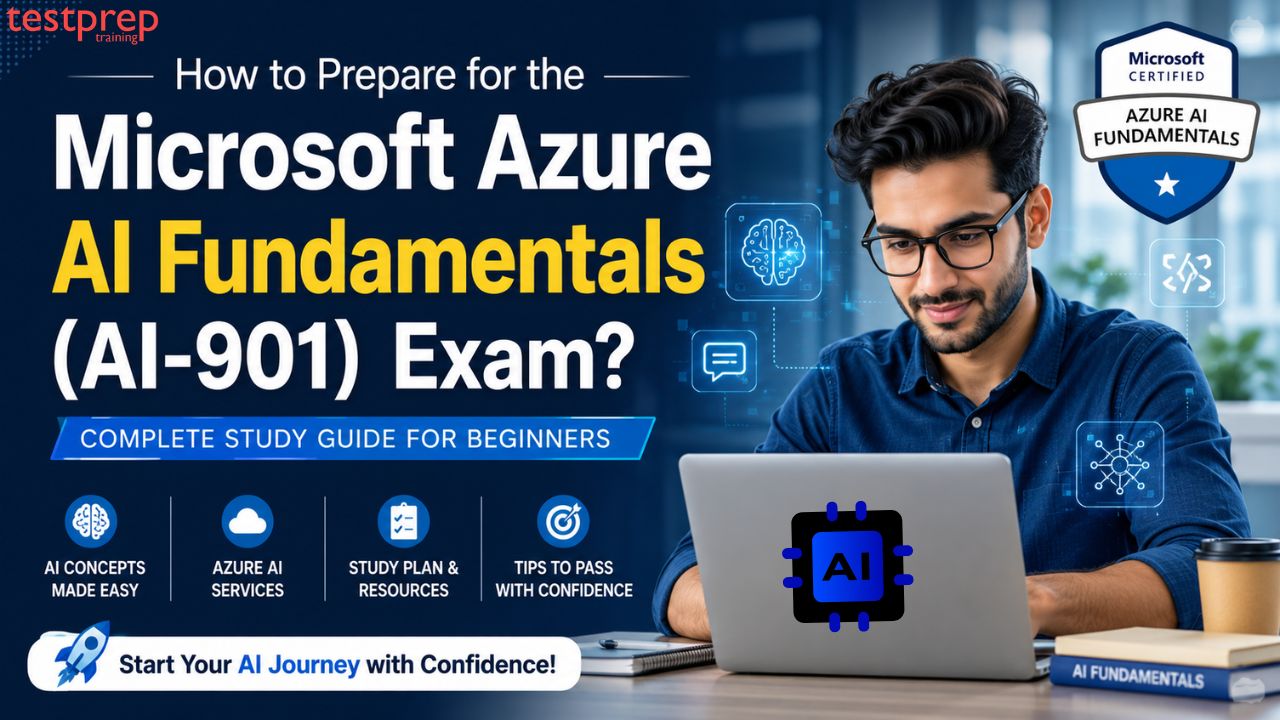
Artificial Intelligence is rapidly transforming industries across the world, and companies are actively looking for professionals who understand how AI technologies work in real-world cloud environments. As Microsoft continues expanding its AI ecosystem through Azure AI services, generative AI tools, and Microsoft Foundry, the demand for individuals with foundational AI knowledge is growing faster than ever. The Microsoft Azure AI Fundamentals (AI-901) certification is designed for beginners who want to build a strong understanding of artificial intelligence concepts and learn how AI solutions are implemented using Microsoft Azure.
Unlike advanced technical certifications, AI-901 focuses on core AI principles, responsible AI practices, machine learning basics, generative AI concepts, and Azure AI services without requiring deep programming expertise. And one of the biggest reasons this certification is gaining popularity is its beginner-friendly approach. Whether you are a student, fresher, IT professional, developer, business analyst, or someone planning to enter the AI industry, AI-901 provides an excellent starting point for understanding modern AI technologies in a cloud-based environment.
The newer AI-901 version also reflects Microsoft’s growing focus on generative AI and practical AI implementation. Topics such as large language models (LLMs), AI copilots, prompt engineering fundamentals, responsible AI, and Microsoft Foundry now play a much bigger role in the certification objectives, making the exam more aligned with current industry trends and real-world AI adoption.
However, many candidates struggle to understand where to begin, what resources to use, how much technical knowledge is required, and which topics deserve the most attention. With the right preparation strategy, official learning resources, hands-on practice, and proper revision planning, passing the AI-901 exam becomes much more manageable—even for complete beginners.
In this guide, you will learn everything you need to know about preparing for the Microsoft Azure AI Fundamentals (AI-901) exam, including the exam structure, important domains, study resources, preparation strategies, hands-on practice tips, and common mistakes to avoid during your preparation journey.
What is the Microsoft Azure AI Fundamentals (AI-901) Exam?
Microsoft has positioned Azure as one of the leading cloud platforms for AI innovation, and the Microsoft Azure AI Fundamentals (AI-901) certification was created to help individuals build a foundational understanding of these technologies without requiring advanced technical expertise.
The AI-901 exam is a beginner-level Microsoft certification that validates a candidate’s understanding of artificial intelligence concepts and how AI solutions are implemented using Microsoft Azure services. Rather than focusing heavily on coding or deep machine learning development, the certification emphasizes conceptual clarity, practical awareness of Azure AI tools, responsible AI principles, and modern generative AI technologies that are shaping the current industry landscape.
This certification is especially valuable for students, freshers, business professionals, cloud beginners, developers, and IT professionals who want to understand how AI works in real-world cloud environments before moving toward advanced AI or data-focused certifications.
Understanding the Purpose of the AI-901 Certification
The primary goal of the AI-901 certification is to provide candidates with a strong foundation in artificial intelligence and Microsoft Azure AI services. Microsoft designed this certification to bridge the gap between theoretical AI concepts and practical cloud-based AI implementation.
Unlike advanced AI certifications that require strong programming, data science, or machine learning engineering skills, AI-901 introduces candidates to the core principles behind AI systems in an accessible and structured manner. The exam focuses on helping learners understand how AI workloads operate, where AI solutions are commonly used, and how Azure services support the development and deployment of intelligent applications.
The certification also reflects the growing importance of generative AI technologies. Microsoft has updated the exam objectives to include modern AI concepts such as large language models (LLMs), AI copilots, prompt engineering fundamentals, and Microsoft Foundry capabilities, making the certification more aligned with current enterprise AI adoption trends.
Furthermore, candidates are expected to demonstrate knowledge of AI workloads, machine learning principles, computer vision, natural language processing, generative AI concepts, and responsible AI practices using Azure AI services.
Who Should Take the AI-901 Exam?
One of the biggest advantages of the AI-901 certification is its accessibility. The exam is designed for individuals from both technical and non-technical backgrounds who want to understand the fundamentals of artificial intelligence within the Microsoft Azure ecosystem. This certification is particularly suitable for:
- Students and freshers planning to enter cloud computing or AI-related careers
- Developers who want introductory exposure to Azure AI services
- IT professionals exploring AI-powered cloud solutions
- Business analysts and managers involved in AI-driven projects
- Professionals preparing for advanced Microsoft AI certifications
- Individuals interested in generative AI and responsible AI technologies
Microsoft does not require prior Azure certifications or advanced programming experience for AI-901. While having basic cloud computing awareness can be helpful, the certification primarily focuses on conceptual understanding rather than deep technical implementation.
For candidates with limited technical backgrounds, AI-901 often serves as an excellent first step before progressing toward role-based certifications such as Azure AI Engineer Associate or Azure Data Scientist Associate.
Why the AI-901 Certification Matters in the Current AI Industry
- The rapid adoption of AI across industries has created demand for professionals who understand both AI concepts and cloud-based AI platforms. Many organizations are no longer looking only for machine learning engineers or data scientists; they also need professionals who can communicate AI capabilities, understand responsible AI implementation, and work with AI-powered business solutions.
- The AI-901 certification helps candidates demonstrate foundational AI literacy while building familiarity with Microsoft’s rapidly expanding AI ecosystem. Because Azure integrates AI services directly into enterprise cloud infrastructure, the certification also provides exposure to real-world AI implementation scenarios used by businesses globally.
- Another major advantage of AI-901 is that it creates a pathway toward more specialized Microsoft certifications in areas such as AI engineering, data science, and cloud solution architecture. For many beginners, this certification serves as both a confidence-building milestone and a structured introduction to the broader world of artificial intelligence and cloud computing.
Important Microsoft AI-901 Exam Details
Before starting preparation for the Microsoft Azure AI Fundamentals (AI-901) certification, it is essential to understand how the exam is structured, what skills are evaluated, how the scoring system works, and what Microsoft expects candidates to know at the foundational level. Many students begin studying without fully understanding the certification format, which often leads to inefficient preparation and unnecessary confusion during the exam.
The AI-901 certification is designed to validate foundational knowledge of artificial intelligence concepts and Microsoft Azure AI services. Although the exam is considered beginner-friendly, Microsoft still evaluates a candidate’s ability to understand real-world AI workloads, recognize appropriate Azure AI solutions, and apply responsible AI principles across different business scenarios.
Having a clear understanding of the exam structure, domain weightage, question patterns, and certification expectations can significantly improve preparation efficiency and help candidates focus on the areas that matter most.
Official Certification and Exam Details
The Microsoft Azure AI Fundamentals certification belongs to Microsoft’s fundamentals-level credential track and focuses on introducing learners to artificial intelligence concepts within the Azure ecosystem. The official certification name is: Microsoft Certified: Azure AI Fundamentals. The associated exam code is: AI-901.
Unlike role-based certifications that focus heavily on engineering or administration tasks, AI-901 is intended to test broad AI awareness and conceptual understanding rather than deep technical implementation skills.
The AI-901 exam follows Microsoft’s standard certification assessment format and includes multiple question types designed to test both conceptual understanding and practical recognition of Azure AI services. Candidates may encounter:
- Multiple-choice questions
- Multiple-response questions
- Drag-and-drop activities
- Matching-based questions
- Scenario-driven questions
- Short case-study style assessments
The exam is designed to measure how well candidates understand AI concepts rather than how well they memorize definitions. Many questions present business or technical scenarios where candidates must identify the most appropriate Azure AI service or responsible AI principle.
The certification exam is delivered in a proctored environment and can usually be taken either online or at authorized testing centers depending on the candidate’s region and testing availability. Microsoft may also include unscored evaluation questions within the exam. These questions are used internally to improve future certification assessments and are not identified separately during the test.

Exam Duration and Passing Score
The AI-901 exam is relatively short compared to advanced Microsoft certifications, making it approachable for beginners and first-time certification candidates. Important exam details include:
- Exam duration: Approximately 45 minutes
- Recommended arrival/check-in time: Additional time for verification and instructions
- Passing score: 700 out of 1000
- Exam delivery format: Proctored certification exam
Although the certification is considered foundational, candidates should not underestimate the importance of understanding concepts thoroughly. Questions are often designed to test practical interpretation rather than simple memorization.
AI-900 vs AI-901: Understanding the Transition
One important detail many learners should understand is the evolution from the older AI-900 certification structure toward the updated AI-901 exam objectives. Microsoft redesigned the certification to better align with modern AI industry trends and the rapid growth of generative AI technologies. The newer AI-901 version places greater emphasis on:
- Generative AI concepts
- Azure OpenAI capabilities
- Large language models
- Responsible AI governance
- AI copilots
- Prompt engineering fundamentals
- Microsoft Foundry integration
- Practical AI implementation workflows
This transition reflects the increasing importance of enterprise AI adoption and cloud-based AI services in modern business environments.
Recommended Knowledge Before Taking the Exam
Microsoft does not enforce formal prerequisites for AI-901, but candidates generally benefit from having basic familiarity with:
- Cloud computing concepts
- Microsoft Azure fundamentals
- General AI terminology
- Basic data concepts
- Simple Python awareness
- Understanding of common business AI use cases
Even though programming is not heavily tested, candidates who understand basic technical workflows often find scenario-based questions easier to interpret. The certification is specifically designed to remain accessible to non-technical learners, which is why Microsoft focuses more on conceptual understanding and service recognition than coding-heavy implementation tasks.
Certification Validity and Career Relevance
The Microsoft Azure AI Fundamentals certification serves as an entry point into Microsoft’s AI certification ecosystem and demonstrates foundational AI literacy to employers and organizations. The certification can help candidates:
- Build credibility in AI and cloud computing
- Understand enterprise AI technologies
- Prepare for advanced Azure AI certifications
- Strengthen resumes for AI-related roles
- Gain familiarity with responsible AI practices
- Develop foundational knowledge for generative AI technologies
Because AI adoption continues expanding across industries, foundational AI certifications are becoming increasingly valuable not only for technical professionals but also for managers, analysts, consultants, and decision-makers working with AI-powered systems.
Understand the AI-901 Exam Skills Measured
One of the most important parts of preparing for the Microsoft Azure AI Fundamentals (AI-901) certification is understanding exactly what Microsoft expects candidates to know before attempting the exam. Many learners spend time studying random AI topics without realizing that Microsoft follows a very specific skills framework designed around practical AI awareness, responsible AI usage, and familiarity with Azure AI technologies.
The AI-901 certification is not designed to test deep-level machine learning engineering or advanced data science expertise. Instead, Microsoft focuses on evaluating whether candidates understand the core concepts behind artificial intelligence, recognize different AI workloads, and know how Azure AI services are used to build intelligent solutions in modern cloud environments.
The official AI-901 study guide divides the certification into two primary skill domains. Each domain measures different aspects of AI knowledge, ranging from responsible AI principles to generative AI technologies and Azure AI implementation workflows. Understanding these domains in detail allows candidates to prioritize their study plan more effectively and avoid spending unnecessary time on topics that are outside the exam scope.
Domain 1: Identifying AI Concepts and Responsible AI Considerations
The first domain forms a major portion of the AI-901 exam and focuses on the conceptual understanding of artificial intelligence technologies, AI workloads, and responsible AI principles. Microsoft expects candidates to understand how AI systems operate, where they are used, and what ethical responsibilities organizations must consider while developing intelligent solutions. This section evaluates foundational AI literacy rather than technical implementation skills, making it especially important for beginners entering the AI field.
– Understanding Common AI Workloads
Candidates preparing for AI-901 must understand the major categories of AI workloads and how they solve real-world business problems.
1. Machine Learning Fundamentals
Machine learning is one of the core topics covered in the exam. Candidates are expected to understand how machine learning enables systems to learn patterns from data and make predictions without being explicitly programmed for every task. Important concepts include:
- Supervised learning
- Unsupervised learning
- Classification models
- Regression models
- Clustering techniques
- Training datasets
- Validation and evaluation concepts
The exam does not require deep mathematical expertise or advanced algorithm development, but candidates should understand the practical purpose of machine learning models and when they are commonly used.
2. Computer Vision Concepts
Computer vision focuses on enabling systems to interpret and analyze images and visual content. Microsoft expects candidates to understand common computer vision workloads supported through Azure AI services. Key areas include:
- Image classification
- Object detection
- Facial analysis
- Optical character recognition (OCR)
- Document analysis
- Image tagging and caption generation
Candidates should understand how Azure AI Vision services help organizations automate visual recognition tasks across industries such as retail, healthcare, manufacturing, and security.
3. Natural Language Processing (NLP)
Natural language processing is another important exam area that focuses on how AI systems understand, interpret, and generate human language. Topics commonly covered include:
- Sentiment analysis
- Language detection
- Text classification
- Key phrase extraction
- Conversational AI
- Chatbots and virtual assistants
- Language translation
The AI-901 exam frequently tests scenario-based understanding of how Azure AI Language services can support customer service, automation, and enterprise communication workflows.
4. Speech AI Workloads
Candidates should also understand speech-related AI capabilities and how speech services support voice-based interaction systems. Important concepts include:
- Speech-to-text conversion
- Text-to-speech generation
- Speech translation
- Voice assistants
- Real-time transcription
Microsoft includes speech AI because voice-enabled applications are increasingly integrated into modern business systems and consumer technologies.
– Generative AI and Large Language Models (LLMs)
One of the most significant additions to the updated AI-901 certification is the increased focus on generative AI technologies. Microsoft now expects candidates to understand the foundational concepts behind:
- Generative AI systems
- Large language models (LLMs)
- Foundation models
- AI copilots
- Prompt engineering basics
- Content generation workflows
Rather than focusing only on traditional AI services, the certification now introduces candidates to modern enterprise AI applications powered by large-scale models such as those used in conversational AI systems and intelligent assistants. Candidates should understand how generative AI can create:
- Text content
- Images
- Code
- Summaries
- Conversational responses
The exam may also test awareness of limitations and risks associated with generative AI systems, including hallucinations, bias, privacy concerns, and misinformation risks.
– Responsible AI Principles
Responsible AI is one of the most critical areas of the AI-901 certification. Microsoft strongly emphasizes ethical AI development and expects candidates to understand how organizations should design and deploy AI systems responsibly. Candidates should be familiar with the six core responsible AI principles promoted by Microsoft:
- Fairness
- Reliability and safety
- Privacy and security
- Inclusiveness
- Transparency
- Accountability
The exam may include scenario-based questions where candidates must identify responsible AI concerns related to bias, transparency, data privacy, or ethical decision-making. Understanding these principles is essential because modern organizations increasingly require AI systems that are trustworthy, compliant, and ethically designed.

Domain 2: Implement AI Solutions Using Microsoft Azure Technologies
The second major domain focuses on practical familiarity with Microsoft’s AI ecosystem and Azure AI implementation workflows. While AI-901 remains a fundamentals-level certification, Microsoft expects candidates to recognize how Azure AI services are used to solve different business and technical problems. This section is heavily aligned with Azure AI products, generative AI platforms, and Microsoft Foundry technologies.
– Understanding Azure AI Services
Candidates should understand the purpose and primary capabilities of Microsoft Azure AI services and how they support intelligent application development.
1. Azure AI Vision
Azure AI Vision enables organizations to analyze images, extract text, detect objects, and process visual information using AI-powered models. Candidates should understand use cases such as:
- Image recognition
- OCR
- Face analysis
- Product identification
- Document digitization
2. Azure AI Language
Azure AI Language services focus on analyzing and processing text-based content. Key capabilities include:
- Sentiment analysis
- Entity recognition
- Text summarization
- Language detection
- Conversational AI support
Candidates should understand how businesses use language services to automate customer support, analyze feedback, and improve communication systems.
3. Azure AI Speech
Azure AI Speech services support speech recognition and voice-based AI interactions. Candidates should understand:
- Real-time transcription
- Voice synthesis
- Speech translation
- Voice-enabled applications
4. Azure OpenAI Service
The updated AI-901 certification now places major importance on Azure OpenAI capabilities and enterprise generative AI implementation. Candidates should understand:
- How Azure OpenAI integrates with enterprise applications
- AI copilots and assistants
- Prompt-based AI interaction
- Responsible generative AI usage
- Large language model deployment concepts
Although deep technical configuration is not required, learners should understand the role Azure OpenAI plays within Microsoft’s AI ecosystem.
– Microsoft Foundry and AI Development Workflows
Another important addition to the AI-901 exam is Microsoft Foundry awareness. Candidates are expected to understand how Microsoft Foundry supports AI application development, model deployment, orchestration, and AI-powered solution management. Important concepts include:
- AI project workflows
- Model deployment pipelines
- AI orchestration concepts
- Resource management
- Enterprise AI integration
This reflects Microsoft’s broader shift toward integrated AI development platforms that simplify enterprise AI adoption.
– Basic Python Awareness in AI Workflows
The updated exam objectives also introduce basic Python-related awareness within AI workflows. Candidates are not expected to become Python developers, but they should understand:
- Simple Python syntax concepts
- Basic API interaction logic
- How AI services may be accessed programmatically
- General structure of AI implementation examples
This addition helps candidates better understand how AI services connect with applications and automation workflows in real-world environments.
Best Study Resources for AI-901 Preparation
Preparing for the Microsoft Azure AI Fundamentals (AI-901) exam becomes significantly easier when candidates use the right combination of official documentation, structured learning platforms, hands-on Azure practice, and realistic practice assessments. One of the most common mistakes beginners make is relying entirely on random video playlists or outdated notes without following the actual Microsoft exam objectives.
Because the AI-901 certification focuses heavily on conceptual understanding, responsible AI awareness, Azure AI services, and generative AI fundamentals, students need study resources that are accurate, updated, and aligned directly with Microsoft’s official skills measured document. A well-structured preparation approach should not only help candidates memorize concepts but also understand how Azure AI technologies are applied in real-world business environments.
Microsoft continuously updates the AI-901 certification objectives to reflect modern AI trends such as large language models, AI copilots, Azure OpenAI capabilities, and Microsoft Foundry integration. As a result, candidates should prioritize official learning resources and supplement them with practical exercises, mock tests, and community discussions to build complete exam readiness.
1. Microsoft Learn: The Most Important Resource for AI-901 Preparation
For most candidates, Microsoft Learn should serve as the primary study platform for AI-901 preparation. Microsoft designs its official learning paths specifically around the exam objectives, which makes the platform one of the most reliable and exam-aligned resources available. Unlike generic tutorials that often focus only on theory, Microsoft Learn combines conceptual explanations with interactive exercises, guided labs, and Azure-based demonstrations. This approach helps learners understand not only what Azure AI services do, but also how they are used in practical cloud environments.
The learning paths are especially useful for beginners because they gradually introduce AI concepts before moving toward Azure AI services, responsible AI principles, and generative AI workflows. Microsoft Learn includes courses such as:
– Understanding AI Fundamentals for Developers and IT Professionals
This learning area introduces the foundational principles of artificial intelligence and helps developers and technology professionals build a strong understanding of modern AI concepts, terminology, and real-world applications. It begins with an overview of how AI systems function and gradually explores the major AI workloads commonly used in today’s technology landscape.
Learners gain insight into important AI domains such as generative AI and intelligent AI agents, computer vision and image recognition technologies, speech recognition and voice-based AI solutions, natural language processing (NLP) and text analytics, and information extraction and data interpretation techniques. The objective of this section is to help learners understand how intelligent systems process data, recognize patterns, interpret language, and support decision-making across modern digital environments.
– Introduction to AI Solutions and Intelligent Applications on Azure
This section focuses on building practical knowledge of AI applications and services within the Microsoft Azure ecosystem. Candidates learn how to begin working with AI workloads using Microsoft Foundry and Azure AI tools to create intelligent cloud-based solutions. The learning path starts with foundational concepts related to Azure AI services and then expands into commonly used AI scenarios, including building applications with generative AI and AI agents, performing text analysis and language understanding tasks, working with speech-enabled AI services, using computer vision capabilities for image processing, and extracting valuable information from structured and unstructured data.
This section helps learners understand how Azure AI services can be applied to create scalable, intelligent, and cloud-based applications for real-world business and technology solutions.
Another major advantage is that Microsoft Learn offers instructor-led training courses as well. This includes:
– Course AI-901T00-A: Introduction to AI in Azure
The Microsoft AI-901T00-A: Introduction to AI in Azure course introduces learners to the core concepts of artificial intelligence and the Azure services used to create AI-powered solutions. It combines foundational AI knowledge with practical cloud-based technologies to help learners understand how intelligent applications are developed within the Microsoft Azure environment. This course is intended for students, aspiring IT professionals, and beginner developers starting their journey in artificial intelligence.
It covers important AI workloads such as machine learning, computer vision, natural language processing, conversational AI, and generative AI, while demonstrating how Azure AI services support these technologies in real-world scenarios. The training does not require advanced technical experience. Basic understanding of Python syntax and programming concepts can be helpful for following examples and hands-on demonstrations.
2. Why the Official AI-901 Study Guide Matters
One of the most overlooked preparation resources is the official AI-901 study guide published by Microsoft. Many candidates jump directly into tutorials without carefully reviewing the skills measured document, which often results in studying unnecessary topics while missing important exam objectives. The official study guide acts as the blueprint for the certification exam. It clearly outlines:
- Exam domains
- Skill weightage
- Topic breakdowns
- Expected knowledge areas
- Azure AI technologies covered
- Responsible AI requirements
- Generative AI topics included in the exam
Because Microsoft updates the certification periodically, the study guide also helps candidates identify newly introduced areas such as:
- Large language models (LLMs)
- Prompt engineering basics
- AI copilots
- Microsoft Foundry capabilities
- Azure OpenAI integration
A highly effective preparation strategy is to use the study guide as a checklist while studying. Candidates can track which objectives they have completed and identify weak areas requiring additional revision. The study guide is particularly useful during the final stages of preparation because it helps learners focus only on exam-relevant topics rather than broad AI theory outside the certification scope.
3. Hands-On Azure Practice and Interactive Learning
Although AI-901 is considered a fundamentals-level certification, practical exposure to Azure AI services can significantly improve understanding and exam performance. Many AI-901 questions are scenario-based and require candidates to recognize which Azure AI service is best suited for a particular business or technical requirement.
Students who only memorize definitions often struggle with these questions because they lack practical familiarity with the Azure ecosystem. Creating a free Azure account allows candidates to explore:
- Azure AI Vision
- Azure AI Language
- Azure AI Speech
- Azure OpenAI Service
- Azure Machine Learning
- AI Studio and Foundry environments
Hands-on learning helps students better understand:
- AI service interfaces
- Model deployment concepts
- Prompt-based interactions
- AI workflow integration
- Real-world business use cases
Even simple experimentation with Azure AI demos can improve conceptual clarity far more effectively than passive reading alone. Microsoft also provides sandbox exercises and guided demonstrations through Microsoft Learn, allowing candidates to gain practical experience without needing advanced technical setups.

4. Practice Tests and Mock Exams
Practice tests play a critical role in AI-901 preparation because they help candidates understand the structure and wording of Microsoft certification questions. Unlike standard academic exams, Microsoft certification questions often evaluate conceptual interpretation, business reasoning, and service selection rather than straightforward factual recall. Practice assessments help learners adapt to this style of questioning. Effective practice testing helps candidates:
- Improve time management
- Identify weak domains
- Understand question patterns
- Strengthen scenario-based reasoning
- Reduce exam anxiety
- Build confidence before the real exam
However, candidates should avoid relying on “exam dumps” or memorized question banks. These resources often contain outdated or inaccurate information and may not reflect the current AI-901 objectives, especially after Microsoft’s updates related to generative AI and Foundry technologies. Instead, students should focus on understanding why an answer is correct rather than memorizing option patterns.
5. Using Documentation and Azure Product Pages Effectively
Many candidates underestimate the value of Microsoft’s official Azure documentation during preparation. While documentation can initially appear technical, it provides highly accurate explanations of Azure AI services and often clarifies concepts that shorter tutorials fail to explain properly. Reading selected documentation sections helps candidates understand:
- Service capabilities
- Use cases
- Responsible AI considerations
- AI workflow integration
- Generative AI implementation concepts
- Azure AI terminology
For AI-901 preparation, candidates do not need to study every technical detail. Instead, they should focus on understanding the purpose and practical applications of major Azure AI services. This becomes especially important for:
- Azure OpenAI Service
- Azure AI Vision
- Azure AI Language
- Azure AI Speech
- Microsoft Foundry workflows
Because Microsoft creates the certification, its official documentation remains one of the most reliable sources for exam-aligned learning.
6. Community Discussions and Real Candidate Experiences
Another valuable preparation method is learning from the experiences of candidates who have already attempted the AI-901 exam. Platforms such as Reddit, Microsoft Learn communities, and certification discussion forums often provide insights into:
- Commonly tested concepts
- Difficulty level expectations
- Study duration recommendations
- Effective revision strategies
- Real exam experiences
- Frequently misunderstood topics
These discussions can give candidates better insight into how Microsoft structures exam questions and which topics demand a stronger conceptual understanding. However, learners should approach community discussions with caution and confirm technical details through official Microsoft resources, as exam objectives can evolve over time. A balanced preparation strategy usually combines official Microsoft learning materials with practical Azure exposure, mock assessments, and selective community-driven insights.
Hands-On Practice Strategy for Passing the Microsoft AI-901 Exam
| Practice Area | What to Focus On | Recommended Azure Tools/Services | Why It Matters for AI-901 |
|---|---|---|---|
| Azure Portal Familiarity | Learn how to navigate the Azure dashboard, create resources, explore AI services, and manage basic settings | Azure Portal | Helps candidates understand how AI services are organized and deployed in real cloud environments |
| Azure AI Vision | Explore image analysis, OCR, object detection, facial analysis, and image tagging capabilities | Azure AI Vision Studio | Builds understanding of computer vision workloads frequently tested in scenario-based questions |
| Azure AI Language | Practice sentiment analysis, key phrase extraction, language detection, and conversational AI features | Azure AI Language Studio | Helps learners understand how NLP solutions are implemented using Azure services |
| Azure AI Speech | Test speech-to-text, text-to-speech, speech translation, and voice recognition features | Azure AI Speech Services | Improves familiarity with speech AI workloads and enterprise voice applications |
| Generative AI Basics | Experiment with prompts, AI-generated responses, summaries, and conversational AI interactions | Azure OpenAI Service | Helps candidates understand modern generative AI concepts included in updated AI-901 objectives |
| Prompt Engineering Practice | Understand how prompts shape AI-generated responses and affect the overall quality of outputs. | Azure OpenAI Playground | Strengthens understanding of prompt-based AI interactions and AI copilots |
| Responsible AI Features | Review AI transparency, fairness, content filtering, and ethical AI practices | Azure AI Content Safety, Responsible AI Documentation | Responsible AI is a major exam domain and commonly appears in conceptual questions |
| Machine Learning Awareness | Understand datasets, model training, prediction workflows, and evaluation concepts | Azure Machine Learning Studio | Provides practical exposure to machine learning workflows without requiring advanced coding |
| Document Intelligence | Practice extracting text and structured information from forms and scanned files | Azure AI Document Intelligence | Helps learners understand document processing and business automation use cases |
| AI Service Selection Scenarios | Learn which Azure AI service is appropriate for different business problems | Multiple Azure AI Services | Important for scenario-based questions where candidates must identify the correct Azure solution |
| Microsoft Foundry Concepts | Explore AI project workflows, orchestration concepts, and model deployment processes | Microsoft Foundry | Aligns with updated AI-901 objectives covering enterprise AI implementation workflows |
| Basic Python Exposure | Understand simple AI-related Python examples and API interaction concepts | Microsoft Learn Sandbox Exercises | Supports understanding of practical AI workflows without requiring deep programming expertise |
| Microsoft Learn Hands-On Labs | Complete guided exercises and interactive learning modules | Microsoft Learn | Reinforces conceptual understanding through practical exercises aligned with exam objectives |
| Practice Assessments | Simulate certification-style questions and improve exam readiness | Microsoft Practice Assessments | Helps identify weak areas, improve time management, and strengthen conceptual interpretation |
| Real-World AI Use Cases | Study how AI services are applied in industries such as healthcare, retail, finance, and customer support | Azure AI Case Studies and Demos | Improves ability to handle business-oriented and scenario-driven exam questions |
Study Plan for Passing the Microsoft AI-901 Exam
Preparing for the Microsoft Azure AI Fundamentals (AI-901) certification becomes much more manageable when candidates follow a structured study plan instead of randomly switching between videos, documentation, and practice questions. Because the AI-901 exam covers multiple domains—including AI concepts, responsible AI, generative AI, Azure AI services, and Microsoft Foundry workflows—students often struggle to decide how much time should be allocated to each topic.
A proper study plan helps candidates organize their preparation according to Microsoft’s official skills measured document while ensuring enough time for revision, hands-on practice, and mock assessments. Since AI-901 is a fundamentals-level certification, the goal is not deep technical specialization but strong conceptual understanding combined with practical awareness of Azure AI technologies.
The amount of preparation time required depends on the learner’s background. Candidates with prior cloud or AI exposure may complete preparation within two weeks, while complete beginners may prefer a more gradual 30-day learning approach. In both cases, consistency and topic prioritization are far more important than studying for long hours without structure.
2-Week AI-901 Study Plan for Fast Preparation
A two-week preparation plan works best for learners who already have basic familiarity with cloud computing, Azure fundamentals, or general AI concepts. This approach focuses on concentrated learning and daily revision while maintaining enough time for practice assessments.
Week 1: Build Core AI and Azure AI Foundations
The first week should focus on understanding the conceptual side of artificial intelligence and the major Azure AI services covered in the exam.
Day 1–2: Introduction to AI and Machine Learning Fundamentals
Focus areas should include:
- AI workloads
- Machine learning basics
- Supervised vs unsupervised learning
- Classification and regression
- Responsible AI overview
At this stage, candidates should prioritize understanding practical AI concepts rather than technical implementation details.
Recommended resources:
- Microsoft Learn AI Fundamentals modules
- Official AI-901 study guide
- Azure AI introductory documentation
Day 3–4: Computer Vision and NLP Services
Study the Azure AI services related to visual and language processing workloads.cImportant topics include:
- Azure AI Vision
- OCR and image analysis
- Sentiment analysis
- Language detection
- Conversational AI
- Chatbot concepts
Candidates should also spend time exploring Azure demos and service interfaces to improve practical understanding.
Day 5: Speech AI and Document Intelligence
Focus on speech-related AI capabilities and document processing services. Topics should include:
- Speech-to-text
- Text-to-speech
- Translation services
- Voice-enabled AI applications
- Document extraction and analysis
Hands-on exploration through Microsoft Learn labs can improve retention significantly.
Day 6–7: Generative AI and Responsible AI
Because the updated AI-901 certification places significant emphasis on generative AI, candidates should dedicate focused time to:
- Large language models (LLMs)
- Prompt engineering basics
- AI copilots
- Azure OpenAI concepts
- Responsible AI principles
- AI fairness and transparency
Students should pay close attention to ethical AI principles as well, since questions related to responsible AI are commonly included in the exam.
Week 2: Practical Familiarity and Exam Readiness
The second week should focus more heavily on practical service understanding, revision, and exam-oriented preparation.
Day 8–9: Azure AI Services and Microsoft Foundry
Candidates should review how Azure AI services are implemented within enterprise workflows. Important services include:
- Azure AI Vision
- Azure AI Language
- Azure AI Speech
- Azure OpenAI Service
- Azure Machine Learning
- Microsoft Foundry concepts
At this stage, students should begin identifying which Azure service is appropriate for different business scenarios because many exam questions are scenario-based.
Day 10–11: Hands-On Azure Practice
Spend dedicated time exploring Azure AI tools and Microsoft Learn sandbox exercises. Recommended activities include:
- Testing AI Vision demos
- Running language analysis examples
- Exploring prompt-based AI responses
- Reviewing AI Studio environments
- Understanding service deployment workflows
Even basic practical interaction with Azure AI services can improve exam confidence considerably.
Day 12–13: Practice Assessments and Weak Area Revision
Candidates should now begin taking practice tests and reviewing incorrect answers carefully. Focus areas should include:
- Time management
- Scenario interpretation
- Responsible AI questions
- Generative AI terminology
- Azure AI service selection
Rather than memorizing answers, students should analyze why certain Azure services are appropriate in different scenarios.
Day 14: Final Revision and Exam Readiness
The final preparation day should focus on light revision rather than heavy studying. Recommended activities include:
- Reviewing notes
- Revisiting responsible AI principles
- Reviewing generative AI concepts
- Reading the official skills measured document again
- Revising Azure AI service purposes
This stage should focus on reinforcing conceptual clarity and avoiding information overload before the actual exam.
Microsoft AI-901 Study Plan for Beginners
For complete beginners, a 30-day preparation strategy allows more time for gradual learning, revision, and hands-on practice without creating unnecessary pressure. This longer schedule is especially useful for:
- Students new to AI
- Non-technical professionals
- Career switchers
- Candidates unfamiliar with Azure
- Learners balancing preparation with work or studies
Week 1: AI Fundamentals and Machine Learning Basics
The first week should focus entirely on building foundational AI understanding. Topics include:
- Introduction to artificial intelligence
- AI workloads
- Machine learning concepts
- Responsible AI principles
- Real-world AI applications
Candidates should avoid rushing through technical details and instead focus on conceptual understanding.
Week 2: Azure AI Services
The second week should focus on Azure AI products and service capabilities. Study areas include:
- Azure AI Vision
- Azure AI Language
- Azure AI Speech
- Azure Machine Learning
- Document Intelligence
Hands-on exploration becomes increasingly important during this phase.
Week 3: Generative AI and Microsoft Foundry
This week should focus on newer AI-901 objectives related to generative AI. Important topics include:
- Large language models
- Azure OpenAI Service
- AI copilots
- Prompt engineering basics
- Microsoft Foundry workflows
- Responsible generative AI usage
Candidates should also review AI limitations, ethical concerns, and content safety concepts.
Week 4: Mock Tests, Revision, and Final Preparation
The final week should focus heavily on practice assessments and targeted revision. Recommended activities include:
- Full-length practice tests
- Reviewing weak topics
- Revising Azure AI services
- Practicing scenario-based questions
- Reviewing responsible AI concepts
- Strengthening generative AI terminology
At this stage, students should focus on improving confidence and consistency rather than learning entirely new topics.
Recommended Daily Study Routine
Regardless of whether candidates follow a 2-week or 30-day plan, maintaining a balanced daily study structure can improve retention and reduce burnout. A practical daily routine may include:
| Study Activity | Recommended Duration |
|---|---|
| Microsoft Learn Modules | 1–2 Hours |
| Azure Hands-On Practice | 30–60 Minutes |
| Revision Notes | 20–30 Minutes |
| Practice Questions | 30–45 Minutes |
| Weak Area Review | 20 Minutes |
Consistency is generally more effective than long irregular study sessions, especially for conceptual certifications like AI-901.
Common Mistakes to Avoid During Preparation and Microsoft AI-901 Exam
Preparing for the Microsoft Azure AI Fundamentals (AI-901) exam is not only about completing study modules and watching tutorials. Many candidates fail to perform well because they focus on memorization, ignore practical understanding, or underestimate the importance of newer AI topics such as generative AI and responsible AI. Since the certification is designed around conceptual understanding and real-world Azure AI scenarios, having the right preparation strategy is just as important as studying the syllabus itself.
Understanding the most common preparation mistakes and following effective exam-day strategies can help candidates improve confidence, manage time properly, and approach the certification with a more structured mindset.
Common AI-901 Preparation Mistakes and How to Avoid Them
| Common Mistake | Why It Affects Performance | Better Approach |
|---|---|---|
| Memorizing concepts without understanding use cases | AI-901 questions are often scenario-based and test practical understanding | Focus on how Azure AI services solve real business problems |
| Ignoring Responsible AI topics | Responsible AI is a major exam objective in updated AI-901 versions | Study fairness, transparency, accountability, privacy, and inclusiveness carefully |
| Skipping hands-on Azure practice | Lack of practical exposure makes Azure service questions harder | Explore Azure AI demos, Microsoft Learn labs, and service interfaces |
| Using outdated study resources | Older materials may miss generative AI and Microsoft Foundry topics | Use updated Microsoft Learn modules and official study guides |
| Relying completely on practice question memorization | Memorized answers may not help with new scenario questions | Understand why each answer is correct instead of memorizing options |
Important AI-901 Exam Tips
As the exam date approaches, candidates should shift their focus toward revision, confidence building, and understanding question patterns instead of trying to learn entirely new topics. Microsoft certification exams often test interpretation and service selection skills rather than deep technical implementation. The following strategies can help improve exam performance and reduce unnecessary mistakes during the certification attempt.
| Exam Tip | Why It Matters |
|---|---|
| Read scenario-based questions carefully | Small details often determine the correct Azure AI service |
| Revise Azure AI service purposes before the exam | Helps quickly identify the correct service during questions |
| Focus heavily on generative AI and Responsible AI | These are major focus areas in the updated AI-901 objectives |
| Manage exam time properly | Avoid spending too long on difficult questions early in the exam |
| Review weak areas using the official skills measured document | Ensures coverage of all important exam objectives |
| Avoid last-minute information overload | Final revision should reinforce concepts instead of creating confusion |
| Practice interpreting business use cases | Many questions are based on real-world AI implementation scenarios |
Final Thoughts
The Microsoft Azure AI Fundamentals (AI-901) certification serves as an excellent starting point for anyone looking to build foundational knowledge in artificial intelligence and cloud-based AI technologies. As organizations continue integrating AI into business operations, understanding how AI workloads, generative AI systems, and Azure AI services function has become increasingly valuable across both technical and non-technical roles.
One of the biggest strengths of the AI-901 certification is its accessibility. Candidates do not need advanced programming expertise or deep machine learning experience to begin preparing for the exam. Instead, success depends more on understanding core AI concepts, recognizing practical Azure AI use cases, and developing familiarity with responsible AI principles and modern generative AI technologies.
A well-structured preparation strategy can make a significant difference in exam performance. Candidates who combine official Microsoft Learn modules, hands-on Azure practice, practice assessments, and consistent revision often develop a much stronger understanding of the certification objectives compared to those who rely only on memorization or outdated resources.
The updated AI-901 exam also reflects the rapid evolution of the AI industry. Topics such as large language models, AI copilots, prompt engineering, Azure OpenAI Service, and Microsoft Foundry now play an important role in the certification, making the exam more aligned with real-world enterprise AI adoption and current industry demands.
The key to success is consistency, practical understanding, and focusing on Microsoft’s official exam objectives throughout the preparation journey. With the right resources, structured study plan, and hands-on learning approach, the AI-901 certification becomes an achievable and valuable milestone for anyone beginning their journey into artificial intelligence and Azure cloud technologies.

