
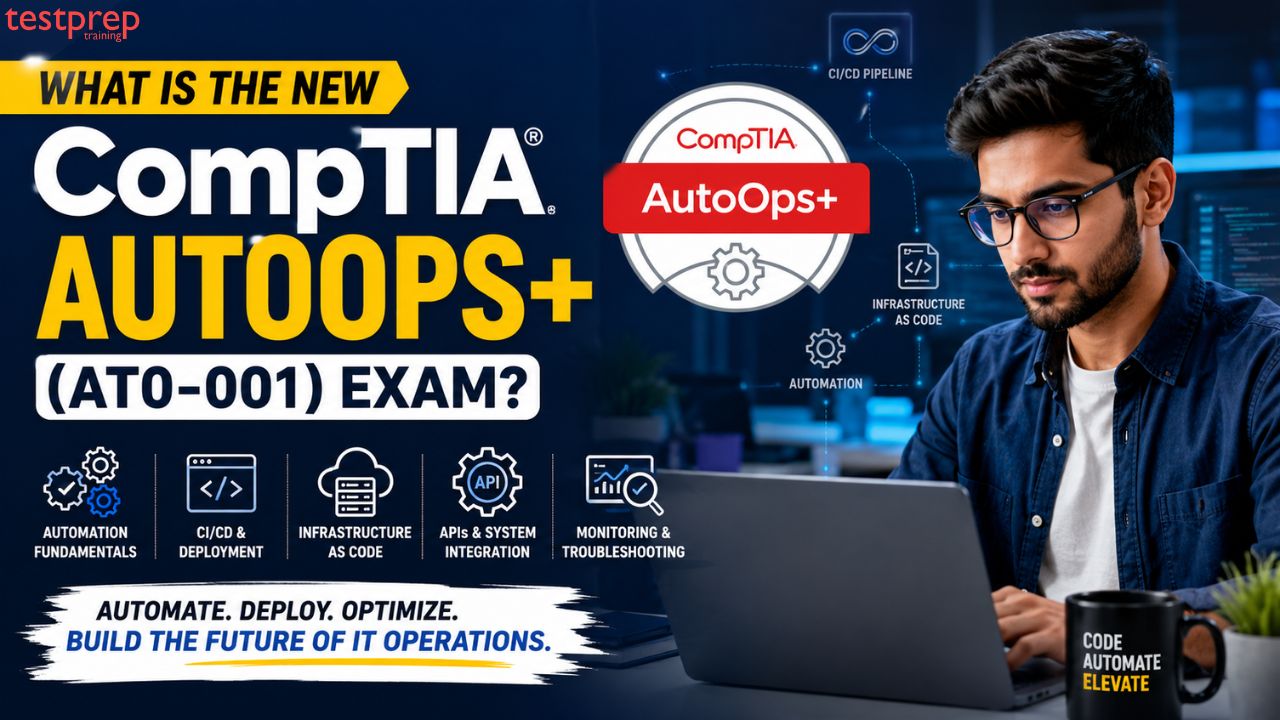
The IT industry is rapidly moving toward automation-driven infrastructure, cloud-native operations, and DevOps-based deployment models. Organizations today are no longer relying only on manual system administration tasks because modern environments require faster deployments, scalable infrastructure management, continuous integration pipelines, and automated operational workflows. As businesses continue adopting hybrid cloud and Infrastructure as Code (IaC) practices, the demand for professionals who understand automation and operational efficiency is growing significantly across the industry. To address this evolving skills gap, CompTIA has introduced the new CompTIA AutoOps+ (AT0-001) certification.
This certification is designed for IT professionals who want to build practical knowledge in automation, scripting, CI/CD pipelines, configuration management, infrastructure operations, and cloud-based operational workflows. AutoOps+ focuses on the real-world skills needed to manage and automate modern IT environments while helping candidates bridge the gap between traditional IT administration and modern DevOps operations.
Unlike many certifications that focus only on theory, AutoOps+ emphasizes hands-on operational concepts such as Git workflows, REST APIs, automation logic, infrastructure provisioning, deployment strategies, and troubleshooting automated environments. It is intended for system administrators, cloud administrators, junior DevOps engineers, infrastructure professionals, and IT operations teams who want to future-proof their careers in an increasingly automated technology landscape. In this detailed guide, we will explore everything you need to know about the NEW CompTIA AutoOps+ (AT0-001) exam, including exam objectives, domains, required skills, preparation strategies, career opportunities, recommended resources, and whether this certification is worth pursuing in 2026 and beyond.
What is CompTIA AutoOps+ (AT0-001)?
CompTIA introduced the new CompTIA AutoOps+ (AT0-001) certification as part of its expanding portfolio of infrastructure and operations certifications. This is a vendor-neutral certification focused on automation-driven IT operations and modern infrastructure management practices. The certification validates the practical knowledge required to automate workflows, configure systems, integrate APIs, manage CI/CD pipelines, and support cloud and hybrid operational environments. Unlike certifications that focus only on theoretical cloud concepts or traditional administration tasks, AutoOps+ is designed to emphasize operational efficiency, automation logic, deployment reliability, and infrastructure scalability in real-world environments.
The certification primarily targets professionals working in IT operations, cloud administration, DevOps support, infrastructure management, and automation-focused technical roles. It is especially valuable for individuals who want to transition from manual system administration into automation-centric infrastructure operations, where scripting, orchestration, and deployment automation are becoming essential skills rather than optional expertise.
Understanding the Purpose of AutoOps+
The main objective of AutoOps+ is to help IT professionals develop practical automation skills that align with the operational needs of modern organizations. Today’s infrastructure environments are built around rapid deployments, scalable cloud services, containerized applications, and continuous software updates. Because of this shift, companies need professionals who understand how to automate repetitive operational tasks, reduce deployment risks, improve infrastructure consistency, and maintain reliable system performance.
CompTIA developed AutoOps+ to validate these modern operational capabilities in a structured and industry-recognized format. The certification focuses heavily on automation workflows, scripting fundamentals, version control systems, infrastructure provisioning, deployment methodologies, and troubleshooting automated environments. It bridges the gap between foundational IT administration and advanced DevOps-oriented operations by introducing candidates to technologies and concepts commonly used in enterprise infrastructure environments.
Rather than concentrating on a single vendor ecosystem, AutoOps+ takes a platform-neutral approach. This allows candidates to understand broader operational concepts that can be applied across different cloud providers, automation platforms, and enterprise infrastructures.
What Skills Does the AutoOps+ Certification Cover?
The CompTIA AutoOps+ (AT0-001) certification is designed to help IT professionals develop the practical automation and operational skills required in modern cloud and infrastructure environments. As organizations increasingly adopt CI/CD pipelines, Infrastructure as Code (IaC), cloud-native platforms, and automated deployment systems, infrastructure teams are expected to manage operations through automation rather than relying only on manual administration.
To meet these evolving industry demands, CompTIA structured AutoOps+ around real-world operational workflows, scripting concepts, deployment automation, infrastructure management, and troubleshooting practices. The certification focuses on helping students understand how modern operational environments function in enterprise infrastructure settings.
1. Automation and Scripting Skills
One of the core skills covered in AutoOps+ is automation logic and scripting fundamentals. Students learn how automation workflows reduce repetitive operational tasks and improve deployment efficiency. The certification introduces concepts such as variables, loops, functions, conditional logic, and script troubleshooting, helping candidates understand how automation interacts with infrastructure environments.
2. Version Control and Git Workflows
The certification also teaches version control concepts commonly used in modern infrastructure operations. Candidates learn how Git-based workflows help teams manage operational changes, track infrastructure updates, and maintain deployment consistency. Topics such as repositories, commits, branching, merges, and semantic versioning are important parts of the learning process.
3. Infrastructure as Code (IaC) and Configuration Management
AutoOps+ introduces Infrastructure as Code concepts used in scalable cloud environments. Students learn how automated provisioning, reusable configurations, and infrastructure templates help organizations maintain consistent operational environments. The certification also covers configuration management principles, including configuration consistency, provisioning workflows, and infrastructure automation practices.
4. Continuous Integration and Continuous Delivery (CI/CD)
Modern deployment pipelines are another major focus area within the certification. Students learn how CI/CD workflows automate build, integration, testing, and deployment processes in enterprise environments. The certification introduces operational concepts related to Jenkins, GitHub Actions, deployment orchestration, artifact management, and release strategies such as rolling deployments and blue-green deployments.
5. API and Cloud Integration Skills
Candidates also develop foundational knowledge of REST APIs and operational integrations. The certification explains how infrastructure systems communicate programmatically using APIs, authentication methods, and automation-based service integrations. These skills are increasingly important in cloud-native operational environments where automation systems interact continuously with infrastructure platforms.
6. Troubleshooting and Operational Workflow Analysis
A major strength of the AutoOps+ certification is its focus on troubleshooting automation environments. Students learn how to identify deployment failures, analyze pipeline issues, troubleshoot configuration inconsistencies, and evaluate operational workflow behavior within real-world infrastructure scenarios.
Why AutoOps+ Is Different From Traditional IT Certifications?
One of the most important aspects of AutoOps+ is its strong focus on operational automation rather than only infrastructure maintenance. Traditional certifications often emphasize hardware management, networking fundamentals, or operating system administration. While those skills remain important, modern IT roles increasingly require professionals to automate infrastructure tasks, integrate cloud services, manage deployment workflows, and troubleshoot pipeline failures efficiently.
AutoOps+ stands out because it combines operational administration with automation practices commonly associated with DevOps and cloud engineering roles. The certification introduces learners to practical concepts such as Git-based version control, API integrations, YAML-based configuration workflows, CI/CD processes, and deployment automation. This makes the certification highly relevant for professionals preparing for future infrastructure and cloud operations careers.
The vendor-neutral nature of the certification is another advantage. Instead of limiting learners to a single platform, AutoOps+ teaches transferable concepts that can apply across multiple cloud providers and enterprise environments. This broader approach helps candidates build flexible operational skills that remain useful even as technologies evolve.
Why Did CompTIA AutoOps+ (AT0-001) Launch AutoOps+?
The modern IT industry is experiencing one of the biggest operational transformations in recent years. Organizations are rapidly shifting from manually managed infrastructure toward highly automated, cloud-driven, and continuously deployed environments. As businesses adopt DevOps methodologies, Infrastructure as Code (IaC), hybrid cloud platforms, and automated deployment pipelines, the demand for professionals who understand automation operations has increased significantly. To address this growing skills gap, CompTIA introduced the CompTIA AutoOps+ (AT0-001) certification to validate the practical operational skills required in modern infrastructure environments.
CompTIA recognized that traditional IT administration roles are evolving rapidly. Modern operations teams are no longer responsible only for server maintenance, operating system management, or basic networking tasks. Today’s infrastructure professionals are expected to automate deployments, manage CI/CD pipelines, integrate APIs, handle infrastructure provisioning, and support scalable cloud operations. AutoOps+ was launched to help professionals build these modern automation-focused skills in a structured and industry-recognized way.
The Growing Shift Toward Automation-Driven IT Operations
One of the primary reasons behind the launch of AutoOps+ is the industry-wide movement toward operational automation. Organizations now manage large-scale infrastructures across cloud, hybrid, and distributed environments where manual administration alone is no longer efficient. Infrastructure teams must deploy updates faster, reduce configuration inconsistencies, minimize operational downtime, and improve scalability without increasing administrative complexity.
Automation has become essential because businesses need reliable and repeatable operational processes. Instead of manually configuring systems one by one, organizations now use scripts, templates, APIs, and automation tools to provision infrastructure and manage deployments automatically. This not only enhances operational efficiency but also minimizes human mistakes and improves consistency across different environments.
CompTIA identified that many IT professionals still lacked formal validation of these automation skills even though employers increasingly expect them in infrastructure and operations roles. AutoOps+ was designed to fill this gap by focusing specifically on operational automation concepts rather than only traditional IT administration tasks.
The Rise of DevOps and Infrastructure as Code
Another major reason for launching AutoOps+ is the rapid adoption of DevOps practices across enterprise environments. Development and operations teams now work more closely together to deliver software updates continuously and maintain infrastructure reliability. As a result, infrastructure professionals must understand deployment pipelines, version control systems, configuration management, and orchestration workflows.
Infrastructure as Code (IaC) has become a widely adopted operational approach in modern IT environments. Organizations increasingly rely on automated templates and configuration files to deploy cloud resources consistently and efficiently. This approach improves scalability while helping businesses maintain standardized infrastructure across development, testing, and production environments.
CompTIA recognized that many existing certifications did not fully focus on the operational side of automation and deployment workflows. AutoOps+ was created to help professionals understand the foundational concepts behind IaC, CI/CD operations, deployment automation, and configuration management without tying learners to a single vendor platform. The certification therefore aligns closely with the skills now required in DevOps-oriented operational roles while remaining accessible to IT professionals transitioning from traditional administration backgrounds.

Addressing the Skills Gap in Modern Infrastructure Teams
The technology industry is currently facing a significant skills shortage in automation and cloud operations. Many organizations struggle to find professionals who can manage automated operational workflows while also understanding infrastructure reliability and deployment processes. Employers increasingly look for candidates who can work with scripting, automation logic, APIs, Git workflows, CI/CD pipelines, and infrastructure provisioning systems.
CompTIA launched AutoOps+ to help create a clearer learning pathway for individuals preparing for these modern operational roles. The certification provides a structured framework covering automation coding concepts, system configuration management, continuous integration, and continuous delivery practices. This helps learners build practical knowledge that aligns with current enterprise operational requirements.
Because the certification is vendor-neutral, candidates can develop broader operational understanding instead of becoming dependent on a single cloud ecosystem or automation platform. This flexibility makes AutoOps+ valuable for professionals working in multi-cloud and hybrid infrastructure environments where organizations often use multiple tools and technologies together.
Bridging Traditional IT Operations With Modern Automation
One of the biggest challenges many IT professionals encounter today is moving from traditional infrastructure management into roles centered around automation-driven operations. System administrators and infrastructure teams often possess solid technical knowledge in areas such as networking, operating systems, and server administration, but may have less experience with automation workflows, deployment pipelines, and Infrastructure as Code practices.
CompTIA designed AutoOps+ to help bridge this transition. The certification introduces automation gradually by combining foundational operational concepts with modern deployment and orchestration practices. Instead of assuming advanced software engineering experience, the exam focuses on practical operational implementation and workflow management. This approach makes AutoOps+ especially relevant for:
- System administrators moving into DevOps support roles
- Cloud administrators expanding into automation operations
- Infrastructure engineers learning CI/CD practices
- IT professionals preparing for platform engineering and reliability-focused careers
By focusing on practical infrastructure automation rather than deep software development, AutoOps+ creates an accessible pathway into modern operational environments.
Why AutoOps+ Matters in the Current Job Market?
The launch of AutoOps+ also reflects how rapidly the job market is changing within infrastructure and cloud operations. Organizations increasingly prioritize automation to improve efficiency, reduce operational costs, accelerate deployments, and maintain service reliability. As a result, operational roles now frequently require knowledge of:
- Automation scripting
- CI/CD workflows
- Infrastructure provisioning
- API integrations
- Configuration management
- Deployment strategies
- Version control systems
Professionals with expertise in these areas are increasingly in demand across cloud computing, enterprise IT, cybersecurity operations, managed services, SaaS platforms, and large-scale infrastructure environments.
CompTIA’s decision to introduce AutoOps+ demonstrates the growing importance of operational automation as a core IT skill set rather than a niche specialization. The certification helps validate that candidates understand the workflows and operational practices modern organizations rely on to manage scalable and automated infrastructure environments effectively.
AutoOps+ as Part of CompTIA’s Expanding Certification Ecosystem
CompTIA has traditionally focused on foundational and intermediate certifications covering networking, Linux administration, cloud technologies, cybersecurity, and infrastructure management. However, the growing use of automation and DevOps methodologies led to the need for a certification dedicated specifically to operational automation workflows. AutoOps+ complements certifications such as:
- CompTIA Network+
- CompTIA Linux+
- CompTIA Server+
- CompTIA Cloud+
Instead of replacing these certifications, AutoOps+ extends them by introducing the automation and deployment concepts now required in modern operational environments. Candidates with prior infrastructure knowledge can use AutoOps+ to strengthen their understanding of automation-driven operations and cloud infrastructure management.
CompTIA AutoOps+ (AT0-001) Exam Overview
The CompTIA AutoOps+ (AT0-001) certification has been introduced to validate the practical skills required for automation-focused IT operations and modern infrastructure management. As organizations continue adopting cloud-native technologies, Infrastructure as Code (IaC), CI/CD pipelines, and automated deployment workflows, operational teams are expected to manage infrastructure more efficiently through automation rather than relying entirely on manual administration processes.
To support this industry transition, CompTIA designed AutoOps+ as a vendor-neutral certification that focuses on operational automation, infrastructure configuration, continuous integration, deployment workflows, scripting fundamentals, and automation troubleshooting. The exam is intended for professionals who want to build the technical capabilities required in modern cloud and DevOps-oriented operational environments.
Unlike certifications that focus only on foundational IT support or cloud theory, AutoOps+ emphasizes practical operational knowledge that aligns with real-world infrastructure management and deployment practices. The certification is structured to help candidates understand how automation technologies, operational reliability, configuration management, and deployment strategies work together in enterprise environments.
Official Exam Details And Format
The certification exam is officially identified as CompTIA AutoOps+ AT0-001. According to the official CompTIA certification page, the certification is scheduled to launch in June 2026 and is part of CompTIA’s expanding infrastructure and operations certification portfolio. The exam is currently available in English and follows CompTIA’s standard certification lifecycle approach for active exam versions.
CompTIA recommends that candidates possess prior experience in IT operations or infrastructure-related roles before attempting the exam. Although there are no mandatory prerequisites, the certification is intended for professionals who already understand foundational concepts related to networking, Linux systems, cloud technologies, scripting, and infrastructure operations. The certification is particularly suitable for:
- System administrators
- Cloud support professionals
- Infrastructure administrators
- Junior DevOps engineers
- IT operations specialists
- Automation-focused support engineers
The exam focuses heavily on operational workflows rather than purely theoretical concepts, which means candidates are expected to understand how automation and deployment practices function within practical enterprise environments.
Expected Exam Question Types
The CompTIA AutoOps+ (AT0-001) exam is designed to evaluate both conceptual understanding and practical operational knowledge related to automation-driven IT environments. Since the certification focuses heavily on modern infrastructure operations, automation workflows, CI/CD pipelines, and configuration management, candidates should expect an exam structure that tests real-world operational thinking rather than simple memorization of terminology.
While CompTIA may further adjust some exam delivery details before the official release, the certification is expected to follow the same hands-on, scenario-based approach used in many modern CompTIA infrastructure and technical certifications. Candidates preparing for the exam should therefore focus not only on learning definitions, but also on understanding how automation technologies and operational workflows behave within enterprise infrastructure environments.
– Multiple-Choice Questions
Like many CompTIA certifications, AutoOps+ is expected to include standard multiple-choice questions that assess conceptual understanding and operational decision-making. These questions will likely test foundational knowledge related to scripting logic, automation workflows, CI/CD practices, infrastructure management, and deployment strategies.
However, the questions are expected to be more scenario-driven rather than purely definition-based. Candidates may encounter situations involving:
- Troubleshooting automation failures
- Selecting appropriate deployment strategies
- Identifying infrastructure inconsistencies
- Understanding API workflow behavior
- Evaluating CI/CD pipeline configurations
- Recognizing configuration management approaches
Instead of simply asking for terminology definitions, many questions may require candidates to analyze operational scenarios and determine the most appropriate technical solution.
This structure reflects the real-world nature of infrastructure operations, where professionals must regularly interpret system behavior and respond to operational issues efficiently.
– Performance-Based Questions (PBQs)
One of the most important aspects of the AutoOps+ exam is the likely inclusion of Performance-Based Questions (PBQs). CompTIA commonly uses PBQs to evaluate practical skills by presenting interactive or scenario-based operational tasks rather than traditional question formats.
In the context of AutoOps+, PBQs may focus on:
- Interpreting automation workflows
- Identifying scripting issues
- Understanding CI/CD pipeline logic
- Troubleshooting deployment configurations
- Managing infrastructure provisioning scenarios
- Working with version control concepts
- Recognizing API interaction behavior
The goal of PBQs is to measure practical understanding of operational environments rather than memorization alone. Candidates may be required to analyze workflow diagrams, identify configuration problems, interpret deployment processes, or evaluate operational outcomes based on automation-related scenarios.
Since the certification focuses strongly on automation operations, students should expect practical thinking and troubleshooting to play a major role throughout the exam experience.
– Scenario-Based Operational Questions
AutoOps+ is expected to place significant emphasis on real-world operational scenarios because modern infrastructure environments are highly interconnected and automation-driven. Candidates may encounter questions that simulate enterprise operational situations involving deployment pipelines, configuration management systems, cloud infrastructure automation, or CI/CD workflows.
For example, questions may involve:
- Diagnosing failed deployment processes
- Understanding Git workflow conflicts
- Identifying configuration drift issues
- Selecting secure operational practices
- Evaluating deployment reliability strategies
- Managing automation-based operational changes
These scenario-oriented questions are intended to test how candidates apply technical knowledge within practical infrastructure environments rather than simply recalling textbook information.
What the AutoOps+ Exam Validates
The AutoOps+ certification validates a broad range of modern infrastructure and automation skills that are becoming increasingly important in cloud-driven operational environments. The exam is designed to confirm that candidates can understand, manage, troubleshoot, and support automated operational workflows across different infrastructure scenarios.
- One of the core areas validated by the exam is automation coding concepts. Candidates are expected to understand scripting logic, version control practices, automation workflows, and code lifecycle management. Since automation now plays a major role in infrastructure management, these skills are essential for reducing repetitive manual operations and improving deployment consistency.
- The exam also validates system configuration and Infrastructure as Code concepts. Candidates learn how configuration management tools, API integrations, declarative automation methods, and provisioning workflows contribute to infrastructure reliability and scalability. These concepts are important because modern organizations increasingly manage infrastructure programmatically rather than through manual configuration.
- Another major focus area is Continuous Integration (CI) and Continuous Delivery (CD). The certification introduces operational concepts related to CI/CD pipelines, workflow orchestration, artifact repositories, deployment strategies, secrets management, and operational reliability. Understanding these areas helps professionals support automated deployment environments that deliver applications and infrastructure updates efficiently.
The exam also emphasizes troubleshooting and operational problem-solving. Candidates are expected to identify automation failures, workflow issues, configuration inconsistencies, and deployment-related operational challenges in realistic infrastructure scenarios.
Recommended Knowledge Before Taking the Exam
Although CompTIA AutoOps+ does not require mandatory prerequisite certifications, the exam is designed for individuals who already possess foundational infrastructure knowledge. Candidates who already have experience with Linux administration, cloud operations, networking basics, and scripting concepts will generally find the exam objectives more approachable and easier to grasp. CompTIA also recommends familiarity with:
- Git and version control systems
- Basic scripting concepts
- APIs and REST services
- Infrastructure deployment workflows
- CI/CD operational concepts
- Cloud and hybrid infrastructure environments
Professionals who have previously studied certifications such as CompTIA Network+, Linux+, Cloud+, or Server+ may already have foundational knowledge that supports AutoOps+ preparation.
Practical Focus of the AutoOps+ Certification
One of the key features of the AutoOps+ exam is its strong focus on operational processes and workflow-driven concepts. The certification is not limited to memorizing theoretical definitions or isolated infrastructure concepts. Instead, the exam emphasizes understanding how automation technologies interact within real operational environments. Candidates preparing for the exam should expect scenario-driven learning that focuses on:
- Troubleshooting automation workflows
- Managing deployment reliability
- Understanding infrastructure provisioning logic
- Working with version-controlled operational changes
- Supporting CI/CD environments
- Managing automation-based operational tasks
This practical focus aligns with how modern organizations manage infrastructure and software delivery pipelines in enterprise cloud environments.
Who should take the CompTIA AutoOps+ Certification?
The CompTIA AutoOps+ (AT0-001) certification was created for IT professionals who want to build practical automation and operational management skills for modern infrastructure environments. As organizations continue adopting cloud technologies, CI/CD workflows, Infrastructure as Code (IaC), and automated deployment systems, operational roles are evolving far beyond traditional server administration and manual configuration tasks. Modern IT teams increasingly require professionals who understand automation logic, deployment pipelines, infrastructure provisioning, and operational troubleshooting within scalable cloud and hybrid environments.
As a result of this industry shift, CompTIA developed AutoOps+ to help professionals move into automation-driven operational roles. The certification is especially valuable for individuals who already possess foundational IT knowledge and want to strengthen their understanding of automation-driven infrastructure management.
Unlike highly specialized vendor-specific certifications, AutoOps+ focuses on broader operational concepts that apply across multiple infrastructure platforms and cloud ecosystems. This makes the certification relevant for a wide range of IT professionals preparing for future-focused infrastructure and DevOps-oriented roles.
1. IT Professionals Transitioning Into Automation Roles
One of the primary audiences for AutoOps+ includes IT professionals who are moving from traditional administration responsibilities into automation-focused operational environments. Many system administrators and infrastructure support teams already manage servers, operating systems, networking configurations, and virtualization platforms, but modern enterprise environments increasingly require them to automate repetitive operational tasks and deployment workflows.
Professionals in these roles often need to expand their skills beyond manual administration by learning:
- Infrastructure automation
- Configuration management
- Deployment orchestration
- API-based integrations
- CI/CD workflows
- Version-controlled operational processes
AutoOps+ uses practical automation concepts in a structured and operationally focused manner to bridge this transition. The certification allows infrastructure professionals to develop automation knowledge without requiring advanced software engineering backgrounds.
2. System Administrators and Infrastructure Engineers
System administrators are among the strongest candidates for the AutoOps+ certification because modern infrastructure management now heavily relies on automation and orchestration technologies. Organizations operating cloud or hybrid infrastructures need administrators who can provision resources programmatically, automate maintenance workflows, and manage deployments more efficiently.
Infrastructure engineers managing cloud platforms, virtualized systems, or enterprise environments can benefit from this certification because it covers operational practices widely applied in scalable infrastructure settings. Topics such as Infrastructure as Code, configuration management, deployment strategies, and automation troubleshooting directly align with many real-world infrastructure responsibilities.
The certification also helps infrastructure professionals understand how automation integrates with operational reliability and deployment management, which are becoming increasingly important in enterprise IT operations.
3. Cloud Operations and Cloud Support Professionals
Cloud adoption continues to grow rapidly across industries, creating strong demand for operational professionals who can manage automated cloud environments effectively. Cloud administrators and cloud support engineers are increasingly expected to understand deployment pipelines, infrastructure automation, service integrations, and scalable operational workflows.
AutoOps+ is particularly valuable for cloud-focused professionals because it introduces concepts directly related to cloud operational management, including:
- API-based automation
- Provisioning workflows
- CI/CD pipelines
- Infrastructure configuration
- Deployment methodologies
- Secure operational integrations
Since cloud environments often rely heavily on automation for scalability and consistency, the certification helps candidates develop operational skills that align with modern cloud infrastructure requirements.
Professionals working with hybrid cloud or multi-cloud environments may also benefit from the vendor-neutral nature of the certification, as the concepts covered can apply across multiple platforms rather than focusing on a single cloud provider ecosystem.
4. Junior DevOps and Automation Professionals
AutoOps+ is also suitable for individuals beginning their journey into DevOps and operational automation roles. Many aspiring DevOps professionals struggle to identify a clear starting point because DevOps combines infrastructure management, automation, software deployment, and operational collaboration.
CompTIA designed AutoOps+ to provide a more accessible entry point into automation-focused operational workflows. The certification emphasizes practical operational areas such as:
- Automation scripting
- Version control systems
- CI/CD operations
- Deployment strategies
- Workflow troubleshooting
- Infrastructure management practices
This operational focus makes AutoOps+ useful for junior DevOps engineers, automation support specialists, and IT professionals who want to build foundational automation knowledge before progressing into more advanced cloud engineering or platform engineering roles. The certification also helps learners understand how modern infrastructure teams collaborate using automated operational processes rather than relying solely on manual system administration.
5. Professionals Preparing for Future Infrastructure Careers
The IT industry is rapidly evolving toward automation-centric operational models, which means many future infrastructure roles will require at least some understanding of scripting, deployment automation, orchestration workflows, and Infrastructure as Code concepts. AutoOps+ can therefore serve as a strategic certification for professionals preparing for long-term career growth within infrastructure and cloud operations. The certification aligns well with career paths such as:
- DevOps Engineer
- Cloud Operations Engineer
- Infrastructure Engineer
- Platform Operations Specialist
- Site Reliability Engineer (SRE)
- Automation Engineer
- Systems Operations Administrator
As organizations continue modernizing operational environments, professionals with automation-focused infrastructure skills are expected to remain in strong demand across enterprise IT, SaaS platforms, managed services, cloud providers, cybersecurity operations, and large-scale digital infrastructure environments.
Complete CompTIA AutoOps+ Exam Domains Breakdown
The CompTIA AutoOps+ (AT0-001) exam is designed to validate the operational and automation skills required in modern infrastructure environments. Unlike traditional IT certifications that focus primarily on administration or theoretical concepts, AutoOps+ emphasizes practical automation workflows, infrastructure management, CI/CD operations, deployment reliability, and operational troubleshooting. The certification reflects how enterprise IT environments are evolving toward automation-driven operations where scripting, orchestration, and Infrastructure as Code (IaC) play a major role in day-to-day infrastructure management.
According to CompTIA, the AT0-001 exam is divided into four major domains. Each domain focuses on a specific operational area that modern infrastructure professionals are expected to understand. Together, these domains build a strong foundation in automation-oriented IT operations while preparing candidates for real-world cloud and DevOps-related environments.
Understanding these domains carefully is extremely important because the exam objectives are heavily focused on practical workflows, operational problem-solving, and infrastructure automation concepts rather than memorization alone.
Domain 1: Automation Coding Concepts (31%)
The Automation Coding Concepts domain carries the highest weight in the exam, representing 31% of the total objectives. This section focuses on the foundational coding and scripting concepts used in automation-driven infrastructure environments. Modern IT operations teams increasingly rely on scripts and automation logic to manage repetitive tasks, infrastructure provisioning, deployment workflows, and operational consistency.
- Candidates preparing for this domain are expected to understand the core principles behind scripting structures and automation logic. The exam introduces variables, loops, functions, conditionals, and workflow execution processes commonly used in operational automation tasks. While AutoOps+ is not a software development certification, it still requires learners to understand how scripts interact with infrastructure systems and automation pipelines.
- Another major focus area within this domain is version control and code lifecycle management. Candidates learn how modern infrastructure teams use Git-based workflows to track changes, collaborate across operational environments, and maintain deployment consistency. Concepts such as repositories, commits, branches, merges, and semantic versioning are important because infrastructure automation increasingly depends on controlled and traceable operational changes.
- Troubleshooting automation workflows is also a key objective in this section. Candidates are expected to identify issues related to automation scripts, configuration errors, execution failures, and workflow inconsistencies. Since operational environments depend heavily on automation reliability, understanding how to analyze and resolve automation failures becomes essential. This domain reflects the industry-wide shift toward automation-first operational models where scripting knowledge is becoming a foundational skill for infrastructure and cloud professionals.
Domain 2: System Configuration (25%)
The System Configuration domain represents 25% of the exam and focuses on infrastructure management, configuration automation, and Infrastructure as Code concepts. This section is especially important because modern organizations increasingly manage infrastructure programmatically rather than configuring systems manually.
- One of the central topics in this domain is configuration management. Candidates learn how automation tools and workflows help maintain consistent infrastructure states across multiple systems and environments. The exam introduces concepts such as declarative and imperative automation models, which define different approaches for managing infrastructure configurations and operational changes.
- Infrastructure as Code (IaC) is another major area covered within this domain. Candidates are introduced to provisioning workflows, reusable infrastructure templates, idempotency concepts, and infrastructure consistency practices. These concepts are critical because cloud and hybrid environments now depend heavily on automated provisioning systems to support scalability and operational efficiency.
- The domain also focuses on API integrations and REST-based operational workflows. Since many modern infrastructure platforms rely on APIs for automation and management, candidates must understand how operational systems communicate programmatically. Topics related to API requests, authentication methods, CRUD operations, and automation-based integrations are important components of this section.
- Operational troubleshooting remains a strong focus here as well. Candidates are expected to identify infrastructure inconsistencies, automation failures, provisioning errors, and configuration-related operational issues. The exam emphasizes understanding how automated systems behave within real operational environments rather than simply memorizing configuration terminology.
This domain helps learners understand how scalable infrastructures are managed efficiently in modern cloud-driven organizations.

Domain 3: Continuous Integration (24%)
The Continuous Integration (CI) domain accounts for 24% of the exam objectives and focuses on automated build and integration workflows used in modern DevOps and infrastructure environments. Continuous Integration has become a core operational practice because organizations now release software updates and infrastructure changes much more frequently than in traditional operational models.
- Candidates preparing for this domain learn how CI workflows improve deployment efficiency, reduce integration problems, and support operational consistency across development and production environments. The exam introduces the structure and purpose of CI pipelines, including workflow orchestration, automated triggers, validation processes, and integration checkpoints.
- A major area covered within this section involves tools and operational concepts related to platforms such as Jenkins and GitHub Actions. Candidates are expected to understand how automation pipelines execute operational workflows, manage artifacts, and integrate infrastructure changes into deployment environments. Although the exam does not focus on advanced software engineering, it still requires a practical understanding of how CI systems support operational reliability and deployment automation.
- Artifact management is another important topic within this domain. Candidates learn how build outputs, deployment packages, and operational artifacts are stored, managed, and transferred throughout CI/CD workflows. Understanding artifact handling is important because enterprise deployment environments depend heavily on controlled release management processes.
The domain also introduces secrets management and secure operational integrations. Since automation pipelines often interact with sensitive infrastructure resources, candidates must understand the importance of managing credentials, tokens, and operational authentication securely within automated workflows.
This section reflects the growing operational importance of CI pipelines in modern cloud-native infrastructure environments.
Domain 4: Continuous Delivery (20%)
The Continuous Delivery (CD) domain represents 20% of the exam and focuses on deployment workflows, operational reliability, and automated release management strategies. As organizations continue adopting rapid deployment models, infrastructure teams must understand how to deploy changes safely, efficiently, and with minimal service disruption.
Candidates preparing for this domain learn about several modern deployment methodologies used in enterprise operational environments. The exam covers deployment strategies such as:
- Blue-green deployments
- Rolling deployments
- Canary releases
- In-place deployment approaches
Understanding these strategies is important because organizations use different deployment models depending on infrastructure architecture, risk management requirements, and operational reliability goals. Candidates are expected to understand concepts such as:
- Service Level Agreements (SLAs)
- Service Level Objectives (SLOs)
- Mean Time to Recovery (MTTR)
These metrics help organizations measure infrastructure performance, service reliability, and operational recovery efficiency within automated operational environments.
Identity and access management integration is another important area within this section. Modern automation pipelines frequently interact with cloud providers, deployment environments, APIs, and infrastructure platforms that require secure authentication and authorization controls. Candidates learn how provider integrations, secure credential handling, and IAM-based access management support operational security within automated workflows.
Best Resources to Prepare for CompTIA AutoOps+ (AT0-001)
Preparing for the CompTIA AutoOps+ (AT0-001) exam requires more than simply memorizing technical definitions or reviewing isolated concepts. Since the certification focuses heavily on automation workflows, CI/CD operations, Infrastructure as Code (IaC), scripting fundamentals, deployment methodologies, and operational troubleshooting, students should build a preparation strategy that combines theoretical understanding with practical hands-on experience.
Modern infrastructure operations depend heavily on automation-driven environments where deployment pipelines, APIs, cloud integrations, and version control systems work together continuously. Because of this, candidates preparing for AutoOps+ should focus on learning operational workflows in realistic scenarios rather than relying entirely on traditional exam memorization techniques.
Fortunately, several high-quality learning resources can help students prepare effectively for the exam. The most successful candidates typically combine official CompTIA study materials with practical labs, scripting practice, CI/CD exposure, and cloud-based operational exercises.
1. Official CompTIA Resources
One of the most important preparation resources for AutoOps+ is the official material provided by CompTIA itself. Since the certification is still relatively new, official resources remain the most accurate source for understanding the exam structure, objective coverage, and operational focus areas.
The official exam objectives document should always be the starting point for every student preparing for AutoOps+. This document outlines all domains, subtopics, and technical areas covered in the exam, helping candidates understand exactly what CompTIA expects them to learn. Because AutoOps+ includes multiple operational technologies and workflow concepts, using the official objectives as a study roadmap can help students avoid missing important topics during preparation.
CompTIA also provides official learning solutions through:
- CertMaster Perform
- CertMaster Study
- CertMaster Labs
- Official study guides
- Instructor-led training programs
These resources are designed specifically around the AT0-001 exam objectives and often include scenario-driven learning exercises that reflect the practical nature of the certification. CertMaster Labs can be especially useful because the AutoOps+ exam focuses heavily on operational understanding rather than only theoretical knowledge.
2. Hands-On Practice Environments
Because AutoOps+ emphasizes practical operational workflows, hands-on practice is one of the most important parts of exam preparation. Students should not rely entirely on reading materials or passive video learning. Instead, they should actively practice automation concepts within real or simulated environments.
Working with Git-based version control systems is highly recommended because Git workflows are closely connected to automation pipelines and operational collaboration processes. Students should become comfortable with repositories, commits, branches, merges, and version tracking concepts before attempting the exam. Practical exposure to Linux environments is also extremely valuable. Since many automation tools and operational workflows run within Linux-based systems, candidates should understand:
- Basic Linux navigation
- File permissions
- Shell commands
- Environment variables
- Basic scripting behavior
Hands-on scripting practice can significantly improve understanding of automation logic and workflow troubleshooting. Students do not necessarily need advanced programming expertise, but they should become comfortable reading and understanding simple automation scripts and operational workflows.
Working with YAML-based configurations is another important preparation area because many CI/CD and Infrastructure as Code systems rely heavily on structured configuration files.
3. Learning CI/CD and Automation Workflows
One of the defining characteristics of AutoOps+ is its strong emphasis on Continuous Integration and Continuous Delivery workflows. Students preparing for the certification should spend time understanding how automated deployment pipelines function within modern operational environments. Practical familiarity with platforms such as:
- Jenkins
- GitHub Actions
- GitLab CI/CD
- Azure DevOps pipelines
can significantly improve understanding of pipeline orchestration and workflow execution concepts. Students should focus on learning:
- Pipeline stages
- Build automation logic
- Workflow triggers
- Artifact management
- Secrets handling
- Deployment approvals
- Automated testing concepts
Even basic exposure to these workflows helps candidates understand the operational relationships between infrastructure automation and deployment systems. Instead of becoming tool-specific experts, students should concentrate on understanding the broader operational principles behind CI/CD environments because AutoOps+ is designed as a vendor-neutral certification.
4. Infrastructure as Code and Configuration Management Resources
Infrastructure as Code is a central topic within the AutoOps+ exam objectives, making IaC learning resources extremely important for preparation. Students should understand how infrastructure provisioning and configuration management work within automated operational environments. Candidates can benefit from studying:
- Declarative versus imperative automation approaches
- Infrastructure provisioning concepts
- Configuration consistency
- Idempotency
- Automation-based infrastructure scaling
Exposure to tools and concepts associated with:
- Terraform
- Ansible
- CloudFormation
- Puppet
- Chef
can help students understand how modern infrastructures are managed programmatically.
The goal is not necessarily mastering every automation tool, but rather understanding the operational purpose behind configuration management and infrastructure automation workflows. Students who practice provisioning simple infrastructure environments or reviewing configuration templates often develop a much stronger understanding of operational automation concepts compared to candidates who study theory alone.
5. API and Cloud Integration Practice
Modern infrastructure environments depend extensively on APIs to support automation, orchestration, and seamless service integration. Because of this, students preparing for AutoOps+ should become familiar with basic REST API concepts and operational integration workflows. Candidates should understand:
- API requests and responses
- Authentication methods
- CRUD operations
- JSON-based communication
- Service integration workflows
Using API testing platforms such as Postman can help students understand how automation systems communicate with cloud platforms and operational services. Cloud exposure is also highly beneficial during preparation. Since many operational workflows involve cloud-based infrastructure management, students should become familiar with:
- Cloud deployment models
- Resource provisioning concepts
- Identity and access management basics
- Hybrid infrastructure operations
Even an entry-level cloud experience can help candidates understand the infrastructure automation scenarios likely to appear throughout the exam.
6. Community Learning and Documentation Resources
In addition to official training materials, students can strengthen their understanding through technical documentation, community discussions, and real-world operational examples. Reading operational documentation helps candidates become more comfortable with the terminology and workflows commonly used within automation environments. Useful learning resources may include:
- GitHub documentation
- Jenkins documentation
- Docker documentation
- Terraform documentation
- Linux administration guides
- CI/CD workflow tutorials
Technical communities and forums can also help students understand how operational professionals troubleshoot automation issues and deployment challenges in real environments. However, students should ensure that community-based resources align with the official CompTIA objectives rather than relying entirely on third-party interpretations.
7. Building an Effective Study Strategy
Because AutoOps+ covers multiple interconnected operational domains, students should avoid studying each topic independently. The most effective preparation strategies focus on understanding how automation workflows, CI/CD pipelines, APIs, configuration management systems, and deployment strategies interact together operationally.
A strong preparation approach usually combines:
- Official CompTIA objectives
- Hands-on operational labs
- CI/CD workflow practice
- Git and scripting exposure
- Infrastructure automation learning
- Troubleshooting exercises
- Cloud operations familiarity
Students should also regularly review scenario-based operational problems because the exam is expected to emphasize practical workflow understanding rather than simple factual recall.
Suggested CompTIA AutoOps+ (AT0-001) Study Roadmap for Beginners
Preparing for the CompTIA AutoOps+ (AT0-001) exam can seem challenging for beginners because the certification brings together multiple modern operational concepts such as automation, scripting, Infrastructure as Code (IaC), CI/CD pipelines, configuration management, APIs, and deployment workflows. Unlike traditional IT certifications that focus mainly on administration or theoretical knowledge, AutoOps+ is built around practical operational understanding used in modern cloud and DevOps-driven environments.
For beginners, the most effective approach is to build knowledge gradually rather than trying to learn every automation tool at once. Since the certification focuses heavily on workflow understanding and operational logic, students should first strengthen their infrastructure fundamentals before moving into advanced automation and deployment concepts.
The roadmap below provides a structured learning path that helps beginners prepare for the exam step-by-step while building practical operational understanding along the way.
Phase 1: Build Strong IT and Infrastructure Foundations
Before learning automation technologies, students should first become comfortable with basic infrastructure and system administration concepts. AutoOps+ assumes candidates already understand how modern IT environments function, especially in areas related to networking, operating systems, and cloud infrastructure. Beginners should focus on learning:
- Linux fundamentals
- Networking basics
- Cloud computing concepts
- File systems and permissions
- Command-line navigation
- Basic troubleshooting practices
Linux knowledge is especially important because many automation tools, CI/CD platforms, and infrastructure workflows operate within Linux-based environments. Students do not need advanced Linux expertise initially, but they should understand basic shell commands, directory structures, permissions, and operational workflows.
Furthermore, students who already hold foundational certifications such as CompTIA Network+, Linux+, or Cloud+ may already have a strong starting point for AutoOps+ preparation.
Phase 2: Learn Automation and Scripting Fundamentals
Once foundational infrastructure knowledge is established, students should begin learning automation concepts and scripting fundamentals. Since automation is one of the core themes of AutoOps+, understanding scripting logic is extremely important for both the exam and real-world operational environments. At this stage, beginners should focus on:
- Variables and functions
- Loops and conditional logic
- Basic shell scripting concepts
- Automation workflows
- Error handling basics
- Operational scripting logic
The goal is not to become a professional software developer, but rather to understand how automation scripts support infrastructure operations and deployment workflows.
Students should also begin learning version control concepts during this phase. Git-based workflows are heavily connected to modern automation environments, so candidates should become familiar with:
- Repositories
- Commits
- Branches
- Merges
- Version tracking
- Semantic versioning
Phase 3: Understanding Configuration Management and Infrastructure as Code
After learning scripting fundamentals, students should move into Infrastructure as Code and configuration management concepts. This phase introduces how organizations automate infrastructure provisioning and maintain operational consistency across cloud environments.
Students should focus on understanding:
- Infrastructure provisioning workflows
- Declarative vs imperative automation
- Configuration consistency
- Idempotency concepts
- Infrastructure templates
- Automation-based configuration management
At this stage, exposure to tools such as Terraform, Ansible, or cloud provisioning platforms can help students understand how infrastructure automation works in practice. However, beginners should prioritize understanding operational concepts over mastering individual tools.
The certification focuses more on operational workflow understanding than deep product specialization, so conceptual clarity is more important than memorizing platform-specific commands.
Phase 4: Learn CI/CD Workflow Concepts
Continuous Integration and Continuous Delivery are key components of the AutoOps+ exam, making a solid understanding of CI/CD important for beginners preparing for the certification. Students should learn how automated deployment pipelines function within modern operational environments. Important topics include:
- Build automation
- Pipeline stages
- Workflow triggers
- Artifact management
- Deployment orchestration
- Secrets management
- Release management concepts
Platforms such as Jenkins and GitHub Actions are useful for understanding how automation workflows operate in enterprise environments. Students should become familiar with YAML-based pipeline structures and basic deployment logic because these concepts frequently appear in automation-driven operational workflows.
Understanding deployment strategies such as rolling deployments, blue-green deployments, and canary releases can also help students develop stronger operational awareness.
Phase 5: Practice APIs and Cloud Integrations
Modern infrastructure automation depends heavily on APIs and service integrations. During this phase, students should learn how systems communicate programmatically within cloud and automation environments.
Beginners should understand:
- REST API basics
- API authentication
- CRUD operations
- JSON data handling
- Integration workflows
- Automation-based service communication
Using API testing platforms like Postman can help students understand how operational automation interacts with cloud services and infrastructure platforms.
Students should also continue building familiarity with cloud concepts because many operational scenarios in AutoOps+ involve cloud-native infrastructure environments.
Phase 6: Focus on Troubleshooting and Scenario Practice
The final preparation phase should focus heavily on troubleshooting and operational workflow analysis. Since the AutoOps+ exam is expected to include scenario-based and performance-oriented questions, students must understand how to analyze operational problems rather than only memorize concepts.
Candidates should practice:
- Troubleshooting automation failures
- Identifying configuration inconsistencies
- Understanding pipeline execution issues
- Diagnosing deployment failures
- Reviewing infrastructure workflow scenarios
- Interpreting operational behavior
This stage is also the best time to review the official CompTIA objectives thoroughly and identify weaker areas before the exam.
Hands-on practice, workflow analysis, and operational troubleshooting are often more valuable during final preparation than repeatedly rereading theoretical notes.
Common Challenges when preparing for CompTIA AutoOps+ (AT0-001)
The CompTIA AutoOps+ (AT0-001) exam introduces several modern operational concepts that can feel difficult for beginners, especially for students transitioning from traditional IT administration into automation-focused environments. Since the certification combines scripting, CI/CD workflows, Infrastructure as Code (IaC), APIs, deployment strategies, and troubleshooting practices, many learners initially struggle with understanding how these technologies work together in real operational scenarios. The table below highlights some of the most common challenges students face during preparation and why these areas often require additional practice and hands-on learning.
| Challenge Area | Why Students Struggle | Recommended Approach |
|---|---|---|
| Automation and Scripting Logic | Beginners often have limited exposure to scripting concepts such as loops, variables, functions, and workflow execution. | Start with simple Bash or Python scripts and practice automation step-by-step rather than learning advanced scripting immediately. |
| Git and Version Control | Git workflows, branching, commits, and merge operations can initially feel confusing for infrastructure-focused learners. | Use Git daily for small practice projects to understand repositories, branches, and version tracking practically. |
| Infrastructure as Code (IaC) | Concepts such as declarative automation, idempotency, and infrastructure provisioning are new to many students. | Focus on understanding the purpose behind IaC before learning tool-specific syntax or configurations. |
| CI/CD Pipelines | Continuous Integration and deployment workflows involve multiple interconnected operational processes. | Study how pipelines flow from code integration to deployment using visual workflow examples and beginner labs. |
| YAML Configuration Files | YAML syntax can be difficult because spacing and formatting errors often break configurations. | Practice reading and editing simple YAML files used in GitHub Actions or CI/CD workflows. |
| REST APIs and Integrations | API requests, authentication methods, and JSON-based communication may be unfamiliar to beginners. | Use API testing tools like Postman to understand requests, responses, and automation integrations practically. |
| Deployment Strategies | Students often confuse deployment models such as canary, rolling, and blue-green deployments. | Learn deployment strategies visually by understanding their operational purpose and risk management benefits. |
| Troubleshooting Automation Failures | Automation troubleshooting requires workflow analysis instead of direct manual fixes. | Practice identifying errors in scripts, pipelines, and deployment workflows using scenario-based exercises. |
| Understanding DevOps Workflows | Many beginners struggle to connect infrastructure management with automation and deployment pipelines. | Focus on understanding how development, operations, CI/CD, and automation interact together operationally. |
| Balancing Theory With Hands-On Practice | Some students rely on memorization without operational exposure. | Combine official study resources with labs, Git practice, CI/CD exercises, and cloud-based learning environments. |
Conclusion
The CompTIA AutoOps+ (AT0-001) certification represents a major step toward preparing IT professionals for the future of automation-driven infrastructure operations. As organizations continue adopting cloud-native environments, CI/CD pipelines, Infrastructure as Code (IaC), and automated deployment workflows, the demand for professionals who understand operational automation is growing rapidly across the industry.
Unlike traditional infrastructure certifications that focus mainly on manual administration tasks, AutoOps+ introduces a more modern operational approach centered around automation, workflow management, deployment reliability, configuration consistency, and troubleshooting within scalable infrastructure environments. The certification helps bridge the gap between traditional IT operations and modern DevOps-oriented operational practices.
For beginners, the certification provides a structured pathway into automation-focused infrastructure management without requiring deep software development expertise. By learning scripting fundamentals, Git workflows, CI/CD concepts, deployment strategies, APIs, and infrastructure automation practices, students can build practical skills that align closely with current enterprise operational requirements.
The key to success in AutoOps+ preparation is balancing theoretical study with hands-on operational practice. Students who actively work with automation workflows, version control systems, cloud concepts, and deployment pipelines will develop a much stronger understanding of how modern infrastructure environments function in real-world scenarios.
